
WOW is aptly named; this is a whopper of a novel in more ways than one! This is another independently published novel I discovered through a FB group I’m in.
WOW revolves around — and is narrated by — Paul Drake, an ordinary, suburban Englishman, who, as the result of having a coconut fall on his head, begins to experience a series of strange consequences. The coconut itself causes him severe bodily damage, and Paul is hospitalized. This is where he begins to feel an unexplainable sense that he will be the recipient of some kind of message, though from whom or where, remains a mystery to him. He is drawn to a piece of paper, with expectations that this object holds some significance for the future of humanity.
It is here that we are introduced to the novel’s cast of quirky characters: Zack, Paul’s unorthodox doctor, who treats him for the psychological fallout of the coconut-induced incident and the other three members of the therapy group, all of whom are “delusional” (or are they?) according to the medical establishment. They are: Franck (with a “C”), who suffers from paranoia as much as he is deluded by it; John, who wears a pasta strainer as a hat and who identifies as a Pastafarian; and, Ruth, aka Dobby, who has PSTD from a series of tragic and awful events in her life, and who is haunted by the number 19. The novel revolves around the five of them, as they attempt to make sense of each other, their lives, and the other-wordly claims of their newest member, Paul.
Readers who enjoy deeply reflective narrations — and unreliable narrators! — in the vein of Sophie’s World by Jostein Gaarder, where the characters strive to unravel the mysteries of why we exist, our individual and collective purposes in life, and the “meaning of it all,” will find WOW satisfying — and humorous, to boot! The novel unfolds in a similar epistolary style as journal entries and diaried events. In this respect, Wilkinson channels the dry humor common in many of Ian McEwan’s novels, without McEwan’s trademark darkness. WOW is also reminiscent of another novel, one which Wilkinson mentions in this work: Douglas Adams’ The Hitchhiker’s Guide to the Galaxy. Indeed, the quirkiness in WOW does mimic this science-fiction classic.
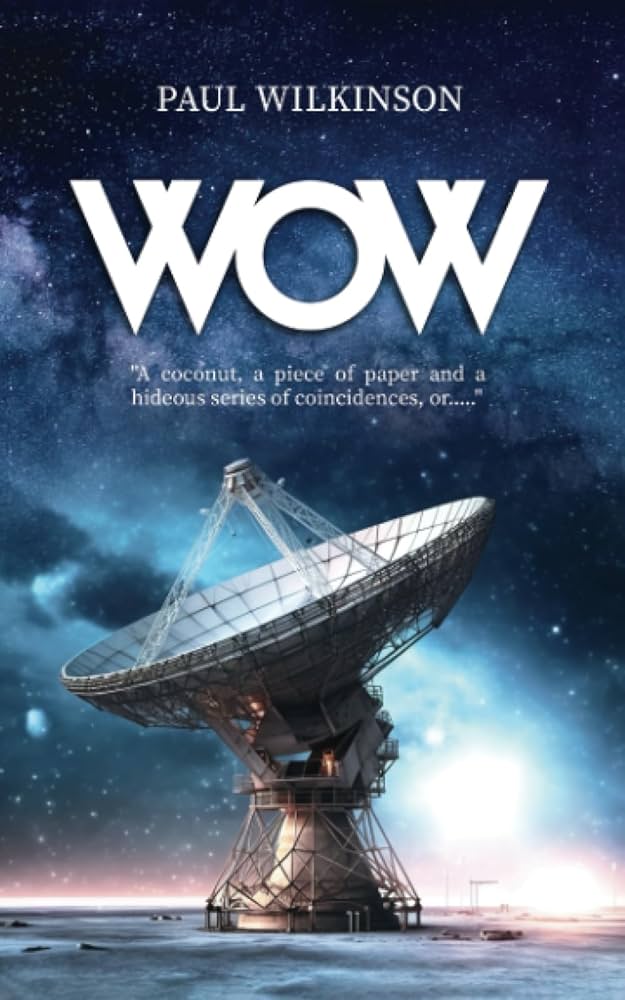
It is here that my review begins, primarily because the genre of the novel sets the tone for readers’ expectations. The novel is categorized as science fiction and “first contact” fiction, a notion supported by the (gorgeous) cover of the novel, an image of a large satellite pointed into space, suggestive of humanity’s SETI (the Search for Extraterrestrial Intelligence) efforts. But WOW is not a science fiction novel, it leans far more into literary fiction and its focus is wholly on the human effort to understand our earthly purposes. Readers who expect science fiction are likely to feel disappointment as the story unfolds: it lacks the world-building, technology, and off-world focus that science-fiction typically delivers.
On that note, readers of speculative fiction may find WOW fits their preferred genre more. It is speculative, though, as previously noted, the novel runs toward the philosophical more than anything. A reason for this is the lack of story arc and narrative in the novel; WOW captures Paul and his friends’ experiences and thoughts, but nothing really happens. But, that’s the point of the novel, it is a deeply reflective and philosophical exploration.
The outer space this novel traverses is really more of an inner space. Looking beyond our world puts our own into higher definition.
As a philosophical work — a treatise, in some ways — there are several moments in which the novel lags, running off on a tangent. Readers will have different levels of tolerance for this; for this reader, the novel was longer than it needed to be. But this is a minor complaints. At 315 pages it is a far more succinct read than Gaarder’s novel at 500+ pages, both of which tackle much the same questions!
This novel is literary fiction in other ways as well. Its lack of plot and narrative arc is a hallmark of literary fiction, and likewise, its characters are its primary focal points. Wilkinson does fantastic work of creating and developing intriguing, thoughtful, deeply self-aware characters. The story is propelled by their delusions, thoughts, the functions of their inner worlds. This is a character-based novel and this is where WOW shines.
My overall rating is therefore, mixed. I placed it at a solid 3 stars as I enjoyed it for it is, rather than what I expected it to be.
Readers who would like to explore Paul Drake’s mind on their own — or his friends’, can purchase WOW from Amazon here. It is currently selling for $14.00 for the paperback, $19.40 for the hardback, or $3.99 as a Kindle ebook. Readers who subscribe to Kindle Unlimited also have access to it.

 Dr JoAnn LoSavio