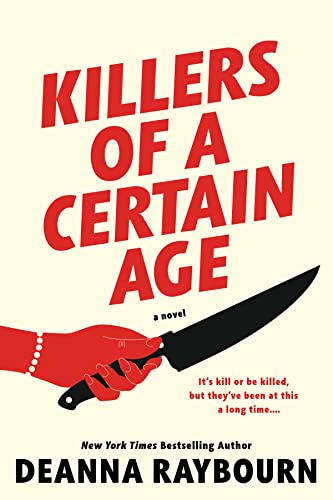
Killers of A Certain Age: A Novel by Deanna Raybourn
Oh, this was such a fun book to read! This novel plays out like a film. It’s got the panache of Ocean’s Eleven, the humor of Mr and Mrs Smith, and oozes a middle-aged version of the familiar camaraderie of The Golden Girls. It’s perfect.
The story traces the lives of a clannish posse of retirement-aged Charlie’s Angels, assassins who work for a clandestine international organization intended to keep the world’s evil at bay through extralegal and morally questionable means (murder). These women have devoted their lives – professional and personal – to this cause and vocation. They’re ready to throw in the proverbial towel, trade in the excitement and the deception for some much deserved rest and relaxation when they realize they’re the targets of assassination themselves.
Now they’ve got to figure out who, why, and what the hell.
And that’s the rest of the novel. It’s humorous and mysterious. It’s stylish and spy-savvy. It’s Jane Bond, darling. This reader was driven by the desire to find out who had set them up and why. There was no doubt they’d succeed, but the thrill was in reading how these feminine Chuck Norrises were going to get it done.
Like a film, this novel moves swiftly, propelled by witty prose and cutting dialogue between its the sharp-edged characters. The women in this story are nuanced, fleshy, sinful and deliciously flawed, but the reader should not necessarily expect depth; simply put, this novel isn’t about depth as much as it is a much needed op-ed on the awful way in which women are made invisible on account of their age in our patriarchal society. The onset of menopause — no, even just the briefest mention of hot flashes –and women middle-aged (and older) are suddenly recast in a dimmer light. Where once they were all-powerful Women, they suddenly are under-estimated, dismissed, erased. This novel does not seek to redress the issue, but does highlight it. As I said, an excellent comment on what is an on-going problem in our youth obsessed society. It weaves in a feminist commentary in parts, but this is not a serious work of feminist disruption.
This is a fun, entertaining read. And one I recommend.
A Map for the Missing: A Novel by Belinda Huijuan Tang
This novel is about loss, many different kinds of loss through death or ill luck, through forces of politics and history beyond our own or anyone’s individual control. It is about loss as a natural outcome of growth and change. It is about loss and its inscrutable, unshakeable companion, grief. It is also about the successors to loss: acceptance, perspective, renewal.
The story begins with a mystery and an immediate confrontation with loss. Yitian, a middle aged Chinese professor of mathematics who lives and works in the United States, finds himself on the calm end of a frantic phone call with his mother who announces that his father has gone missing. The remainder of the novel revolves around this event. This is the first loss, an obvious one.
But as the story unfolds and Yitian returns to China to solve this mystery, help his mother, and locate his father, it becomes clear this is only the last of many that have come before. The novel moves fluidly from the present into the deep past, into Yitian’s childhood, teenage years, and early adulthood.
We encounter the loss of worlds that no longer exist: China pre-1949, before Mao and the Cultural Revolution stripped Chinese culture down to a party line; China in the throes of the Cultural Revolution when young men and women were “sent down” youths, cast out of towns and cities and abandoned in the countryside, their personal desires and ambitions beaten out of them; China of the 1980s in its easing up of strict communist restrictions on lifestyle and living.
As Tang Yitian re-engages with China and the people of his past, the reader experiences with him the loss of his past. In that past is death of different kinds. There is literal death, but also metaphorical death — of love, romance, family cohesion. We encounter loss and grief as disappointment. So often disappointment is overlooked as a form of loss, but Tang’s A Map for the Missing makes a profound case for it here. The repeated disappointments that life deals us are obstacles in our path, they are barriers that prevent us from manifesting into reality the image of ourselves we see in our heads. Yitian’s wife experiences this. So does Hanwen. So too do the elder Tang men.
We also see the tale unravel from the point of view of those in Yitian’s past, specifically Hanwen, a young woman, one of the “sent down” youths. In some ways, A Map for the Missing is a tale of these two characters and how their encounter, brief and powerful, shaped their lives.
This is a novel of how loss shapes our lives. And because of that, the novel is less bleak than it might seem at the outset. There is a hopefulness embedded in it. Perhaps this is hinted at in the promise of its title. A map leads to a destination, doesn’t it? It rescues the lost. It is simply a matter of reading the map, learning the topography and the legend and its scale. Yitian’s journey lasts only a few weeks in real time, but it is really a deep delve into his past of several decades; it is on this journey into the past that he learns how to read the map.
A Map for the Missing takes us with Yitian and the other characters on their trips through memory. Belinda Huijuan Tang’s prose is a delicate vehicle for the reader’s ride. The reader will barely feel the movement as they are shuttled through the novel from one moment to another, from one story to another, the past, the present, back again. Her prose flows. The chapters flow. Tang’s description of place, perhaps foreign to some readers, fits the mood of the novel; it is sparse in parts, but succinct, delivering an image for the reader’s mind in a sweep of few words. The characters too are real, even if their histories and cultures might differ from the average English-reading audience; they are easily recognizable across cultures. The men and women of Tang’s novel are grounded in a specifically Chinese history and culture, but they are also relatable as mothers, fathers, sons, daughters, teenagers, young adults, wives, and husbands.
The reader will travel with these characters, witnessing Chinese history and their lives silently. At the end of this book, the reader cannot help but feel like they’ve gone somewhere familiar and alien. All of us know this story, we know this journey; it may be one we’ve taken before or one that we know we should take ourselves — or one we might be forced to undertake, like some of the characters here. You, Reader, will feel exhausted, but you’ll also feel… hopeful.
A Map for the Missing is a wandering worth the taking. for both the destination and the experiences along the way.


 Dr JoAnn LoSavio