
The Nickel Boys: A Novel by Colson Whitehead

The Nickel Boys: A Novel by Colson Whitehead

This novel knocked the breath out of me. It’s a punchy, unabashed novel that does not hold back for the delicate senses of the reader. And that’s really its purpose: to strike, to aggressively announce blackness and the terrible history of being black in America.

The Nickel Boys are children and teens who have been sentenced to a juvenile detention center of the same name, a place that announces its purpose is rehabilitation and calls itself a school in name only. This is where the state of Florida shuts away its poor, young white and black boys. The novel follows a young man who, after seventeen years of successfully avoiding the racism roaming the streets in the form of cops, finds himself arrested and carted off to Nickel for his sentence. Here, he and reader have their eyes opened to the brutalities of being a black boy in a white man’s world.

Like Whitehead’s other novels, The Nickel Boys is written with an urban lyricism unique to him. The way Whitehead’s prose and story weaves in on itself, producing by the novel’s end, a symmetrical structure is deeply satisfying and alluring to this reader. Throughout the novel there are little hints at its ending, as if its ending was never — should never — be a surprise (though it is, and purposefully so). Whitehead is a master at unravelling just enough thread to keep the reader dangling, tying off all the knots at the end to zip it all up.
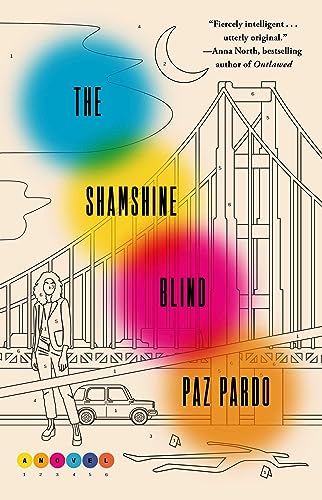
The Shamshine Blind: A Novel by Paz Pardo

The Shamshine Blind: A Novel
by Paz Pardo

I absolutely love love LOVE this novel. That said, it took me four attempts to actually become immersed in it. My first attempt told me that this was a gorgeously written novel; I could tell immediately that the prose is sharp, precise as a scalpel, so on point that one could cut diamonds with these words. But my mind wasn’t in the right place; I couldn’t focus on the investigation, my mind wandered. It happened again on the second and third attempts.

And yet, I refused to give up on this novel. I shelved it, but I kept picking it up. I knew something good was in it, but my head wasn’t in the right space. Could there be some truth behind Pardo’s emotion counts? Do feelings linger in the atmosphere?

My fourth plunge into this novel was as deep as I could get. I finished it in two and half days, prolonged because work interrupted my reading.

This novel is everything a reader could possibly want. The Shamshine Blind is amazingly original in its concept and delivery, even while it builds on the roman noir, hard-boiled detective trope. Its guts make it a mystery and thriller, but the prose that flows is literary liquid.

Its landscape is foreign and familiar, its world is one of speculative fiction; the setting is 2009 in an alternate reality where the Argentines won the war against the United Kingdom for the Falkland Islands — the Malvinas — and then went on to decimate the rest of the world. The Argentines’ weapon of mass destruction was a work of chemical genius: capturing emotion and concentrating it into a deadly debilitating bullet. The science didn’t stop there and in this reality society must now grapple with mind-altering drugs, psychopigments, which alter our emotions, our reactions and responses, our behavior. “Your Emotions Are Not Your Own” is a warning repeated in the novel.

Kay Curtida is the detective put on a psychopigment case, a homicide — which, when its layers are peeled away, reveals something much larger and far more corrupting than simple murder is at foot.

And I’ll leave you hanging there. Go read it.

Believe Me: A Novel by Molly Garcia

Believe Me: A Novel by Molly Garcia

Believe Me is the kind of novel that defines its genre. It is the perfect psychological thriller, with all the twists and turns and impossible possibilities that make readers clench their teeth while reading.

The novel begins with an explosive arrest; Carrie is carted off while doing her weekly shopping. She is accused and then convicted of murdering three young children in the woods. But did she really do it? The novel revolves around the psychiatric report ordered for her parole hearing several years later, and the investigation Dr Quinn, her appointed psychiatrist, discovers he must conduct to properly write his assessment of her.

Did she do it? Why? Where are their little bodies buried? These are the questions that haunt the compassionate doctor — and the reader.

For readers who enjoy psychological thrillers in the vein of Tana French or Sue Grafton, Believe Me will deliver abundant satisfaction. I found myself comparing Garcia’s novel to Margaret Atwood’s Alias Grace, though this novel is set in the contemporary moment, and a far shorter read. Believe Me is a compact 184 pages, and very well-written. I found myself especially drawn to Garcia’s dialogue. The characters come alive through their conversations; their voices are clear and distinct. Garcia’s prose was smooth and evocative. This reader could feel the tension between Dr Quinn and his patient, between the doctor and the staff at the prison where Carrie is an inmate. The mood Garcia creates is a veil obscuring the truth, one the doctor and the reader will claw at.

Believe Me kept me tilting on the edge throughout its 184 pages — and the ending! What a twist!