
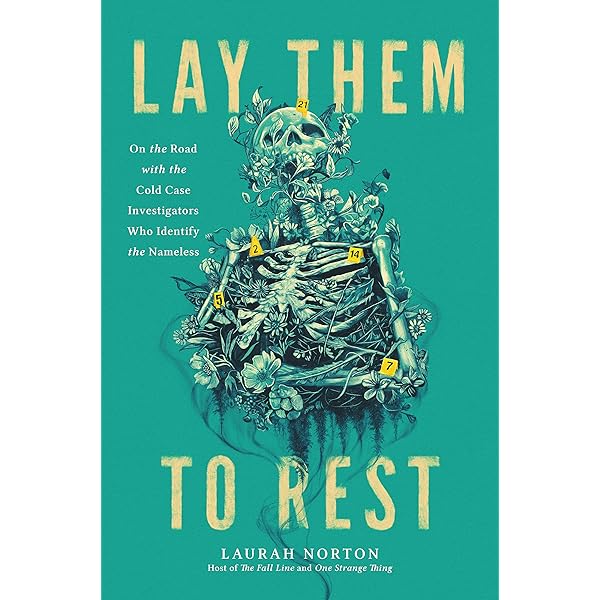
I thoroughly enjoy my true crime reads, gruesome and terrifying as they are. I especially enjoy the intricacies of police work and investigation, probably that’s a side of the analysis that I can both relate to and have no idea about. I love learning about the ways in which investigations of this nature are conducted, the nuances of analysis and the low and high technology that comes into play.
Lay Them to Rest delivered… and yet, also didn’t quite hit the high notes for me.
The bad part first. I didn’t enjoy the degree of personal involvement and commentary Norton provided. While it is common for writers to relay their personal trajectories and use it to form the narrative arc of their non-fiction books, I found the way in which Norton did this to be distracting. The injection of her personal thoughts felt like intrusive minutiae. This is, of course, a subjective opinion; other readers may very much enjoy Norton’s personal journey. For this reader, not only did this detract from the primary story of the victims and their cold cases, but Norton’s self-deprecating approach undermined her credibility and authority, coming off as fumbling. I believe the intention was to code Norton’s “character” as endearing, but its delivery did not persuade me of this view of her.
But now, the good. Norton’s partnership with a biological anthropologist produced an academic perspective which I greatly appreciated. It is clear a great deal of research had been conducted, both by Norton and Amy Michael, as well as the many others Norton shadowed, interviewed, and worked with. The book provides a great deal of information, and Norton’s delivery of that — along with the abundant necessary context — was accomplished with both straightforward utility and finesse. Norton’s prose was smooth, its language accessible while still necessarily full of the argot of the subject matter. Norton distills an enormously complex subject into easily digestible and palatable parts.
Lay Them to Rest is built through the cold cases of several victims, Jane Does, found dead and abandoned. Norton uses these cases to relay to the reader a nuanced view of the layered landscape of police work, forensic analysis, and dysfunctional systems of databases for DNA tracking used for investigating and solving crime. The focus here is not on the victims, or their families, or even on the police or investigators who strive to solve their crimes; Lay Them to Rest focuses on the structural elements of criminal investigation, the organizations and systems which organize and sift through the millions of bits of data and information that can be gathered about victims and the crimes against them. This angle into the world of criminal investigation was a novel one for me; most of the true crime I have read have not delved into this specific aspect of investigation. I found this perspective refreshing and intriguing.
Readers of true crime will find Lay Them to Rest a worthy addition to their libraries. Or, at the very least, well worth the time and effort of reading it.
 Dr JoAnn LoSavio