
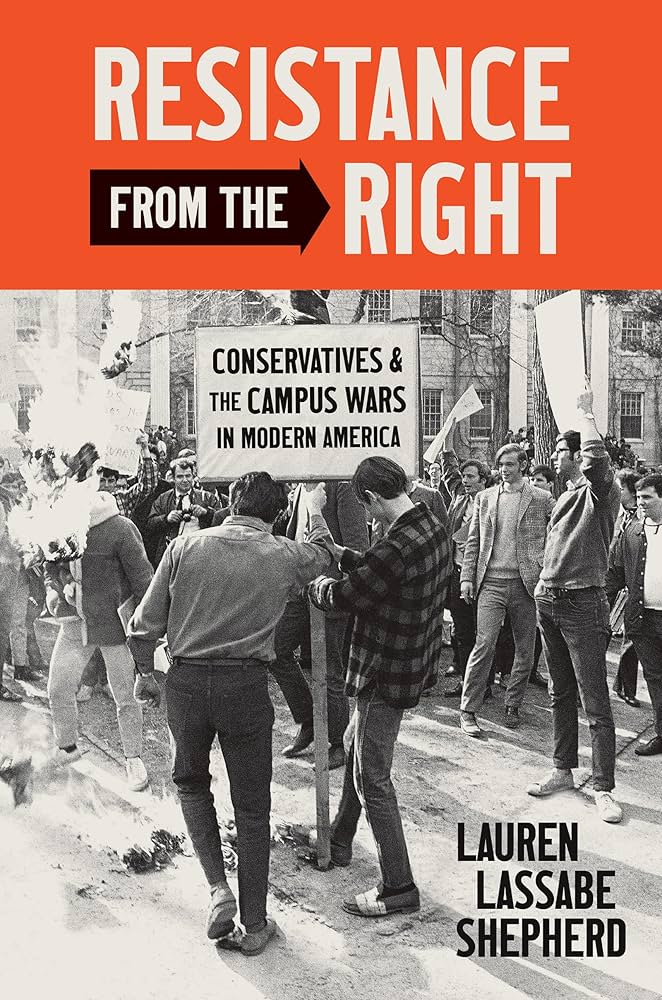
Resistance from the Right: Conservatives and the Campus Wars in Modern America by Lauren Lassabe Shepherd

Resistance from the Right:
Conservatives and the Campus Wars in Modern America by Lauren Lassabe Shepherd

In the ever-increasingly bifurcated world of American politics, Lassabe Shepherd’s monograph on the tactics of the conservative right to achieve a voice and influence on American college campuses is more than well-timed. This book uncovers the depth of today’s conservative/liberal divide, and while it focuses on the site of the university campus and highlights the actions of student organizations, bodies, and activists through the 1960s, 70s, and 80s, it also brings to the fore the work of conservative academics who made these student-based activities possible. Emerging out of this history is the current network of conservative activists, academics, scholars, and strategies, their aim not much different than it had been, but accelerated and perfected: to amplify conservative values and ideology regardless of popular opinion, consensus among the student population or American population at large.

Lassabe’s argument, in essence, is layered: conservatives adopted the strategies of the liberal left for its own intentions and benefits with great success. In doing so, these conservative campus constituents undermined the efforts of the left and were able to achieve institutional and legislative changes favorable to their ideas. Over a period of decades, these conservative parties circumvented the majority — and largely liberal — voice, to ascend to a position of power and policy-making within the university and beyond it. Conservatives operated through and targeted their efforts towards institutional mechanisms to override liberal efforts and enact their values and ideologies in policy.

The book is divided into two parts, the first attends to “Coalition Building” and the ways in which campus conservatives found like-minded students, academics, and other supporters. In these chapters, Lassabe Shepherd reveals to the reader the ways in which conservatives adopted similar but oppositional signaling from the Liberal Left through sartorial means, appearance, and branding. In the second section, titled “Law, Order, and Punishment” chapters highlight the effects of the American War in Vietnam, the rise of Black Studies and other Ethnic Studies, or Area Studies departments in the university, as well the development of a network of conservative students, scholars, and external (to the university) supporters, many of whom entered the world of politics beyond the campus in the last decades of the 20th century; their work has contributed to the conservatism and its political strategies today.

The subject matter of Resistance From the Right indicates a clear target audience, though the monograph would be an immersive and revelatory read for most members of the educated public (liberal, conservative, or independent alike): that is, liberal scholars and educators in American academia today. Lassabe Shepherd answers a question most liberal scholars puzzle over, though it is never explicitly written in the book itself, and that is: Why and How did we end up with such conservative regulations, policies, and protocols when we seem to have such support for liberal values and ideas? Or, the more colloquial form, “What the H happened to us?” As universities continued to grapple with far right propaganda and groups on campuses, hate crimes and violence, racism, and classism, many administrators, faculty, and staff struggle to reconcile the diametrically opposed operations of their institutions with their own (typically liberal) perspectives.

Resistance From the Right is a necessary read for all American academics. It explains a lot.

We Are Not Okay: Elegy for a Broken America, Memoir-in-essays by Christian Livermore

We Are Not Okay: Elegy for a Broken America, Memoir-in-essays by Christian Livermore

The title alone is enough to catch anyone’s attention. “We are not okay” are words that resonate across the world, with anyone who’s been alive for the past ten years — or the last three, for that matter. I’m not the first to tell you, Reader, that we are still struggling through a pandemic, an era of shrinking wages and increasing inflation, inadequate housing, dismal health care, sweltering/deluging/freezing climate change, and the list goes on and on and on… And has been accruing for… well, since human society began. And that’s part of Livermore’s point: We have not been okay for awhile and this is an intergenerational problem, an unescapable inheritance that will just keep paying it forward over and over — though, hopefully, with less interest for each successive cohort.

The teetering house on the stark cover of Livermore’s book is home for many of us. If I had a house, it might have been my own. This is We Are Not Okay‘s appeal: it is a book that sends a familiar vibration in all of us (except the wealthy 5%), “us” meaning the lower, working, striving-to-be-middle-class end gamers. I think Livermore (and I) are accurate in our assumption that there are more of us in this category, more of “us” than we want to admit to. It’s taken me decades to shrug off my mother’s middle class aspirations and acknowledge that we’ve balanced on that razor edge for generations, a paycheck, a job, a single recession, a whiff of luck and one good friend away from being not okay.

Here is where Livermore shows their metal: it’s not where we are now, but where we’ve come from that marks us. Poverty is that malingering virus that begets a comorbidity of chronic dysfunctions so banal as to be classified as “life” or “age.” (Health is one of the key points Livermore brings up, health and unhealth those of the lower and lower-working classes just assume to be a part of living.)

I am writing this on my Mac Air, which I bought new (with a justified educator discount) and I have a great job — and like Livermore, I have a degree that I thought made me… well, to be frank, classy. Now, in some ways — and Livermore doesn’t raise this point much — my degree has elevated my status. I can command a kind of respect in some circles, not so much in others. (My brother asked me in my last year of graduate school, “What’re you going to do with that degree? You must really like school, you keep going back.” What he didn’t say was, “For the love of biscuits, WHY?” I replied, “Yeah, I’m not going to make much money, but it’s important to me.” And it is. It really is. But, I digress.)

Livermore’s point is: Poverty is not a number, it is not something you can grow out of or improve, except in that small incremental way, like a credit score — but not really within one’s lifetime, but through generations. Three points up in one generation. Twelve points down the next. Because someone lost a job, had a mental breakdown, fell into alcoholism… Three points up in a month. Twelve points down in this lifetime. Because I paid off my car. Poverty is not something Livermore, I, or anyone can erase with a piece of paper that confers on the bearer the title “Doctor” — and a student loan. But we can learn the appropriate disguises, find the a mask that hides our origins enough. I can pump up my credit score enough to get that car loan, I can.

This is a form of code switching.

But here is where Livermore and I part ways a little. Code switching for me and for many other Americans is embedded in a racial history. Livermore is white, their experiences are also white. This is not to say Livermore is raceless; no one is without race. But there were elements of Livermore’s story I couldn’t fully reconcile. It is here that Livermore schools me (though it’s a lesson I’ve learnt before, it is one worth repeating): White code switching is class-passing. Race and class are inextricably intertwined, it’s true. Racial code switching for whites pulls from the intangible domain of “class.”

Class is a tricky category, meaning so many things, some tangible like income and the size and type of your house, others intangible like the way you hold your fork. I see it in my students (of all colors and races and ethnicities) who don’t ask for help in class or anywhere because they’re used to not getting any, used to being beaten down, used to being denied. Class is about getting access to things and services and attention. Whiteness is about the same, but not all whites have class. And the way in which Livermore presents that is brilliant.

Livermore’s prose is authentic, the highest praise I can imagine for a memoir. It is brutal in parts and funny and sad and emotional. It is detached in other parts. It is cold and harsh. It performs the emotions and conflicts Livermore is bringing to the forefront. This swiveling, this code switching is a key characteristic of poor people. It is self hate, it is selfishness as self care. It is as convoluted as humanity because poverty is a wholly human construction built on the development of hierarchical society, that is: civilization.

Livermore’s We Are Not Okay follows in the vein of Tara Westover’s Educated: A Memoir in that it explores the embodied cultural legacies of poverty. However, Livermore’s book differs from Westover’s in that it is more relatable. First, Westover’s book is grounded in a specific religious community, society, and history. Livermore’s background is more ordinary and bland, therein, more relatable. Livermore might be anyone’s neighbor, anyone’s school mate, anyone’s professor. I wonder now how much or how little do I know about my colleagues, my former professors. Do I see their whiteness and assume a privilege that isn’t really there? Livermore’s We Are Not Okay is one to linger with any reader. I will think of it when the Fall semester begins again, as I look into my sea of students, throw back summer stories with my faculty peers. Second, and perhaps more poignantly, Livermore’s We Are Not Okay does not come to a natural closure as Educated: A Memoir does. I will not spoil the ending; you’ll have to read it. Let’s just say Livermore’s memoir is… realistic. It is not that Westover’s is not, but if you’ve read Educated: A Memoir it does come to an organic closure. Livermore leaves us in that teetering house, pondering our own fate… This is part of the lingering of this book, a sensation that makes this worth reading.

Livermore delivers. This is a book that will stick with you. It may even dig into your bones where poverty may have been leaching away at your marrow for longer than you know.