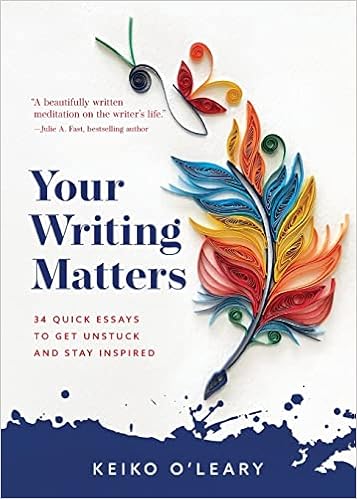
Your Writing Matters: 34 Quick Essays to Get Unstuck and Stay Inspired by Keiko O’Leary
I’m not one for “self-help” or instructional types of books, at least not in my pleasure reading. Sometimes I read non-fiction to learn new pedagogical strategies or theories, classroom psychology or activities, that sort of thing. But rarely do I read a book on how to write. I don’t generally need help writing (I mean, I’m here blogging for fun in my free time.) And my writing is decent. It’s not perfect, but it suffices. I know the more I do it, the better it gets — sometimes. Something I just don’t give a shhhuffft and will vomit-write.
But, back to Your Writing Matters.
O’Leary has some very solid advice here. The core message of this manual is to just write, all of it, until you’re done. So why read this? Because sometimes writers just need to hear it (or see it, in this case), to remember that they should keep writing. These are fantastic bite-sized pick-me-ups, short bursts of “hey, you can do it!” that a writer can inject into their day when they feel their productivity, their writing flagging.
Some of the essays include exercises for the reader to do while they are reading, while they are feeling self-conscious of their writing, when they are on the cusp of giving up. Other essays intend to remind the reader of their value as a writer, that their ideas — no matter how awfully expressed, no matter how chunkily written — are worthy artifacts to keep and to hone. A few intend to make light of the gravity of writing. They aim to make us smile, laugh even.
This is a book for a writer to keep at the ready, on the desk where the said task is done, next to the delete button to prevent the writer from second-guessing their work, next to the thesaurus.
Water’s Edge: Writing on Water Edited by Lenore Manderson and Forrest Gander
Lenore Manderson was one of the primary appeals of this collection for me. Having read some of her historical scholarship I was intrigued about this diversion into water as a subject. Her collaboration with the poet, Forrest Gander, also made me pause over this title.
I am not sure what I expected, but was pleasantly surprised to find that Water’s Edge is less a work of scholarship than an academic, literary contemplation on climate change, the significance of water, and the role of water in the intimate spaces of our lives. The collection is vast in its scope, though narrowly focused on its topic, water: poems, visuals, images, photographs, sociological and anthropological essays on researching water, and essays on the ways in which we move water and how it moves us.
My favorite — and indeed one of the most surprising essays — was not on water directly, but on chickenshit. I will say no more, but that incongruity may intrigue you as much as it did me. The reward was immediate. There is more connection between water and chickenshit than I gave credence to before reading this essay, not that I paid much attention to chicken excrement…
Indeed many of the essays and poems in Water’s Edge are rewarding and quickly so; they are short, spanning only a few pages each at most. Their length makes this a quick and flowing read, not unlike a river (perhaps that was intentional!)
As for the intended audience of this work… It is academic; its language and form are designed for an aesthetically sensitive mind, one that is poetic and will appreciate the nuances of a breath or the sensation of a light spray of water. The reader should expect to work for their reward. The content is intellectual and demands a certain degree of effort to excavate some of the deeper meanings embedded in the text. I would expect no less from poets and scholars. That said, I could see this text yield fantastic discussion and organic analysis in a social science graduate or upper level undergraduate seminar. The content, language, and complexity allow for reflection on multiple levels. Poetry and literature are excellent fodder for analysis; I use novels in my history courses frequently.
A very thoughtful read on water and our future with this quotidian, essential substance.
The Six-Minute Memoir: Fifty-Five Short Essays on Life by Mary Helen Stefaniak
I am probably dating myself here, but do you, Reader, remember that Seinfeld episode when Jerry and George are selling their idea for a sitcom to NBC, and one of them says the show they’re proposing is about Nothing. And the television executives’ jaws kind of drop and they go, “Nothing?”
But the joke — and it’s somewhat dark and certainly very serious — was that it wasn’t really about nothing, it was about all the nothings that make up the something, they anything of life. Oh wait, should that be Life with a capital “L” or life with a lowercase “l”? I’m not sure. Some things in life are Life events, demanding the respect of an uppercase “L” and other things are… the stuff that Stefaniak writes about in The Six-Minute Memoir: Fifty-Five Short Essays on Life. That is, the life stuff (little “l”) are still, despite the derision and the banality of it, the stuff of life.
Stefaniak, in this witty, honest, sometimes painfully raw and sometimes hilarious collection of memory snippets, reminds us to take solace and joy from the mundane, because in the end, it’s all we have in this life. And because of that, by dint of simply being the stuff of life it warrants writing down, it warrants a place in our legacy. Stefaniak’s prose and the stories of her life she’s chosen to share with us, ranging from parenting to grand-parenting, from making friends to losing them, makes that point loud and clear.
The essays are indeed six-minute blurps, taking that long (or sometimes less time) to read and enjoy them. Each one is not necessarily connected to the last, except that they revolve around Stefaniak’s life. They are not chronologically arranged, but thematically so. A reader could drop into any one of these blips on any given day; indeed, this book makes for a lovely New Year’s Day gift, something with a note that says, “Read One A Day for 55 Days, then repeat the ones you loved or made you cry.”
For that same reason, The Six-Minute Memoir is a book a reader could revisit over and over, as the pace of their life changes, as age encroaches with its accompanying set of new revelations and experiences. Stefaniak belongs to a different generation than mine; they’ve experienced grandparenthood, the loss of friends to age and illness, they’ve survived their children’s teenage years. I, on the other hand, am a few events behind, but in Stefaniak’s essays I can see a glimpse into my possible future. The stuff of life is specific to the individual, that’s true, but these events are also common ones across communities, cultures, class, race, and even historical context to a degree. Surely my grandparents and my great-grant parents would relate to the moment they realized their children were no longer children, or the day their own age became more than a known, intellectual fact and more a felt, lived, notched-into-the-bone-marrow sensation.
The Six-Minute Memoir reminds me of the very complicated word, “quotidian.” I’ve always loved this word, because it is such an intricate word for what is meant to be so meaningless. What I’ve come to realize — and this is what Stefaniak’s book is all about — is that the quotidian is as complex as this multi-syllabic word, this word that is spelt with the enigmatic “Q”.
So many of us will never see the alps, will never ride a horse through the hills of Outer Mongolia — but isn’t my life worth a record of its own? Yes, it is!
At the end of the The Six-Minute Memoir Stefaniak provides the reader with a chance to add our own stories to the archive. This is one of the best parts of the book, one of the elements which makes it worth purchasing and hanging onto for future use. Stefaniak gives the reader a selection of Writing Prompts, subtitled, “Write Your Own Six-Minute Memoirs”.
I can think of no better ode to this collection than to follow that directive. So, here goes. My very own 6-minute memoir…
The prompt: “Describe… a photo you wish you had taken — or one that you have lost.”
1997
Melaka is a small city in Malaysia just a couple of hours drive south of the capital, Kuala Lumpur by highway. It sits on the east coast of the country, looking out towards the Indonesian island of Java and over a narrow sliver of calm sea that kingdoms, empires, and nations have desired and fought over for over a thousand years, the Strait(s) of Malacca. The strait was the pathway to China, where traders since the 8th century acquired lacquer, paints, dyes, porcelain, and silk (among other things including weapons, horse saddles, cabinetry, animal skins, you-name-it-they-got-it.) The strait was the entry point to the riches of Southeast Asia too, a place that uniquely produced fragrant spices and herbs like pepper, galangal, ginger, nutmeg, and cinnamon, and woods like sandalwood and teak. For centuries Roman, Greek, African, Islamic and Hindu traders came from all over the world — from North Africa to South Asia — to network with local tribes and chiefs to obtain these goods and access to the larger markets in China. Then in the 14th century, the Portuguese arrived, paving the way for the English, the Dutch, and later the French.
The city that housed the port controlling this coveted bit of sea is Melaka (previously, Malacca). It became the epicenter of these mercantile endeavors and in the 15th century it became the target of these nations jealousies, a symbol and method of economic and political control over the region. Melaka was lost to the Malays who had ruled it for hundreds of years, coming under the governance of various European nations until 1957 when the thirteen Malay states re-asserted its independence. In 1963 the states combined themselves into the nation we know today as Malaysia.
Melaka, with its history, became a UNESCO Heritage site in 2008. But even before then its significance was famous. Jonker Street was (and remains) a huge tourist attraction, for its quaint architecture, its Nyonya restaurants, its hodgepodge of old and new, precolonial, colonial, postcolonial elements, its pop-music blaring rickshaws and tee-shirt/tie-dye sarong shopping, its utter Malaysianness.
I’d always been interested in history. I don’t remember a time when I wasn’t. Melaka was a favorite weekend getaway for me and I often asked my parents to go there. One year I had gotten myself a fancy, SLR camera. It wasn’t a digital one, like the ones you get today. It was a manual Pentax, one of the newer ones made in China. Nonetheless, it was expensive and I had had to save up many, many months of allowances to get it. I bought it in a shop near Bukit Bintang, near where Sungei Wang and the Metrojaya shopping complex used to be. It was one of those shophouses where the aircon was always blowing out into the walkway. I really wanted a fish eye lens and some other fancy stuff, but could only afford the camera and some film. My mother and I went and I spent about $800 ringgit on it. A fortune when you are fifteen years old and have$50 ringgit a month for fun stuff and school lunches. (God, I miss my kanteen food.)
I bought black and white film and color film. My father agreed to drive the three of us down to Melaka for a weekend trip. I saw the excursion as an opportunity for a photoshoot. We wandered around Jonker Street, walked up the hill to the ruins of St Paul’s cathedral, roamed through the ghastly Portuguese, Dutch, and British graves, toured the Stadthuys, the former Dutch administrative building turned into a museum. We ate chicken rice and Melaka Nyonya kuih desserts. I don’t remember much actually.
But I remember my father asking me in an exasperated tone, “Why are you taking pictures of the buildings? Where are the people in your pictures?”
He was right. I avoided taking photos of people in my photographs. I narrowed in on small architectural details like crumbling cornices, focused on the dark green moss growing on a white washed wall, the facade of a shop house.
He said, “It’s the people who are important.”
I disagreed in typical teenage form, through silence and with a surreptitious eye roll. I felt that he did not understand my aesthetic. I was trying to capture a past, an embodied past. Ironically, I saw this past in the concrete objects of buildings and things, but not in people. I did not understand then, as I do now, that history and DNA are entangled, that memory and fact are two sides of the same coin, and that the treasured object (history) is not a static artifact.
I realize now he was right and I was foolish. It took me a few decades after that weekend trip to realize this. Had I taken photographs of people, I might have noticed that
I do not remember those photos I took. I have no idea where they are. It is likely because no one I know is in them.
What matters in my memories are the people who were there. I remember nothing else but the sense of their presence, their smell, their voice, their laughter, their sadness or their anger.
I wish I’d known that and taken pictures of them, my parents and myself with them.
Thank you, Mary Helen Stefaniak for a very profound collection of essays. And for getting me to write my own six-minute memoir.



 Dr JoAnn LoSavio