This was such a moving story: poignant, profound, thoughtful, soul-wrenching. I can’t help but wonder how many of us live lives like this: short and sad and broken.
The story is an odd one. A ghost thinks back on his life, how the pieces of his life fractured. Decisions were made, as they always are, with the best intentions and the results aren’t always what we hope for.
I don’t want to give it away. You’ll just have to read it. And it’s a short read; there’s so much emotion packed into this small space. There is something performative, a sombre mimicry, about the way this story is condensed — almost truncated — much like the life it is about. The novel feels like a life lived unfinished, in staggered surges.
Like most Japanese novels, Miri’s prose is succinct; the words are few but thoughtfully placed to elicit the most emotional response.
One Night Two Souls Went Walking: A Novel by Ellen Cooney
This was such a beautiful, poignant story, the kind of novel that makes you wonder how permeable the line between each of us really is — or if there is even a line.
The story revolves around a nurse and her encounters with patients, coworkers — and possibly a few specters who linger in the halls of this hospital. Time and space aren’t boundaries in this story, not in the typical way narratives run. There are moments when this reader wasn’t entirely sure of what or who was real, but the thing was: it didn’t matter — and I think that was the point.
It’s hard to put this novel into a category, perhaps I shouldn’t, but readers who enjoy literary fiction, pondering life experiences, and paranormal encounters are likely to find it enjoyable.
Cooney’s style and prose was, as with her other novels. impeccably paced, succinctly evocative, perfect. There’s nothing else to say on that point, really. I cannot get enough of Cooney and have several other of her novels on my TBR.
The Dead Don’t Speak is an entertaining read, especially for a late-night goosebump. At 75 pages, it makes for a fun-creepy bedtime story, something to cuddle down into the blankets with to scare the heebiejeebies out of you as you drift off — if you can afterwards!
The story focuses on a young man who has committed a serious and fatal crime, the victim of which begins to haunt him.
The novella unfolds as nearly all dialogue, which makes for a very quick read. That said, the depth of the characters remains somewhat shallow, and at times it is difficult to distinguish who said what, as the protagonist and their tormenter often share a similar voice. Olson’s prose is fairly well done, but the novella as a whole lacks a depth I expect from horror of this gothic-style, reflective genre.
What lingers afterwards is how wonderfully creepy this novel is. Readers will find These Things Linger a fantastic combination of paranormal horror and literary fiction. It is a tale of a haunting, but Franklin’s delivery and the depth of his characters make this a unique ghost story. Franklin unspools the terror in a fashion reminiscent of contemporary gothic literature, The Hacienda by Isabel Cañas or Silver Nitrate by Silvia Moreno-Garcia, except that the protagonist is male.
Alex is a young man on the edge of his future. He is starting a new career and building a prosperous, fulfilling life with his fiancé, Raychel and their soon-to-born child. He abandons a past and a world that he no longer belongs to, but then a family crisis forces him to confront those he has left behind. The novel immerses the reader in the trauma of its protagonist, framing the horror as deeply personal and intimate. Readers of classic gothic horror and literary fiction will appreciate the reflexivity and character-based approach Franklin takes; indeed, the unraveling of Alex’s sanity is what makes These Things Linger so successful as a horror novel.
Story aside, the novel is well-crafted. Franklin’s prose invokes more than just imagery, it builds an affect of fear, successfully persuading this reader to keep reading well into the night. Despite an occasional clichéd metaphor or turn of phrase, Franklin’s authorial voice is clear, confident, and distinct. Independently published novels often suffer from fractured writing, fuzzy characters, or clipped stories; but, These Things Linger does not. Alex, Lacey, Raychel, Uncle Matty, and Buzz are fully tangible characters. The novel’s tempo is swift (here is where it diverges from the typical gothic horror); the pace at which the secrets of Alex’s life are revealed to the reader produces a compulsion to read on.
These Things Linger deserves a spot in your To Be Read List. If it is already on your TBR, it ought to be moved up in the queue.
This is not your average haunted house story. It is your better than average haunted house story. Readers of literary fiction will absolutely love this spin on the haunted house trope for its deep character development and character-focused orientation.
The novel is simple enough in its premise: a couple invite pandemonium into their house when they have a television crew for a “ghost hunter” style show come to their home to document their haunting. The events take place around this misfit cast of producers, camera operators, show staffers, the homeowners, and the carious psychics they call on to flesh out the dramatics of the show. It is the interplay of their individual needs, desires (met and unmet) that form the basis for this novel. Underlying all this is the omnipresent question: Is the haunting real? Or a figment of everyone’s desires? Every actor here has a vested interest in the reality of this haunting, leading the reader on a pursuit for the truth and an authenticity which may be impossible to find. This is, after all, the premise of such television shows.
Fussner’s prose was also an incredible appeal; it is literary in its language, its unfolding. Fussner’s choice of words draws a performative veil over the novel, intriguing this reader at least. I was hooked from start to finish.
Night Side of the River: Stories by Jeanette Winterson
I thoroughly enjoyed this collection of ghostly tales, but then, I may be biased; I’m a sucker for a good haunting. Of course, I did have my favorites.
I especially enjoyed “A Fur Coat”, “App-Arition” and “The Spare Room”, primarily because the haunted in these stories isn’t necessarily the living, but the dead haunting themselves or one another. Indeed, that was the attraction for me in Winterson’s tales: they challenged the concept of haunting, yet remained authentic to the trope of the traditional ghost story. Readers shouldn’t expect to be thrown into a new genre here; this is not speculative horror, but tried-and-true revised into immersive stories.
And, of course, the revelations in these stories are more about the living than the dead, which is ultimately the mark of a good short story.
The collection as a whole is fantastic, and follows through on this tightrope balance between showing the reader something novel and satisfying their hankering and expectations of the “ghost story” trope. In some stories, Winterson brings in an element of the contemporary through technology and devices we use today, in other cases, it is the characters’ quotidian lives in the present — marred somehow with an encounter with death and the dead — that makes it clear to the reader there is an anachronistic meeting of time here.
Winterson’s writing is superb, well-suited to the genre of the short story form. With few words wasted on exposition and an emphasis on characters’ thoughts, Winterson quickly immerses the reader in the story. It is everything a reader wants from this short form.
Halloween has passed, but Winter is upon us; put this on your list for this year’s gloomy, deathly season.
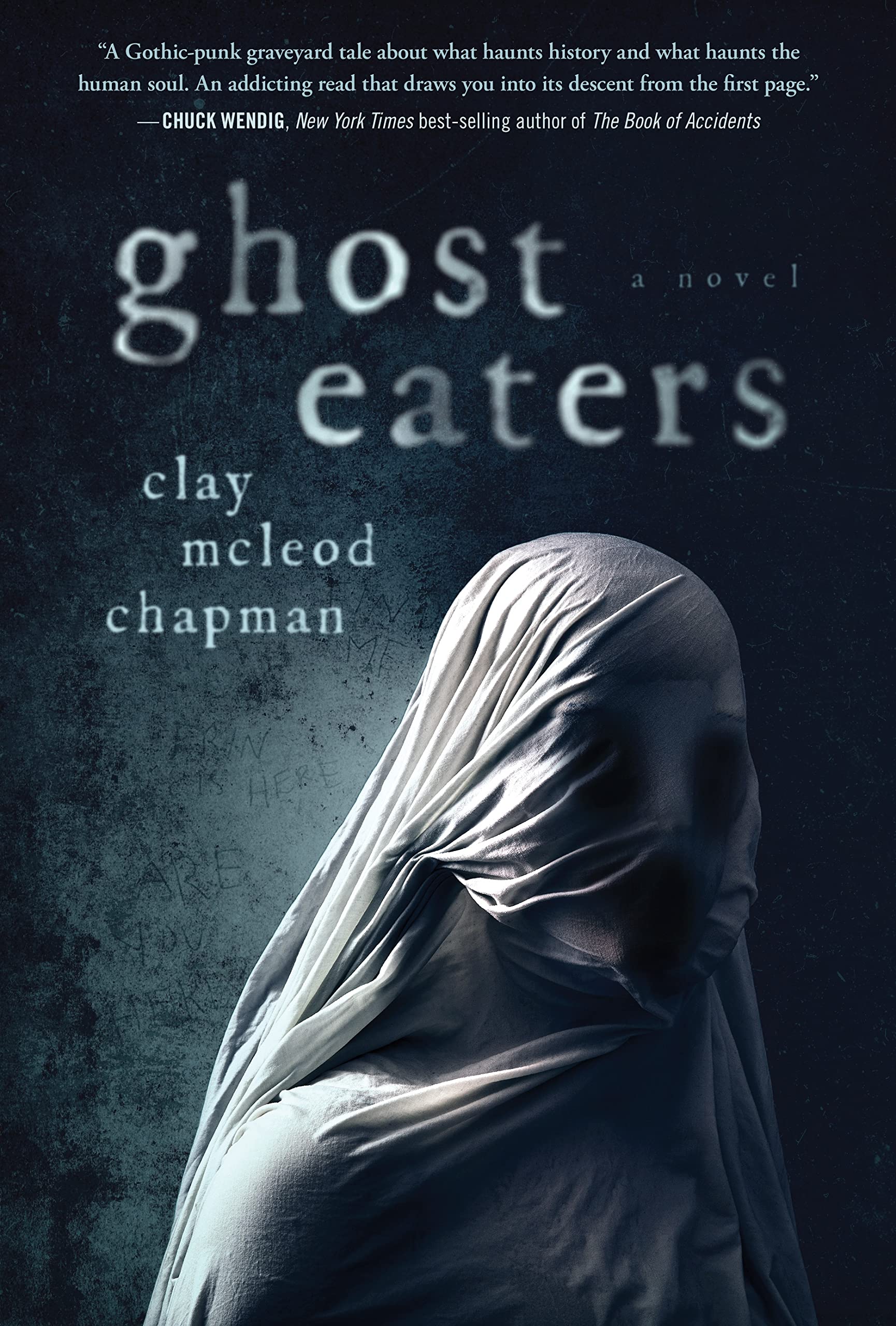
I was fully expecting a traditional ghost story. Maybe a haunted house. Something that is tried-and-true in the ghost story genre. And I don’t mean that as shade; I like ghost stories that follow a formula. They are still scary as F if they are written well. The creepy ethereality of gothic horror is my jam. And that’s what I thought Ghost Eaters was going to deliver.
Was I wrong in the most deliciously skin-crawling way! Ghost Eaters reads like a mature Young Adult novel that merges the horror of fresh-out-of-college, emergence-from-the-chrysalis loss with the ghostly supernatural. Chapman’s prose fits the YA genre; this novel borders on YA and contemporary adult horror. It feels like YA to me because, well, I’m not in my early twenties like the characters are. But the events and themes in the novel are better suited for an adult (if young adult) audience. There are mature themes here of death, grief, the loss of friends, parents, and loved ones. There is the threat of loss of the self: perception is a two-way mirror in this novel, and you’re never quite sure which side of the glass you’re on.
The story follows a young woman and is told from her perspective. Erin is a privileged, educated woman. She has family, family money, family connections, but despite this, she flounders in life. That’s the first horror, one that is banal and familiar to many. Erin is part of a group of friends; their leader has floundered in worse ways than Erin. Silas seems to be drowning in a drug-induced depression. When their social circle falls apart as the result of an untimely death, each one of them seeks to find meaning and reconnection in different ways.
Some of them take the task literally.
And that’s the second horror of this novel. The dark mental and physical adventure that ensues as Erin, Amaya, and Toby play dangerously with the line between living and dying, the present and the afterlife. I won’t ruin this for the reader. Just know that “ghost” in this novel has multiple meanings, and the loss that one associates with death is more than never seeing someone again.
A worthy Halloween horror read that haunts in multiple ways!



 Dr JoAnn LoSavio