The Dyatlov Pass Mystery: A Graphic History by Cédric Mayen and illustrated by Jandro González
I don’t often read graphic histories, but I was intrigued by this one, not knowing much about the mystery of the Soviet team who were lost while passing through these mountains in the 1950s. On February 1st, 1959 a group of young Soviet students who were hiking through the mountains disappeared without a trace. It has never been fully understood or revealed what happened to them.
The graphic novel tracks along two timelines: the team as it traversed the snowy mountain trails and the investigation afterwards. In the former timeline, the reader is given a fictionalized glimpse into the relationships and conversations between the teammates, their hopes and dreams, and an understanding of who they were as individuals. The latter time line offers the reader an understanding of the politics surrounding the mystery and its investigation, an event potentially embarrassing to the then-regime.
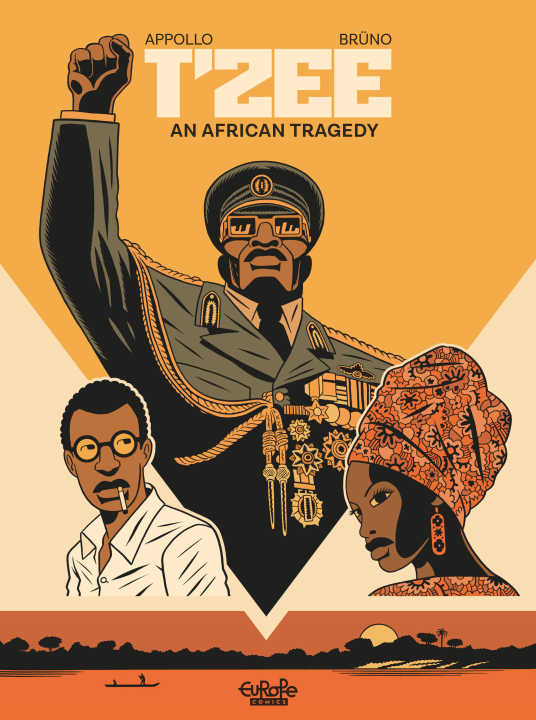
T’zee: An African Tragedy (A Graphic Novel) by Appollo (script) and Brüno (art)
T’zee is an action-packed, noir blockbuster in a graphic novel. It has all the makings of a Hollywood or Nollywood film: Post-colonial angst, corruption, family drama, illicit romance, sabotage, political violence. T’zee lacks actual history – it is all fiction — but its premise is grounded in real events of the twentieth century.
The story starts and ends with T’zee, the amoral dictator of an unnamed African nation struggling through its traumatic post-colonial afterbirth, but revolves around his young wife and youngest son, who each are coming to terms living with their larger-than-life husband and father and the roles they are supposed to play in this political drama. The former is a member of the new elite — but the limitations of gender and patriarchy force her into positions she might later regret. The latter is also a member of the new elite, the intellectual elite. During the typical educational sojourn young men of his class make in this era, T’zee’s son finds himself torn between his family and his morals. Politics, power, and ambition rule over both of them, force the wife and the son into decisions that are less of their own making than orders carried out under duress.
In three acts the reader witnesses the ebbs and flows of T’zee’s power, how his family fares in the pressure house of his politics, and the swiftness by which all their fates can change course.
This is an entertaining read. However, elements of its narrative promote a colonial logic which need to be addressed. T’zee is portrayed as a cruel and inept leader, one focused solely on his own aggrandizement and accumulation of wealth, at the expense of his people. His wife too is a woman focused solely on her own selfish advancement and fulfillment. The son is feckless and weak. Scenes of the city and the rural areas of this nation are memes of poverty and crime too often associated with the so-called “developing” or “under-developed” world, what has been classed so disparagingly as the “third world.”
I balk at depictions of African nations as cesspits of corruption, poverty, and crime. The implication that African peoples cannot rule themselves is one grounded so obviously in the so-called Civilizing Mission, that lynchpin of colonial logic; this is wholly inaccurate and stereotyping. I wish that elements of the story had addressed T’zee and his regime with more nuance; I wanted more decolonization in these pages. I cannot help but read as a historian, especially on a subject so close to my heart.
Still, this was a fun read and one I would suggest for casual consumption.


 Dr JoAnn LoSavio