What more could I say about this classic work of the Shoah? I’ll start with when and how I obtained my copy. I won it as part of a Goodreads giveaway in 2022, when Maus was hitting its school/library book ban (to date) and the book was featured in all sorts of news media, for better or worse, and copies of it were whizzing off online and physical booksellers’ shelves (a good thing!)
I was thrilled to get a copy as I had never read it, though of course, I know and teach the Holocaust in my classroom.
Reading it humbled me, as all novels and non-fiction of the Holocaust does and should, but the visual aspect of the graphic novel did it in ways I had not expected. As one can guess from its iconic and unforgettable cover, Maus is populated with mice, cats, and dogs rather than humans. The dehumanization of the Jewish people by the Nazi regime was no less poignant for this swap. Perhaps it is even more powerful; animals are an obvious metaphor: the hunters and the hunted, the obedient and the illicit.
Aside from the personal, intimate view into the Holocaust experience, I deeply appreciated Spiegelman’s portrayal of adjustment to emigration, and the struggle of the following generation to understand the depth and pain of those who had suffered through it. What happens afterward is equally worthy of attention as the event(s) of the Holocaust itself; really, these are not discrete events. These scenes made it clear the Holocaust is not a finished incident, but a deep intergenerational open wound spanning decades.
American Gun: The True Story of the AR-15 by Zusha Elinson & Cameron McWhirter
This is the book you dread to read, not because you think it will not be interesting (it is) or because you don’t agree with the object its centered on (I’m not a gun owner), but because the subject matter is too real, too terrifying, too… unavoidable. I saw this book and I said to myself, “I have to read this. I don’t really want to, but I have to. I have to.”
I did. I read it. I felt disturbed by its contents. I cried uncontrollably through one of its chapters (on Sandy Hook), and I thought, “This is the history book of our present moment. I am glad I’m reading this.” And I am. I am glad I read it, but it felt like hell to do it.
I’m getting a copy of this book for my personal library. I have to.
Elinson and McWhirter have produced a very well-researched, deeply nuanced, and straightforward history of the AR-15, the ArmaLite semi-automatic rifle designed by Eugene Stoner in the 1950s, as the Cold War threatened to heat up. The first half of this monograph lays out the very mechanical, step-by-step process of politics and engineering that lead to the creation of this weapon and its eventual adoption by the American military. After the chapters on its use in the Vietnam War, the book turns to the political life of the weapon: its feature in the anti-gun legislation and Americans’ varied responses to it and those proposed bans. Here the writers also highlight the life of the gun as it was used in civilian situations, in mass shootings, which began far earlier than most people know in the 1970s and 1980s. It is here that the AR-15 becomes much larger than it is, becomes a symbol larger than itself. The monograph ends with the current debates around the use, ban, manufacture, and cultural life of the weapon.
This is a brilliant cultural history of the semi-automatic gun, from its inception, manufacture, to its bloom as a totemic idea, a fulcrum upon which other ideological debates flux and see-saw as society and its values fluctuate. Readers on any (every?) side of the aisle on the issue of gun control should read this.
Heartland: A Memoir of Working Hard and Being Broke in the Richest Country on Earth by Sarah Smarsh
Heartland is a memoir at the intersection of Educated by Tara Westover and Nickel and Dimed by Barbara Ehrenreich. For readers who actively seek out trying on someone else’s shoes, Smarsh’s memoir will amply deliver.
Heartland explores the experiences of four generations of women and men in a working-class class family in rural Kansas, delving into their experiences of love, marriage, work, and education. The book is sectioned into thematic chapters, rather than being strictly chronological, covering her family’s peripatetic travels across the state for work, romance, love — and all too often, sanctuary and safety. Readers should know the book discusses abuse and neglect in a multitude of ways; violence is woven in the fabric of these women’s lives, both a symptom and cause of their poverty.
The book includes a massive cast of individuals from both sides of Smarsh’s family. [A family tree map would have been a helpful addition, but this is a minor detraction.] Through this account and interpretation of her family’s history, Smarsh makes an argument for greater attention to the social, cultural, and gendered reasons for poverty in America. She challenges the popular and misguided myth of meritocracy, especially highlighting the multiple ways spousal and domestic violence play an enormous role in this societal problem.
Smarsh’s delivery of this message lacks — thankfully — pedantism or blame, focusing instead on the interconnected web of cultural expectations and histories which have resulted in these outcomes. Her writing also is smooth, journalistic, and easily accessible; in fact, evoking an emotional response from this reader on more than one occasion.
Heartland is a fantastic non-fiction read on poverty, especially among the white working class, in middle America.
Facing the Mountain: An Inspiring Story of Japanese American Patriots in World War II by Daniel James Brown
I joined my local public library Adult Book Club and this was the first book I read with the group.
As an Asian and Asian American, I was immediately drawn the subject matter in Brown’s book. Given the rabid anti-Asian hate that has been on the rise in this country since Covid-19, non-fiction like this serves to do more than illuminate obscured histories; they emphasize the significance of diversity in American identity and entrench the idea that Asian American citizens — long held as “perpetual strangers/aliens” — belong in American society.
Facing The Mountain did not disappoint. While the book is a non-fiction history written for a popular press and a general adult audience, its methodology and archival research would more than satisfy any academic reviewer. Brown drew, not only from archives, but from oral histories and interviews to produce a historical monograph of significant breadth.
The book begins with the Japanese and Japanese American community in Hawai’i, but also explores the larger Japanese diaspora in the United States, on the mainland. Indeed, one of the highlights of the book is its attention to the diversity of voices within the Japanese American community: Mainlanders and Islanders came from very different cultures, sometimes held opposing views, and certainly cannot be assumed to be a monolithic society with a single voice. Its chapters explore the nuances of these different ideas within the community and how Japanese people across the United States, diverse in their social and economic class, gender, and generation, reacted to and handled the Presidential executive orders which sent them to internment camps and cast them out of American society as “enemy aliens.” Chapters document Japanese citizens’ resistance, compliance, sorrow, and joy, allowing the reader to witness the experience of WWII in many ways.
Facing The Mountain focuses heavily on the military experience as well, both domestically and abroad, which made the reading of this book novel for me. I do not typically gravitate toward military histories, finding many of them dry and clunky. But Brown turned this into a social history of the US military and the 442nd Regiment, making it a lively and very enjoyable read.
This was the very appealing part of Facing The Mountain for me; Brown made this political and military history feel intimate. It is, in fact, a prosopography. Facing the Mountain follows a cast of specific individuals and families who occupy different roles, careers, and places in the United States and American society. Through their experiences the readers views the entire landscape of the Japanese American perspective of WWII.
Wondrous Transformations: A Maverick Physician, the Science of Hormones, and the Birth of the Transgender Revolution by Alison Li
I was thrilled to read this. There remain far fewer transgender historical monographs in the field, compared to the number published in other sub-disciplines. This biography of Harry Benjamin, an endocrinologist whose research and promotion of the effect of hormones on the human body, gender, and perceptions of health, fills a gap in our understanding of the formation of gender and transgender in the 20th century.
Li’s monograph is well-researched, pulling from a variety of sources to build a fleshy portrait of the man, but not only him; as with all good histories, Li produces a landscape of the era for the reader to understand the context of the individual. Benjamin, however, was a man beyond his time, thinking of gender in ways more similar to our own period than his — but that is the point: Benjamin is one of the forerunners of the way we think about gender today, as a spectrum. It is the contrast between him and his contemporaries which helps the reader visualize this landscape.
The chapters are chronological (rather than strictly thematic), offering the reader a clear trajectory of how concepts of gender and transgender — and here, especially — how the use of hormones became mainstream and effected changes in how medicine and healthcare as a whole.
I hesitate to write a full academic review as the digital review copy I had expired! Readers, this is a worthy book to read to grasp an often un-addressed aspect of transgender history!
High Bias: The Distorted History of the Cassette Tape by Marc Masters
What I’m going to say is unusual for an academic, peer-reviewed book (brace yourself): I’m buying this book as gifts for my non-academia friends. Whaaaat? No one buys academic books for fun and certainly not for non-academic friends, people who couldn’t give a chuck about literature reviews and theoretical frameworks and nuances and problematizing blah blah blah blah….
While published by University of North Carolina Press, as a very well-researched, stunning piece of scholarship, High Bias makes for an amazingly refreshing, smooth, and interesting work of non-fiction. It is one of those rare books that is entirely suited to an academic audience as well as a general adult readership.
Some of this is due to the subject matter. Every generation has its nostalgic artifacts; music in particular — and here also, its mode, the cassette tape — is one that reaches across many divides. Regardless of our individual tastes in music, those of us who grew in its era can relate to the tactile use of one. The book triggers a muscle memory in both our brains and fingertips. As I read this book I could recall with vivid clarity how the grooves in my cassette tapes felt as I twisted it around to switch from Side A to Side B, or vice versa.
Sentimentality aside, High Bias delivers as a stellar piece of academic scholarship.
The book is divided into and introduction and seven chapters. The first two detail the physical history of the cassette, its development and rise; chapters three and four explore how music travelled in the real world, as dubbed music, from one hand to another. These chapters pay especial attention to the cassette and its involvement in the evolution of hip hop, rap, and DJ music. Chapter five takes this exploration further, beyond American shores, to trace the cultural impact of cassettes on music and its distribution in other places: Turkey, Southeast Asia, and so on. What struck me about these chapters is how the cassette functioned as a mode of connection between people in far flung places. Chapter six ends this discussion with the thing that most of us remember: the personal mixtape. Chapter seven leaves the future of the cassette open; aptly titled, “Tape’s Not Dead.”
Masters draws from oral histories, interviews, archival text, as well as published texts and articles from the last half of the twentieth century; this is a multiple material culture approach to the topic, one that is likely necessary due to the nature and era of the cassette. Masters’ scholarship has breadth, even while — as mentioned earlier — it deftly avoids the pedantism typical of most academic books.
Masters’ prose adds to the accessibility of this book. It reads like a podcast, something I might expect on cassette from a friend who says, “Hey, you gotta listen to this,” and slips it into my bag. The words flow and paint a palpable texture of the many lives that have created and been touched by the cassette and the music it contained.
I’m going to go now and put this book on my Wish List. I want a copy for my personal library.
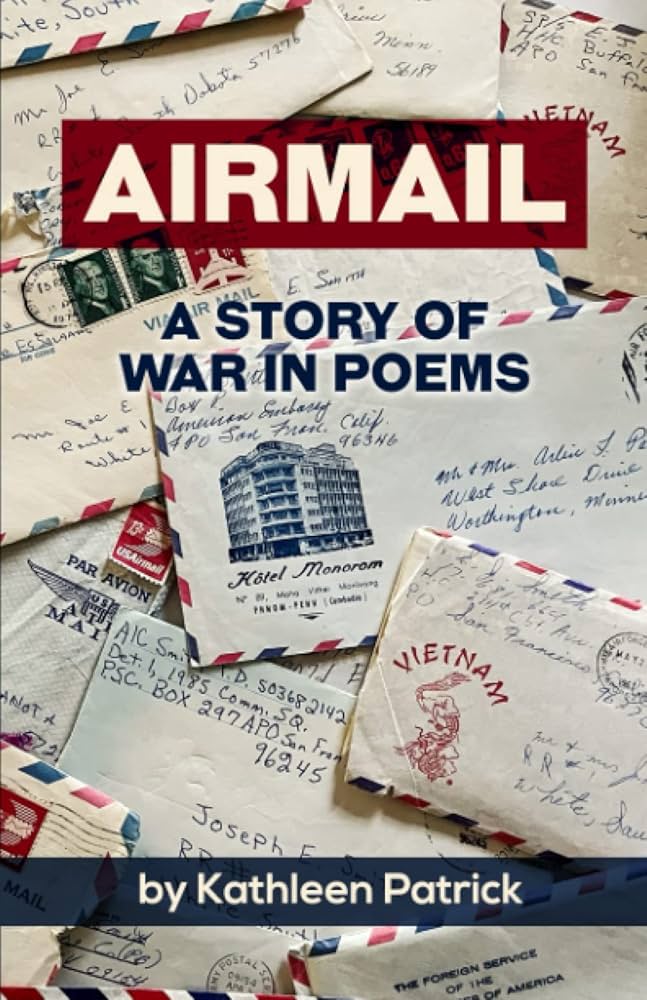
Airmail: A Story of War in Poems by Kathleen Patrick
This is a collection of poems about the experience of American soldiers off to war in Vietnam. It is about the family that they left behind in the United States. It is about the loss and gains of war, patriotism, the inevitable criss-crossing of cultures and people across oceans.
It has been a long time since I have read poetry, and especially since I have reviewed any. Poetry is harder, so much harder to assess. Or rather, its assessment — if that is the right word — is so much more subjective (in one sense) or so much more technical (in another sense).
I’ll start with this: The subject matter of this collection of poems makes an impression on me in ways particular to my personal heritage and profession. I am from Southeast Asia, though not from Vietnam or Cambodia or Laos, the places where the Vietnam War (or the American War, as it is also called in Southeast Asia) took place. I am also a historian of the twentieth century, of Southeast Asian history, of decolonization, and transnational connections between Southeast Asia, the United Kingdom, and the United States. The way I have read these poems — and the way in which I review them — is inevitably filtered through these twin lenses.
These poems are powerful, both as evidence of historical perspectives and subjectively, as pathways of emotion. These poems open up avenues for understanding and seeing the experience of war, beyond the political, beyond the combat, beyond the filter of news.
I especially enjoyed “Voices, A Collage” which spans years and tells us a soldier’s letters home. This is poem about regrets, but it is also about how a family remains connected in spite of the distance, in spite of the pain of war.
“Telegram”, a much shorter poem, was especially poignant; its truncated form permits the reader to come to their own organic feelings and expectations. There is an implication of regret or guilt; an odd thing to say, but I really enjoyed that about “Telegram.”
“Robert M. in the Doorway” struck me as being about the PTSD of war, and for that reason, it was also a favorite. Again, a short poem, but powerful and thought-provoking. “Picking Rock” and “Don’t Forget the Women” brought to light the consequences of war that are often left unsaid; the soldier’s experience is not the only one. These poems made that clear, and sadly so.
What can I say about these poems? They made me feel, and that is — to me — the only thing a poem should aspire to.
This is a historian’s historical novel, in every sense of the word. Not surprisingly, is is written by a former academic; Kathleen Jones began her writing career as a political scientist and professor, before turning to literary fiction. Cities of Women is a seamless blend of these two domains of their experience, reflecting a deep respect for the scholarly pursuit of history while offering readers a deeply textured and emotional perspective of the past.
The novel toggles between the modern present and the medieval past, beginning with a tenure track historian’s search for her place in the academia. Verity Frazier then encounters, by chance, that rare glimpse of an undiscovered history. This is the sort of thing historians dream of when they enter archives; Jones portrayal Verity’s hope and desire is palpable — or perhaps that is just my historian’s heart set aflutter. Buried, like so many women of his age, is the presence of a female illuminator, Anastasia.
The unfolding of Verity’s archival adventure draws the reader into a world that is both exotic and familiar. Verity and Anastasia (like us all) live in a patriarchal world, one which fails to take women seriously, which gaslights us, and forces us to make undesirable choices. This is a feminist novel, bringing to the fore these age-old prejudices and the battles women must fight to be heard, seen, remembered.
Then novel also contains more than one beautiful and flawed sapphic romance, highlighting the containment and self-sustaining world of womanhood. This is the beauty of Cities of Women; it is an illumination of women, an honest portrait of women’s struggles and successes, a tale of oppression and empowerment as the two sides of our collective experience. Readers should know this realist capturing of the female experience may trigger; who among us cannot point to some evidence of trauma in our lives?
Indeed, Jones’ characters are as made of flesh as ourselves, so well does her characterization reflect the depth of her historical research and her skill as an author. We can feel Verity’s pain, the elasticity of Anastasia’s tenacity, Christine’s boldness and pride. We can also recognize the women around them, the friends who succumbed to the status quo, the colleagues who share in the frustration of being a woman in a man’s world, the lovers who boost us and tear us down.
The novel revolves around these women and their lives, and as such, being character-driven, moves at a languid pace, stretching the length of lives for some characters and capturing mere months of others. Time, in fact, is fluid in this novel, a kind of ephemeral backdrop; the lives Jones tells us about cut across time, flatten it. Women have then, as now, experienced much the same things.
Dialogue between the characters is seamless, perhaps too much so sometimes; I was left wondering if people really talk like this? But then, the world is wide and there are many in it, so perhaps they do. Or perhaps Jones is referencing the physic unity between women, so One-Of-Mind are we that our words may zipper so flawlessly together. Overall, however, Jones’ prose is splendid, mature, and expressive; it is smooth, flowing, and sensuous in many parts. Readers will find themselves cradled in gorgeous text throughout.
Fatherland: A Memoir of War, Conscience, and Family Secrets by Burkhard Bilger
Fatherland: A Memoir is a must-read for readers who gravitate to histories of the European theater of WWII. The book is a case study, illuminating aspects of the human side of these histories which are often left in the dark: here, what happened to those millions of Germans who were caught up in the Nazi machine, willingly or otherwise? Significant numbers of the German citizenry did not support the Nazi party, but as the regime gained power Germans were pressured into adopting or participating in its politics in both minor and significant ways. Thousands were caught between survival and their beliefs, others benefited from the regime’s policies, witnessing no ill-effects as so many millions of others did.
War and ideological divides produce so much more intimate conflicts and consequences than politics would suggest. Fatherland makes this complexity abundantly clear, and more importantly, without being apologetic or sympathetic to Nazism. Indeed, it highlights the different between Nazi party members, Germans, and the Nazi state, forcing the reader to see beyond the inaccurate and unjustified conflation of these constituents with one another.
Bilger dives into their own family history to produce a prosopography, one which explores the complicated consequences of surviving the Nazi regime before, during, and after the war, especially for those who were forced or otherwise minor participants in state operations. Their family derives from a region of Europe straddling the often fluctuating boundary between France and Germany, Alsace and the region around the Black Forest. This geography has — and continues — to produce a culturally and politically fluid community. Bilger also looks beyond their own family, including the personal war-time histories of other German and French citizens in their proximity: for example, mayors of the myriad of French-German towns who were caught in the Nazi and French crossfire, and women who were forced to interact (in platonic and other ways) with German soldiers or Nazi officials.
During the interwar and WWII years, citizens found themselves dispossessed of either their French or German identities, subject to changes in language, dress, and culture as politics blew one way or the other. After the war Germans and French alike found themselves needed to pick up the pieces of their lives, and grapple with former enemies living in their midst. Questions of culpability rent communities and families apart in the aftermath of WWII as war crimes were being prosecuted; to what degree was Life and the Need to Survive responsible for the choices that people made? To what degree was circumvention of Nazi policies a resistance against Nazism? Did local officials and citizens pander to Nazis out of genuine belief in the regime or were their actions made under duress? Did neutrality absolve people from being responsible for war crimes that occurred?
Indeed, the years following the end of war were some of the hardest, perhaps even harder than during the war for some Germans and French. This aspect of Fatherland is, to this reader, its most poignant and significant contribution; war does not begin with a declaration, nor does it end with a surrender and a treaty. War begins so much earlier, the combat and physical destruction being only its peak, and it lingers on for years, even decades, afterward. Bilger reveals that in the case of Germans, the effects of WWII remain today; it is a scar stretched across multiple generations.
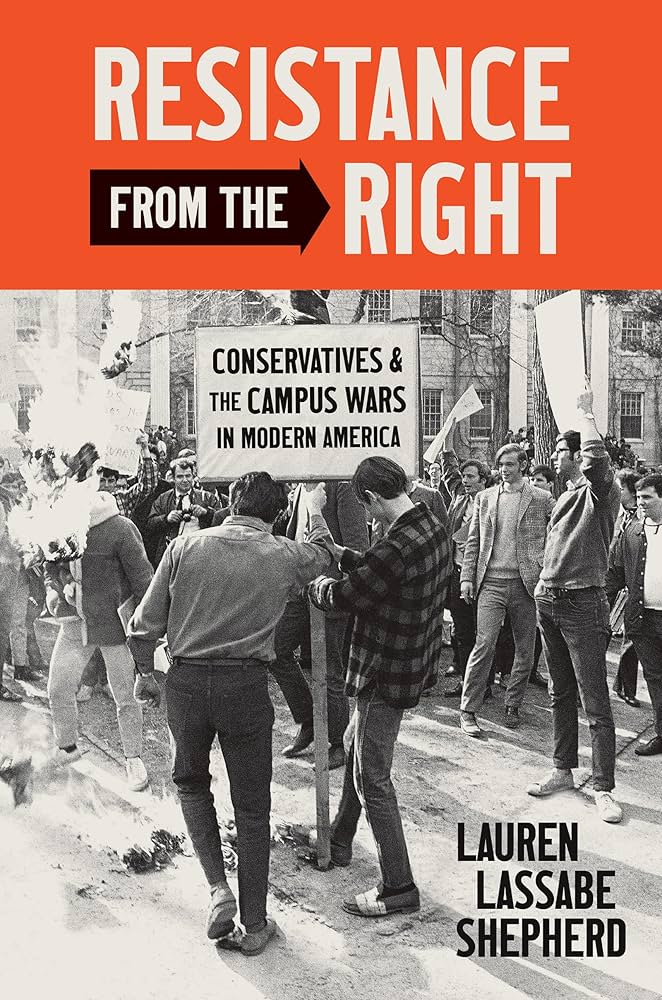
Resistance from the Right: Conservatives and the Campus Wars in Modern America by Lauren Lassabe Shepherd
In the ever-increasingly bifurcated world of American politics, Lassabe Shepherd’s monograph on the tactics of the conservative right to achieve a voice and influence on American college campuses is more than well-timed. This book uncovers the depth of today’s conservative/liberal divide, and while it focuses on the site of the university campus and highlights the actions of student organizations, bodies, and activists through the 1960s, 70s, and 80s, it also brings to the fore the work of conservative academics who made these student-based activities possible. Emerging out of this history is the current network of conservative activists, academics, scholars, and strategies, their aim not much different than it had been, but accelerated and perfected: to amplify conservative values and ideology regardless of popular opinion, consensus among the student population or American population at large.
Lassabe’s argument, in essence, is layered: conservatives adopted the strategies of the liberal left for its own intentions and benefits with great success. In doing so, these conservative campus constituents undermined the efforts of the left and were able to achieve institutional and legislative changes favorable to their ideas. Over a period of decades, these conservative parties circumvented the majority — and largely liberal — voice, to ascend to a position of power and policy-making within the university and beyond it. Conservatives operated through and targeted their efforts towards institutional mechanisms to override liberal efforts and enact their values and ideologies in policy.
The book is divided into two parts, the first attends to “Coalition Building” and the ways in which campus conservatives found like-minded students, academics, and other supporters. In these chapters, Lassabe Shepherd reveals to the reader the ways in which conservatives adopted similar but oppositional signaling from the Liberal Left through sartorial means, appearance, and branding. In the second section, titled “Law, Order, and Punishment” chapters highlight the effects of the American War in Vietnam, the rise of Black Studies and other Ethnic Studies, or Area Studies departments in the university, as well the development of a network of conservative students, scholars, and external (to the university) supporters, many of whom entered the world of politics beyond the campus in the last decades of the 20th century; their work has contributed to the conservatism and its political strategies today.
The subject matter of Resistance From the Right indicates a clear target audience, though the monograph would be an immersive and revelatory read for most members of the educated public (liberal, conservative, or independent alike): that is, liberal scholars and educators in American academia today. Lassabe Shepherd answers a question most liberal scholars puzzle over, though it is never explicitly written in the book itself, and that is: Why and How did we end up with such conservative regulations, policies, and protocols when we seem to have such support for liberal values and ideas? Or, the more colloquial form, “What the H happened to us?” As universities continued to grapple with far right propaganda and groups on campuses, hate crimes and violence, racism, and classism, many administrators, faculty, and staff struggle to reconcile the diametrically opposed operations of their institutions with their own (typically liberal) perspectives.
Resistance From the Right is a necessary read for all American academics. It explains a lot.





 Dr JoAnn LoSavio