Public Opinion: A Novel by Nathan Pettijohn

Public Opinion: A Novel by Nathan Pettijohn

I’m wondering to myself — kicking myself — why didn’t I read this book sooner? I won Public Opinion in a Goodreads giveaway last year, but only just read it. I absolutely love it. Kicking myself not reading this sooner.

The novel revolves around a character you love to hate. Melvin Ritkin is a horrible human being who does unsavory things for unseemly amounts of money. He’s built a career around scamming people, creating false realities, and fixing other awful people’s problems. He lives in a place most people love to hate too: Los Angeles, CA. But Melvin’s world is Hollywood adjacent; it is Hollywood’s underworld. Melvin maneuvers and is part of the grotesque underbelly that makes the glitz and glamor possible on its surface. This is the behind-the-scenes view of Hollywood and it is as ugly as one can imagine. The characters are utterly sinful; palpable, pitiable, and on occasional, lovable. This is world of victims and villains, and where the line between the two is porous.

Through Melvin’s eyes we see how perception is easily manipulated. But readers are also treated to the tantalizing view of how the manipulators themselves rot inside. Melvin’s life, relationships, and work all come together in a collision that leaves him… well, I will leave it to the reader to find out. But, Reader, know that there is a moral to this tale, though, it is the journey which makes that lesson so delicious.

Story aside, it is Pettijohn’s prose, his distinct and witty authorial voice that carries the novel beyond snark and soap opera, and into the territory of literary fiction. This is a very well-crafted independent novel. Nathan Pettijohn has a new fan and I very much look forward to their next novel.

The Brightest Star: A Novel by Gail Tsukiyama

The Brightest Star: A Novel
by Gail Tsukiyama

I read this novel along side a non-fiction biography/prosopography of Anna May Wong’s life and times, and honestly, I don’t know if that boded well for my review of this novel! In short, I found Tsukiyama’s fictive treatment of Wong’s life bland and depthless. I wanted interiority, a deep dive into Wong’s subjectivity. I wanted a view of Wong as a woman, as a human being, as a daughter, as a sister, anything, but not as a star.

Sadly, Wong’s characterization in the novel was one-sided, though to Tsukiyama’s credit the facet chosen was one that warrants highlighting: Wong here is portrayed as underfoot the racist boot of Hollywood, the racist weight of America and the White, Colonized world bearing down on her ambitions. I appreciate Tsukiyama’s attention to this racial and racist history; Wong was indeed a woman of her era, a victim of yellowface and orientalism. But I wanted more.

Perhaps I am not the target demographic for this novel; I know this history as a professional, I live its legacy as a Chinese-American woman in a state founded on White Supremacy. I am more than a target of racial hatred, more than a colonized human being, more than an Asian Woman, and so I wanted Anna May of The Brightest Star to also be more, to allow me entry into her mind, her heart, her existence as a lover, as a sister, as a friend. I wanted to know the facets of her that moved beyond the armor she had to wear to protect herself from the world.

I recognize that I already know the racist history Tsukiyama highlights, the weaponized language, the sneer against color, the snide remarks, and that this colors my view of the novel. I recognize that many other readers likely do not know this history. For those whose decolonizing journeys are just beginning, The Brightest Star will deliver a poignant and profound glimpse into Wong’s life as an Asian woman objectified and consumed as Other. Tsukiyama does a fantastic job peeling back the layers of glamour to reveal the ugly side of Wong’s stardom.

Daughter of the Dragon: Anna May Wong’s Rendezvous with American History by Yunte Huang

Daughter of the Dragon: Anna May Wong’s Rendezvous with American History by Yunte Huang

It’s only August, but I know Daughter of the Dragon is one of the best histories I have read this year. It ranks pretty near Number 1 right now. Huang delivers more than a life in this biography; Daughter of the Dragon is a portrait of Asian American history in all its glory and ugliness, it is a history of a community, an ethnic group, a skin color as it played out and was embodied by Anna May Wong.

Anna May Wong’s life is a microcosm of Asian American history, of American history.

Huang’s research is impeccable; each chapter is fully fleshed out with evidence from previous scholarship and archival sources. Letters to and from friends and family, press interviews, and a myriad of other Hollywood ephemera serve as Huang’s fodder. But Anna May’s own voice is rarely invoked; it would appear that few records in her own words exist, though Huang uses what artifacts she did leave behind. Putting the patchwork together as any good historian does, Huang captures and interprets her voice for us in his own; Anna May comes through the pages as if she were seated on the edge of desk, cigarette in hand.

The book follows a typical biographical chronology, from birth to death and everything in-between; however, Huang leans heavily toward Wong’s filmography as the measurement of her state of mind as well as a platform for a deeper discussion of legislation against Asian American citizenship and social standing in the American popular imagination. This is more than a biography, and while Daughter of the Dragon reads like a filmography: it is a vivid cultural history of Asian American film and representation in Hollywood. Indeed, Anna May Wong was a by-word for Asian American film for much of the twentieth century and her career. There can be no discussion of Asian representation in the media without her.

The result is a very satisfying history.

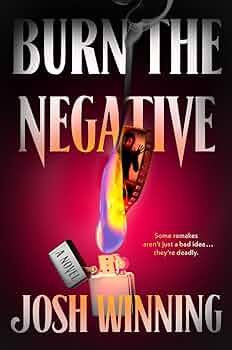
Burn The Negative: A Novel by Josh Winning

Burn The Negative: A Novel by Josh Winning

It’s such a cliché to say “I couldn’t put it down!” but with Burn The Negative it was so true! Thrillers set in contemporary digs are rarely my chosen genre, but every once in awhile a little thrill appeals to me and relieves me from the setting and character-driven interiority of historical or literary fiction. Burn The Negative had everything I wanted in a thriller: compelling characters with flawed, awful motives; a fast-paced plot that left me thinking “Oh no, what the WHAT?” as things go from horrendous to abysmal; mysterious hints that led me to announce “Aha!” far too early; and, the cherry on top: a twisted ending.

The novel opens with a fabulous line, immediately a portent of fuckery on a grand scale. A young women is headed somewhere she’d rather not be. It’s for work, but it isn’t really, and she’s having a bit of a nervous breakdown over it. The woman is the novel’s protagonist, Laura, who is a former child actor, now tasked with rehashing her Hollywood trauma as a journalist writing an article about the remake of the horror film that killed her career and ended her normal psychological development as a teenager. This is a novel that revolves around the drama of Hollywood on multiple levels, leaving the reader feeling very much like they are watching a Netflix Original horror film unfold in text.

As the remake of the film progresses, things go unbelievably wrong. But is this marketing? Is this the curse of the original horror film? Is it Laura herself? Both the remake and Laura’s memories of her Hollywood nightmare disintegrate into a surreal soup, leaving the reader wondering if there is something paranormal at foot or not.

The story alone is not the only draw of the novel. Winning’s prose is witty and the book includes fun elements — flashbacks, articles, ephemera, movie lore — which flesh out the story arc, provide context, and make the novel feel deliciously kitschy. This book is fun.

Fans of horror films, horror film lore, haunted media, and fast-paced mysteries can fully expect to enjoy Burn The Negative.