
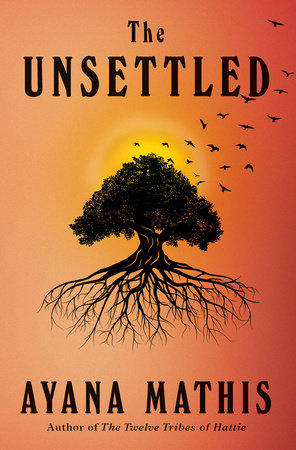
The Unsettled: A Novel by Ayana Mathis

The Unsettled: A Novel
by Ayana Mathis

This novel gut-punched me in ways that only good novels can. I could feel tears sting along those nerves behind my eyes. Sometimes I felt my skin get sweat-clammy. The Unsettled unsettles, just like Mathis wants it to.

Right from the start, The Unsettled knocks you down and it doesn’t let up. Its breathless, relentless struggle, the way it forces the reader to keep grasping for relief mimics the feeling that its protagonists feel, trapped in a transient limbo of poverty and abuse and disappointment. This is a novel about what it is to be black and working class in urban America.

The novel revolves around a young boy and his mother, forced to live in temporary housing because of an abusive stepfather and husband, because of racist, classist inequities, because life has dealt them a harsh hand. The novel documents their life before and during their stay in this housing, the people they encounter there, at school, in their former and current neighborhoods. Interwoven between these grim chapters is the story of the mother’s past, her mother and a different world of an all-black enclave in the deep south. In this place too, there is the struggle for blackness to simply exist. The two stories are linked by several threads, the most salient of which is the structural oppression of blackness in America; both stories eventually merge into one, culminating in an explosive end.

Mathis writes with a machete, its edge as sharp as a scalpel. The prose in The Unsettled is blunt, straightforward, and will absolutely cut you down. But the pace of this beating does not exhaust; I was compelled to return to the book again and again until it was done with me (and not I done with it). Its characters were there with me, around me, so fleshy and tangible. I read mostly in bed, where I feel warm and safe, and there were more than a few times when I put down the book and nearly cried, wishing they did not have to live in such an unsafe, cold, grey place.

Rough Sleepers: Dr Jim McConnell’s Urgent Mission to Bring Healing to Homeless People by Tracy Kidder

Rough Sleepers: Dr Jim McConnell’s Urgent Mission to Bring Healing to Homeless People by Tracy Kidder

Living in the urban PNW, homelessness is a very real, very visible flaw in our society, something that shows up in the local news daily. Encampments dot the city I live and work in, transient individuals spend their days roaming the streets I drive. Last semester I encountered students in my own classroom who were in middle of housing crises and were facing housing insecurity. [I helped them get set up with Passport, a housing insecurity program for students my campus offers.] I often wonder about those students who didn’t come forward or reach out to me and I hope they got the help they needed elsewhere.

Rough Sleepers is the book I needed to read. It is the book many of us need to read. I’m glad for the opportunity to have done so; I won this book in a Goodreads Giveaway and I am so pleased to have been selected.

Rough Sleepers revolves around a specific case study of homeless assistance, Dr Jim McConnell and the Street Team, who operate in, for, and with Boston’s homeless population. Kidder spent a number of years observing and interviewing McConnell and the Street Team, as well as other stakeholders — including homeless individuals — before compiling the book. The assistance program that is the focal point of Rough Sleepers has spanned decades and continues to do so, with the help of private donors. As a result of Kidder’s breadth and ethnographic method, Rough Sleepers possesses an intimate grassroots perspective; readers will feel like they’re along for the midnight van rides, sitting in the clinic with individuals like Tony and Rebecca. The voices of those involved is clear, even as they are filtered through Kidder’s lens.

Kidder also provides the reader with historical, social, and political context, allowing the reader to view the issue of homelessness as both a personal lived experience and a larger community concern. Federal and state administrations and policies, along with a capitalist system, have contributed to the problem of housing insecurity; the lives Kidder gives us a glimpse into show how the good intentions and limitations of government have inadvertently exacerbated homelessness in so many ways. In one case, the peripatetic movements that kept a homeless man safe at night made him ineligible to apply for housing as a “chronically homeless” individual.

For this reader, the stories of real people like Tony and Rebecca who lived and slept on the streets, were the most moving of those Kidder collected. These real-life cases strip the abstraction from homelessness as a societal issue. McConnell’s interviews also provide insight, from the perspective of an activist with decades of deep involvement. The Street Team and fund-raising observations give readers a view into the mechanics and politics of activism around this problem.

Readers should expect to feel discomfort, but this is not due to anything Kidder does; indeed, Kidder refrains from inserting supercilious remarks — to their credit! It is my opinion as a reviewer that this dissonance is the objective of Rough Sleepers. We, as readers, can (dare I say, ought to?) use the discomfort this book raises to mobilize our actions or reconsider their philosophies towards homelessness. Certainly, this book has given me cause to pause and think.