
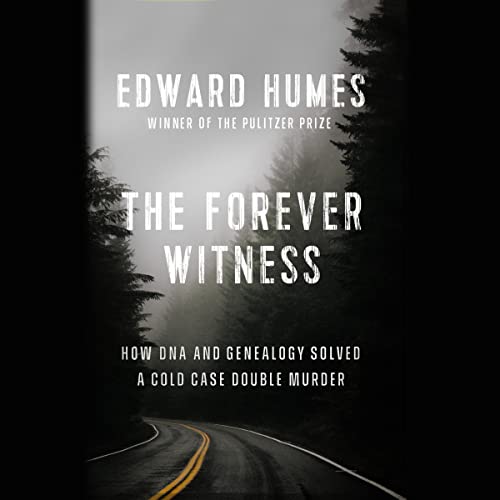
The Forever Witness: How Genetic Genealogy Solved A Cold Case Double Murder by Edward Hume

I am such a fan of true crime (not an amateur expert in it, but I enjoy it a lot!) and Humes’s The Forever Witness delivered in all the best ways. This book details the context and circumstances of a cold blooded double murder of a young man and woman in Washington state, near Seattle. They disappeared while on an overnight roadtrip, running an errand. Their murder was a cold case for decades until new technologies became more available.

What makes The Forever Witness so compelling though isn’t just the fact that Humes gives us an account of how such DNA identifying technologies worked or even how the case was eventually solved (though those are good enough reasons to pick it up!), no, what makes this book unputdownable is Humes deeper delving into the larger national and world wide considerations and context of using DNA, genealogical, and qualitative research together in combination to investigate such crimes. Humes provides the reader with a landscape of criminal methodologies, giving them a glimpse into a world often over-dramatized and glossed over with unspecific details in news media and hour-long television serials. As if often the case, when compared with film, the book is better. The Forever Witness is full of nuanced context and specific information, perfect for the true crime fanatic for whom details are everything.

Readers should be aware that this wide fish-eye lens of the book and its subject matter does mean that Humes veers on occasion away from the specific case. He draws upon similar cases, discusses parallel crimes and explores the use of genealogy in other, related cases. Humes also provides the reader with a view from the other side; included here are not only the investigators, the family of the victims, but also the perspectives of genealogists and other criminologists not directly involved in these cases. The varied perspectives adds to the book’s appeal, giving the reader a deep understanding of the crime-solving process, with all its obstacles and victories.

Humes’ prose is also deeply compelling: dramatic and yet not overblown, succinct and yet brimming with knowledge, informative without overbearing being pedantic, flowing and smooth throughout. It is clear Humes has a vast and thorough grasp of his subject matter, but he does an exceptional job at breaking this down for the average reader. Terminology is explained, procedures and protocols are laid out step by step and their logics revealed.

In short, a fantastic read and one for every fan of true crime.
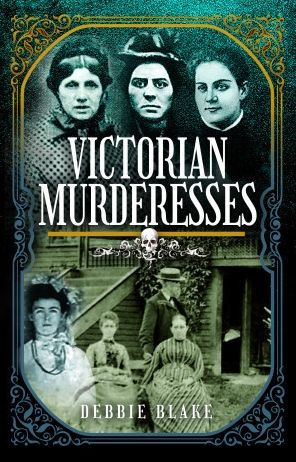
Victorian Murderesses by Debbie Blake

Victorian Murderesses by Debbie Blake

I am sucker for a good true crime non-fiction, any time — and Blake’s Victorian Murderesses absolutely satisfied my every expectation of the genre. It was gory and chilling, all the more so because of the historical grounding of each case covered here.

Each chapter — there are seven of them — examines a specific killer and the details of her crime(s). Four of them focus on British murderesses: Sarah Drake, Mary Ann Brogh, Kate Webster, and Mary Ann Cotton, while the remaining three cross the Atlantic to provide accounts of the disturbing murders perpetrated by Kate Bender, Lizzie Borden (of course), and Jane Toppan. I was grateful that Lizzie got only a chapter; the fame of her crime has sullied my interest in her case. I’ve simply read it too many times for it to invoke any novel shock, but I acknowledge that the Borden murders warrant a place in a book like this.

What makes Victorian Murderesses such a fantastic read is the way in which Blake colors in the context of these women’s lives; not only do we get a rare glimpse into their worlds, but the Victorian world as a whole, especially as it was for women of a certain working and middle class. The reader also gets to see how these women got away with their crimes for a significant part of their lives and how police operated to discover them. In some cases, like with Sarah Drake, I could not help but feel a bit sorry for the murderess as much as the victims; institutionalized sexism drove some of these women to extreme lengths — though I cannot say I condone their decisions to take innocent lives. In some cases, like Cotton’s and Webster’s I found myself wondering how it was possible for them to commit so many crimes without getting caught earlier! I wonder at how it was that Lizzie Borden became so famous when these other women committed so many more criminal acts.

Kate Bender and the Bender family were — for me — the most dastardly, the creepiest of the seven chapters. Their crimes were like those out of a grisly, B-rated horror where a family of four drives down a lonely farm road… and is never seen again… Brr. I feel shivers thinking of it now.

This was a fantastic true crime read, fun and gore all around, enough to keep you wanting more.

The Ghosts That Haunt Me: Memories of a Homicide Detective by Steve Ryan

The Ghosts That Haunt Me: Memories of a Homicide Detective
by Steve Ryan

These memories have haunted Steve Ryan, and now they haunt me too. Ryan warns the reader that the contents of this book will be dark, warns us to close it and move on if we value our peace of mind. He’s right. This book will cleave to my bones like scars from bites. The murderers in Ryan’s cases are depraved animals, creatures looking like humans but lacking humanity. The crimes recounted to us are sweat-inducing-chills-on-the-soles-of-my-feet terrifying. The thing is, they were committed for such trivial, banal, forgivable reasons, sometimes for no reason at all except for the purpose of inflicting pain.

Ryan weaves into his account the effect of these crimes on his psyche, giving us — those who have not worked in policing work or its related domains — insight into the damage being witness can cause. We don’t just see the effect on Ryan, but on the entire community of those who do this work. It becomes quickly clear that this work is as emotional and psychological as it is mired in materiality: these people study the severing of a life from its body, but in this memoir we see how deeply entwined the soul is to the the gory material left behind. In a sense, the homicide detective is required to lend the dead their own soul, a poor but necessary substitute in the effort to ameliorate the injustice of the victim’s murder.

The reader will weep for Ryan and for all homicide detectives as much as they weep for the victims and their families. And, let us also not forget, the families of the murderers — in some cases, the extended family of the murdered and the murderer are one and the same, a double slice, the cut twice as deep.

Ryan takes us through six of his most memorable, most awful cases, the ones which made him value his humanity. They are baffling in different ways: How could this have happened? In some cases the murder was sudden, a crime of impulse and opportunity. In others, it was planned with meticulous attention to detail. Some murders were the inevitable outcomes of years of abuse, the eventual killing a culmination of many crimes perpetrated. The scars were not always only the fatal ones.

These cases occurred in Canada, Ryan being a detective in Toronto and serving the GTA (Greater Toronto Area), but these will be familiar to any urban resident. The cases here involved immigrants, travelers, transnational cultures and expectations, mothers, wives, husbands, lovers, children, fathers, brothers. There is the odd stranger as well, a crime committed via a random encounter by someone the victim does not know — to be fair, the discovery of a murderer in the family can invoke a feeling of utter strangeness and dissonance, it is so unfathomable that someone we hold close and love could be capable of these kinds of crimes — but Ryan proves to us that intimacy is not a prerequisite for really knowing the interior mind of anyone. We can never really know the person we sleep next to at night. That’s the horror here. Trust is malleable in the mind and hands of murderers.

I’m glad to have read this book, chilling as its contents are. I sleep worse for it. But I a little less so because of people like Steve Ryan. I am grateful people willing and able to sacrifice a little of their soul to deliver justice to victims of crimes like these.