The Dead Don’t Speak is an entertaining read, especially for a late-night goosebump. At 75 pages, it makes for a fun-creepy bedtime story, something to cuddle down into the blankets with to scare the heebiejeebies out of you as you drift off — if you can afterwards!
The story focuses on a young man who has committed a serious and fatal crime, the victim of which begins to haunt him.
The novella unfolds as nearly all dialogue, which makes for a very quick read. That said, the depth of the characters remains somewhat shallow, and at times it is difficult to distinguish who said what, as the protagonist and their tormenter often share a similar voice. Olson’s prose is fairly well done, but the novella as a whole lacks a depth I expect from horror of this gothic-style, reflective genre.
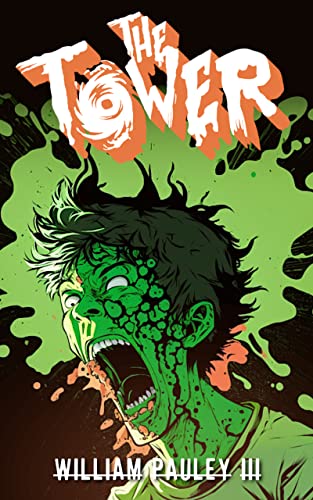
Bizarre is the only word to describe these stories. The Bedlam Bible series, of which The Tower and White Fuzz are the first two novellas, revolve around a residential building in which the residents are trapped. Strange, monstrous things happen to them. They are often themselves the monsters. There is a sense of gothic madness in these tales.
In The Tower, we are introduced to the building, the Eighth Block Tower, where these events occur. The Tower consists of three stories: “Hypanogogia,” “The Invalids”, and “Under Green Brain”, while White Fuzz is its own standalone story.
I hesitate to tell you any more, because it really would ruin the surprise and shock of reading them yourself. Readers who enjoy speculative fiction, horror, or science fiction are likely to enjoy the otherworldliness of these stories. Collectively, they ride the border of horror and science fiction. Readers will find them reminiscent of Kafka and Kavan in that there is an internal insanity at play here. Or, if television is your thing, one might liken them to American Horror Story or particular grotesque version of Black Mirror.
It’s cute. And cozy. And there is a mystery lurking in this suburban-y, bougie town. Antiques and Drinks delivers on its promise. For readers who enjoy light mystery with a bit of cheeky humor, this novel will be a delight.
The novel revolves around a middle-aged woman, alone and without family, who runs an antique shop in a tourist town. A set of plates is brought on to be put on consignment, but the owner of the plates rescinds the deal. The plates are not as they seem. They are enchanted and the results are fatal. This is how the mystery — and the fantasy — begins.
I did not enjoy it as much as I hoped to. However, I think this is more about myself as a reader, than the merits or demerits of the novel itself.
On that note, a few things which lessened my enjoyment of it. First, I could not get a full sense of place or person through the dialogue or exposition; the novel failed to flesh out the physical environment of the town, the store itself, and the atmosphere of the place. Similarly, the characters did not come to life for me; they were unique, but did not become tangible in a way that would bring me into their world. Second, there were elements of the story that felt like reaching, or seemed to me to be so outrageous as to feel like farce.
On a more positive note: the novel is amusing and the twists of its mystery are unexpected and — perhaps because of their absurdity — compel the reader to keep going, if only to see what on earth could happen next. Another factor in its favor: Bellinger writes well. The expectation here is not for literary prose, but the prose is clear and thoughtful. It is perfect for a cozy mystery.
Believe Me is the kind of novel that defines its genre. It is the perfect psychological thriller, with all the twists and turns and impossible possibilities that make readers clench their teeth while reading.
The novel begins with an explosive arrest; Carrie is carted off while doing her weekly shopping. She is accused and then convicted of murdering three young children in the woods. But did she really do it? The novel revolves around the psychiatric report ordered for her parole hearing several years later, and the investigation Dr Quinn, her appointed psychiatrist, discovers he must conduct to properly write his assessment of her.
Did she do it? Why? Where are their little bodies buried? These are the questions that haunt the compassionate doctor — and the reader.
For readers who enjoy psychological thrillers in the vein of Tana French or Sue Grafton, Believe Me will deliver abundant satisfaction. I found myself comparing Garcia’s novel to Margaret Atwood’s Alias Grace, though this novel is set in the contemporary moment, and a far shorter read. Believe Me is a compact 184 pages, and very well-written. I found myself especially drawn to Garcia’s dialogue. The characters come alive through their conversations; their voices are clear and distinct. Garcia’s prose was smooth and evocative. This reader could feel the tension between Dr Quinn and his patient, between the doctor and the staff at the prison where Carrie is an inmate. The mood Garcia creates is a veil obscuring the truth, one the doctor and the reader will claw at.
Believe Me kept me tilting on the edge throughout its 184 pages — and the ending! What a twist!
House on Fire utterly gutted me; I very nearly cried — and I am not easily moved. As a historian I am immersed in our collective debris, the ugliness of humanity constantly. But this novel’s humanity, the harsh, honest, and all too familiar trauma of the human experience it brings to the fore struck me hard, so much so the reader in me dreaded and welcomed its final pages. Several times I had to set down this novel, take in a breath, take a break.
House on Fire belongs to that category of novel which epitomizes literature’s ideal. Like Ian McEwan’s moral-bending work or Nadifa Mohamed’s The Fortune Men, House on Fire forces the reader to reflect deeply, demands the reader challenge their own existence, choices, life. Its tagline is apt: How far would you go to keep a promise? This novel forced me to consider my own ethics, my own values, the relationships of my own life.
I will not forget this book.
The opening line alone will arrest you. It delivers the novel’s premise, one which confronts the reader and its protagonist immediately: Bernadette, an ICU nurse is asked to euthanize a man by his wife, but this is beyond a professional request: the man is her father, the wife her mother. The reader becomes witness to a far more complicated situation that one of abstract ethics, should she or shouldn’t she? It becomes personal in much deeper ways. The reader is immersed in the life of a family, chapters retreating back in time provide a full view of Bernadette; her sister Colleen and brother Adam; her mother and father. Bernadette’s life is, like our own, far more entangled than it would seem; there is also her “ex”, Shayne and her son, Jax, her best friend and colleague, Kara, Kara’s husband, Eliot, Colleen’s husband, Liam and their nine children. Their relationships and struggles, as portrayed in House on Fire identify and challenge the obligations and bonds between parents and children, children to their parents, between siblings, between spouses. What do we owe? What are we owed in return? Is “owe” even the right word here? Maybe, maybe not.
The novel unfolds over the course of a few weeks, but transports us to other times and places as well; in that short and interminable length of the time, a number of events occur, both traumatic and mundane, devastating and reconciliatory. A House on Fire is a portrait of real life.
The beginning conundrum is one which threads through the entire book: Will Bernadette help euthanize her father? Will fate force her decision? Is her decision even hers to make? The ending will leave the reader — as it did this one — in tears or close to it. This reader found these to be tears of relief and sadness, tears of grief for the loss of the past and tears of gratitude for what has been gained in return.
House of Fire was published March, 2023 and can be purchased from Amazon here for $12.99 for the paperback, $2.99 for the Kindle, or free with Kindle Unlimited. The novel is 274 pages.





 Dr JoAnn LoSavio