The Dead Don’t Speak is an entertaining read, especially for a late-night goosebump. At 75 pages, it makes for a fun-creepy bedtime story, something to cuddle down into the blankets with to scare the heebiejeebies out of you as you drift off — if you can afterwards!
The story focuses on a young man who has committed a serious and fatal crime, the victim of which begins to haunt him.
The novella unfolds as nearly all dialogue, which makes for a very quick read. That said, the depth of the characters remains somewhat shallow, and at times it is difficult to distinguish who said what, as the protagonist and their tormenter often share a similar voice. Olson’s prose is fairly well done, but the novella as a whole lacks a depth I expect from horror of this gothic-style, reflective genre.
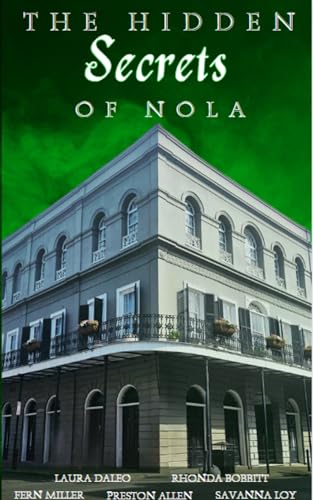
The Hidden Secrets of NOLA: Stories by Laura Daleo, Fern Miller, Savanna Loy, Rhonda Bobbitt, & Preston Allen
This was the perfect Halloween read and one that I’d been looking forward to for several weeks! I saw the book in one of the FB groups I’m in and I put in a pre-order for the ebook (something I rarely do). It did not disappoint! This anthology of five tales set in New Orleans conjures the mystique and history of that city’s famous French quarter; the stories force the reader to reconsider their notions of the supernatural, to wonder if darkness is really the evil we assume it is. Laura Daleo’s short story about what happens when Death meets an innocent is one of these tales which gets the reader wondering about the nature of evil and compassion, how they are two sides of the same coin. Rhonda Bobbit’s tale delivers the shivers; two sisters, Rose and Lydia are haunted by a family heirloom and an inheritance they did not expect. Fern Miller, a romance writer, takes us in another direction, trading on the lust and romance of New Orleans. It is a place where lovers escape to — or attempt to escape each other –but fate always has its plans for us. Preston Allen’s story, Crossed at the Cafe, was my favorite of the five; a story revolving the hoodoo that NOLA is famous for. Powerful curses and malevolent witches deliver the shivers in this tale. Savanna Loy’s Borrowed Bayou was my second favorite story here. This was a dark tale as well. The Laguerre family hides a terrible secret; they’ve made a pact that must be kept, or thousands might lose their lives.
This is a diverse collection of tales. Readers are sure to find at least one which appeals to them. They are, on the whole, well-written and conceived. Each one evokes a different characteristic of the city: its dark history, its romance, its mystery, its portals into the underbelly of humanity. These tales record the bargains we must make; here, these are the bargains New Orleans extracts from all who visit it. Some of pacts deliver unexpected happy endings. Certainly all of the stories here make the reader wonder what they might do in the same situation.
The Vales: A Story of Love, Evil, and Redemption by George Graziani
I encountered The Vales through a Facebook group I'm in, where I serve as a reviewer of (mostly) independently published books. Organized by the admins of this group, the review event takes place bimonthly, and involves reviewers submitting a short biography to the organizer. Authors who are looking for reviews of their work reply to the organizer, selecting the reviewer of their choice. Reviewers then select which authors and books they'd agree to review based on the descriptions of the books.
My review: ⭐️⭐️⭐️⭐️ for prose and writing, ⭐️⭐️⭐️ for storytelling. ⭐️⭐️⭐️⭐️⭐️ for character development. An overall rating of ⭐️⭐️⭐️.75
The Vales is an intensely character-driven novel revolving around two, intertwined stories, and taking place over the course of a long weekend. The first centers on a family gathering at the home of the grandparents, while the other is a criminal misadventure. Both stories run parallel — until they collide, drawing the innocent family into chaos. Both tales unfold through first person accounts of the events in real time, each chapter devoted to the perspective of one of the characters.
The Vales comprise of Grace and Joseph, the matriarch and patriarch of the family. It is their home where the weekend gathering takes place. Their children, Eva and Bobby, are middle-aged adults with families of their own. Eva has her husband, Adam and a wild teenage daughter, Ziggy. Bobby has his wife, Renata, and two boys, Danny and Roland, who are a little younger than their cousin.
This is a novel seeking to excavate the layers of motivation — emotional, cultural, and pragmatic — behind an individual’s actions. Each narrator exposes their most vulnerable selves in these pages, with a deeply intimate result. The reader is privy to each narrator’s desires, secrets, and fears — even those they are unwilling to acknowledge themselves. The flawed natures of the characters are sure to evoke a sense of empathy in the reader; there’s someone we recognize in each of them, our own mothers, aunts, uncles, friends.
The prose throughout the novel therefore changes voice frequently; the pitch and tone of Danny’s chapters reflect the concerns of a boy on the edge of puberty, while Bobby’s are the stuff of adult-sized angst. The prose is very well-crafted, but this reader found this recurrent shift in voice created a superfluousness that did not pay an eventual reward. This was also due, in part, to the content of each narrator’s chapter.
Because of the story unfolds through the eyes of several narrators and each one provides an account of events in the present tense, there is a redundancy in the retelling of events which the reader already knew about. The telling and multiple retelling of the same events by different narrators did not progress the story. Instead this tendency caused the novel to sag in several parts. It was unfortunate that the different perspectives did not add conflict or dramatic effect to the events.
The intense interiority of each narration also produced other jarring effects. Perhaps the author submerged this reader too well, too deeply, with their intimate prose because the the shifts in narrators pulled this reader from the depths of a character’s mind too soon, leading to breaks in the mood of the moment. The other effect, also a consequence of the deep interior view into the character’s mind, was the character’s mental wandering into tangential domains; the result was the introduction of many supporting characters, too many for this reader to keep track of. Were they important enough to remember? This reader found that many of them were there to serve as foils to the characters themselves, and as such they did not add to the story significantly.
My verdict on The Vales is therefore mixed. On the one hand, it is very well-written and full of well-crafted characters. The character-driven aspect of the work is apparent and very much appreciated. On the other hand, the delivery of the story stagnated at several points and ultimately did not pay out on the promise made in the subtitle: Love, Evil, and Redemption. Of the three, love was most visible. Evil was present, though the events did not quite merit that extreme of a description. Redemption felt rushed at the end; the point at which the two stories slam into each other possessed a moment of conflict that was (to this reader) under-dramatized. The events bringing the Vales into contact with a sordid reality deserved greater attention, not in terms of a play-by-play of the events themselves, but in terms of their meaning to the characters involved.
I am nonetheless glad for the experience of reading it. If you would like to, you can find the novel for sale here. Currently, The Vales is available for purchase at the price of $29.99 for a hardback, $14.93 for a paperback, and $7.46 for the Kindle ebook version. To learn more about the author, you may click here.
A profoundly moving novel, with a story so powerful as to cause me to pause every few pages to wipe away tears. Mercy packs an emotional punch along the lines of Tinker by Paul Harding or Annie Proulx’s Brokeback Mountain. This is an impressive debut novel, one well-worth the grief and tears it is sure to evoke.
The novel revolves around Sadie, a twelve-year old girl abandoned by her parents and her subsequent landing on her Uncle Charlie’s farm in South Dakota. Mercy is both what she finds and what she delivers to those in her life, whether they are deserving of forgiveness or not. This is literary fiction at its best: raw and rich characters; humanity at its flawed worst and inspiring best.
Patrick is an excellent writer; her prose is evocative and succinct, creating an affect that strikes the reader deep in the gut with very few words. In the space of 154 pages, Patrick immerses the reader in Sadie’s juvenile, but deeply adult and complicated world. The reader follows Sadie’s journey as she navigates the traumatic events of her abandonment, her memories of the past, her fears for her future. Patrick very successfully channels the emotions of a 12-year old, whilst balancing the very mature context of her circumstances; this is not a novel for a teenaged audience necessarily, its themes cross age-oriented literary boundaries.
The novel could use a professional editing, as there are some inaccuracies in turns of phrase; “Martha could have cared less” on page 23 for example. Indeed, it appears that Martha could not possibly have cared any less. [Some of the lack of professional editing may be due to the novel being independently published.] Still, despite the occasional typographic error, Mercy remains irresistible. I read it in an afternoon, I could not put it down.
I encountered this book via a Facebook Group, in which I serve as a reviewer for ARCs and independently published novels. I have previously read and reviewed another of Patrick’s books here, Anxiety in the Wilderness: Stories. If you are interested in Patrick’s work, please see her Amazon author page here. You may purchase Mercy there, currently priced at $9.99 for a paperback, $15.99 for a hardback, and $2.99 for the Kindle ebook format.




 Dr JoAnn LoSavio