
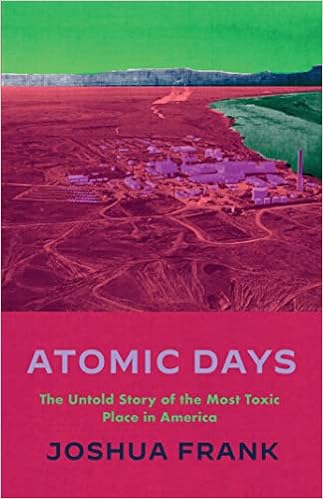
Atomic Days: The Untold Story of the Most Toxic Place in America by Joshua Frank

Atomic Days: The Untold Story of the Most Toxic Place in America by Joshua Frank

My local community library hosts reading events and they gave copies of this book, Atomic Days away as part of one of them. The program includes an event with the author and other experts on the subject. One of my colleagues was part of this. I had hoped to participate in the events, but couldn’t on the day of. I did, however, read the book.

For a resident of the PNW Atomic Days is a disturbing read, its eponymous locale is a mere few hours drive from where I live and work. My usual landscape is serene: mountains, verdant pines, blue-grey skies, the sound of fresh water pelting down from the sky or rushing in the creeks and rivers everywhere around here. Atomic Days is a harsh concrete disruption, a whiplash to reality. This work of investigative journalism exposes a danger in our plain sight: the Hanford nuclear power plant near the TriCities in Washington state.

Riding on the same wave of documentaries like “Meltdown: Three Mile Island”, Atomic Days highlights serious nuclear accidents and the potential for future serious public health concerns arising from the United States government’s Cold War policies and decisions. Frank’s research unfolds the history of these decisions, their outcomes, and their potential for future disaster through oral histories, archival research, and interviews with stakeholders on all levels. The chapters focused on individuals’ experiences, those who have been intimately involved in the plant and its operations, its workers and residents of the immediate vicinity are especially riveting and profound.

Justifiably, there is a warning tone in Frank’s account. It is not one we should ignore as difficult as it is to read about such threats to our mortality and way of life. But Frank’s prose is not pedantic; the language is accessible and written for a general audience — for everyone, as with a doubt, what Frank highlights is very much everyone’s concern.
The Forever Witness: How Genetic Genealogy Solved A Cold Case Double Murder by Edward Hume

I am such a fan of true crime (not an amateur expert in it, but I enjoy it a lot!) and Humes’s The Forever Witness delivered in all the best ways. This book details the context and circumstances of a cold blooded double murder of a young man and woman in Washington state, near Seattle. They disappeared while on an overnight roadtrip, running an errand. Their murder was a cold case for decades until new technologies became more available.

What makes The Forever Witness so compelling though isn’t just the fact that Humes gives us an account of how such DNA identifying technologies worked or even how the case was eventually solved (though those are good enough reasons to pick it up!), no, what makes this book unputdownable is Humes deeper delving into the larger national and world wide considerations and context of using DNA, genealogical, and qualitative research together in combination to investigate such crimes. Humes provides the reader with a landscape of criminal methodologies, giving them a glimpse into a world often over-dramatized and glossed over with unspecific details in news media and hour-long television serials. As if often the case, when compared with film, the book is better. The Forever Witness is full of nuanced context and specific information, perfect for the true crime fanatic for whom details are everything.

Readers should be aware that this wide fish-eye lens of the book and its subject matter does mean that Humes veers on occasion away from the specific case. He draws upon similar cases, discusses parallel crimes and explores the use of genealogy in other, related cases. Humes also provides the reader with a view from the other side; included here are not only the investigators, the family of the victims, but also the perspectives of genealogists and other criminologists not directly involved in these cases. The varied perspectives adds to the book’s appeal, giving the reader a deep understanding of the crime-solving process, with all its obstacles and victories.

Humes’ prose is also deeply compelling: dramatic and yet not overblown, succinct and yet brimming with knowledge, informative without overbearing being pedantic, flowing and smooth throughout. It is clear Humes has a vast and thorough grasp of his subject matter, but he does an exceptional job at breaking this down for the average reader. Terminology is explained, procedures and protocols are laid out step by step and their logics revealed.

In short, a fantastic read and one for every fan of true crime.