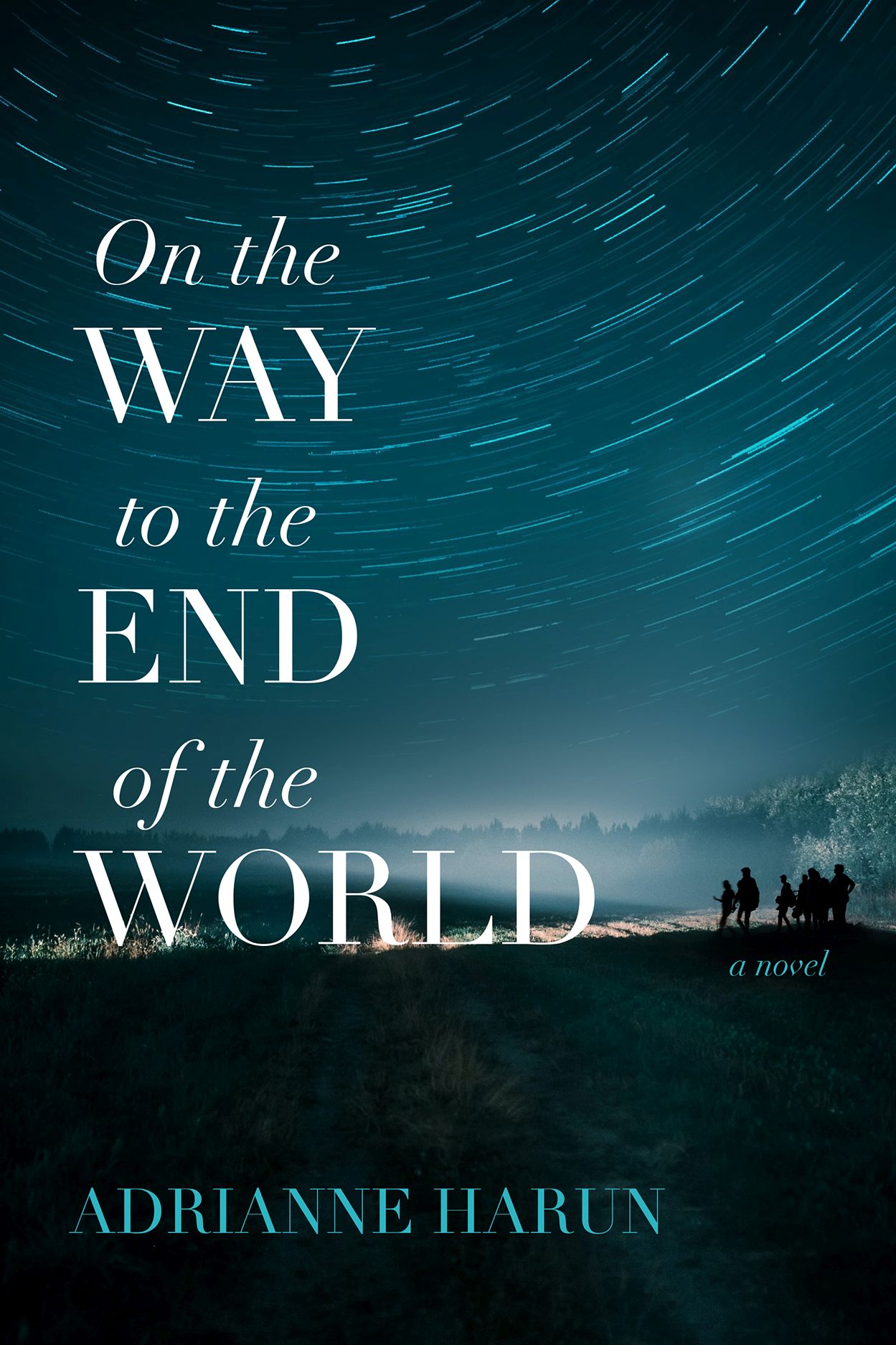
On the Way to the End of the World: A Novel by Adrianne Harun
I wanted to like this novel more than I actually did. Some parts of it utterly exhilarated, drove me on to the next page. Other parts dragged. Ultimately and sadly, many of the endings in the novel unravelled the tight twists of its mysteries into mere frayed ends.
But, that said, Harun’s prose and character building was phenomenal; I could almost feel their breath in the air as I read. For readers who enjoy the gossip and politics of living in a small town, this is the novel for you. The tensions were real and tight and very appealing.
The premise of the story, while it falls flat, is an intriguing one. The novel centers on a strange community building exercise instigated by President John F. Kennedy in 1962, exhorting citizens to walk fifty miles within twenty hours. This brainchild, the Kennedy March, is the event which brings together an odd collection of a Pacific Northwest’s townsfolk: boy scouts, middle and high school students, a widow, the town’s telephone operator, and a mish-mash of others. It is an informal, poorly organized march, mapped out for the participants and then nothing — they are left to navigate the route on their own.
What occurs during those twenty hours is what draws them together, asks them confront and perhaps reconcile the restlessness of their personal trajectories, forces them to look upon one another with suspicion. The rag-tag group encounter secrets along their march and in doing so must sort out who they think they really are.
Embedded in their adventure are the misadventures of others in their town. It is here that I was disappointed. There are mysterious lures… there is the promise — actually several — of scandal and thrill, but the story never fully resolves those mysteries, abandons them. I read on hoping that the novel would return to those threads, but it didn’t. At least not to my satisfaction.
Nonetheless, an intriguing and character-centric read, one that will please fans of literary fiction.
I absolutely love love LOVE this novel. That said, it took me four attempts to actually become immersed in it. My first attempt told me that this was a gorgeously written novel; I could tell immediately that the prose is sharp, precise as a scalpel, so on point that one could cut diamonds with these words. But my mind wasn’t in the right place; I couldn’t focus on the investigation, my mind wandered. It happened again on the second and third attempts.
And yet, I refused to give up on this novel. I shelved it, but I kept picking it up. I knew something good was in it, but my head wasn’t in the right space. Could there be some truth behind Pardo’s emotion counts? Do feelings linger in the atmosphere?
My fourth plunge into this novel was as deep as I could get. I finished it in two and half days, prolonged because work interrupted my reading.
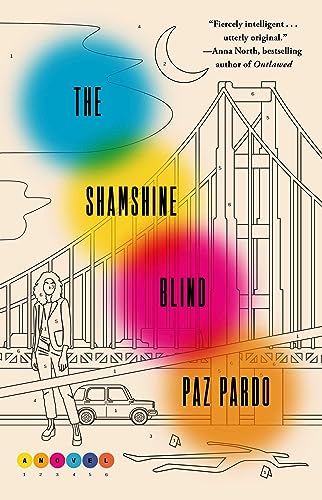
This novel is everything a reader could possibly want. The Shamshine Blind is amazingly original in its concept and delivery, even while it builds on the roman noir, hard-boiled detective trope. Its guts make it a mystery and thriller, but the prose that flows is literary liquid.
Its landscape is foreign and familiar, its world is one of speculative fiction; the setting is 2009 in an alternate reality where the Argentines won the war against the United Kingdom for the Falkland Islands — the Malvinas — and then went on to decimate the rest of the world. The Argentines’ weapon of mass destruction was a work of chemical genius: capturing emotion and concentrating it into a deadly debilitating bullet. The science didn’t stop there and in this reality society must now grapple with mind-altering drugs, psychopigments, which alter our emotions, our reactions and responses, our behavior. “Your Emotions Are Not Your Own” is a warning repeated in the novel.
Kay Curtida is the detective put on a psychopigment case, a homicide — which, when its layers are peeled away, reveals something much larger and far more corrupting than simple murder is at foot.
I have never read anything by Isabel Allende before this novel. I know she’s a well-known, well-respected author, critically acclaimed and with a string of best-sellers. I just hadn’t come across her books before — and so, when I got the chance to read this, I was thrilled to!
The novel is a historical and contemporary work of literary fiction; weaving together multiple, seemingly disparate threads, across time and distance. This is a story of multigenerational, intergenerational trauma and the power of found family, the connections we build through shared experience and history. The novel begins with a young boy, left bereft by World War II and the holocaust, then segues into the latter end of the 20th century, refocusing on a young woman whose own life was torn apart by political and real warfare in El Salvador. The paths of these two individuals merge together in 2017 when the United States begins its policy of deporting refugees and refusing asylum to those at the Mexican-US border.
This is a harrowing story, one designed to evoke an emotional response, to serve as an act of resistance and resilience, a political statement and work of activism. It delivers on all these points.
To meet the novel’s objectives, Allende writes simply. The language is straightforward and direct, with little metaphor or room for interpretation; it is accessible in order to reach diverse readers. The prose possesses a determined clarity, one which all readers will appreciate. But readers should not confuse simplicity for lack of depth; Allende’s writing is emotionally charged, it reveals a deep awareness of human frailty and response to trauma.
It is this reader’s opinion that few readers will able to walk away from this novel unmoved by its content and message.
This is not your average haunted house story. It is your better than average haunted house story. Readers of literary fiction will absolutely love this spin on the haunted house trope for its deep character development and character-focused orientation.
The novel is simple enough in its premise: a couple invite pandemonium into their house when they have a television crew for a “ghost hunter” style show come to their home to document their haunting. The events take place around this misfit cast of producers, camera operators, show staffers, the homeowners, and the carious psychics they call on to flesh out the dramatics of the show. It is the interplay of their individual needs, desires (met and unmet) that form the basis for this novel. Underlying all this is the omnipresent question: Is the haunting real? Or a figment of everyone’s desires? Every actor here has a vested interest in the reality of this haunting, leading the reader on a pursuit for the truth and an authenticity which may be impossible to find. This is, after all, the premise of such television shows.
Fussner’s prose was also an incredible appeal; it is literary in its language, its unfolding. Fussner’s choice of words draws a performative veil over the novel, intriguing this reader at least. I was hooked from start to finish.
This novel moved me to tears, which is a rare occurrence — and more than once. One Last Waltz takes the reader on a journey of several lifetimes. This novel is a rich emotional experience for the reader.
One Last Waltz is set in a retirement community/home for the elderly, The Acorns, and the stories of its residents are told through the eyes of one of its employees, a caregiver, Angie Tomlinson (Ang, to her clients and friends.) These are the days of their lives, as their lives arrive at their terminal point. The novel highlights their small moments and casual conversations, but this is not a quotidian experience for them or the reader; it is in these small, personal interactions that the most intimate exchanges are made. This is a novel about the depth that exists in the ordinary and mundane.
Over the course of three years, the novel takes us and the residents of the Acorns, to various locations. A field day for them is as much a field day for the reader. There is indeed, a final waltz, and it is a beautiful, inspiring thing to witness as a reader.
One Last Waltz is also gorgeously written. With few words — Scholes applies an economical approach to writing — he creates an emotive landscape and breathing characters. Readers should not expect verbose visual descriptions, rather, a starkness here allows the reader to fill the visual gaps with emotion; it is their joy and pain, regret and worry, contentment and satisfaction, that is the reward of this novel. Scholes handles chronological leaps easily, taking the reader back in time to witness the events of the elderly residents lives and the meaning these have had for them. Of course, their journeys are really for our benefit as readers, as we traverse the course of our own lives, parallels to theirs.
For readers at any stage of life, Our Last Waltz is an uplifting (yet deeply solemn) and profound novel well-worth the tears it will bring to the eyes.
Easily the best novel I have read this year. Or, at least, the most engaging and ire-provoking one. If you haven’t yet read Yellowface, you must. The novel is one of those you just can’t put down because you are dying to know what next wreck is going to happen.
The main character is a woman you’ll hate. The victim is also pretty unlovable. And the psychological twists lead to an unpredictable and yet oh-so-predictable ending. I know I’m being coy. Just read the book. You won’t regret it.
The novel revolves around two authors, one who plagiarizes another in the most god-awful way possible. And then more or less gets away with it. Sort of. That’s it. That’s the book.
But oh, the way Kuang tells it is so deliciously witty. The snark and sharp edginess of resentment and guilt and hate is palpable in Kuang’s prose. It’s the kind of writing that stirs up hot and fiery anger in the reader. I loved it.
Read it.
Get on that ridiculously long library hold list and wait for this book. So worth it.
Perfume River is a New Adult bildungsroman, revolving around a young woman named Sam as she navigates her life around competing stakeholders: lovers, friends, herself. She is also wrestling with her past, specifically, her dysfunctional childhood and relationship with her parents. She encounters a young black boy, also suffering through his own life and problems. Together, they attempt to make sense of the world around them and the demands made upon them, to be adults, to grow up, to take on the consequences of others’ decisions.
My review of the novel is mixed. On the one hand, the novel is well-written, in a technical sense; Patrick’s prose is smooth, even, and consistent. As with her other work, her use of words is sparse and succinct, leaving the reader to indulge in their own imaginings of the space and events. The pauses and silences are evocative.
On the other hand, unlike Patrick’s other works, Mercy and Anxiety in the Wilderness, Perfume River lacks emotional depth. Overall, this novel does not deliver on its emotional promise, the one made in its synopsis.
There are absences which flattened Sam and Rexel as individuals. The muteness of Rexel’s family and the superficial context of his life beyond his encounters and engagement with Sam were a detraction for this reader. The reader is treated to one facet of Rexel’s emotive life: his wariness, his diffidence, his armor. Sam doesn’t seem to really break through Rexel’s armor in a meaningful way so that the friendship benefits him. A deeper view into Rexel’s life beyond Sam, perhaps his own chapters, would flesh him out further as a primary actor in this story. (Or, perhaps, the story isn’t or shouldn’t be about him. Is this really Sam’s story and not his?)
Ultimately, for this reader, what is lacking in the story is change. Sam’s metamorphosis is too subtle, delivered too late in the novel. Much of the novel feels like it isn’t “going anywhere” as the events which are meant to serve as catalysts are given too brief of a treatment. This reader found it difficult to connect with the other characters in order to feel the tension between them and Sam. Much of the tension that exists is situational, but the internal psychological turmoil they cause is left unsaid; this absence hindered this reader’s ability to connect with Sam and these other characters.
For this reader, the Prologue was the most compelling element of the novel; it was intriguing and suggests a story about dysfunctional families. However, the distance between Sam’s childhood and adulthood is not bridged by the remainder of the novel.
Overall, for this reader, the novel did not deliver on its synopsis’ promise; it feels unfinished, like it hasn’t had time to fully develop. Its characters feel under-developed, as if the author hasn’t had time to get to know them fully yet, and as a result, this story of their lives only skims their surfaces.
All this said, I am a fan of Kathleen Patrick’s work and look forward to her next novel.
I’m wondering to myself — kicking myself — why didn’t I read this book sooner? I won Public Opinion in a Goodreads giveaway last year, but only just read it. I absolutely love it. Kicking myself not reading this sooner.
The novel revolves around a character you love to hate. Melvin Ritkin is a horrible human being who does unsavory things for unseemly amounts of money. He’s built a career around scamming people, creating false realities, and fixing other awful people’s problems. He lives in a place most people love to hate too: Los Angeles, CA. But Melvin’s world is Hollywood adjacent; it is Hollywood’s underworld. Melvin maneuvers and is part of the grotesque underbelly that makes the glitz and glamor possible on its surface. This is the behind-the-scenes view of Hollywood and it is as ugly as one can imagine. The characters are utterly sinful; palpable, pitiable, and on occasional, lovable. This is world of victims and villains, and where the line between the two is porous.
Through Melvin’s eyes we see how perception is easily manipulated. But readers are also treated to the tantalizing view of how the manipulators themselves rot inside. Melvin’s life, relationships, and work all come together in a collision that leaves him… well, I will leave it to the reader to find out. But, Reader, know that there is a moral to this tale, though, it is the journey which makes that lesson so delicious.
Story aside, it is Pettijohn’s prose, his distinct and witty authorial voice that carries the novel beyond snark and soap opera, and into the territory of literary fiction. This is a very well-crafted independent novel. Nathan Pettijohn has a new fan and I very much look forward to their next novel.
WOW is aptly named; this is a whopper of a novel in more ways than one! This is another independently published novel I discovered through a FB group I’m in.
WOW revolves around — and is narrated by — Paul Drake, an ordinary, suburban Englishman, who, as the result of having a coconut fall on his head, begins to experience a series of strange consequences. The coconut itself causes him severe bodily damage, and Paul is hospitalized. This is where he begins to feel an unexplainable sense that he will be the recipient of some kind of message, though from whom or where, remains a mystery to him. He is drawn to a piece of paper, with expectations that this object holds some significance for the future of humanity.
It is here that we are introduced to the novel’s cast of quirky characters: Zack, Paul’s unorthodox doctor, who treats him for the psychological fallout of the coconut-induced incident and the other three members of the therapy group, all of whom are “delusional” (or are they?) according to the medical establishment. They are: Franck (with a “C”), who suffers from paranoia as much as he is deluded by it; John, who wears a pasta strainer as a hat and who identifies as a Pastafarian; and, Ruth, aka Dobby, who has PSTD from a series of tragic and awful events in her life, and who is haunted by the number 19. The novel revolves around the five of them, as they attempt to make sense of each other, their lives, and the other-wordly claims of their newest member, Paul.
Readers who enjoy deeply reflective narrations — and unreliable narrators! — in the vein of Sophie’s World by Jostein Gaarder, where the characters strive to unravel the mysteries of why we exist, our individual and collective purposes in life, and the “meaning of it all,” will find WOW satisfying — and humorous, to boot! The novel unfolds in a similar epistolary style as journal entries and diaried events. In this respect, Wilkinson channels the dry humor common in many of Ian McEwan’s novels, without McEwan’s trademark darkness. WOW is also reminiscent of another novel, one which Wilkinson mentions in this work: Douglas Adams’ The Hitchhiker’s Guide to the Galaxy. Indeed, the quirkiness in WOW does mimic this science-fiction classic.
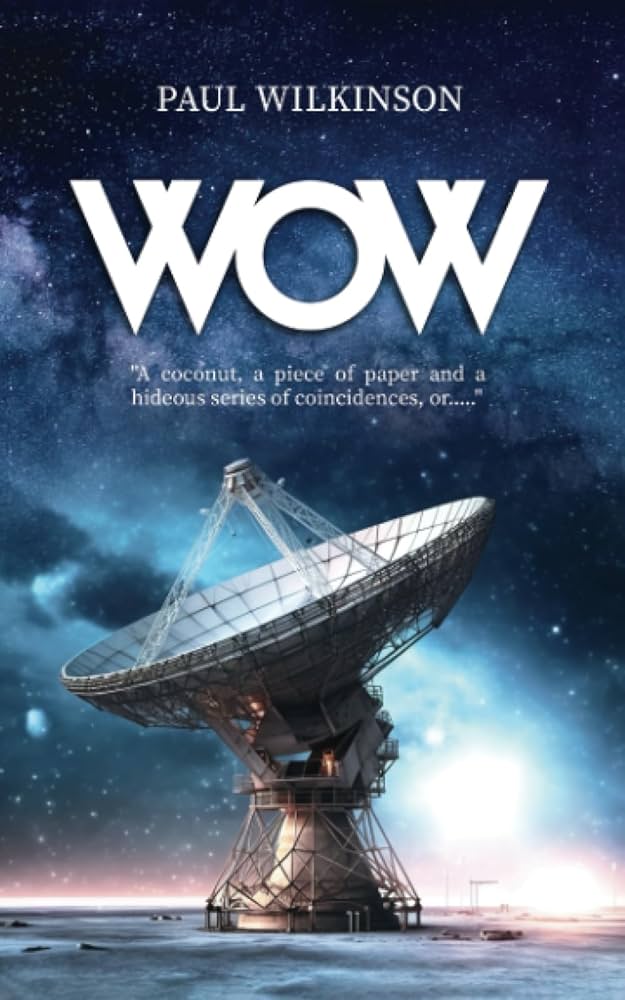
It is here that my review begins, primarily because the genre of the novel sets the tone for readers’ expectations. The novel is categorized as science fiction and “first contact” fiction, a notion supported by the (gorgeous) cover of the novel, an image of a large satellite pointed into space, suggestive of humanity’s SETI (the Search for Extraterrestrial Intelligence) efforts. But WOW is not a science fiction novel, it leans far more into literary fiction and its focus is wholly on the human effort to understand our earthly purposes. Readers who expect science fiction are likely to feel disappointment as the story unfolds: it lacks the world-building, technology, and off-world focus that science-fiction typically delivers.
On that note, readers of speculative fiction may find WOW fits their preferred genre more. It is speculative, though, as previously noted, the novel runs toward the philosophical more than anything. A reason for this is the lack of story arc and narrative in the novel; WOW captures Paul and his friends’ experiences and thoughts, but nothing really happens. But, that’s the point of the novel, it is a deeply reflective and philosophical exploration.
The outer space this novel traverses is really more of an inner space. Looking beyond our world puts our own into higher definition.
As a philosophical work — a treatise, in some ways — there are several moments in which the novel lags, running off on a tangent. Readers will have different levels of tolerance for this; for this reader, the novel was longer than it needed to be. But this is a minor complaints. At 315 pages it is a far more succinct read than Gaarder’s novel at 500+ pages, both of which tackle much the same questions!
This novel is literary fiction in other ways as well. Its lack of plot and narrative arc is a hallmark of literary fiction, and likewise, its characters are its primary focal points. Wilkinson does fantastic work of creating and developing intriguing, thoughtful, deeply self-aware characters. The story is propelled by their delusions, thoughts, the functions of their inner worlds. This is a character-based novel and this is where WOW shines.
My overall rating is therefore, mixed. I placed it at a solid 3 stars as I enjoyed it for it is, rather than what I expected it to be.
Readers who would like to explore Paul Drake’s mind on their own — or his friends’, can purchase WOW from Amazon here. It is currently selling for $14.00 for the paperback, $19.40 for the hardback, or $3.99 as a Kindle ebook. Readers who subscribe to Kindle Unlimited also have access to it.
The Skin and Its Girl is a creative feat, a unique novel even within its genre, literary fiction, a genre well known for its diversity and breadth. Perhaps for that reason, this is a novel for a selective reader, one who does not possess fixed expectations or a very firm hold on the physics of reality.
This is a book of metaphors. It is literary fluid.
The novel revolves around the existence of a girl who should not exist, a girl with blue skin. It is an epistolary novel, written by the girl to her aunt, a woman who has functioned as her mother, guardian, defender. The blue-skinned baby is born into a world, her personal individual world is marked by the disintegrating relationship of a man and woman, her father and mother. Much of the novel revolves around their sheltering of their child and the tensions produced by varying relatives’ opinions about the girl’s interaction with the world.
Being written from a child’s perspective, though in retrospect, the novel’s prose possesses a kind of surreal, dream-like quality. Conversations are sliced into snippets, images are partial and incomplete, events are smudged down to the primal feelings they invoked, much as things might be in memories. But — and this is where a mature, independent reader will find the novel intriguing — this incompleteness allows and challenges the reader to sift through these bits and pieces to find the connections that bind the protagonist to her aunt, to her mother, to the world at large “out there” that she is prevented from seeing.
I will leave it to the reader to see what becomes of this strange blue-skinned girl.
Overall, my review is a mixed one; its creativity is singular, but its delivery is difficult. Much of the story unfolds slowly and without a predetermined destination, yet, this mimics the life it documents — a life that is not meant to exist, has no purpose but to simply be and by being is an affront to others’ sense of being.




 Dr JoAnn LoSavio