Land of Milk and Honey: A Novel by C Pam Zhang

Land of Milk and Honey: A Novel
by C Pam Zhang

Land of Milk and Honey is a haunting novel, the kind that consumes you long after you think you’re done with it. Certainly, it reverses the usual process: where a reader typically consumes, by the end, I felt consumed.

That said, for this reader, my initial attempt to read it caused a slow and uncomfortable indigestion, and I was tempted to abandon the book several times. I found Zhang’s prose felt overwritten, pretentious, too academically literary as if it had been pummeled, shaped, and reshaped in an MFA workshop where Zhang had been too eager to please an implacable professor. The food too, its descriptions and imagery, was overly reminiscent of the kind of unsatisfying fare one might find at Alinea or on Top Chef Season 2,349,349, pretty without satiety. But, in retrospect, having reached the end of the novel: that was the point.

I am glad I did not DNF the novel, and followed it through to the last “course.” It was well worth the patience.

Land of Milk and Honey is a speculative, near-future earth-bound science fiction. Written during the 2020-2023 Covid pandemic when the world had shut down and shut in, Zhang built an insular microcosm of our contemporary world. It is the same, yet different: more intensely bleak, more virulently violent, more callous. Readers, myself included, will easily recognize our pandemic selves in the characters of the novel.

The events of the novel take place in a bleak “what if” landscape, a world which is ravaged by climate change and late-stage capitalism, having never progressed further in its decolonization than our present. Food as we know it is scarce, GMO crops abound out of necessity. Nationalist and populist fears of scarcity have made political borders impermeable, except where power and money create porosity. A young Asian American professional cook trapped in immigrant, stateless limbo in Europe finds herself posing as a chef and working for a strange and shady corporation, one whose mission is evolutionary revolution. This is eugenics gone awry (as it historically has, no surprise here).

Public Opinion: A Novel by Nathan Pettijohn

Public Opinion: A Novel by Nathan Pettijohn

I’m wondering to myself — kicking myself — why didn’t I read this book sooner? I won Public Opinion in a Goodreads giveaway last year, but only just read it. I absolutely love it. Kicking myself not reading this sooner.

The novel revolves around a character you love to hate. Melvin Ritkin is a horrible human being who does unsavory things for unseemly amounts of money. He’s built a career around scamming people, creating false realities, and fixing other awful people’s problems. He lives in a place most people love to hate too: Los Angeles, CA. But Melvin’s world is Hollywood adjacent; it is Hollywood’s underworld. Melvin maneuvers and is part of the grotesque underbelly that makes the glitz and glamor possible on its surface. This is the behind-the-scenes view of Hollywood and it is as ugly as one can imagine. The characters are utterly sinful; palpable, pitiable, and on occasional, lovable. This is world of victims and villains, and where the line between the two is porous.

Through Melvin’s eyes we see how perception is easily manipulated. But readers are also treated to the tantalizing view of how the manipulators themselves rot inside. Melvin’s life, relationships, and work all come together in a collision that leaves him… well, I will leave it to the reader to find out. But, Reader, know that there is a moral to this tale, though, it is the journey which makes that lesson so delicious.

Story aside, it is Pettijohn’s prose, his distinct and witty authorial voice that carries the novel beyond snark and soap opera, and into the territory of literary fiction. This is a very well-crafted independent novel. Nathan Pettijohn has a new fan and I very much look forward to their next novel.

The Master: A Novel by Patrick Rambaud

Translated by Nicole and David Ball

The Master: A Novel
by Patrick Rambaud

The Master is a stark novel, the kind that is absent of luxurious words and descriptions, but whose minimal lines imply a lush intellectual interior may lie beyond the text, if the reader is willing to linger on the line just a little longer than necessary.

The protagonist is Zhuang Zhou (also known as Zhaungzi), an actual historical figure, a Chinese philosopher who lived circa 369 BCE to 286 BCE and contributed greatly to the philosophy of Taoism. He is the eponymous master of this novel. It begins with his childhood and recounts the fictionalized events of his life, with especial attention to Zhaung’s moments of philosophical enlightenment. Zhuang is propelled, by his choice or by the whims of others, from one kingdom to another, finding his life and livelihood tied to the court, a recipient of a benefice from the king. In some periods of his life he welcomes this privileged position, living the abstracted life of the mind. At other times he rejects this and delves into more material pursuits. His experiences lead him to write the piece of scholarship he is known for, The Zhuangzi.

The novel reads like an ancient epic moving swiftly from one event to another. It does allow the reader some interiority into Zhuang’s mind, but only his, and only insofar as it pertains to his judgements on morality and ethical behavior. This is not a personal account of the interiority of his life in an emotional sense; the reader should not expect entree into Zhuang’s feelings, so much as his intellectual musings on morality and correct ways ruler should govern. (Indeed, the reader may get the impression Zhuang was a less than stellar parent and romantic lover.) Rambaud delivers the character with a kind of detachment, as if merely filtering a series of observations for the benefit of the reader and for the reader to analyze and judge Zhuang for themselves.

The purpose of the novel seems to be less focused on the man than his scholarship. I have the distinct impression I am meant to walk away with a fuller view of what the sage intended for us to understand about Taoism. But I admit, I was less impressed with Zhuang’s heavy handed pedagogy and deliberate elusiveness, and so the lesson missed me.

As a result, this reader notices a pedantic aspect to the book, which while it performs the conventions of Chinese philosophical writing authentic to its setting and protagonist, may read as supercilious to the modern reader. But then again, the philosophy of ethics is about passing judgement and imposing moral watermarks on society, so… I am left wondering if a book on a topic like this can ever be written without an element of condescension baked into it. If so, Rambaud is excused from any accusation of arrogance; indeed, Rambaud’s role in this novel is exemplary otherwise.

Rambaud’s portrayal of Zhuang follows an expected patriarchal narrative that is likely accurate; we are not given any historical evidence that the real Zhuang was a feminist, after all. To portray him as such would have been inauthentic (if satisfying as a disruption, a revolution). We can understand Rambaud’s role here as a messenger. His prose is beautiful in its sparseness; with few words an image of Zhuang — not his physical being but his essence — is apparent to the reader, as are his friends who accompany him, betray him, befriend him on the journey of his life. Rambaud delivers the tensions of the social landscape of ancient China well, without romanticizing or Orientalizing the place or people. It is a harsh world: peasants live and die at the whims of their lords, people live and die at the whims of nature via its tantrums in the form of floods or droughts. Rambaud transports the reader to this moment and place well.

Overall, The Master is an enjoyable read, one that informs and does what historical fiction ought to do: transport the reader across time.

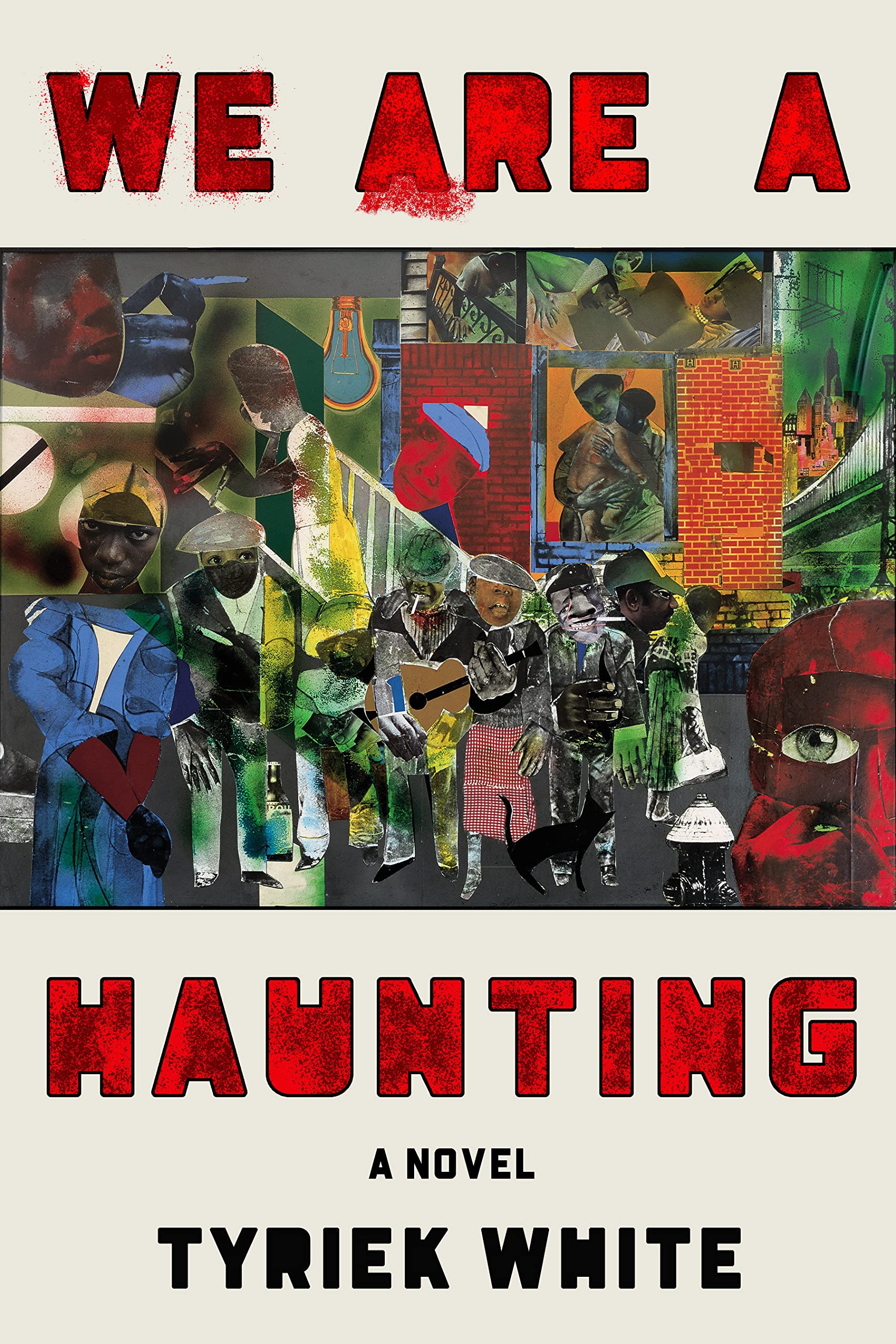
We Are A Haunting: A Novel by Tyriek White

We Are A Haunting: A Novel by Tyriek White

We Are A Haunting is a poetic song, like a siren that lured me into its world. Through the eyes of three generations of a black family living in New York City: Colly, Key, and Audrey, and the unraveling of their lives in a world rife with systemic racism, poverty, violence, grief, loss, readers are treated to a story that flows seamlessly between decades and generations.

White’s novel toggles forward and back in time. Characters float — as ghosts — between the past and the present. As the space between these three generations contracts and expands, the reader’s construction of time and history is reshaped, no longer a linear thing but a fluid matrix in which they live, all together, simultaneously at once. As a historian, We Are A Haunting reminds me that the past is never past, the present is merely a locus in history’s path.

The language which binds all these moments and spirits together is history, emotion, and experience: suffering and longing, obligations and promises kept or broken, strength and compromise, the ability to survive and a sense of defeat under the unwavering boot of poverty and racism. This is a complicated world in which awful events — such as getting fired and losing one’s income — is a nonevent warranting no reaction because of how useless it is to express emotion over it. This is just how life is. But, at the same time, such events are also gateways, paths that lead elsewhere, to better futures.

The interactions of the main characters with others in their lives: friends, fathers, husbands, children, and the dead or dying create the bonds which constitute the community and are the paths along which history travels. Each generation seeks to identify for themselves who they are and what they want, but they are also inevitably bound to the previous generation. Just as the living and the dead move seamlessly between their worlds in this novel, birth and death are a window that lets light in and keeps out the wind. Key, in her community, serves as a kind of gateway for life, possessing the ability to see things others cannot and in the capacity of a doula.

We Are A Haunting is not just about the black community itself, as an insular, discrete object in a vacuum. Then novel situates these black histories and experiences within the context of American material culture and history. Colly, Key, and Audrey and those around them are embedded in a world that has and continues to be assaulted by colonial institutions and racist systems. The deaths — those both metaphorical and physical — in We Are A Haunting are caused by this abuse and indifference. Casual micro-aggressions are tiny cuts and death is caused by a thousand of them.

This is a complex novel. For all its historical meaning, this is not a historical fiction in an informative sense; the time-bending, paranormal elements and the focus on characters’ and their emotional lives make this a more literary work than a historical narrative. This is not a novel that brings all its narrative arcs to happy, organic closures; un-repaired relationships, unfulfilled desires, and falsehoods are part of its characters’ lives. Morose, resentful endings are, after all, part of the colonial experience (at least from the perspective of the colonized.) In no way is this a detraction; this honest harshness is an authentic portrayal of racialized America.

The prose is literary. It is singularly focused on its characters more than its plot, though the unfolding of events lead to the characters’ interactions that shape their experiences. The characters are tangible, flawed, and powerfully written in each their own voices. Readers will have access to their interiority, but this is not an easy read in that the characters are — as real people are — guarded, afraid, unwilling to be vulnerable. Readers should not expect to be told what to think; this reader had to work to understand the motives and meanings of their conversation, their actions. The work, however, is worth it.