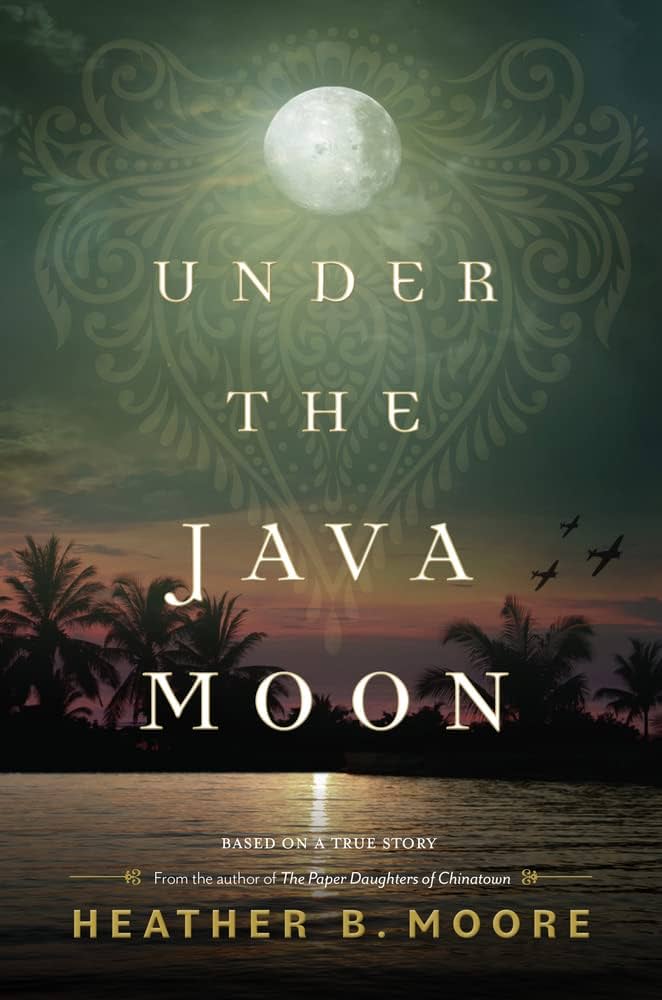
Under the Java Moon: A Novel of World War II by Heather B. Moore
For those interested in the Pacific theater of WWII and the lived experiences of Japanese occupation, Under the Java Moon delivers a poignant and moving story of loss and perseverance.
The novel follows the Vischer family, Dutch colonials living in Indonesia when the Japanese arrive and occupy the region. George, an engineer is drafted into service, separated from his family, who are marched out of their home and into the enemy alien camp at Tjideng. Told through the eyes of George, Mary, and their young daughter, Rita, the reader is immersed in the experience of living through war.
The novel and story is emotional and psychologically nuanced, but — for this reader — sanitized. While I felt sympathy for the Vischers, I felt no emotional pull, no real heart-wrenching, which — perhaps strange to say — I expect to feel from a story of this genre.
Moore’s novel is well-crafted as a historical novel; pertinent historical events serve as the structure of the story, without it turning into a history textbook. But it is unfortunate that we only see the Dutch perspective of WWII here, and very little of the Indonesian experience. I would have liked to seen a little more balance of perspectives.
Overall, an enjoyable read, though less profound that its subject suggests.
Trail of the Lost: The Relentless Search to Bring Home the Missing Hikers of the Pacific Crest Trail by Andrea Langford
This work of true crime utterly possessed me; I am torn between wanting my hiking friends to read it, because I don’t want any of these awful things to happen to them, or not wanting them to read it, because it will terrify them into never venturing into the wilds again. (I am probably going to buy a few copies of this book this Christmas as gifts for those same friends!) Anyone who knows someone who hikes or camps or goes “off trail” for any reason should have an eye out for this book.
The depth of Lankford’s research, the number of interviews and observations, and the countless hours and days and weeks spent in Search and Rescue to make this book happen is staggering; that alone is a draw for anyone interested in this kind of crime non-fiction. Lankford themself is well-positioned to write on the subject. As a former ranger involved in several S&R investigations, Lankford is more than a hiker. Here, Lankford takes on the role of investigative journalist, detective, social worker, and friend.
The book focuses on the disappearances of three men (primarily) from the Pacific Crest Trail, which runs along the West Coast, from California up to and through Washington State. Kris Fowler, David O’Sullivan, and Chris Sylvia vanished from the trail in mysterious circumstances and have yet to be found, alive or otherwise.
But, of course, the book is about more than them and their individual cases; Trail of the Lost is also about their families and loved ones, the grief and pain of their loss, the process and protocols of police and other investigations into vanishings, and — perhaps this is where the book truly shines and connects with readers on a wholly different level — the culture of the trail and of extreme hiking. By giving readers a view into the the lure of these activities and the perils they entail, Trail illuminates certain flaws in our societal ideals and in the normative flows of life around work-family-friendship-community. Lankford highlights what might be missing in our urban/suburban spaces that trails like this offer. Chapters that seemingly veer off onto tangential subjects, like the Yellow Deli Group, or suspicious and creepy “trail trolls” in fact, draw attention to deeply inclusive, welcoming, altruistic, and connected the culture of the PCT and hiking is (or can be).
The irony is, of course, that individuals take on these hikes individually; they seek isolation — and yet, the culture of the trail highlights the deep dependence we, as humans, have on each other, and our need for social contact, a sense of belonging with others, a sense of community.
If you’re looking for a creeping, eerie read for the wintry months to come, Freshwater Fire must be on your to-be-read list. Forget Halloween, with its flashy, trashy gore, Mullins’ slim novella, with its sparse and evocative prose, and its fog-shrouded terror, brings out of the deepest of our fears as the decay of winter descends. This is a book to curl up to with candle light when the storm takes out the electricity. Or… maybe, that might just send you over the edge into madness. Read at your own risk, right?
I took this risk on this novella. I usually hesitate to spend money or time on independently published fiction; the gamble so often doesn’t pay off. But Mullins is a talented writer. With very few words, Freshwater Fire summons the smell of decay and manifests humanity’s darkest fears: that we are not alone in this world and worse, we are not as invincible as we would like to believe. Mullins builds a devastating sense of futility that the reader cannot shake off. This is a classic gothic horror.
The tale revolves around a lighthouse and its new keepers, sailors who quickly find the isolation of their task is more than a mental exercise in surviving entrapment. Their fears are more than simply psychological, they are real and monstrous. For readers who enjoy mythology, paranormal elements, and psychological thrillers, Freshwater Fire will deliver a satisfying reward.
The story aside, Mullins’ characters are fleshy, their dialogue and fear is palpable. Their reactions to their circumstances are more than plausible, revealing Mullins’ deep understanding of the human psyche and the lengths we will go, not only to survive but must do to overcome our fears. Terrifying as this novella is, it is also inspiring.
I look forward to Mullins’ other novels! They are on my wish list!
I’m wondering to myself — kicking myself — why didn’t I read this book sooner? I won Public Opinion in a Goodreads giveaway last year, but only just read it. I absolutely love it. Kicking myself not reading this sooner.
The novel revolves around a character you love to hate. Melvin Ritkin is a horrible human being who does unsavory things for unseemly amounts of money. He’s built a career around scamming people, creating false realities, and fixing other awful people’s problems. He lives in a place most people love to hate too: Los Angeles, CA. But Melvin’s world is Hollywood adjacent; it is Hollywood’s underworld. Melvin maneuvers and is part of the grotesque underbelly that makes the glitz and glamor possible on its surface. This is the behind-the-scenes view of Hollywood and it is as ugly as one can imagine. The characters are utterly sinful; palpable, pitiable, and on occasional, lovable. This is world of victims and villains, and where the line between the two is porous.
Through Melvin’s eyes we see how perception is easily manipulated. But readers are also treated to the tantalizing view of how the manipulators themselves rot inside. Melvin’s life, relationships, and work all come together in a collision that leaves him… well, I will leave it to the reader to find out. But, Reader, know that there is a moral to this tale, though, it is the journey which makes that lesson so delicious.
Story aside, it is Pettijohn’s prose, his distinct and witty authorial voice that carries the novel beyond snark and soap opera, and into the territory of literary fiction. This is a very well-crafted independent novel. Nathan Pettijohn has a new fan and I very much look forward to their next novel.
Absolutely chilling and brilliantly written. This book made me stay up all night for all the right reasons. It also made me afraid of my own house – and for a horror novel, that’s killing it!
I won a paperback copy from a Facebook Group giveaway, and was thrilled because I am so ready for the spooky October season. (It’s my first spooky October read!) It arrived via Amazon; and a little later, some goodies also arrived from the author (a bookmark and cards depicting the scary characters from the novel).
The Suffering is a new adult horror revolving around the haunting of a group of housemates. Kyle, Pete, Lance, Tad, and Cass are the university students and friends who reside at Brackenby House, a Victorian mansion where the rent is cheap — and where a century ago a famed psychic and a group of would-be occultists performed a séance. That demonic summoning resulted in a terrible bloodbath; all the occupants of the house at the time, save one, perished in inexplicable ways. The gory history of the house was never more than a joke to the young friends, until one Halloween, they decided to perform their own séance.
I will leave the reader to discover the awful consequences.
The haunted house story is not the novel’s only appeal, classic as it is. Mars’ writing and nuanced character development are what makes The Suffering truly shine. The pacing of the book is swift; the story unravels like a horror film. Often, with only a short sentence, Mars sent shivers across my skin. The economy of her words works well to build suspense and dread. She forces the reader to fill in the unsaid darkness with the most evil things.
The characters are also well-crafted. They are unique and yet recognizable, wholly likable, and realistic. The genre so often (sadly) produces puppet-like characters, stereotypes who feel (to this reader) more like ghosts than human. But Mars successfully avoids this; these young friends react as you or I might in the same situations — and in their effort to survive their hauntings — connect with the reader as much as they do to each other, through compassion, friendship, honesty, and fear. Very quickly, this reader found herself bonded to the unfortunate residents of the house.
Readers should also know that the book is spicy in some parts. The romantic aspects of the novel add to the storyline. The language also is suited to an adult audience; this is not a juvenile horror novel, though there is nothing in the novel that would warrant an R rating.
MJ Mars has earned a fan in this reader. I look forward to their other stories and novels!
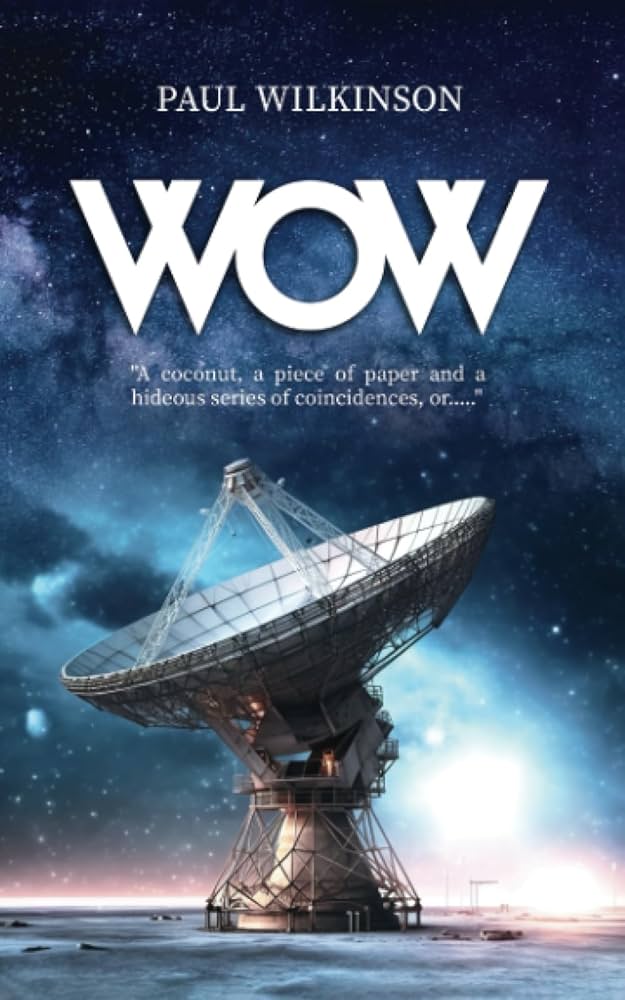
WOW is aptly named; this is a whopper of a novel in more ways than one! This is another independently published novel I discovered through a FB group I’m in.
WOW revolves around — and is narrated by — Paul Drake, an ordinary, suburban Englishman, who, as the result of having a coconut fall on his head, begins to experience a series of strange consequences. The coconut itself causes him severe bodily damage, and Paul is hospitalized. This is where he begins to feel an unexplainable sense that he will be the recipient of some kind of message, though from whom or where, remains a mystery to him. He is drawn to a piece of paper, with expectations that this object holds some significance for the future of humanity.
It is here that we are introduced to the novel’s cast of quirky characters: Zack, Paul’s unorthodox doctor, who treats him for the psychological fallout of the coconut-induced incident and the other three members of the therapy group, all of whom are “delusional” (or are they?) according to the medical establishment. They are: Franck (with a “C”), who suffers from paranoia as much as he is deluded by it; John, who wears a pasta strainer as a hat and who identifies as a Pastafarian; and, Ruth, aka Dobby, who has PSTD from a series of tragic and awful events in her life, and who is haunted by the number 19. The novel revolves around the five of them, as they attempt to make sense of each other, their lives, and the other-wordly claims of their newest member, Paul.
Readers who enjoy deeply reflective narrations — and unreliable narrators! — in the vein of Sophie’s World by Jostein Gaarder, where the characters strive to unravel the mysteries of why we exist, our individual and collective purposes in life, and the “meaning of it all,” will find WOW satisfying — and humorous, to boot! The novel unfolds in a similar epistolary style as journal entries and diaried events. In this respect, Wilkinson channels the dry humor common in many of Ian McEwan’s novels, without McEwan’s trademark darkness. WOW is also reminiscent of another novel, one which Wilkinson mentions in this work: Douglas Adams’ The Hitchhiker’s Guide to the Galaxy. Indeed, the quirkiness in WOW does mimic this science-fiction classic.
It is here that my review begins, primarily because the genre of the novel sets the tone for readers’ expectations. The novel is categorized as science fiction and “first contact” fiction, a notion supported by the (gorgeous) cover of the novel, an image of a large satellite pointed into space, suggestive of humanity’s SETI (the Search for Extraterrestrial Intelligence) efforts. But WOW is not a science fiction novel, it leans far more into literary fiction and its focus is wholly on the human effort to understand our earthly purposes. Readers who expect science fiction are likely to feel disappointment as the story unfolds: it lacks the world-building, technology, and off-world focus that science-fiction typically delivers.
On that note, readers of speculative fiction may find WOW fits their preferred genre more. It is speculative, though, as previously noted, the novel runs toward the philosophical more than anything. A reason for this is the lack of story arc and narrative in the novel; WOW captures Paul and his friends’ experiences and thoughts, but nothing really happens. But, that’s the point of the novel, it is a deeply reflective and philosophical exploration.
The outer space this novel traverses is really more of an inner space. Looking beyond our world puts our own into higher definition.
As a philosophical work — a treatise, in some ways — there are several moments in which the novel lags, running off on a tangent. Readers will have different levels of tolerance for this; for this reader, the novel was longer than it needed to be. But this is a minor complaints. At 315 pages it is a far more succinct read than Gaarder’s novel at 500+ pages, both of which tackle much the same questions!
This novel is literary fiction in other ways as well. Its lack of plot and narrative arc is a hallmark of literary fiction, and likewise, its characters are its primary focal points. Wilkinson does fantastic work of creating and developing intriguing, thoughtful, deeply self-aware characters. The story is propelled by their delusions, thoughts, the functions of their inner worlds. This is a character-based novel and this is where WOW shines.
My overall rating is therefore, mixed. I placed it at a solid 3 stars as I enjoyed it for it is, rather than what I expected it to be.
Readers who would like to explore Paul Drake’s mind on their own — or his friends’, can purchase WOW from Amazon here. It is currently selling for $14.00 for the paperback, $19.40 for the hardback, or $3.99 as a Kindle ebook. Readers who subscribe to Kindle Unlimited also have access to it.
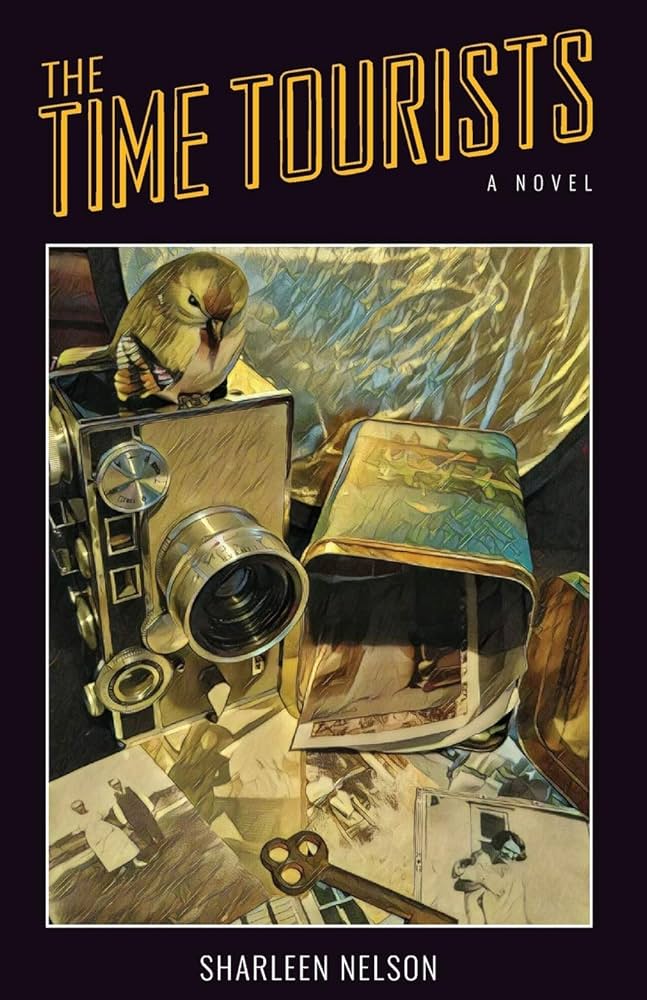
I am thrilled to be reading and reviewing a novel written and published by a local PNW author and independent press. This is a backlist book from GladEye Press, having come out in 2018, but The Time Tourists deserves another round in the limelight.
Readers of speculative historical fiction in the vein of Dr Who, and especially those who delight in time travel, with all its peculiar possibilities, will enjoy this novel. The Time Tourists centers on the concept of time travel through photographs, revolving around a particular set of individuals who have discovered how to both profit from this and use the skill to provide closure for descendants living in the present. Specifics about the process of time travel are murky; this is not purely science fiction, the novel leans toward historical fiction and mystery over the former genre. At the core of the novel is a young woman, Imogen Oliver, who discovers she possesses this rare ability. Through her adventures into the past, she assists people in finding out about their ancestors, retrieves items lost to them and their families — and, perhaps most importantly, learns that her parents’ disappearance is not all it seemed to be. Indeed, the novel ends on a cliffhanger, encouraging the reader to seek out Nelson’s second book, The Yesterday Girl.
Readers should allow the novel time to unwind; it does lead to a very exciting mystery. But, perhaps because The Time Tourists is the first novel in the series, readers may find the first eight chapters, fifty-odd pages, a little more heavy on exposition and slow-paced than expected. In these chapters, Nelson provides a thorough, but sometimes plodding, outline of Imogen’s personal history and life. I found this section of the novel somewhat confusing: Is this a Young Adult novel? A Coming of Age bildungsroman? When do we get to the time travel part? As a lover of historical fiction, the contemporary focus lost me periodically. Indeed, it was not until page 92, the beginning of Chapter 14 that I began to find the novel intriguing. And, to be honest, it wasn’t until the last line on Page 147: “Leeroy Jenkins, my ass,” that it gripped me. The novel comes off as episodic; it reads as two separate novels rolled into one, which a significant chunk of the beginning serving as prologue.
The reader will be quickly introduced to Imogen’s friends and family, parents Niles and Francis, her Grammy, friends Fletcher and Jade, but also others within her orbit who have less kindly motives and personalities. Theodore Diamond and his mother, Mimi Pinky, are neighbors who have lived nearby for several years. As the novel progresses, readers will become abundantly aware this is not a juvenile novel; it borders on the cusp between Young Adult and Adult. Similarly, readers should be aware the novel also raises and explores toxic masculinity, incel “male-rights”, sexual abuse, child abuse, mental health, and death. Should these be your triggers, this novel may not be for you. That said, Nelson weaves these dark ideas into the narrative arc of the story exceedingly well, and they are central to understanding the characters, their motives, and behavior.
On that note, Nelson’s characters are well-crafted and possess depth, though in several parts of the novel, expository details run long and sometimes derail its flow and pace. As a consequence, the novel sags in some parts, requiring the reader to push on to pick back up the story’s arc. (Non-American readers may find the pop culture references do not add to the characters’ development in ways that American readers might.) Historical references, on the other hand, do provide the novice historical reader with plenty of context. Nelson’s handling of the disparities in cultural differences and historicity are especially appreciated by this reader, though as noted previously, historical exposition slows the progress of the story. Just as readers should not expect a heavy dose of science in this fiction, readers should not expect scholarly content, though it is clear Nelson has done a significant amount of historical research.
The final third of the novel is where the real excitement begins, and Nelson maximizes the mystery that has brewed in the first two-thirds. All the threads that have begun earlier come to an explosive, emotional ending, one which — I think — will satisfy most readers and leave them wanting more.
Readers who would like to purchase this novel may do so on Amazon here, or find it on GladEye Press’s website here. At present this 387-page novel sells on Amazon for $11.09 for the paperback and $5.99 for the Kindle ebook, and on the press website for $14.95 (paperback), where buyers also have the option of having it custom signed by the author for an additional $3.
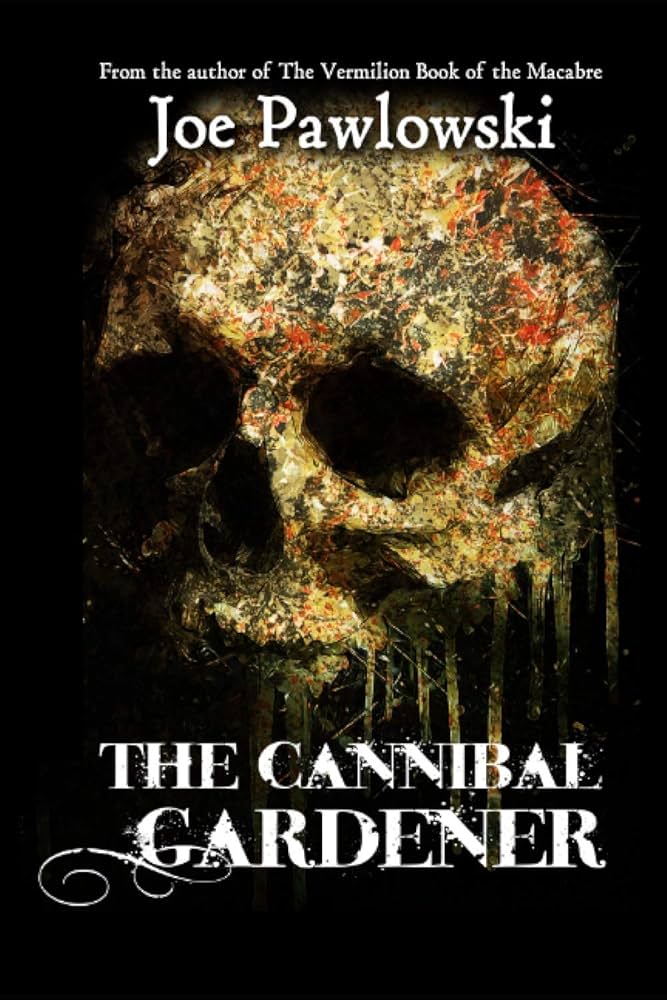
I am kicking myself for letting The Cannibal Gardener sit on my (ridiculously, 4-digit long) TBR List (To Be Read) for as long as I did. This novel delivered on all the horror and squeamish discomfort it promised. For readers who enjoy paranormal and historical elements, delight in having their own sense of security in the Righteous Ways of the World shaken, and well-delivered gore, this exploration into cannibalism and flesh-lust is a must-read.
That said, readers should be aware that gore here is not for the faint of heart. The subject matter, cannibalism, is already one which pings our most primal fears. The idea of consuming human flesh twigs an evolutionary nerve in our psyche the wrong way; we are social beings, needing the survival of others to secure our own. Even in a case of hyper-evolution of the competitive drive as individuals seek to enhance evolutionary fitness, human culture has developed an universal anathema to indulge in killing and eating a member of our own species. An odd quirk of humanity, as one character in the novel, Denise, notes.
This nauseating subject is also what makes this novel such a good horror read. And it is indeed, all about cannibalism. The novel is an entanglement of its characters’ diverse stories, each one eventually weaving together with another until all come together at the end. Their disparate lives are connected by this ugly, bloody practice in some way. Edmund, Denise, Milo, and George are the primary protagonists of the novel. Each of them engages in the profane act in some sense and this draws them into an ancient goddess’ cruel net.
Aside from the lurid story itself, Pawlowski’s fast-paced prose, adeptness at storytelling, and nuanced character development is an major appeal. The novel flows at a pace which fuels the urgency of events and, yet also linger on the characters’ voices and inner dialogue. The resultant surge and lull allows the reader to feel the thrill of a mystery and immerse themselves in the interior world of the characters. This is in part achieved by allotting each chapter to a different narrator.
The prose is mature, as is Pawlowski’s authorial voice. It is consistent, succinct, expressive. It is also clear Pawlowski’s journalistic experience enhances his craft. Not only have his observations of human behavior led him to create fleshy characters (forgive the pun!), his decisions of what to reveal and when reflect a deep understanding of his audience. I also much appreciated his vocabulary; the novel’s language borders on the intellectual. I mean this as a compliment. Its precision delivers a sharp image of events to the reader, leaving well-placed gaps that each one may organically fill in with their own imagination.
I look forward to Pawlowski’s other horror fiction…
The Skin and Its Girl is a creative feat, a unique novel even within its genre, literary fiction, a genre well known for its diversity and breadth. Perhaps for that reason, this is a novel for a selective reader, one who does not possess fixed expectations or a very firm hold on the physics of reality.
This is a book of metaphors. It is literary fluid.
The novel revolves around the existence of a girl who should not exist, a girl with blue skin. It is an epistolary novel, written by the girl to her aunt, a woman who has functioned as her mother, guardian, defender. The blue-skinned baby is born into a world, her personal individual world is marked by the disintegrating relationship of a man and woman, her father and mother. Much of the novel revolves around their sheltering of their child and the tensions produced by varying relatives’ opinions about the girl’s interaction with the world.
Being written from a child’s perspective, though in retrospect, the novel’s prose possesses a kind of surreal, dream-like quality. Conversations are sliced into snippets, images are partial and incomplete, events are smudged down to the primal feelings they invoked, much as things might be in memories. But — and this is where a mature, independent reader will find the novel intriguing — this incompleteness allows and challenges the reader to sift through these bits and pieces to find the connections that bind the protagonist to her aunt, to her mother, to the world at large “out there” that she is prevented from seeing.
I will leave it to the reader to see what becomes of this strange blue-skinned girl.
Overall, my review is a mixed one; its creativity is singular, but its delivery is difficult. Much of the story unfolds slowly and without a predetermined destination, yet, this mimics the life it documents — a life that is not meant to exist, has no purpose but to simply be and by being is an affront to others’ sense of being.
Contracted Together, a young adult romance novel, is a step (or two!) out of my usual range of reading; I encountered the novel via a Facebook group that runs regular reviews of independently published or self-published writing.
The novel revolves around a pair of ill-fated marriage partners. The term “lover” would be a stretch here, since Zavian and Mona’s union is premised on a legal arrangement, a contract lasting for a year, during which Mona agrees to play Zavian’s wife in public, with none of the private affection, sexual expectations, or even, friendship. This is a spin on the classic Hate to Love trope. Indeed, Zavian finds his bride — in his words — “annoying” even as he betrays a softness for those same characteristics. The pair’s relationship — strained though it already is — is beset by a strange set of circumstances: estranged parents, exes, their own proclivities towards workaholism or romanticism, expectations of the other. I will leave it to the reader to discover the end results and what happens to Zavian and Mona.
Out of a total possible 5 stars, my overall rating is ⭐️⭐️⭐️
My review of Contracted Together is mixed; on one hand, given Dhanota’s biography and stated intentions of the novel and their writing (as a whole), there is much I was left wanting. Yet, on the other hand, the novel has great promise and delivers on a number of other points.
The novel has been well-edited and is grammatically sound. Dhanota’s writing is technically very good, and the language and vocabulary chosen is suitable for its stated audience. The novel’s premise is also attractive. It opens with an immediate hook, framing Zavian’s life and relationship to his family in an unusual light; the premise of a contract marriage is also a successful lure.
The novel possesses a great deal of promise. However, the substance of the novel does not deliver. The novel’s detractions, in spite of the above positives, dulled the experience of reading it for me.
The novel, even as a Young Adult work of fiction, runs towards the superficial. Its main characters need deeper development. For example, Mona’s requirements of Zavian are shallow, and her motivations behind agreeing to a contract are unclear, leaving the reader incapable of understanding what Mona hopes to gain from this connection. Moreover, the absence of her own family and their opinions on her decision to agree to this contract is a noticeable gap in the story’s logic.
Some of this superficiality is conveyed to the reader through the characters’ dialogues, which lack individuality. Zavian’s narrative voice is too similar to Mona’s. Their conversations also, lacked depth, sounding more like teenagers’ casual conversation than that between two young adults (one being a CEO and the other a Kindergarten teacher). Zavian and Mona are petty in their arguments, their concerns betray a fundamental immaturity that readers may expect young adults to possess, or at least, be in the process of developing. The character’s narratives lacked interiority, and a sense of the character’s awareness of self. Ultimately, this surface-level characterization of Mona and Zavian failed to convey what was really happening in their hearts and minds, and dampened the romantic tension that would have made the hate-to-love trope here more successful.
Dhanota’s intent (as stated in their biography at the end of the novel) is to bring Indian culture to the fore, to examine and challenge Indian practices and societal norms; however, the novel itself does not provide context or direct allusions to those norms and societal expectations. The novel would have benefited from an inclusion of these ideas and Indian culture, not as a separate section, but woven into the fabric of the novel itself. Such descriptions would also have added more texture and individuality to the novel as a whole, as a uniquely Indian romance.
Readers who would like to read the novel for themselves, and draw their own conclusions, can find it on Amazon here where it is currently priced at $16.99 for the paperback and $4.55 for the Kindle ebook. It is also available via Kindle Unlimited.





 Dr JoAnn LoSavio