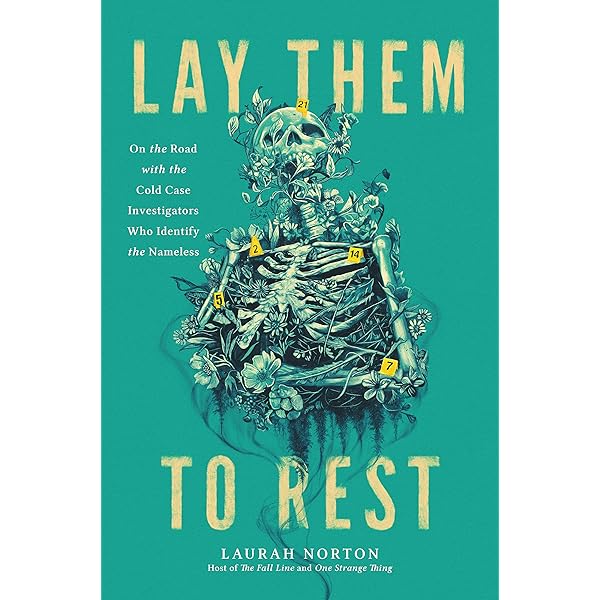
Lay Them to Rest: On the Road with the Cold Case Investigators Who Identify the Nameless by Laurah Norton

Lay Them to Rest: On the Road with the Cold Case Investigators Who Identify the Nameless by Laurah Norton

I thoroughly enjoy my true crime reads, gruesome and terrifying as they are. I especially enjoy the intricacies of police work and investigation, probably that’s a side of the analysis that I can both relate to and have no idea about. I love learning about the ways in which investigations of this nature are conducted, the nuances of analysis and the low and high technology that comes into play.

Lay Them to Rest delivered… and yet, also didn’t quite hit the high notes for me.

The bad part first. I didn’t enjoy the degree of personal involvement and commentary Norton provided. While it is common for writers to relay their personal trajectories and use it to form the narrative arc of their non-fiction books, I found the way in which Norton did this to be distracting. The injection of her personal thoughts felt like intrusive minutiae. This is, of course, a subjective opinion; other readers may very much enjoy Norton’s personal journey. For this reader, not only did this detract from the primary story of the victims and their cold cases, but Norton’s self-deprecating approach undermined her credibility and authority, coming off as fumbling. I believe the intention was to code Norton’s “character” as endearing, but its delivery did not persuade me of this view of her.

But now, the good. Norton’s partnership with a biological anthropologist produced an academic perspective which I greatly appreciated. It is clear a great deal of research had been conducted, both by Norton and Amy Michael, as well as the many others Norton shadowed, interviewed, and worked with. The book provides a great deal of information, and Norton’s delivery of that — along with the abundant necessary context — was accomplished with both straightforward utility and finesse. Norton’s prose was smooth, its language accessible while still necessarily full of the argot of the subject matter. Norton distills an enormously complex subject into easily digestible and palatable parts.

Lay Them to Rest is built through the cold cases of several victims, Jane Does, found dead and abandoned. Norton uses these cases to relay to the reader a nuanced view of the layered landscape of police work, forensic analysis, and dysfunctional systems of databases for DNA tracking used for investigating and solving crime. The focus here is not on the victims, or their families, or even on the police or investigators who strive to solve their crimes; Lay Them to Rest focuses on the structural elements of criminal investigation, the organizations and systems which organize and sift through the millions of bits of data and information that can be gathered about victims and the crimes against them. This angle into the world of criminal investigation was a novel one for me; most of the true crime I have read have not delved into this specific aspect of investigation. I found this perspective refreshing and intriguing.

Readers of true crime will find Lay Them to Rest a worthy addition to their libraries. Or, at the very least, well worth the time and effort of reading it.
The Cannibal Gardener: A Novel by Joe Pawlowski

The Cannibal Gardener: A Novel by Joe Pawlowski

I am kicking myself for letting The Cannibal Gardener sit on my (ridiculously, 4-digit long) TBR List (To Be Read) for as long as I did. This novel delivered on all the horror and squeamish discomfort it promised. For readers who enjoy paranormal and historical elements, delight in having their own sense of security in the Righteous Ways of the World shaken, and well-delivered gore, this exploration into cannibalism and flesh-lust is a must-read.

That said, readers should be aware that gore here is not for the faint of heart. The subject matter, cannibalism, is already one which pings our most primal fears. The idea of consuming human flesh twigs an evolutionary nerve in our psyche the wrong way; we are social beings, needing the survival of others to secure our own. Even in a case of hyper-evolution of the competitive drive as individuals seek to enhance evolutionary fitness, human culture has developed an universal anathema to indulge in killing and eating a member of our own species. An odd quirk of humanity, as one character in the novel, Denise, notes.

This nauseating subject is also what makes this novel such a good horror read. And it is indeed, all about cannibalism. The novel is an entanglement of its characters’ diverse stories, each one eventually weaving together with another until all come together at the end. Their disparate lives are connected by this ugly, bloody practice in some way. Edmund, Denise, Milo, and George are the primary protagonists of the novel. Each of them engages in the profane act in some sense and this draws them into an ancient goddess’ cruel net.

Aside from the lurid story itself, Pawlowski’s fast-paced prose, adeptness at storytelling, and nuanced character development is an major appeal. The novel flows at a pace which fuels the urgency of events and, yet also linger on the characters’ voices and inner dialogue. The resultant surge and lull allows the reader to feel the thrill of a mystery and immerse themselves in the interior world of the characters. This is in part achieved by allotting each chapter to a different narrator.

The prose is mature, as is Pawlowski’s authorial voice. It is consistent, succinct, expressive. It is also clear Pawlowski’s journalistic experience enhances his craft. Not only have his observations of human behavior led him to create fleshy characters (forgive the pun!), his decisions of what to reveal and when reflect a deep understanding of his audience. I also much appreciated his vocabulary; the novel’s language borders on the intellectual. I mean this as a compliment. Its precision delivers a sharp image of events to the reader, leaving well-placed gaps that each one may organically fill in with their own imagination.

I look forward to Pawlowski’s other horror fiction…

The Forever Witness: How Genetic Genealogy Solved A Cold Case Double Murder by Edward Hume

I am such a fan of true crime (not an amateur expert in it, but I enjoy it a lot!) and Humes’s The Forever Witness delivered in all the best ways. This book details the context and circumstances of a cold blooded double murder of a young man and woman in Washington state, near Seattle. They disappeared while on an overnight roadtrip, running an errand. Their murder was a cold case for decades until new technologies became more available.

What makes The Forever Witness so compelling though isn’t just the fact that Humes gives us an account of how such DNA identifying technologies worked or even how the case was eventually solved (though those are good enough reasons to pick it up!), no, what makes this book unputdownable is Humes deeper delving into the larger national and world wide considerations and context of using DNA, genealogical, and qualitative research together in combination to investigate such crimes. Humes provides the reader with a landscape of criminal methodologies, giving them a glimpse into a world often over-dramatized and glossed over with unspecific details in news media and hour-long television serials. As if often the case, when compared with film, the book is better. The Forever Witness is full of nuanced context and specific information, perfect for the true crime fanatic for whom details are everything.

Readers should be aware that this wide fish-eye lens of the book and its subject matter does mean that Humes veers on occasion away from the specific case. He draws upon similar cases, discusses parallel crimes and explores the use of genealogy in other, related cases. Humes also provides the reader with a view from the other side; included here are not only the investigators, the family of the victims, but also the perspectives of genealogists and other criminologists not directly involved in these cases. The varied perspectives adds to the book’s appeal, giving the reader a deep understanding of the crime-solving process, with all its obstacles and victories.

Humes’ prose is also deeply compelling: dramatic and yet not overblown, succinct and yet brimming with knowledge, informative without overbearing being pedantic, flowing and smooth throughout. It is clear Humes has a vast and thorough grasp of his subject matter, but he does an exceptional job at breaking this down for the average reader. Terminology is explained, procedures and protocols are laid out step by step and their logics revealed.

In short, a fantastic read and one for every fan of true crime.

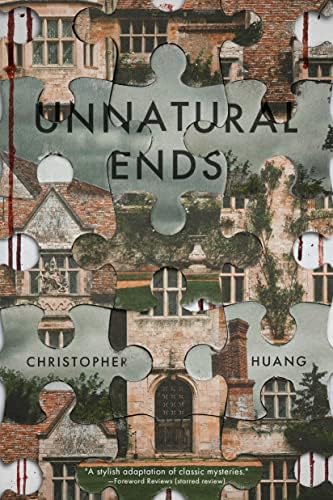
Unnatural Ends: A Novel by Christopher Huang

Unnatural Ends: A Novel
by Christopher Huang

Unnatural Ends reads like a French six-course dinner prepared and delivered by the latest cohort of Top Chef, served in the very classy digs of Downton Abbey, while you and your guests find yourself flung into a live-action Gosford Park; in short, this novel is the quintessential English manor-murder-mystery, updated for the 2022 reader. There is a hint of Mavis Hay’s (1936) Santa Klaus Murder here, a bit of Agatha Christie, and a good strong nod to the immorality of the British Empire (though, nothing quite so dark as Kazuo Ishiguro’s Remains of the Day). This novel is unbelievably English.

I loved it.

It did take me a few chapters to fully dig into the thrill of the case, but the family was so immediately deranged and dysfunctional, I couldn’t look away any more than if I encountered a train accident and found it to be the wreckage of the Orient Express.

The story begins with the death of the patriarch — his ghastly murder — and the strange clause in his will that disproportionately favors any of his adopted children who solves the crime. The novel unfolds from that point on in a predictable fashion for any mystery, but the ending and the twists of blood, family, and the loyalties of genetics kept this reader on her toes. Just when this reader thought she’d solved it, something emerged which threw her off! Between the three siblings, the pathetic mother and widow, the overbearing and sadistic father, and the eye-rolling police, Unnatural Ends delivers a very witty enjoyable read from start to finish.

For the reader who enjoys more than mystery, the novel also possesses several threads of underlying social and historical commentary. Britain’s dark imperial history, rife with its undeniable racism and eugenic standards of morality, are key foundational elements of the plot. Indeed, the cruel history of eugenics and colonialism are integral to the constituency of its characters and the motivations behind the twists and ruts of this mystery. On that note, however, the novel is not pedantic or a history lesson: it is wholly a mystery novel.

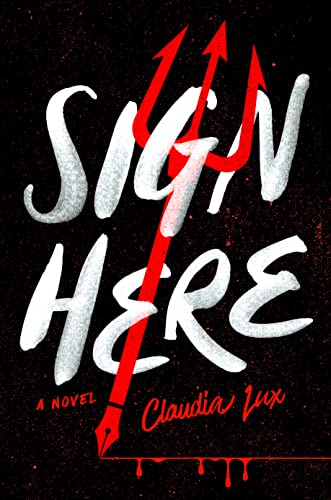
Sign Here: A Novel by Claudia Lux

Sign Here: A Novel by Claudia Lux

A departure from the more serious novels I’ve been reading lately, and perfect — if a little late — for the Spooky season. Still, if you are a horror fan, any time is a good time for a paranormal mystery, which is exactly what Sign Here is, with a generous injection of humor.

Sign Here is a combination of the television show, “The Good Place” and one of Simone St. James’s paranormal mysteries, the kind which unravels to reveal a multi-generational history. It’s laugh-out-loud funny and also deadly serious at the same time. I couldn’t have asked for a better post-Halloween read than this. It gripped me to very end.

The novel is set in two dimensions: Hell and Earth. The former is a bureaucrat’s heaven, a place where the radio station is constantly on commercial break and the music is every genre you can’t abide. There’s fun to be had in Hell, but no peace, utterly no reprieve from annoyance. Ever. One of the main protagonists of the novel is a demon who long lost his humanity and now deceives or manipulates souls in order to collect them for his hellish quota. His goal is to complete a “full set” of a family, one soul from each generation. And to find some measure of peace in the afterlife. The two objectives are not exclusive.

The family he has targeted is a wealthy and dysfunctional one, a collection of questionable traits has passed down from one generation to the next. They have a long history with this demon, a transactional history of quid pro quo. There is also trauma, murder, abuse, and just downright immorality in the family’s past; one might say, the stuff that Hell is made of. But they are lovable too. Their flawed histories and personalities make them all the more human, all the more recognizable, for all their privilege and wealth. The reader will get the impression there is something not quite right about them though, and as the novel progresses, it becomes clear that several of them have something to hide — even from the demon himself.

The novel is set at the start of the annual family vacation, a dreaded and welcome event. There’s a newcomer to the lake house with them: the new best friend of the daughter. She’s bright and curious — and may just force the family’s dark secrets into the light.

The two storylines intertwine: Will our demon be able to exploit the family to meet his quota? Will he ever escape his Hell? Will the family be able to keep their horrors safely hidden in the past? Someone’s soul is at stake. Will it be the father? The mother? One of the kids?

Sign Here ends explosively and satisfyingly. Everyone gets what they deserve.

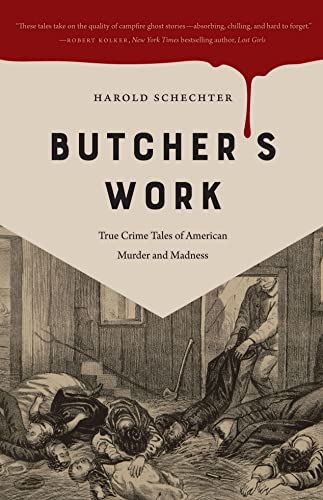
Butcher’s Work: True Crime Tales of American Murder and Madness by Harold Schechter

Butcher’s Work: True Crime Tales of American Murder and Madness by Harold Schechter

The premise of Schechter’s Butcher’s Work is intriguing enough to entice any fan of true crime to pick it up: Serial killers and murder are nothing new, why have we forgotten some crimes and remembered others? And, more curiously, what are those cases which we have forgotten? The easy answer is that they weren’t horrendous enough, disgusting enough, criminal enough to earn a place in our long, collective memory. But the cases in Butcher’s Work dismisses that possibility quickly; the crimes highlighted in this work are all that and more chilling. The fact that they have disappeared from our remembrance is itself quite a horrific notion.

Butcher’s Work is divided into four sections: Butcher’s Work, The Poison Fiend, Lady-Killer, and The Ragged Stranger. As their titles suggest, each one focuses on a particular method or victim of murder. There is a featured case of each, but interspersed within the pages of the chapters are cameos of other criminals employing the same method. Collectively they form a creepy landscape of crime, where trusting another human being is something to fear. Lady-Killer was one of my favorite sections. Marriage and murder form the central focus here, a gendered violence perpetrated by men against women. I won’t spoil it for anyone, but DANG, how did these men get away with this? Oh, right, but still!

Schechter is a marvelous story-teller. The prose flows, as compellingly as the stories and characters. And, as a researcher myself, I deeply appreciate the depth and details Schechter has excavated in this work. The result is not only a focused, historically rich, and keen archival piece of work; Butcher’s Work is also a nuanced landscape of American life in the 19th century. Schechter brings to the reader’s attention how it is not only the ambition of the criminal, but also the systems and structures of society that permit and foster these crimes. How else might a man such as Hoch in Lady Killer commit bigamy and murder so successfully and remain for so long undetected? What gave him the confidence to believe in his own acquittal? Of course, the criminals here were apprehended, so there is a more optimistic ending. We can rest knowing the authorities — police, witnesses, lawyers, courts, etc — did succeed in forcing them to confront their crimes. But, I could not help but wonder how many others got away with it altogether? The idea is spine-chilling.

Butcher’s Work is a fantastic read for any fan of true crime and 19th century American history.

The Ghosts That Haunt Me: Memories of a Homicide Detective by Steve Ryan

The Ghosts That Haunt Me: Memories of a Homicide Detective
by Steve Ryan

These memories have haunted Steve Ryan, and now they haunt me too. Ryan warns the reader that the contents of this book will be dark, warns us to close it and move on if we value our peace of mind. He’s right. This book will cleave to my bones like scars from bites. The murderers in Ryan’s cases are depraved animals, creatures looking like humans but lacking humanity. The crimes recounted to us are sweat-inducing-chills-on-the-soles-of-my-feet terrifying. The thing is, they were committed for such trivial, banal, forgivable reasons, sometimes for no reason at all except for the purpose of inflicting pain.

Ryan weaves into his account the effect of these crimes on his psyche, giving us — those who have not worked in policing work or its related domains — insight into the damage being witness can cause. We don’t just see the effect on Ryan, but on the entire community of those who do this work. It becomes quickly clear that this work is as emotional and psychological as it is mired in materiality: these people study the severing of a life from its body, but in this memoir we see how deeply entwined the soul is to the the gory material left behind. In a sense, the homicide detective is required to lend the dead their own soul, a poor but necessary substitute in the effort to ameliorate the injustice of the victim’s murder.

The reader will weep for Ryan and for all homicide detectives as much as they weep for the victims and their families. And, let us also not forget, the families of the murderers — in some cases, the extended family of the murdered and the murderer are one and the same, a double slice, the cut twice as deep.

Ryan takes us through six of his most memorable, most awful cases, the ones which made him value his humanity. They are baffling in different ways: How could this have happened? In some cases the murder was sudden, a crime of impulse and opportunity. In others, it was planned with meticulous attention to detail. Some murders were the inevitable outcomes of years of abuse, the eventual killing a culmination of many crimes perpetrated. The scars were not always only the fatal ones.

These cases occurred in Canada, Ryan being a detective in Toronto and serving the GTA (Greater Toronto Area), but these will be familiar to any urban resident. The cases here involved immigrants, travelers, transnational cultures and expectations, mothers, wives, husbands, lovers, children, fathers, brothers. There is the odd stranger as well, a crime committed via a random encounter by someone the victim does not know — to be fair, the discovery of a murderer in the family can invoke a feeling of utter strangeness and dissonance, it is so unfathomable that someone we hold close and love could be capable of these kinds of crimes — but Ryan proves to us that intimacy is not a prerequisite for really knowing the interior mind of anyone. We can never really know the person we sleep next to at night. That’s the horror here. Trust is malleable in the mind and hands of murderers.

I’m glad to have read this book, chilling as its contents are. I sleep worse for it. But I a little less so because of people like Steve Ryan. I am grateful people willing and able to sacrifice a little of their soul to deliver justice to victims of crimes like these.