
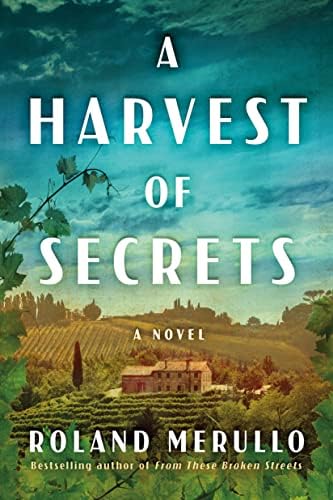
A Harvest of Secrets: A Novel by Roland Merullo

A Harvest of Secrets: A Novel
by Roland Merullo

A Harvest of Secrets is a slow burner, then halfway it ignites like gunpowder and the end is an emotional and deeply satisfying explosion, uniting all the storylines of the novel together in a kind of literary bonfire.

The novel is set in WWII, fascist Italy when much of the country has fallen under the control of the Nazi regime. The story unfolds primarily in a rural northern village where an old, aristocratic family grows grapes and produces wine. The San Antonio family and their estate have been lords over the land and the people for generations. There are tensions between the family who own the winery and its workers, age old class-based tensions that threaten to erupt under the additional strain of wartime food shortages and unpredictable Nazi raids. The war has also brought about new factions and exacerbated pre-existing enmities: resistance fighters and saboteurs against Hitler’s Nazis and Mussolini’s Blackshirts, deserters from the Italian and German armies, Il Duce’s spies, and Nazi collaborators. Caught in the cross hairs between these conflicting factions are two young lovers: Vittoria, the daughter of the proud noble family and Carlo, the orphaned peasant boy she grew up playing with. There are also others who find themselves trapped on one side or the other of the war: Old Paolo, the foreman at the winery, Umberto San Antonio, the noble man who owns the land, Enrico San Antonio, his son and Vittoria’s brother, Eleonora, the Jewish woman in their midst. They each have their obligations to family, country, and to those who have sheltered, raised, and loved them. These obligations tear the lovers and their community apart — and bring everyone together in other ways.

Merullo’s novel is not only about the lovers; it also about the many individuals whose lives intertwine with theirs. Indeed, the novel is more of a broad panoramic view of Italian society in this fraught period of the twentieth century. Some of the people Carlo meets are sympathetic to Mussolini, others seek freedom from the politics that engulfs them all, others are victims of Il Duce’s ill-conceived plans and ambitions. Vittoria is likewise surrounded by those who would do her harm and protect her from it. There are resistance fighters, Nazi soldiers and officers, Nazi collaborators, and Mussolini’s spies lurking and active all over the countryside, waiting to strike or entrap her and other innocent Italians who simply want to do what is right for themselves and their families, and by their conscience. As a woman of this period, Vittoria’s options are limited. Italian patriarchy places shackles on her that are made for women alone. She is meant to be a good daughter, a good woman, a quiet woman — but in the chaos of the war Vittoria cannot remain silent.

Woven into this larger cultural, social, and political vista of Italian wartime life is a domestic drama and mystery. Vittoria’s dilemma is at the center of this. She must bargain her silence for her freedom, sacrifice her morals to be a good daughter. But she is also a product of a longer history of women like herself.

Secrets held for decades, the kind begotten by forbidden love, are as much a part of the estate and the fabric of life in the vineyards as the vines themselves. These unraveling mysteries push and pull Vittoria, Paolo, Umberto, and Carlo in all directions. The emotional and real famine of war force these long buried secrets to emerge on the surface. As the Americans and Allies bomb Italy in order to free it, Vittoria, Carlo, Paolo, Umberto San Antonio, and others scramble for safety and try, hard as they can, to keep these secrets under cover.

Overall, a good read, especially for readers who enjoy themes of class conflict, gender histories, and ensemble casts of characters, and domestic mysteries.
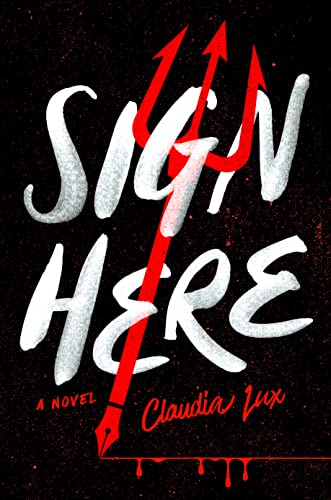
Sign Here: A Novel by Claudia Lux

Sign Here: A Novel by Claudia Lux

A departure from the more serious novels I’ve been reading lately, and perfect — if a little late — for the Spooky season. Still, if you are a horror fan, any time is a good time for a paranormal mystery, which is exactly what Sign Here is, with a generous injection of humor.

Sign Here is a combination of the television show, “The Good Place” and one of Simone St. James’s paranormal mysteries, the kind which unravels to reveal a multi-generational history. It’s laugh-out-loud funny and also deadly serious at the same time. I couldn’t have asked for a better post-Halloween read than this. It gripped me to very end.

The novel is set in two dimensions: Hell and Earth. The former is a bureaucrat’s heaven, a place where the radio station is constantly on commercial break and the music is every genre you can’t abide. There’s fun to be had in Hell, but no peace, utterly no reprieve from annoyance. Ever. One of the main protagonists of the novel is a demon who long lost his humanity and now deceives or manipulates souls in order to collect them for his hellish quota. His goal is to complete a “full set” of a family, one soul from each generation. And to find some measure of peace in the afterlife. The two objectives are not exclusive.

The family he has targeted is a wealthy and dysfunctional one, a collection of questionable traits has passed down from one generation to the next. They have a long history with this demon, a transactional history of quid pro quo. There is also trauma, murder, abuse, and just downright immorality in the family’s past; one might say, the stuff that Hell is made of. But they are lovable too. Their flawed histories and personalities make them all the more human, all the more recognizable, for all their privilege and wealth. The reader will get the impression there is something not quite right about them though, and as the novel progresses, it becomes clear that several of them have something to hide — even from the demon himself.

The novel is set at the start of the annual family vacation, a dreaded and welcome event. There’s a newcomer to the lake house with them: the new best friend of the daughter. She’s bright and curious — and may just force the family’s dark secrets into the light.

The two storylines intertwine: Will our demon be able to exploit the family to meet his quota? Will he ever escape his Hell? Will the family be able to keep their horrors safely hidden in the past? Someone’s soul is at stake. Will it be the father? The mother? One of the kids?

Sign Here ends explosively and satisfyingly. Everyone gets what they deserve.

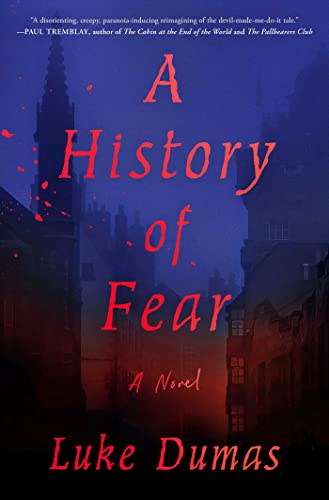
A History of Fear: A Novel by Luke Dumas

A History of Fear: A Novel
by Luke Dumas

By page three, I was hooked. The ending comes to a perfect, organic conclusion — but I readily admit that if Dumas writes a sequel, I’m all in.

A History of Fear unfolds like Stoker’s Dracula, adopting an epistolary approach, delivering the story via journal entries, letters, official reports from doctors, prison officials, and newspaper articles. The novel dives deep into the most disturbing parts of human psychosis reminiscent of Dostoevsky’s Crime and Punishment. It delivers gothic horror too, in the manner of Shelley’s Frankenstein. In the end, the reader can’t be entirely sure of who is the monster, if demons are real, if evil is more human than we comfortable with. A History of Fear is a horror fan’s feast: gore and psychological terror stride side-by-side, the paranormal and the divine and the mundane intertwine to create a world the reader is never entirely sure is real. Illusion may very well be reality… or worse.

But the story is not fantasy; there is a real history embedded in this novel — and a commentary on a history of monstrous bodies, sexuality, religion, and intergenerational trauma. There is a reality underlying the one Dumas weaves for us. This is what makes the novel so appealing; there is a real horror here, one that we can recognize. This history is one that might be so common as to be truly terrifying because it might actually exist within ourselves. Or someone we know.

A History of Fear follows the main character’s slow descent into madness — or his ascent into clarity, depending on your interpretation. There is a true mystery here and this drives the story forward. The reader needs to discover what the main character also seeks: some sense of closure and parental acceptance. The main character is driven by a need to know themselves and their past. This is a genealogy of a family and the homophobic culture of the West. Dumas focuses on the psychological damage inflicted on those who deviated from the dominant norm and those who dared to question their place in it. The novel travels between the past and the present, each part of the jigsaw puzzle adds to the image of the whole of time, allowing the reader to witness the unraveling of the man’s mind and the suffering caused by intergenerational trauma.

The novel opens with the main character’s eventual, inevitable fate; this is the mystery. We know what happens to him. The mystery is why and how. The horror is the long arm of intergenerational trauma.

A wonderful book to have read in October, the Halloween month, but really, a fantastic gothic horror for any time of the year.

1794: The City Between the Bridges (A Novel) by Niklas Natt Och Dag

1794: The City Between the Bridges (A Novel) by Niklas Natt Och Dag

1794 is a deliciously dark journey through the underbelly of 18th century Stockholm. It’s the second novel in Natt och Dag’s Cardell series; but, the novel stands on its own. I didn’t read 1793: The Wolf and the Watchman where the characters, Jean Mickel Cardell and Anna Stina Knapp first appear, but that did not preclude my enjoyment of 1794.

The novel begins with Eric Three Roses, the second and less-loved son of a minor nobleman. Eric’s journey to Sweden’s only tropical colony, Saint Barthélemy and the mysterious, scuzzy individuals he meets there are the mystery that seeds the rest of the novel. What happens to Eric is tragic. Cardell is called upon to discover the crime and the criminal — and bring them to justice. He seeks out Cecil Winge, encounters Anna Knapp again, and slithers through the shadowy and crime-infested underworld of Stockholm, sorting through those who are struggling to survive and those who prey on others to survive.

This is a crime novel, one which reveals a seedy and complex weaving of lives, fortunes, and terrible fates that not only delivers the tension of a mystery but also, and perhaps more appealing to me personally, the texture of 18th century European urban society. Classes collide, fates are intertwined, and motives are never simple. Relationships function on transaction, but the currency people must pay can run the range from gold to love, from silver to power. Murderers murder for the sake of a love of violence. Fathers overlook the transgressions of their daughters for the sake of a peaceful existence. Brothers blind themselves to the follies of their siblings. Sanity and madness are two sides of the same coin.

1794 is not a story with happy endings, neat narratives wrapped up by the end; this is a reflection of life under a harsh light. The mystery lies in how we survive it.