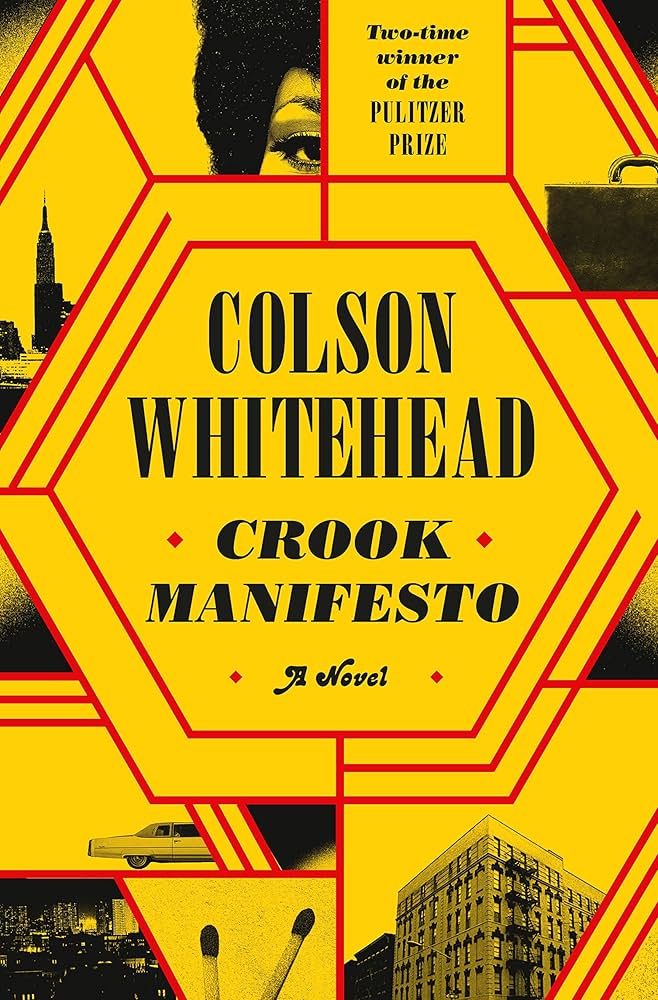
Harlem Shuffle & Crook Manifesto: Novels by Colson Whitehead

Having read Harlem Shuffle and Crook Manifesto, I cannot wait for the third novel in this series. Whitehead has me hooked on Ray Carney and Pepper, men you hate and yet can’t help but respect and care about. These novels had me reading through the night, damn whatever work I had the next day!

Harlem Shuffle is the first of the series, set in the late 1950s and early 1960s. It introduces the reader to the primary protagonist, Ray Carney, a black man who grew up and lives in Harlem, NYC. Carney is a successful business owner selling furniture, both new and gently used. His product is both legitimately sourced and… well, less so. The novel revolves around his world and the choices he has to make as a black man living in a white world, in a community where the lines between the licit and illicit are and have always been fluid. His wife, Elizabeth, for example, works in a travel agency who designs agendas for black folks in need of safe passage through white territory governed by Jim Crow legislation and prejudice. This is an era in which lynchings are common. A world before the American Civil Rights movements began.

The novel revolves around Carney and his immediate circle of friends, employees, and family, including his shiftless cousin, Freddie and his overbearing, “politics of respectability” in-laws. Split into three parts, each segment taking place three years apart, the novel is a collection of events that define Carney’s legitimate and less-legitimate career. Each segment revolves around a specific heist or… shall we say, project Carney gets involved in, willingly or otherwise.

Crook Manifesto follows the same format, except that it picks up where Harlem Shuffle leaves off but three years later in 1971. It is a new era in Harlem now. New York City is a different world than what it had been, but little has changed in Harlem. It is still a white man’s world, still a world in which the boundaries between the legal and illegal are fuzzy. Carney finds himself still doing the Harlem shuffle. Carney’s “projects” are criminal and noble, focused on vengeance and utterly righteous. He is a man of many talents and flaws, the kind of man everyone knows because that’s who we are: good and bad and everything in between.

The main attraction of the novel and the series as a whole is not the characters and their stories, or even the world of Harlem in the mid-20th century — though any one of these draws is enough for me — but Whitehead’s delicious prose and witty turn of phrase. Whitehead can evoke an image with just a handful of words, delivered with the kind of finesse only a slick Harlem player possesses; the prose is as smooth as the cons and crimes carried off in the novels. Whitehead’s words pack a punch, sharp and powerful like the ones Pepper throws. The words flow like music, like funk, and you, Reader, you will find yourself dancing to Whitehead’s beat long into the night.

The characters, and Whitehead’s smart crafting of their stories, does warrant mention. Carney, Pepper, Freddie, Marie, Munson, Zippo, Elizabeth, and Big Mike are each their own literary masterpieces. These are real people, visible and tangible. There is an enormous cast, but as the novels build, the reader will find that they make up the urban village that is Harlem, this closed and vulnerable world, an enclave of blackness in white New York. In Harlem Shuffle we fall in love with these characters, understand them and their desires. In Crook Manifesto Whitehead reprises them and we get a deeper view into their vulnerabilities, their powers, their strengths.

Whitehead’s attention to history and the culture of the past is also commendable. Events of the past are woven into the fabric of the story, as it was in reality, a necessary foundation for the way things end up shaking out. No world, even Black Harlem, exists in a vacuum; the events of New York politics as much as Civil Rights events happening in other parts of the country reverberate in Harlem, in the Carney’s living room, in Carney’s furniture showroom.

I. Cannot. Wait. For the next installment in this series.
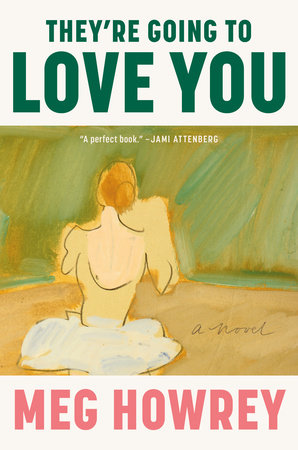
They’re Going to Love You: A Novel by Meg Howrey

They’re Going to Love You: A Novel by Meg Howrey

This one is a quiet burn, the kind of novel that leads to a swell of deep and intense emotion at the end. You’re left, Reader, with a sense of loss at the end, a feeling that you’ve experienced something very intimate, that maybe you shouldn’t have, but you had to — and you did — and now you’re left to think about the memory of the novel. They’re Going to Love You sticks in your mind like taffy to the roof of your mouth, a lingering taste of sweet and salty. Maybe a little sour.

They’re Going to Love You is a story about parenting, being a child, being a child to parents who are human and flawed. It is also a story about the fragility of relationships and the unpredictable strength of them. It’s a story about the trials of family, the values that are assumed in a family unit, assumed because of blood and marriage and birth. It is also a story of betrayal and grief, of not having what we assume we should have or of losing what we felt we should never have been able to lose.

The novel revolves around and is narrated through the eyes of a young girl who becomes a young woman and then a middle aged woman. She is a dancer and the daughter of dancers, ballet dancers in the heady and chaotic New York city scene of the mid-twentieth century. The father is a gay man, openly so, and there is a step-father. Then there is her mother, a former ballerina. The parents expect a lot from the girl. This is a story about expectations and hopes and dreams that are ours and also, not our own.

As the girl grows up there are things she learns about her privileged life and the expectations of her privileged life and the ways in which people look at her from outside her life. She learns about love from her parents and from their divorce and from their forced interactions on her account. She learns about love from her father’s gay friends. She learns about betrayal from her parents and what it means to forgive.

The novel is also about death and the finiteness of this life and of love. It is about realities underlying the fantasy of a ballet-infused, performed life.

Howrey’s prose is stark and cutting. It is dark and yet also childish, implying childhood is in fact a darker space and time than we are often led to believe. The characters are children and adults and you are not sure who is the adult and who is the child sometimes. The dialogue is authentic, sometimes painfully so, too reminiscent of our own familial traumas.

There is an element of this book that prickled me, for as much as I praise it: the characters are insufferably privileged. They are white, wealthy, part of the exclusive milieu of pretentious NYC. The main character is a nepo baby, whether she thinks so or not. So is her father. Intergenerational privilege abounds in this novel. This is a world that exists for a fraction of a fraction of a fraction of the world’s population. It’s not my world, for sure.

But, that is what novels are for (in part): entries into worlds unknown.

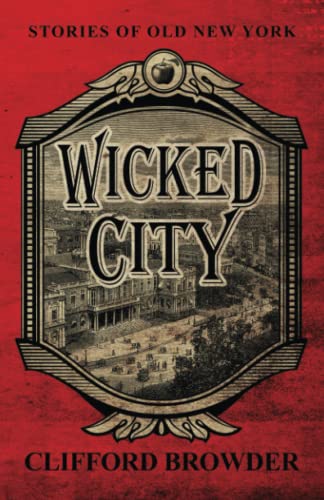
Wicked City: Stories of Old New York by Clifford Browder

Wicked City: Stories of Old New York by Clifford Browder

Oooo! What a slick collection of grimy, gruesome peeks under the golden veneer of the Gilded Age! The prose and tales in Wicked City are as smooth as the criminal characters in its pages, which is to say, if you, Reader, are a fan of urban grit and historical fiction, then this is the collection of stories for you. Wicked City reads like a literary revision of The Gangs of New York, but instead of Daniel Day Lewis, the lead is a very chic Edith Wharton — if Edith had a side hustle as a brothel Madam and if the brothel was run out of the Waldorf Hotel.

Make of that what you will. (I love Edith Wharton’s refined snark and the grubbiness of Gangs of New York.)

The stories in Wicked City are historical, but some things have been updated since the actual Gilded Age. Many of the tales are infused with modern sensibilities, that is, there are more enlightened notions around race, racism, class, and gender in these pages than perhaps there were in history. For example, Browder includes tales from Chinatown and addresses interracial marriage. Jingoism and nativism abound and are present, but Browder does justice to history by highlighting the non-White version of events in his fictions.

Many of the stories interweave, though some of the connections are subtle; there is a sense of dispersed, urban community woven throughout the collection. True to Browder’s work, this is an homage to New York and its history.