Control: The Dark History and Troubling Present of Eugenics by Adam Rutherford
I read Control: The Dark History and Troubling Present of Eugenics last year when I was in search of a text that would A. layout a basic and linguistically accessible history of eugenics suitable for a first- and second-year undergraduate audience and B. be cheap enough to assign as a required text. Rutherford’s Control fit my requirements across the board (but, I opted not to assign it as a required purchase).
Control is a very well-written popular press style non-fiction; Rutherford superbly breaks down what might be confusing historical and academic jargon into easy language and approaches this complicated subject with an eye towards a neophyte reader, a reader who has an interest but not preexisting knowledge of eugenics at all. The book therefore unfolds in chronological order, permitting the reader to develop and understanding of the historical and popular narrative of eugenics as it was understood in various moments of time.
The beginning of the book outlines the birth and rise of eugenics as a popular real and pseudo- science, starting with Francis Galton, and ending with the present, the tinkering of Dolly the sheep’s DNA and duplication as well as other unethical uses of reproductive science. As a historian I found the first half of the book very useful; it was this half which enticed me to use it in my history courses.
The second half of the book diverges into more contemporary concerns and reads as distinctly editorial; there is no hiding Rutherford’s intentions here — nor should there be. I wholehearted agree with Rutherford’s concerns about the future uses of eugenics and what this means for human rights and humanity as a whole. But Rutherford was preaching to the choir here; leaving me well aware that I am not the target audience for this work. Nevertheless, I would encourage everyone to read Control since it doesn’t harm anyone to revisit the horrors of eugenics.
Overall, a very readable and thought-provoking book. References are sparse (for a work of scholarship), but fully adequate for a popular press non-fiction and useful for the interested reader to delve deeper into the topic.
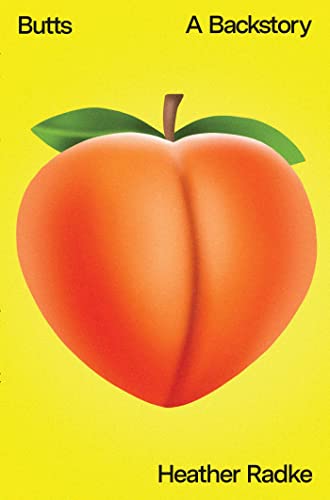
This was an incredibly fun non-fiction to read, the perfect book to carry around in your bag. It’s a conversation starter, a laugh-out-loud-on-the-train commute/waiting room/airplane/sit-by-the-pool-and-watch-butts-walk-by kind of read. I thoroughly enjoyed it on multiple levels.
First, on content: Radke’s research is well done. This is not an academic, peer reviewed piece of scholarship, but it is a well-researched, chronological and multi-disciplinary perspective on that part of our body we might often despise/regret/wish hidden/love/extoll/exhibit. Butts begins with an evolutionary explanation, a physiological treatise in what, why, and how we have butts at all and what they do for us. It then moves on into history proper, working to the present, and ending with a significant number of chapters focused on butts in the contemporary moment (Kim Kardashian and others) and in popular Western culture. [Radke is up front with the Western-centric focus of her study; this is a commentary on butts as understood in Western culture and history and is not a global study.]
Second, prose: Radke’s delivery is on point for a non-academic, general audience non-fiction. The prose is smooth, hilarious in so many parts, and remains lighthearted throughout, even when the content gets heavy and educational.
Whatever you feelings and thoughts about butts, backsides, or bottoms, Butts is a great read.
Unquiet Spirits: Essays by Asian Women in Horror Edited by Angela Yuriko Smith & Lee Murray
I honestly wasn’t sure what to expect from this collection: Modern horror? Literary criticism? Traditional tales of terror? It intrigued me regardless.
What Unquiet Spirits delivers is a combination of all of the above. It is memoir, criticism, history, and ethnography in balanced fusion. Each chapter is written by an Asian female author and in it she discusses both her own writing, the cultural and historical inspiration for her characters, the origins of some feminine demon, ghost, or creepy — a unquiet spirit — which haunts her and the pages she has produced. In some chapters the author draws on a deeper well of literature of the past and ponders the future of the female spirit archetype that is the focus of their chapter.
The books is divided by and devotes its pages equally to feminine spirits across the Asian continent, from East to Southeast to South Asia. I was pleasantly surprised to see such attention given to Southeast Asian spirits and archetypes (my favorite was always the pontianak, the evil spirit of a woman who lurks in the dark under the protection of a banana tree. In my recollection, she can be “pinned” to the tree with a needle or a pin and made to do the pin-holder’s bidding. But, beware to that horrid individual if the offending metal is ever removed!)
While the collection examines different demons and feminine archetypes from across a swath of very diverse cultures, it ultimately makes a singular, united appeal to the reader. Their call to action is unmistakable: Asian women, as a whole, alive or dead, demonic or angelic, monstrous or victimized, are powerful beings. Asian women have been too long overlooked in the literary world and deserve more than the whispered, submissive voice they have been too long assigned by Orientalists; hear them shout, scream, screech!
For that reason alone, Unquiet Spirits is worth reading. But there is more.
The authors reveal facets of the Asian feminine that have rarely been visible, that is to Western audiences. To Asian women, we have always known they were there, even when our patriarchal societies told us to ignore them, to castigate them, to revile these demonic women as ill-influences on ourselves and our communities, yet still, Unquiet Spirits is sure to deliver novelties and new knowledge to Asian/Asian American readers.
The World’s Greatest Sea Mysteries (Non Fiction) by Mollie and Michael Hardwick
This title lit up the 8-year old in me when I saw it. I remember loving those DK trivia books and collections of mysterious events. I am still a sucker for a book on sasquatches or sea monsters. The Hardwick’s collection did not disappoint. Each chapter recounts the tale and history of a vessel lost at sea, a spate of sea monster attacks, ghostly ships, and the like. The chapters are short, succinct, and leave the reader wanting to know more — and isn’t that the purpose of a mystery?
The prose is a bit dated — the Hardwicks wrote the original back in the 1967 — but there is nothing wrong with this. Indeed, that kind of syntax adds a little historicity to the collection. There is something familiar about it and nostalgic in a way. But maybe that’s just me remembering my childhood and the long, lovely hours I spent reading books like these that let my imagination fly wild.
The Nurse: Inside Denmark’s Most Sensational Criminal Trial by Kristian Corfixen
Reading nonfiction true crime is one of my favorite guilty pleasures. I enjoy it with a professional historian’s interest: the analysis of evidence and its presentation in text, the exploration of the social and cultural impact on the communities in which these events occur, and the dissection of the institutions and the systems that enable or hide the crimes and the criminals. Corfixen’s The Nurse, about a young woman’s murder of four of her patients in Denmark and her conviction for these crimes, delivers on all three points. It is a well-researched book on the crime, the criminal, and the Danish healthcare, law enforcement, and judicial systems.
Corfixen interviewed the nurse herself, Christina Aistrup Hansen, her colleagues, detectives, victims’ families and friends, as well as one of the survivors. It presents a fleshed out, rounded account of the events. [If you’re interested in news of the case, you can read more here.]
The Nurse: Inside Denmark’s Most Sensational Criminal Trial begins well before the case and the trial itself. This first section of the book provides the reader with the necessary background knowledge to understand Hansen as well the hospital system in which she committed her crimes. (The book is published in English, presumably for Danish and non-Danish readers.) This part is told through the experiences of Hansen’s colleagues, one in particular. In subsequent sections, Corfixen takes us back in time to Hansen’s childhood and into her personal life, then into her professional life, through the period of her nursing education, and finally into the microcosmic society of the hospital. The reader is immersed in the community and culture of nurses and medical staff at the Nykøbing Falster Hospital. The book continues on to detail the crimes themselves and the investigation that was initiated against Hansen. The Nurse ends with the trial and Hansen’s incarceration. These parts of the book are especially intriguing as Corfixen is given rare access to Hansen herself. The reader is treated to a perspective often absent in true crime accounts.
Corfixen’s prose and the way in which they exhibit these diverse perspectives is a critical part of the book’s success. The writing is smooth, but more significantly, it is seamless as it moves from one point of view to another. The reader gets a privileged view of the events from Hansen as well as from her former colleagues, from the family members of her victims. These are often conflicting — Hansen maintains her innocence throughout — but Corfixen manages to give each perspective time, space, and voice in a balanced way.
The result is an engrossing read that captures the reader’s attention and offers them a textured sense of the macro Danish world and the micro-culture of the Nykøbing Falster Hospital in which Hansen lived, worked, and committed her crimes. From the book’s beginning to its end, despite knowing the final outcome, I was compelled to keep reading, not to know what happens, but how it happened and why.
Bravehearted: The Dramatic Story of Women of the American West by Katie Hickman
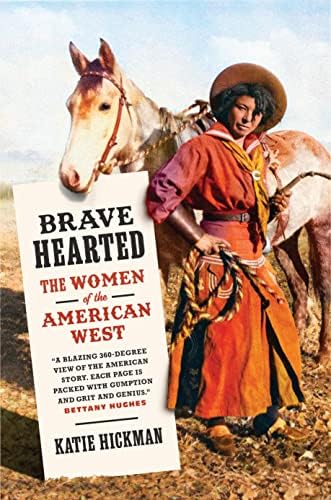
“Gripping,” “Exhilarating!”, “Captivating!” These are descriptors I often flutter my eyes at, chalking these up to marketing histrionics that serve solely to assuage publisher’s fears about book sales and authors’ egos. But in Hickman’s case, I was hard pressed to find more authentic adjectives for Bravehearted: The Dramatic Story of Women of the American West.
I was expecting no less, to be honest. I’ve read Hickman’s work before (Courtesans: Money, Sex and Fame in the Nineteenth Century (2003) and Daughters of Britannia: The Lives and Times of Diplomatic Wives (1999) specifically) and enjoyed her scholarship for many reasons. Bravehearted, however, was the first time I’ve read Hickman’s scholarship since I began and finished graduate school, becoming in my own right, a historian. I can now say I appreciate Hickman even more than I did previously.
Bravehearted (like Hickman’s other works) is, from the perspective of a general reader, incredibly easy and smooth to read. The facts (that is, the history) are woven so artfully into her prose that the reader never feels like there’s a history lesson embedded in it. (There is, of course. More on that below.) Instead, the women, men, and children — indigenous, white settler, and immigrant alike — feel like full-fleshed characters in a story set in an epic, sweeping landscape. I could not help but feel the tragedy and simultaneous hopefulness of their journeys across the United States. At times, the harshness of the wind, the damp of the rain, the aridity of the desert air seemed to tragic, and simultaneously hopeful whip my hair, slick my skin, burn my nose. Hickman achieves what all historians — storytellers that we are — aspire to do: transport the past into the dimension of the present.
Each chapter of the book focused on a different region, a different woman, a different route settlers took toward the Western coast. The Pacific Northwest, the Californian region, and the Southwest were all covered in succession in Bravehearted. Embedded within these pages were not only those perspectives of white settlers, but indigenous voices too; though, the focus of this book was primarily on the European, East Coast, Midwest, and White settlers who encroached, entitled and arrogantly, into Indigenous lands. There are mentions of other people of color, Chinese immigrants and Black women, but again, these feature less prominently than white women and men. It is worth noting that there are few Mexican/indigenous women in Bravehearted; indeed, as I attempt to recall the book from memory, I find myself unable to remember one. Of course, it’s possible I am just forgetting, but that in itself is telling: There weren’t enough of them mentioned to mark a place in my memory. (The index is absent in the ARC so I could not look up where I might have read about them in it.) This is a well-researched, brilliantly written work of historical scholarship for any audience, but, it is not a work of decolonization; its intent is not specifically aimed at disrupting dominant narratives of white settler colonization or to bring to the forefront the voices of women of color.
This is — and this is not a detraction so much as it is a neutral statement — a history for those who are interested in women and the gendered component of history of the American West. The lesson is a simple one, but one which still requires learning: white women were as much part of the making of the West into the WhiteAmerican West as white cowboys, sharp shooting lawmen, and male miners (there were female miners too!) In other words, white women (and women of color in lesser numbers) were there tooand they shaped White America in equal measure to their masculine counterparts.
The content of Bravehearted is not entirely divorced from race or ethnicity, but certainly the focus here is gender more so than race or ethnicity. Hickman’s inclusion of men and women of color and the indigenous perspective is not minor or token in any way; it is well done, but academic readers who may be expecting a stronger connection between or a deeper discussion of gender and race might struggle to locate it within this particular work. This is — and again, this is not a detraction — a work for a general audience. What Bravehearted offers the reader is breadth, indeed, a wide lens of the landscape of the American West in terms of the gendered experience of traversing it in the 19th century.
If, by now, my final verdict is unclear, let me end with it: This is a fantastic telling of American history worth any and every reader’s time.
A History of Women in Medicine and Medical Research: Exploring the Trailblazers of Stem by Dale Debakcsy
I loved reading this ARC (Advanced Reader’s Copy) so much I pre-ordered it! Eye-opening, superbly written, and well-researched. I cannot think of higher praise for a non-peer-reviewed non-fiction written for a general audience. I can’t wait for my copy to arrive so I can re-read it!
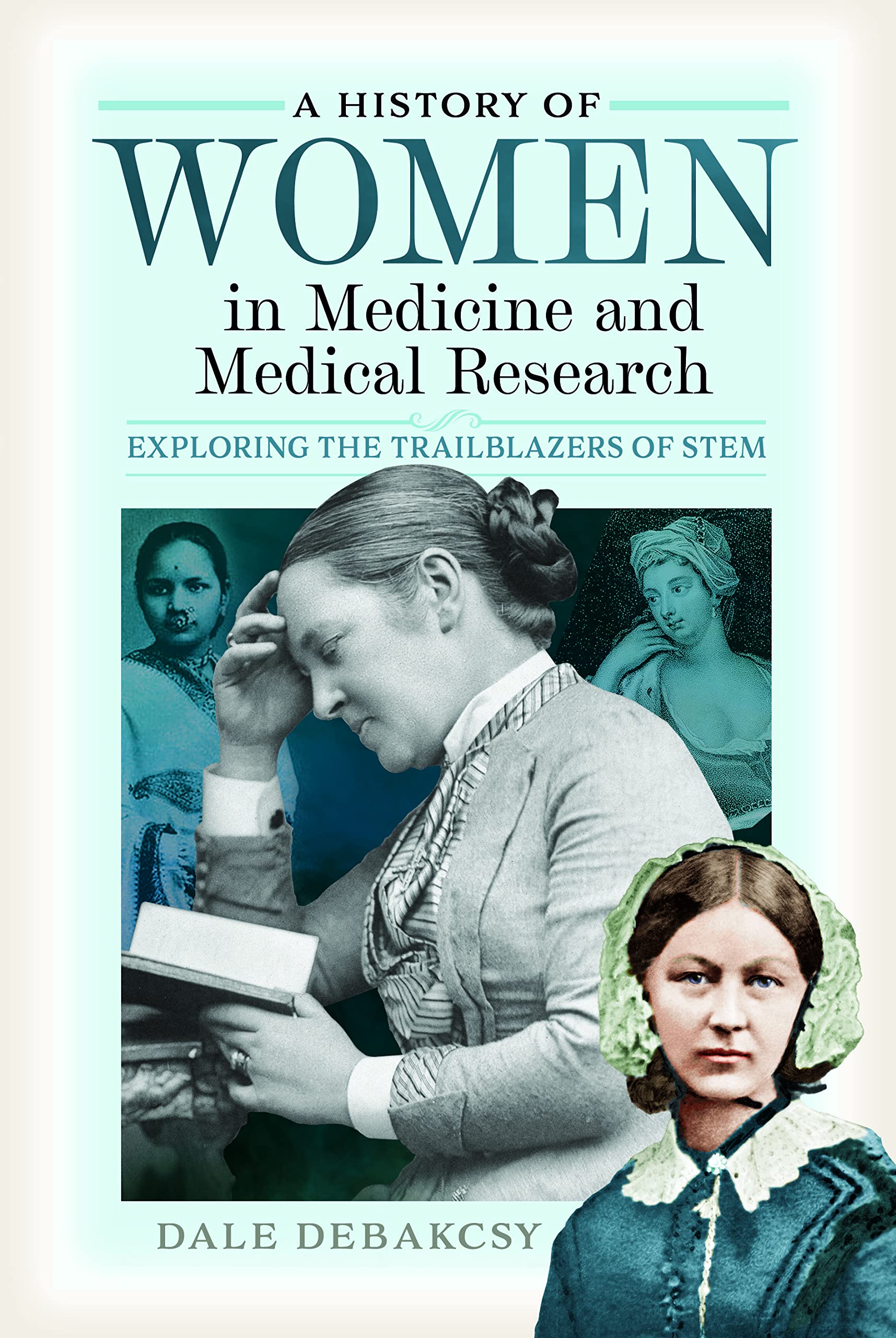
A History of Women in Medicine and Medical Research: Exploring the Trailblazers of Stem is broken down into several chapters, each one focusing on a specific woman, her personal background or life story, and her professional career in the sciences. The book progresses chronologically from the 16th century up to the near present, ending in the 1970s.
Each chapter ends with a section devoted to further reading and sources. While the book lacks citations and formal references, these inclusions are especially valuable. This kind of historiography is difficult to discover without a significant investment of time and effort making Debakcsy’s book all the more useful and appealing. I do not mind admitting this is a key reason why I have chosen to purchase my own copy.
These are not long or exhaustive studies of each individual; these historiographical sections allow the reader to explore further. That said, the brevity of each chapter is not a detraction. These are easily digestible chapters, perfect for classroom use or as readings for an undergraduate course. The chapters capture all they need to, leaving the reader satisfied but curious for more.
The women themselves are fascinating subjects, not only for their contributions to STEM, but also for their perseverance and resilience in the face of class, gender, and racial prejudices. Many of the women derive from the upper classes, but a significant number of them are working- or middle-class. Some were immigrants or enslaved (or lived just outside that category). Many had to break with their families to pursue their dreams. In many cases these women knew or knew of one another, interacted closely or within similar professional circles. A cohort of pioneering women in these fields is visible in the 19th century, particularly in the fields of medicine.
While the majority of women examined and brought to light in DeBakcsy’s book are white, European or American, there are also significant chapters focusing on women of color in the Western world. These are mostly (but not exclusively) black women who broke academic and professional ceilings.
This is a fantastic book for the classroom and any library (academic and home, alike). I cannot wait for my copy to arrive!
Kitty Fisher: The First Female Celebrity by Joanne Major
If Major’s book, Kitty Fisher: The First Female Celebrity was turned into a reality television series depicting the lascivious 18th century — and if time travel could be achieved — Kitty Fisher would have a hit show called, “Keeping up with Kitty.” It would include an extended cast of rival courtesans and other infamous women on Harris’s famous list of loose and exciting women about London. Video clips of Kitty’s horsing accident in the Mall would have broken the internet, shut TikTok down, gone viral.
The World of Kitty Fisher and women like her, courtesans of Britain’s aristocrats and wealthy merchants, with its alcoholic rivers of champagne and deep, rich wine, gluttonous helpings of animal roasts, buckets of gravies, mountains of puddings, and voluptuous flesh in resplendent velvets and silks far outshines the grotesque excesses of our modern times. The ratings of Housewives of Who-Cares-Where and the Bros of Spoilt-Rich-Baby-Daddies would pale to a grey in comparison to a show about Kitty Fisher and her world.
But alas! No such reality shows exists and time travel is still science fiction. Major’s book, Kitty Fisher: The First Female Celebrity, however, does give us a tantalizing glimpse into what might appear on the screen. In nine short chapters — this history book is succinct at 145 pages (minus notes, index, and bibliography) — Major gives the reader a fleshy, tangible sense of the English sex-fueled 18th Century. The first few chapters give us an overview of Kitty Fisher’s world and her personal history. These chapters also chronicle Fisher’s rise to fame and the path to her profession. Chapter 4 focuses on one of the most enduring events of her career, her horse accident and discusses the effect of publicity on her life and career. Chapter 5 gives the reader a closer view into the business aspects of courtesan-ship. In a way, we can see clear connections between the influencers of today and the women of this world. The modes in which women like Kitty Fisher monetized themselves is the subject of chapters four and fives. Chapters 6 and 7 examine how Kitty and other courtesans or kept women segued into comfortable and profitable existences for the long term. Marriage, servitude, and dismissal were all possible endings to these women’s careers; how did women establish security for themselves? The final two chapters discuss what happened after Kitty Fisher left the stage (and this world) and how she became imbued with a legendary status. Kitty Fisher follows the physical lifetime and historical trajectory of the eponymous subject.
While Kitty Fisher is the central heroine of this prosopography, it includes the tales of many other women with the same vocation and the men who served them, worshipped them, paid for them, kept them, maligned them and took advantage of them. Kitty Fisher allows the reader to envision the full landscape of sex work in this era, from those — like Fisher — who proved the exception, to those who proved the rule and have fallen into anonymity.
Their histories and careers, whether illustrious or tragic, forgettable or infamous, reveal an aspect of historical womanhood that is rarely illuminated. The women of Kitty Fisher are far from piteous. Major reveals to us how human they could be, as emotional, youthful, desirous beings. She also shows us how ruthless and powerful they were. These women were not the mere playthings of men, they were businesswomen, shrewd, and canny, educated and intelligent, cognizant of their own agency and unafraid to use it. Of course, patriarchy and its constraints on women were tight around these women, but they learnt how to use the tools and avenues open to them to their own ends. Two of Kitty Fisher’s rivals rose above the others of their profession to marry into the aristocracy.
The book also shows the reader the less glamorous outcomes. Some women died in penury, in debt, in the most awful circumstances. Many women faded away into nothingness, used and abused, broken. In this the book is well-balanced, giving the reader a wide view of the landscape.
As Kitty Fisher is a historical biography written for a general audience and not an academic one, it provides little perspective on the wider social, political, imperial, and economic matters of the era. It does not delve into historiography. This is a public-facing cultural history and is more narrowly focused on the individuals and the immediate milieu of their world. The effect makes for pleasurable reading; Kitty Fisher is very accessible in terms of language and prose, their (hi)stories unfold without requiring the reader to have much pre-existing historical knowledge. I thoroughly enjoyed reading this.
Black Victorians: Hidden in History by Keshia N. Abraham & John Woolf
First, let me begin this review by stating: I WANT A COPY OF THIS BOOK. Please, Somebody, get me this for Whatever-the-Next-Gifting-Holiday-is! I also fervently hope that Duckworth Books will have this available (at a reasonable price!) through an American imprint so it can be adopted for college courses in the United States. This is the perfect book for a decolonizing history curriculum whether the course is focused on Modern Europe, Black History, History of Racism, Modern World — or, in my case — Roots of Contemporary Issues.
The reasons: First, the book is broken down into assignable, digestible thematic sections and chapters which focus on a single individual and their historical significance. Part One is “Context and Concealment” and it provides an overview of the state of black history in Europe and in Victorian Era historiography. Here, the point is made that the act of existing is resistance itself, it is a decolonizing act to just be. Bringing these histories to the forefront is a necessary and powerful step towards decolonizing history as it is popularly understood, historical narrative, and the academy. The following sections: “Struggle and Survival”, “Church and State”, “Cultural VIPs”, and “Fighting for Freedom” offer well-researched deep dives into specific individuals across all classes, genders, and social positions. Working class black Britons, criminals, socialites, intellectuals, clergy, activists and freedom fighters are given a moment of spotlight and discussed as part of a larger colored and white fabric of Victorian society. This is a fantastic prosopography. And it could easily be partitioned to assign one or a few chapters per week to undergraduate students.
The second reason this book is ideal for an undergraduate seminar or an introductory survey course is because the readability of this book is amazing. Abraham’s and Woolf’s prose is smooth, the language requires little effort, their arguments are explicit, allowing for an easy transition from archival data to analysis to discussion. Indeed, the shift from storytelling to analysis is so seamless that many students are likely to be fooled into reading the entirety of any chapter assigned! Bonus: I bet the kids will really enjoy it. I am told over and over by students that they love seeing the “real people” in history.
The third reason is that while its accessibility makes it the perfect addition to any library, for any level of reader, it is also perfect for the more advanced historian, including those well versed in historiography and professional history production. Simply put, our own training is steeped in colonial and orientalist standards that have obscured the presence of color and ethnicity. We need to read this. I could not help but feel joy at reading this, though I am not black I am a scholar of color and from a former colony to boot! Black Victorians: Hidden in History is not the first or only of its kind, but is part of a larger movement towards decolonizing European history, which has been and remains largely as white history. Black Victorians joins Olivette Otele’s African Europeans: An Untold History (2021) and Miranda Kaufman’s Black Tudors: The Untold Story (2018) and others which are highlighting the transnational presence of Black people in other eras. The “Untold” theme across these recent histories is telling and a clue to the point being made: Black People never were confined to the so-called Dark Continent, that notion was a myth promulgated by a eurocentric academy, a eurocentric world — and Here! Here is proof!
Therefore, and perhaps most significantly, Black Victorians is bound to hit with younger readers, a generation for which representation matters and matters a lot! This is for the next generation for whom the symbols and the exhibition of blackness can have an immense impact on their decisions now and in the future. Our students of color need to see themselves in their classrooms, on the big screen (by which I mean the white board and projector screen in the front of the classroom).
All this said, merely bringing black Victorians to the forefront is not the endgame. It is not the last word on this. This is only the beginning; the conclusion emphasizes not only existence of black victorians, but points out that black victorians — black people — have played significant roles in shaping their moment as well as the present, thus their historical existence was not static, sealed in a vacuum, but interactive and dynamically integrated with white victorian society. This is the more powerful message, one which the book manifests.
Again, please, someone, gift me a copy of this book! I will be looking for it to assign in a future course!
My Three Dads: Patriarchy on the Great Plains by Jessa Crispin
This was not what I expected. I mean that in as positive a way as possible. Let’s say that the three dads Crispin deep discusses in the book are not the fathers you might assume from the title. This is not a work centered on biological relationships or familial history; it is, rather, a genealogy of our present moment — Crispin’s response — to the very existential question: What in the biscuits is going on here? (Here being America or ‘Murica. Take your pick, it is somewhat fungible.)
Crispin’s answer is: No gravy. All biscuits, no gravy. From this reviewer’s position, Crispin hits it on the head of the nail pretty dead on. Told from a woman’s perspective, the response cannot but factor in gender and sexuality. A person’s lens is inevitably shaped by their experience of living within the patriarchy. And that’s Crispin’s big point IMO: We all live within a patriarchal world and we always have. It is highly likely we always will. Or, at least, those of us alive today always will.
[Side Note: It is likely Crispin wrote the bulk of this book prior to the recent SCOTUS ruling on abortion. It is interesting reading this in the wake of that decision, on the cusp of things going so very sideways. I would have liked to read Crispin’s view on that in these pages. Perhaps, next time, eh?]
Crispin’s MyThree Dads is a long read essay, flowing from one chapter to another like a river, making turns at arbitrary, but logical loci. The book is split, however, into three major parts, one for each “father”. Dad One is a figure from Crispin’s past, a father figure or an archetype of a male/masculine figure we’ve all known or read about, the invasive species of man who erases women violently, silently, assuredly, simply through living their own lives. The act of being a man — in the midwestern definition — is a violent act toward women. Crispin mulls marriage and children, the banal locale of domesticity as the insidious, quotidian site of patriarchy; here, she admits to its wiles herself. The disguise is love, security, belonging.
Dad Two is the Citizen, in Crispin’s case, John Brown, a Kansan historical figure. But again, John Brown is the manifestation — one of many — Crispin write about it. She’s interested in the archetype again, but again these are men we recognize as living individuals: The White Men Who Feel Their Lack of Control And Lash Out. Politics becomes the platform for these men: the excuse for their rage and the subsequent tantrum. Reading this section was like watching a montage of the American news from the past thirty or so years. Crispin revives Waco, Timothy McVeigh, Nazis, Bolsheviks, bring the conversation to the present with references to unnamed mass shooters. Crispin’s point is made visible by the invisible: there’s no need to name any of the recent mass shooters of the past twenty years because these perpetrators (typically a man or a boy) are so commonplace as to collate into an archetype of their own.
Dad Three is God, but since that is too multicultural, too broadly applicable as a term, Crispin narrows it in: the Protestant God and, even more specifically, his human mouthpieces, Martin Luther. But this is really a discussion of the Church and the folk version of Christianity as it is practiced in the American Midwest. Crispin lost me a little here, but that may be because I can’t relate, having grown up in Asia where religion flavors life in very different ways. That said, having spent a significant amount of my adult life in the Midwest, Crispin’s cultural landscape is familiar.
Crispin critiques the patriarchal world we live in, but her point is its all-encompassing presence. The title says this is focused on the Midwest, but really, the world Crispin paints for us is easily recognizable as anywhere else in the United States. The title and structure of the book even performs Crispin’s point: the world revolves around man and men and their needs, desires, rages. My Three Dads is a snapshot of what it means to be American — but, a caveat on that: The people in Crispin’s work are white. She doesn’t really say this, but she does through silence and implication. The book focuses on the Midwest, after all, and that is the heartland of whiteness, despite the millions of non-white people who reside there now and have historically shaped Americanness. So, let me rephrase: My Three Dads is a snapshot of White Americanness, the kind typically performed, desired, and domiciled in (but not confined to) the American Midwest. But this doesn’t mean this is just about or for white people; People of color have to live in a white world, after all. My Three Dads is a worthy expenditure of time for any reader interested in the question: What in the bisuits is going on in America today? The answer will either confirm what you already know or ricochet off someone you know.






 Dr JoAnn LoSavio