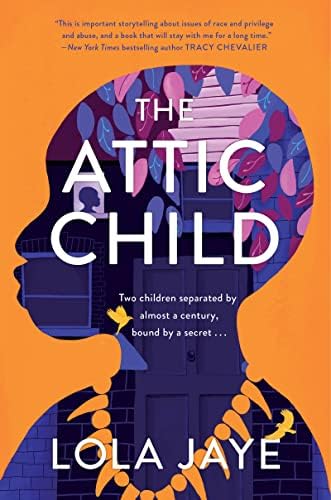
The Attic Child: A Novel by Lola Jaye

The Attic Child: A Novel by Lola Jaye

Something draws me to themes of tragedy and darkness in my choice of reading. The Attic Child might very well be one of the darker — if not darkest — novels I’ve read this year. This is a novel about strength, resilience shaped by necessity of survival and trauma; but it is not only the characters who must cultivate and wield this kind of strength, the novel requires the reader to be brave and hardy too. The reader must be to bear the suffering of reading about the suffering of others.

The pain is intentional. Jaye’s novel addresses, with unflinching realness, the lived trauma of colonialism by highlighting the literal theft of human beings European colonizers forced People of Color and colonial subjects to endure. The novel forces the reader to see how this history is very much present in our contemporary moment, that it is has caused intergenerational harm beyond measure.

As a historian of decolonization I am grateful for a novel like this — and happy to see that it was distributed on a platform as wide and well known as The Book of The Month Club (which is where I obtained it). We — those who come from parts of Europe’s former empires and those whose ancestors benefited from those empires, that is, everyone — need books like this, stories like this, voices like Jaye’s to declare that the grief and loss and wounds of colonialism are still not healed, closed, “over.”

The novel spans many generations and decades, beginning at the start of the twentieth century with a young boy who lives with his family on the African continent. He becomes the Attic Child, the first of many — children shut away, abused, neglected. He is robbed of his identity and his heritage. The story of a young woman who lives in a time closer to our present intertwines with his. The reader is aware there is a connection between the two, something hidden in the attic and the house in which both of these characters grow up, both of them “attic children.” The mystery the reader will find themselves embroiled in is how they are connected and why.

As the mystery unfolds it also deepens, its roots are long and twisted and dangerous. The mystery exposes the characters to pain and the possibility of new emotional wounds. The threat of scarring is real. But they are both hurtling through history and time and must live their lives. If there is a history lesson here, it is that we cannot escape history or making history, as we do so simply by living.

The novel does not pretend to heal the pain of this history. Reader should not expect to be bandaged or coddled in any way. But the novel does end as a historian might expect, with the lesson that history does not end, it goes on and on and therefore, that is itself a kind of closure. Perhaps, the ending is something more of a suture than a healing.

This is a tough and exacting book to read, but one which will not fail to provoke emotion. This is a significant novel.
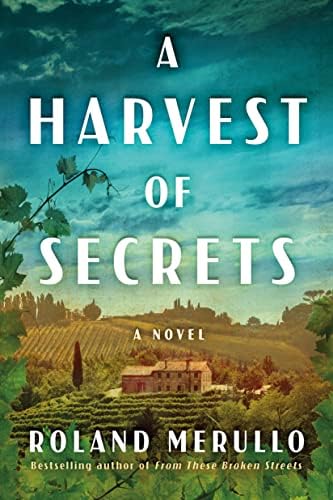
A Harvest of Secrets: A Novel by Roland Merullo

A Harvest of Secrets: A Novel
by Roland Merullo

A Harvest of Secrets is a slow burner, then halfway it ignites like gunpowder and the end is an emotional and deeply satisfying explosion, uniting all the storylines of the novel together in a kind of literary bonfire.

The novel is set in WWII, fascist Italy when much of the country has fallen under the control of the Nazi regime. The story unfolds primarily in a rural northern village where an old, aristocratic family grows grapes and produces wine. The San Antonio family and their estate have been lords over the land and the people for generations. There are tensions between the family who own the winery and its workers, age old class-based tensions that threaten to erupt under the additional strain of wartime food shortages and unpredictable Nazi raids. The war has also brought about new factions and exacerbated pre-existing enmities: resistance fighters and saboteurs against Hitler’s Nazis and Mussolini’s Blackshirts, deserters from the Italian and German armies, Il Duce’s spies, and Nazi collaborators. Caught in the cross hairs between these conflicting factions are two young lovers: Vittoria, the daughter of the proud noble family and Carlo, the orphaned peasant boy she grew up playing with. There are also others who find themselves trapped on one side or the other of the war: Old Paolo, the foreman at the winery, Umberto San Antonio, the noble man who owns the land, Enrico San Antonio, his son and Vittoria’s brother, Eleonora, the Jewish woman in their midst. They each have their obligations to family, country, and to those who have sheltered, raised, and loved them. These obligations tear the lovers and their community apart — and bring everyone together in other ways.

Merullo’s novel is not only about the lovers; it also about the many individuals whose lives intertwine with theirs. Indeed, the novel is more of a broad panoramic view of Italian society in this fraught period of the twentieth century. Some of the people Carlo meets are sympathetic to Mussolini, others seek freedom from the politics that engulfs them all, others are victims of Il Duce’s ill-conceived plans and ambitions. Vittoria is likewise surrounded by those who would do her harm and protect her from it. There are resistance fighters, Nazi soldiers and officers, Nazi collaborators, and Mussolini’s spies lurking and active all over the countryside, waiting to strike or entrap her and other innocent Italians who simply want to do what is right for themselves and their families, and by their conscience. As a woman of this period, Vittoria’s options are limited. Italian patriarchy places shackles on her that are made for women alone. She is meant to be a good daughter, a good woman, a quiet woman — but in the chaos of the war Vittoria cannot remain silent.

Woven into this larger cultural, social, and political vista of Italian wartime life is a domestic drama and mystery. Vittoria’s dilemma is at the center of this. She must bargain her silence for her freedom, sacrifice her morals to be a good daughter. But she is also a product of a longer history of women like herself.

Secrets held for decades, the kind begotten by forbidden love, are as much a part of the estate and the fabric of life in the vineyards as the vines themselves. These unraveling mysteries push and pull Vittoria, Paolo, Umberto, and Carlo in all directions. The emotional and real famine of war force these long buried secrets to emerge on the surface. As the Americans and Allies bomb Italy in order to free it, Vittoria, Carlo, Paolo, Umberto San Antonio, and others scramble for safety and try, hard as they can, to keep these secrets under cover.

Overall, a good read, especially for readers who enjoy themes of class conflict, gender histories, and ensemble casts of characters, and domestic mysteries.

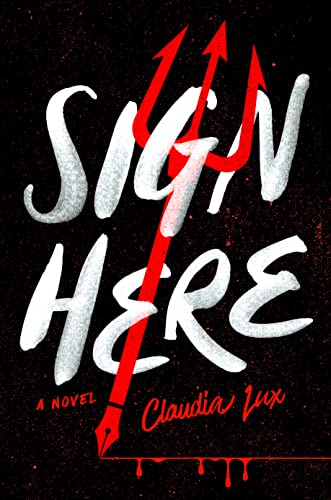
Sign Here: A Novel by Claudia Lux

Sign Here: A Novel by Claudia Lux

A departure from the more serious novels I’ve been reading lately, and perfect — if a little late — for the Spooky season. Still, if you are a horror fan, any time is a good time for a paranormal mystery, which is exactly what Sign Here is, with a generous injection of humor.

Sign Here is a combination of the television show, “The Good Place” and one of Simone St. James’s paranormal mysteries, the kind which unravels to reveal a multi-generational history. It’s laugh-out-loud funny and also deadly serious at the same time. I couldn’t have asked for a better post-Halloween read than this. It gripped me to very end.

The novel is set in two dimensions: Hell and Earth. The former is a bureaucrat’s heaven, a place where the radio station is constantly on commercial break and the music is every genre you can’t abide. There’s fun to be had in Hell, but no peace, utterly no reprieve from annoyance. Ever. One of the main protagonists of the novel is a demon who long lost his humanity and now deceives or manipulates souls in order to collect them for his hellish quota. His goal is to complete a “full set” of a family, one soul from each generation. And to find some measure of peace in the afterlife. The two objectives are not exclusive.

The family he has targeted is a wealthy and dysfunctional one, a collection of questionable traits has passed down from one generation to the next. They have a long history with this demon, a transactional history of quid pro quo. There is also trauma, murder, abuse, and just downright immorality in the family’s past; one might say, the stuff that Hell is made of. But they are lovable too. Their flawed histories and personalities make them all the more human, all the more recognizable, for all their privilege and wealth. The reader will get the impression there is something not quite right about them though, and as the novel progresses, it becomes clear that several of them have something to hide — even from the demon himself.

The novel is set at the start of the annual family vacation, a dreaded and welcome event. There’s a newcomer to the lake house with them: the new best friend of the daughter. She’s bright and curious — and may just force the family’s dark secrets into the light.

The two storylines intertwine: Will our demon be able to exploit the family to meet his quota? Will he ever escape his Hell? Will the family be able to keep their horrors safely hidden in the past? Someone’s soul is at stake. Will it be the father? The mother? One of the kids?

Sign Here ends explosively and satisfyingly. Everyone gets what they deserve.

The Master: A Novel by Patrick Rambaud

Translated by Nicole and David Ball

The Master: A Novel
by Patrick Rambaud

The Master is a stark novel, the kind that is absent of luxurious words and descriptions, but whose minimal lines imply a lush intellectual interior may lie beyond the text, if the reader is willing to linger on the line just a little longer than necessary.

The protagonist is Zhuang Zhou (also known as Zhaungzi), an actual historical figure, a Chinese philosopher who lived circa 369 BCE to 286 BCE and contributed greatly to the philosophy of Taoism. He is the eponymous master of this novel. It begins with his childhood and recounts the fictionalized events of his life, with especial attention to Zhaung’s moments of philosophical enlightenment. Zhuang is propelled, by his choice or by the whims of others, from one kingdom to another, finding his life and livelihood tied to the court, a recipient of a benefice from the king. In some periods of his life he welcomes this privileged position, living the abstracted life of the mind. At other times he rejects this and delves into more material pursuits. His experiences lead him to write the piece of scholarship he is known for, The Zhuangzi.

The novel reads like an ancient epic moving swiftly from one event to another. It does allow the reader some interiority into Zhuang’s mind, but only his, and only insofar as it pertains to his judgements on morality and ethical behavior. This is not a personal account of the interiority of his life in an emotional sense; the reader should not expect entree into Zhuang’s feelings, so much as his intellectual musings on morality and correct ways ruler should govern. (Indeed, the reader may get the impression Zhuang was a less than stellar parent and romantic lover.) Rambaud delivers the character with a kind of detachment, as if merely filtering a series of observations for the benefit of the reader and for the reader to analyze and judge Zhuang for themselves.

The purpose of the novel seems to be less focused on the man than his scholarship. I have the distinct impression I am meant to walk away with a fuller view of what the sage intended for us to understand about Taoism. But I admit, I was less impressed with Zhuang’s heavy handed pedagogy and deliberate elusiveness, and so the lesson missed me.

As a result, this reader notices a pedantic aspect to the book, which while it performs the conventions of Chinese philosophical writing authentic to its setting and protagonist, may read as supercilious to the modern reader. But then again, the philosophy of ethics is about passing judgement and imposing moral watermarks on society, so… I am left wondering if a book on a topic like this can ever be written without an element of condescension baked into it. If so, Rambaud is excused from any accusation of arrogance; indeed, Rambaud’s role in this novel is exemplary otherwise.

Rambaud’s portrayal of Zhuang follows an expected patriarchal narrative that is likely accurate; we are not given any historical evidence that the real Zhuang was a feminist, after all. To portray him as such would have been inauthentic (if satisfying as a disruption, a revolution). We can understand Rambaud’s role here as a messenger. His prose is beautiful in its sparseness; with few words an image of Zhuang — not his physical being but his essence — is apparent to the reader, as are his friends who accompany him, betray him, befriend him on the journey of his life. Rambaud delivers the tensions of the social landscape of ancient China well, without romanticizing or Orientalizing the place or people. It is a harsh world: peasants live and die at the whims of their lords, people live and die at the whims of nature via its tantrums in the form of floods or droughts. Rambaud transports the reader to this moment and place well.

Overall, The Master is an enjoyable read, one that informs and does what historical fiction ought to do: transport the reader across time.

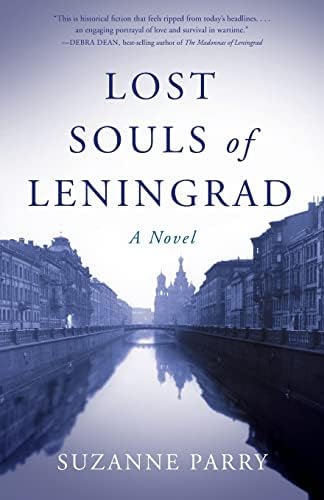
Lost Souls of Leningrad: A Novel by Suzanne Parry

Lost Souls of Leningrad: A Novel
by Suzanne Parry

Lost Souls of Leningrad is a rare novel about the Russian civilian experience of World War II. Even rarer, its primary protagonist — and the character through whose eyes this experience is filtered — is a late-middle aged woman, a widow. (I am not a fan of romantic WWII novels that involve beautiful young women who all wear red lipstick, have perfectly coiffed hair, and fabulous clothes in the middle of wartime. Hello? Rations? I mean, COME ON.)

Parry’s novel possesses a more realistic portrayal of wartime. Its setting is Russia, a nation besieged by Nazis. There is a tightrope tension, drawn even tauter by dwindling supplies of food and medicine. Lost Souls of Leningrad does not romanticize war; events and experiences that other novels paint in sepia tone, Parry swathes in a more authentic grey. The sense of loss, a grieving for the world that was, is palpable in Lost Souls of Leningrad in a way that makes it refreshing as a novel of WWII.

The story revolves around an aging, widowed violinist and her teenaged granddaughter. But the novel is not about them alone. Lost Souls of Leningrad is a landscape of a European city at war. Parry reveals to the reader the swift and terrible death and decay of an urban place and its people when the trappings of civilization are ripped off by war. Food and the lack of it, water and the lack of it, the stench and the unavoidable abundance of it. Fear from all the dark corners, lives cast into darkness in the absence of street lights, electricity, law and order. The other characters are Russian soldiers, mothers, wives, and orphaned children. All of them are the lost souls of the title, each of them has lost something, whether a loved one or a parent, or simply their sense of security in ordered society that they once had, even if imperfect. Loss and grief, not only as a result of war, but through political upheaval, are themes that imbue the book. The novel draws a line between the time before and the time after, the time of war, and afterwards, even when war is over, there remains a division of before and after.

While the novel does not romanticize war, there are romantic threads in its storylines. There is love in this novel in various forms: nurturing and mothering love, parental love, innocent and childish love, romantic love, the kind of love that is weathered by life. While a defeating hopelessness pervades the novel (it is war, after all), there is also an uplift via its characters’ resilience. This strength manifests in many forms but most prominently through love and kindness.

As a historical fiction, it portrays a more social version of history than a military or political one. Readers should not expect dates or events, but an overall texture of life in wartime Russia. This is not a historical fiction that relies heavily on the facts of history, though the timeline of events does follow authentically in line with actual history; this is a novel about the human experience of war, lived and sensed through the skin, the eyes, the nose, the tongue.

This a beautifully written novel about surviving loss of different kinds and the love we need to do so.

The Wintering Place by Kevin McCarthy

The Wintering Place by Kevin McCarthy

Five words or phrases to describe McCarthy’s The Wintering Place: Raw, Disturbing, Visceral, Emotionally Invasive, Riveting. This is a novel for fans of Donald Ray Pollock and Cormac McCarthy, readers who enjoy (perhaps with grimacing faces) the feel of dirt under the character’s nails, an odor of decaying blood lingering and fetid, the kind of novel that settles a deep chill in your bones and in your soul. The Wintering Place is a novel about resilience and survival and the cost of that survival on the human soul.

The novel is set in the 1840s on the American plains, in the rural hills and the long stretches of lonely woods. It revolves around two brothers, Irish immigrants, who have fought and lived according to a primal form of justice. They are army deserters, fugitives in more ways than one. Blood and death are on their hands, rightly or wrongly. A woman, the bride of one of the brothers, accompanies them — and together they are a kind of family, dependent on each other for their survival and security. There is a bond of love between, the kind that is weathered by the harshness of life, silent, sullen, and not always kind. The woman is like the brothers: alone in the world, a survivor of a place and time that beats women out of their dignity, power, and softness.

The three of them seek a wintering place. A place to hole up for the dark season. They need only to survive the weather — that is, until they encounter animals of their own kind who threaten them. Humanity is the evil that lurks in the shadows of the forest. The snow, wolves, and frost kill too, but humans pose the most danger.

The three of them encounter ruffians like themselves, Native Americans, officers of the law, traders and merchants who hold the power of life or death over all who dare to traverse the plains in winter. Everyone is seeking a safe wintering place in some way or another.

My description sounds stark, but McCarthy’s prose and the way he unpicks the fabric of the story and lets it unravel into its bare parts, is captivating. I read this novel compulsively, wanting always to know what happens next. Do they survive another day? Will one of them perish in the effort?

The characters were fleshy, real, and irresistible; the stink of their unwashed bodies and the smell of blood permeated the safety of my apartment as I read this book. It was as if I could sense them in the room with me. McCarthy uses an epistolary delivery, bringing the characters into dialogue with the reader directly; it is almost like having a conversation with them.

At the end of the novel, this reader even felt a little lost — as if there was a little death in the finishing of this book.

I must add one more word to the description: Haunting.

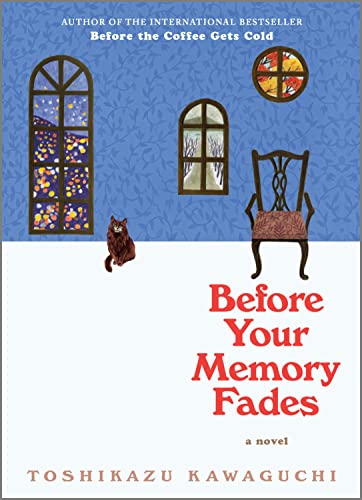
Before Your Memory Fades: A Novel by Toshikazu Kawaguchi

Before the Coffee Gets Cold #3

Before Your Memory Fades: A Novel
by Toshikazu Kawaguchi

Before Your Memory Fades is the third installment of the Before The Coffee Gets Cold series. It picks up directly where the second novel, Tales From The Café leaves off. I thoroughly enjoyed the first novel and loved how the second one tied up loose ends; this third novel follows with the same pace, cadence, and story. For those who love the way the past and present and future intertwines and the mythology of the series, Before Your Memory Fades will feel like a warm welcome in an old and familiar place (the Cafe Funiculi Funicula, of course!)

For me, personally, Before Your Memory Fades made less of an impression on me than I expected. I think I had tired of the story; indeed, there was nothing necessarily new in this novel that the previous two had not delivered. The emotional payoff for me was spent, but this does not lessen the potential payoff of the novel for a fan of the series: There is a ghost, albeit a new one, in The Seat in the café and there are new eager patrons who come to use the time traveling device to correct some wrong they have committed in the past or have yet to commit in the future. Then there is the same terrible lesson they learn: that love and obligation are on the same sides of the coin and that they cannot change the events fated to them, but the knowledge they learn in the past or future can change their hearts and souls in their present.

We are reintroduced to familiar, new, and newish characters, Nagare and Kei’s now teenaged daughter, Miki, and a new employee, Reiji, who works at another café in the “family”, Café Donna Donna, which also has its own time-bending seat, its own ghost, and its own crew of café regulars, Nanako and Dr Saki Muraoka, There are familiar characters: Nagare and Kazu. There is also Kazu’s daughter, Sachi, who is the newest Tokita woman to wield the power of the coffee and time travel. There are new patrons who arrive at the Café Donna Donna to rewrite their pasts: a daughter who seeks out her parents and a way to manifest her vengeance, a comedic celebrity who needs to tell his wife something important, and others.

All in all, Before Your Memory Fades delivers on its promise. It is a fantastic addition to the existing two novels. It continues the tradition of the Café Funiculi Funicula, giving the reader more of what they fell in love with in the first novel.

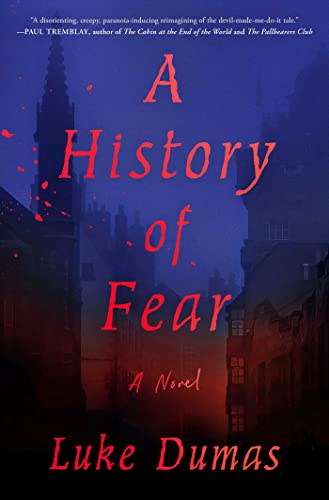
A History of Fear: A Novel by Luke Dumas

A History of Fear: A Novel
by Luke Dumas

By page three, I was hooked. The ending comes to a perfect, organic conclusion — but I readily admit that if Dumas writes a sequel, I’m all in.

A History of Fear unfolds like Stoker’s Dracula, adopting an epistolary approach, delivering the story via journal entries, letters, official reports from doctors, prison officials, and newspaper articles. The novel dives deep into the most disturbing parts of human psychosis reminiscent of Dostoevsky’s Crime and Punishment. It delivers gothic horror too, in the manner of Shelley’s Frankenstein. In the end, the reader can’t be entirely sure of who is the monster, if demons are real, if evil is more human than we comfortable with. A History of Fear is a horror fan’s feast: gore and psychological terror stride side-by-side, the paranormal and the divine and the mundane intertwine to create a world the reader is never entirely sure is real. Illusion may very well be reality… or worse.

But the story is not fantasy; there is a real history embedded in this novel — and a commentary on a history of monstrous bodies, sexuality, religion, and intergenerational trauma. There is a reality underlying the one Dumas weaves for us. This is what makes the novel so appealing; there is a real horror here, one that we can recognize. This history is one that might be so common as to be truly terrifying because it might actually exist within ourselves. Or someone we know.

A History of Fear follows the main character’s slow descent into madness — or his ascent into clarity, depending on your interpretation. There is a true mystery here and this drives the story forward. The reader needs to discover what the main character also seeks: some sense of closure and parental acceptance. The main character is driven by a need to know themselves and their past. This is a genealogy of a family and the homophobic culture of the West. Dumas focuses on the psychological damage inflicted on those who deviated from the dominant norm and those who dared to question their place in it. The novel travels between the past and the present, each part of the jigsaw puzzle adds to the image of the whole of time, allowing the reader to witness the unraveling of the man’s mind and the suffering caused by intergenerational trauma.

The novel opens with the main character’s eventual, inevitable fate; this is the mystery. We know what happens to him. The mystery is why and how. The horror is the long arm of intergenerational trauma.

A wonderful book to have read in October, the Halloween month, but really, a fantastic gothic horror for any time of the year.

The Wounded Age and Eastern Tales by Ferit Edgü

Translated by Aron Aji

The Wounded Age and Eastern Tales by Ferit Edgü

Sparse writing delivers more feeling sometimes, more than a hill of words. The Wounded Age defends that “less is more” adage more than adequately. Edgü is master of the cut, clipped prose; it is this brevity of language that paints a dark history of Turkish war and tragedy. The sense of nothingness is poignant here, deliberate, necessary to understand the effect of war on its subjects.

This collection of stories is marked by an unusual delivery via poetry. The stories unfold in lyric format; this does not mask the pain of ethnic refugees and the suffering of war that is its subject, but in fact highlights it and makes it more powerful. It is as if the Edgü or the reader would only be able to handle such pain if it were framed in poetry; the reality of war and of those mowed down in its path needs to be formatted in this way in order for the reader to see the war for its intimate effects.

The stories and poems themselves evoke a sense of fracture in Turkish life; there is a disjointedness that is purposeful, performative. These are not historical fictions; these are emotive accounts of the Turkish past.

Overall, a beautiful and dark landscape of Edgü’s world.

1794: The City Between the Bridges (A Novel) by Niklas Natt Och Dag

1794: The City Between the Bridges (A Novel) by Niklas Natt Och Dag

1794 is a deliciously dark journey through the underbelly of 18th century Stockholm. It’s the second novel in Natt och Dag’s Cardell series; but, the novel stands on its own. I didn’t read 1793: The Wolf and the Watchman where the characters, Jean Mickel Cardell and Anna Stina Knapp first appear, but that did not preclude my enjoyment of 1794.

The novel begins with Eric Three Roses, the second and less-loved son of a minor nobleman. Eric’s journey to Sweden’s only tropical colony, Saint Barthélemy and the mysterious, scuzzy individuals he meets there are the mystery that seeds the rest of the novel. What happens to Eric is tragic. Cardell is called upon to discover the crime and the criminal — and bring them to justice. He seeks out Cecil Winge, encounters Anna Knapp again, and slithers through the shadowy and crime-infested underworld of Stockholm, sorting through those who are struggling to survive and those who prey on others to survive.

This is a crime novel, one which reveals a seedy and complex weaving of lives, fortunes, and terrible fates that not only delivers the tension of a mystery but also, and perhaps more appealing to me personally, the texture of 18th century European urban society. Classes collide, fates are intertwined, and motives are never simple. Relationships function on transaction, but the currency people must pay can run the range from gold to love, from silver to power. Murderers murder for the sake of a love of violence. Fathers overlook the transgressions of their daughters for the sake of a peaceful existence. Brothers blind themselves to the follies of their siblings. Sanity and madness are two sides of the same coin.

1794 is not a story with happy endings, neat narratives wrapped up by the end; this is a reflection of life under a harsh light. The mystery lies in how we survive it.