One Night Two Souls Went Walking: A Novel by Ellen Cooney
This was such a beautiful, poignant story, the kind of novel that makes you wonder how permeable the line between each of us really is — or if there is even a line.
The story revolves around a nurse and her encounters with patients, coworkers — and possibly a few specters who linger in the halls of this hospital. Time and space aren’t boundaries in this story, not in the typical way narratives run. There are moments when this reader wasn’t entirely sure of what or who was real, but the thing was: it didn’t matter — and I think that was the point.
It’s hard to put this novel into a category, perhaps I shouldn’t, but readers who enjoy literary fiction, pondering life experiences, and paranormal encounters are likely to find it enjoyable.
Cooney’s style and prose was, as with her other novels. impeccably paced, succinctly evocative, perfect. There’s nothing else to say on that point, really. I cannot get enough of Cooney and have several other of her novels on my TBR.
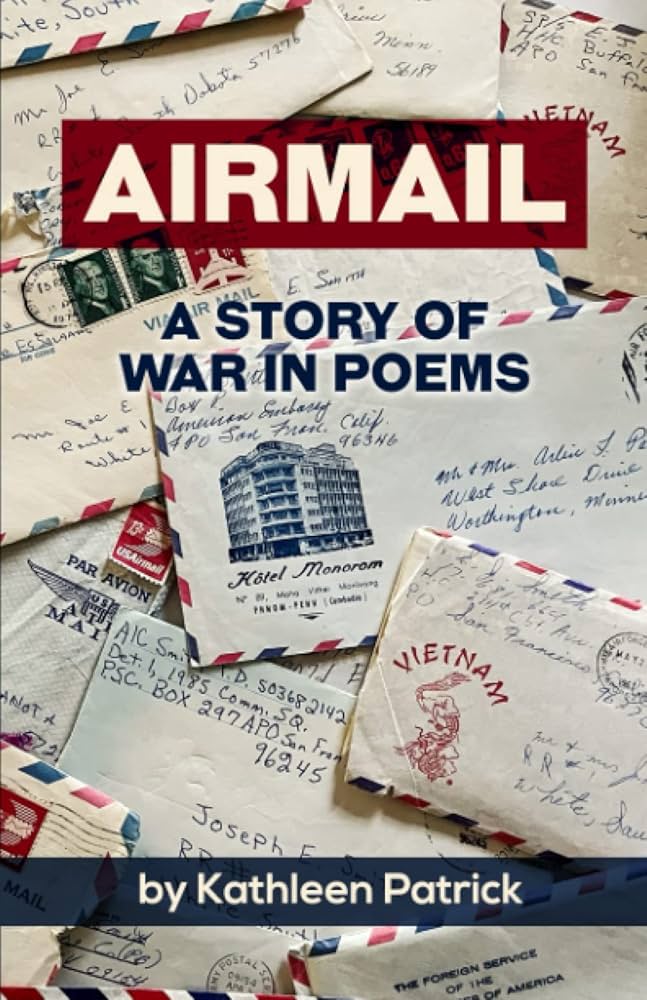
Airmail: A Story of War in Poems by Kathleen Patrick
This is a collection of poems about the experience of American soldiers off to war in Vietnam. It is about the family that they left behind in the United States. It is about the loss and gains of war, patriotism, the inevitable criss-crossing of cultures and people across oceans.
It has been a long time since I have read poetry, and especially since I have reviewed any. Poetry is harder, so much harder to assess. Or rather, its assessment — if that is the right word — is so much more subjective (in one sense) or so much more technical (in another sense).
I’ll start with this: The subject matter of this collection of poems makes an impression on me in ways particular to my personal heritage and profession. I am from Southeast Asia, though not from Vietnam or Cambodia or Laos, the places where the Vietnam War (or the American War, as it is also called in Southeast Asia) took place. I am also a historian of the twentieth century, of Southeast Asian history, of decolonization, and transnational connections between Southeast Asia, the United Kingdom, and the United States. The way I have read these poems — and the way in which I review them — is inevitably filtered through these twin lenses.
These poems are powerful, both as evidence of historical perspectives and subjectively, as pathways of emotion. These poems open up avenues for understanding and seeing the experience of war, beyond the political, beyond the combat, beyond the filter of news.
I especially enjoyed “Voices, A Collage” which spans years and tells us a soldier’s letters home. This is poem about regrets, but it is also about how a family remains connected in spite of the distance, in spite of the pain of war.
“Telegram”, a much shorter poem, was especially poignant; its truncated form permits the reader to come to their own organic feelings and expectations. There is an implication of regret or guilt; an odd thing to say, but I really enjoyed that about “Telegram.”
“Robert M. in the Doorway” struck me as being about the PTSD of war, and for that reason, it was also a favorite. Again, a short poem, but powerful and thought-provoking. “Picking Rock” and “Don’t Forget the Women” brought to light the consequences of war that are often left unsaid; the soldier’s experience is not the only one. These poems made that clear, and sadly so.
What can I say about these poems? They made me feel, and that is — to me — the only thing a poem should aspire to.
Sparse writing delivers more feeling sometimes, more than a hill of words. The Wounded Age defends that “less is more” adage more than adequately. Edgü is master of the cut, clipped prose; it is this brevity of language that paints a dark history of Turkish war and tragedy. The sense of nothingness is poignant here, deliberate, necessary to understand the effect of war on its subjects.
This collection of stories is marked by an unusual delivery via poetry. The stories unfold in lyric format; this does not mask the pain of ethnic refugees and the suffering of war that is its subject, but in fact highlights it and makes it more powerful. It is as if the Edgü or the reader would only be able to handle such pain if it were framed in poetry; the reality of war and of those mowed down in its path needs to be formatted in this way in order for the reader to see the war for its intimate effects.
The stories and poems themselves evoke a sense of fracture in Turkish life; there is a disjointedness that is purposeful, performative. These are not historical fictions; these are emotive accounts of the Turkish past.
Overall, a beautiful and dark landscape of Edgü’s world.
Water’s Edge: Writing on Water Edited by Lenore Manderson and Forrest Gander
Lenore Manderson was one of the primary appeals of this collection for me. Having read some of her historical scholarship I was intrigued about this diversion into water as a subject. Her collaboration with the poet, Forrest Gander, also made me pause over this title.
I am not sure what I expected, but was pleasantly surprised to find that Water’s Edge is less a work of scholarship than an academic, literary contemplation on climate change, the significance of water, and the role of water in the intimate spaces of our lives. The collection is vast in its scope, though narrowly focused on its topic, water: poems, visuals, images, photographs, sociological and anthropological essays on researching water, and essays on the ways in which we move water and how it moves us.
My favorite — and indeed one of the most surprising essays — was not on water directly, but on chickenshit. I will say no more, but that incongruity may intrigue you as much as it did me. The reward was immediate. There is more connection between water and chickenshit than I gave credence to before reading this essay, not that I paid much attention to chicken excrement…
Indeed many of the essays and poems in Water’s Edge are rewarding and quickly so; they are short, spanning only a few pages each at most. Their length makes this a quick and flowing read, not unlike a river (perhaps that was intentional!)
As for the intended audience of this work… It is academic; its language and form are designed for an aesthetically sensitive mind, one that is poetic and will appreciate the nuances of a breath or the sensation of a light spray of water. The reader should expect to work for their reward. The content is intellectual and demands a certain degree of effort to excavate some of the deeper meanings embedded in the text. I would expect no less from poets and scholars. That said, I could see this text yield fantastic discussion and organic analysis in a social science graduate or upper level undergraduate seminar. The content, language, and complexity allow for reflection on multiple levels. Poetry and literature are excellent fodder for analysis; I use novels in my history courses frequently.
A very thoughtful read on water and our future with this quotidian, essential substance.




 Dr JoAnn LoSavio