Prequel: An American Fight Against Fascism by Rachel Maddow
Someone get me a copy of this book for my personal library! (A friend lent it to me.) Maddow’s historical chops are on point in this prosopographical micro-history of mid- and early-twentieth century American political history. And the message is profound and powerful.
Through a close examination of U.S. government officials and political figures from the 1930s through to the mid-century, both those who advocated for a fascist approach to governance and those who opposed it, Maddow makes two important arguments: first, the political climate of the last eight years is not a new phenomena; second, pro-fascist cadre of politicians of the past — and by inference of today — did and do not operate alone, but were supported by institutionalized oppressive systems within the government, networks of pro-fascist supporters who did the political legwork on the ground on municipal, state, as well as federal levels, and their constituencies. In short, no fascist leader functions or sustains in a vacuum. The ideology of oppression arises through a network of individuals working together and often playing on the fears and logic of scarcity.
I would expect no less from Maddow, who holds advanced degrees and is, in my view, a public academic. Maddow does not disappoint on any level: the writing is undeniably in Maddow’s voice (I hear the audiobook is incredible), delivered with succinct sharp wit and their signature speedy, yet smooth, style. Fans of Maddow’s other mediums are sure to enjoy this much longer, more in-depth project.
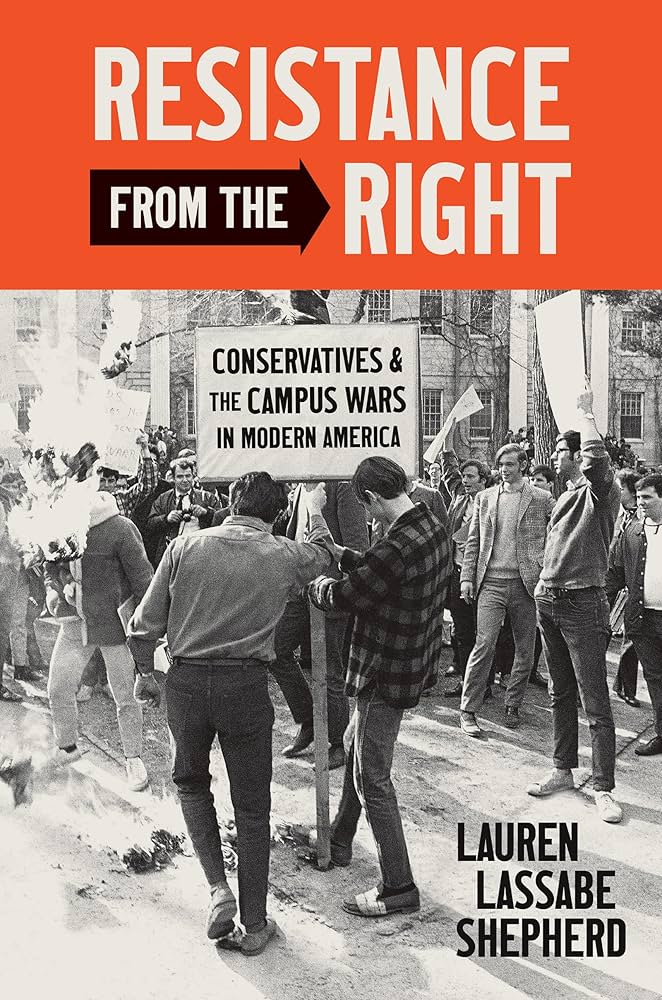
Resistance from the Right: Conservatives and the Campus Wars in Modern America by Lauren Lassabe Shepherd
In the ever-increasingly bifurcated world of American politics, Lassabe Shepherd’s monograph on the tactics of the conservative right to achieve a voice and influence on American college campuses is more than well-timed. This book uncovers the depth of today’s conservative/liberal divide, and while it focuses on the site of the university campus and highlights the actions of student organizations, bodies, and activists through the 1960s, 70s, and 80s, it also brings to the fore the work of conservative academics who made these student-based activities possible. Emerging out of this history is the current network of conservative activists, academics, scholars, and strategies, their aim not much different than it had been, but accelerated and perfected: to amplify conservative values and ideology regardless of popular opinion, consensus among the student population or American population at large.
Lassabe’s argument, in essence, is layered: conservatives adopted the strategies of the liberal left for its own intentions and benefits with great success. In doing so, these conservative campus constituents undermined the efforts of the left and were able to achieve institutional and legislative changes favorable to their ideas. Over a period of decades, these conservative parties circumvented the majority — and largely liberal — voice, to ascend to a position of power and policy-making within the university and beyond it. Conservatives operated through and targeted their efforts towards institutional mechanisms to override liberal efforts and enact their values and ideologies in policy.
The book is divided into two parts, the first attends to “Coalition Building” and the ways in which campus conservatives found like-minded students, academics, and other supporters. In these chapters, Lassabe Shepherd reveals to the reader the ways in which conservatives adopted similar but oppositional signaling from the Liberal Left through sartorial means, appearance, and branding. In the second section, titled “Law, Order, and Punishment” chapters highlight the effects of the American War in Vietnam, the rise of Black Studies and other Ethnic Studies, or Area Studies departments in the university, as well the development of a network of conservative students, scholars, and external (to the university) supporters, many of whom entered the world of politics beyond the campus in the last decades of the 20th century; their work has contributed to the conservatism and its political strategies today.
The subject matter of Resistance From the Right indicates a clear target audience, though the monograph would be an immersive and revelatory read for most members of the educated public (liberal, conservative, or independent alike): that is, liberal scholars and educators in American academia today. Lassabe Shepherd answers a question most liberal scholars puzzle over, though it is never explicitly written in the book itself, and that is: Why and How did we end up with such conservative regulations, policies, and protocols when we seem to have such support for liberal values and ideas? Or, the more colloquial form, “What the H happened to us?” As universities continued to grapple with far right propaganda and groups on campuses, hate crimes and violence, racism, and classism, many administrators, faculty, and staff struggle to reconcile the diametrically opposed operations of their institutions with their own (typically liberal) perspectives.
Resistance From the Right is a necessary read for all American academics. It explains a lot.


 Dr JoAnn LoSavio