
Facing the Mountain: An Inspiring Story of Japanese American Patriots in World War II by Daniel James Brown

Facing the Mountain: An Inspiring Story of Japanese American Patriots in World War II by Daniel James Brown

I joined my local public library Adult Book Club and this was the first book I read with the group.

As an Asian and Asian American, I was immediately drawn the subject matter in Brown’s book. Given the rabid anti-Asian hate that has been on the rise in this country since Covid-19, non-fiction like this serves to do more than illuminate obscured histories; they emphasize the significance of diversity in American identity and entrench the idea that Asian American citizens — long held as “perpetual strangers/aliens” — belong in American society.

Facing The Mountain did not disappoint. While the book is a non-fiction history written for a popular press and a general adult audience, its methodology and archival research would more than satisfy any academic reviewer. Brown drew, not only from archives, but from oral histories and interviews to produce a historical monograph of significant breadth.

The book begins with the Japanese and Japanese American community in Hawai’i, but also explores the larger Japanese diaspora in the United States, on the mainland. Indeed, one of the highlights of the book is its attention to the diversity of voices within the Japanese American community: Mainlanders and Islanders came from very different cultures, sometimes held opposing views, and certainly cannot be assumed to be a monolithic society with a single voice. Its chapters explore the nuances of these different ideas within the community and how Japanese people across the United States, diverse in their social and economic class, gender, and generation, reacted to and handled the Presidential executive orders which sent them to internment camps and cast them out of American society as “enemy aliens.” Chapters document Japanese citizens’ resistance, compliance, sorrow, and joy, allowing the reader to witness the experience of WWII in many ways.

Facing The Mountain focuses heavily on the military experience as well, both domestically and abroad, which made the reading of this book novel for me. I do not typically gravitate toward military histories, finding many of them dry and clunky. But Brown turned this into a social history of the US military and the 442nd Regiment, making it a lively and very enjoyable read.

This was the very appealing part of Facing The Mountain for me; Brown made this political and military history feel intimate. It is, in fact, a prosopography. Facing the Mountain follows a cast of specific individuals and families who occupy different roles, careers, and places in the United States and American society. Through their experiences the readers views the entire landscape of the Japanese American perspective of WWII.
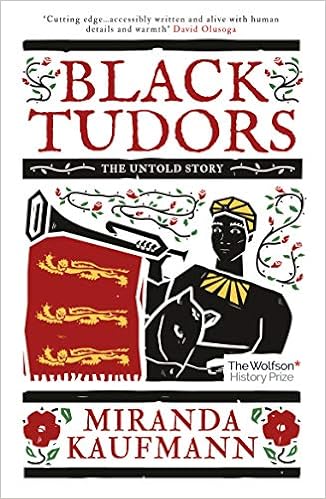
Black Tudors: The Untold Story by Miranda Kaufmann

Black Tudors: The Untold Story
by Miranda Kaufmann

This is the kind of history and historical writing that excites me! Kaufmann’s Black Tudors is a gem because of its topical focus, that is, centering black history, its accessible language, and smooth, flowing prose. I was very excited to read this book and it exceeded expectations!

Black Tudors is split into ten content chapters, bookended with an introduction and conclusion. Each chapter focuses on a specific individual, a black person who left a mark — sometimes a small one — in the historical record for us to find. These individuals were not lords or aristocrats (like Alessandro de Medici, Duke of Florence), but ordinary working folks who came to England through a number of avenues: trade, servitude, attached to diplomatic entourages, etc. While each chapter focuses largely on the individual who lends the chapter their name for its title, Kaufmann also includes evidence of other Black individuals from North and West Africa, the Southern Mediterranean, the Middle East. The result is a rich historical landscape of a hidden minority community and the cultural, social, and political context of their Tudor world.

The reader gets a textured, almost tactile experience of Tudor life, not from an aristocratic or royal perch, but from below. Kaufmann grants the reader entry into the working, merchant classes, into the world of the laborer, the Tudor servant class. This is a culture without a “middle class” in the way in which we understand the term, but there is a servant class, a working class, a peasant class, a mercantile class. Kaufmann gives us a view of these worlds from within and through the lens of foreigners, Africans, and Muslims.

Kaufmann adds to a growing number of histories which add color to the whiteness of European history. It joins the work of Marc Matera, Olivette Otele, and others which have and continue to excavate blackness in a traditionally white-centric history. That said, this is hard work; the act of research in these kinds of histories is difficult as so many layers need to be peeled off to discover hidden individuals in the historical record. I fully acknowledge Kaufmann’s effort and applaud their thorough research.

As an example of historical method and empiricism, Black Tudors shows the reader how to weave a history and a prosopography from very little archival material. This makes this book an excellent historiographical case study for an under– or graduate level seminar on historical methodology.