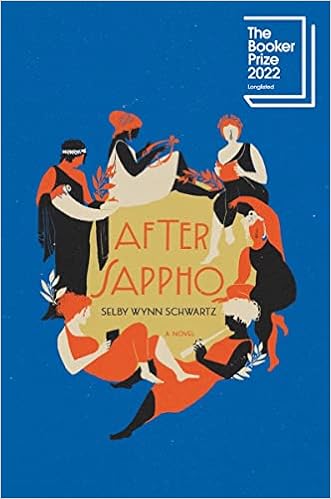
This is a deeply intellectual tale, one woven out of ancient and Italian history, imagination, and philosophies of Womanhood and queerness. The fiction in these pages reads as a reimagined history of real women, whose lives were lost to us because of the threat they posed (just by being) to European and Italian patriarchy. The tale unfolds as a kind of immortal telling of several lives, connected to a single soul. It is multigenerational and historical. There are several “Sapphos”.
As a historian, I deeply appreciated the embedded histories here: legal, social, cultural. There is a historiographical element to the book, an unfolding of a trajectory of thought as the book follows “Sappho” in her various guises and incarnations through time.
This is not an easy read. There is a required pre-existing understanding of Italian and European literature necessary to grasp its nuances. But, that said, the undercurrent of desire, rage, and feminist ambition is hard to miss. For that reason, After Sappho is worth both an initial and several re-reads.
By page three, I was hooked. The ending comes to a perfect, organic conclusion — but I readily admit that if Dumas writes a sequel, I’m all in.
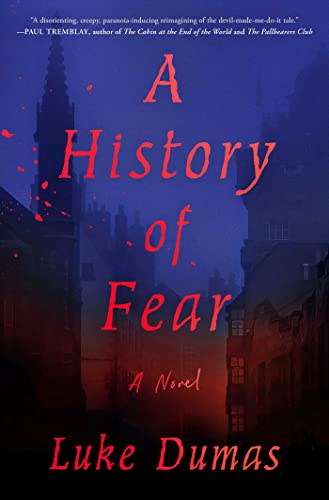
A History of Fear unfolds like Stoker’s Dracula, adopting an epistolary approach, delivering the story via journal entries, letters, official reports from doctors, prison officials, and newspaper articles. The novel dives deep into the most disturbing parts of human psychosis reminiscent of Dostoevsky’s Crime and Punishment. It delivers gothic horror too, in the manner of Shelley’s Frankenstein. In the end, the reader can’t be entirely sure of who is the monster, if demons are real, if evil is more human than we comfortable with. A History of Fear is a horror fan’s feast: gore and psychological terror stride side-by-side, the paranormal and the divine and the mundane intertwine to create a world the reader is never entirely sure is real. Illusion may very well be reality… or worse.
But the story is not fantasy; there is a real history embedded in this novel — and a commentary on a history of monstrous bodies, sexuality, religion, and intergenerational trauma. There is a reality underlying the one Dumas weaves for us. This is what makes the novel so appealing; there is a real horror here, one that we can recognize. This history is one that might be so common as to be truly terrifying because it might actually exist within ourselves. Or someone we know.
A History of Fear follows the main character’s slow descent into madness — or his ascent into clarity, depending on your interpretation. There is a true mystery here and this drives the story forward. The reader needs to discover what the main character also seeks: some sense of closure and parental acceptance. The main character is driven by a need to know themselves and their past. This is a genealogy of a family and the homophobic culture of the West. Dumas focuses on the psychological damage inflicted on those who deviated from the dominant norm and those who dared to question their place in it. The novel travels between the past and the present, each part of the jigsaw puzzle adds to the image of the whole of time, allowing the reader to witness the unraveling of the man’s mind and the suffering caused by intergenerational trauma.
The novel opens with the main character’s eventual, inevitable fate; this is the mystery. We know what happens to him. The mystery is why and how. The horror is the long arm of intergenerational trauma.
A wonderful book to have read in October, the Halloween month, but really, a fantastic gothic horror for any time of the year.

 Dr JoAnn LoSavio