The Time Tourists: A Novel by Sharleen Nelson

Book One of the Dead Relatives, Inc. Series
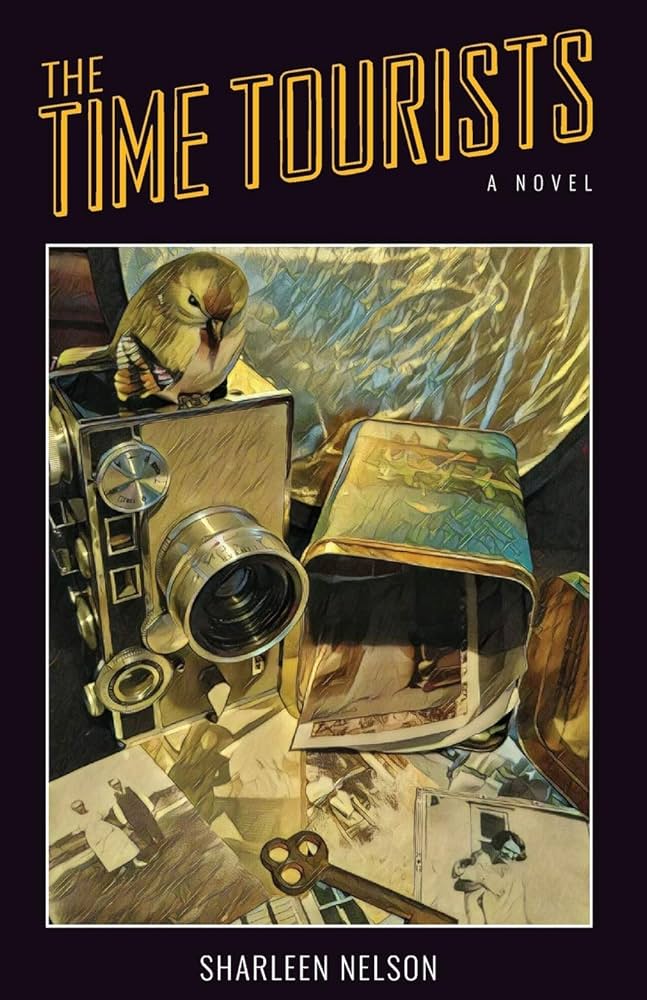
The Time Tourists: A Novel by Sharleen Nelson

I am thrilled to be reading and reviewing a novel written and published by a local PNW author and independent press. This is a backlist book from GladEye Press, having come out in 2018, but The Time Tourists deserves another round in the limelight.

Readers of speculative historical fiction in the vein of Dr Who, and especially those who delight in time travel, with all its peculiar possibilities, will enjoy this novel. The Time Tourists centers on the concept of time travel through photographs, revolving around a particular set of individuals who have discovered how to both profit from this and use the skill to provide closure for descendants living in the present. Specifics about the process of time travel are murky; this is not purely science fiction, the novel leans toward historical fiction and mystery over the former genre. At the core of the novel is a young woman, Imogen Oliver, who discovers she possesses this rare ability. Through her adventures into the past, she assists people in finding out about their ancestors, retrieves items lost to them and their families — and, perhaps most importantly, learns that her parents’ disappearance is not all it seemed to be. Indeed, the novel ends on a cliffhanger, encouraging the reader to seek out Nelson’s second book, The Yesterday Girl.

Readers should allow the novel time to unwind; it does lead to a very exciting mystery. But, perhaps because The Time Tourists is the first novel in the series, readers may find the first eight chapters, fifty-odd pages, a little more heavy on exposition and slow-paced than expected. In these chapters, Nelson provides a thorough, but sometimes plodding, outline of Imogen’s personal history and life. I found this section of the novel somewhat confusing: Is this a Young Adult novel? A Coming of Age bildungsroman? When do we get to the time travel part? As a lover of historical fiction, the contemporary focus lost me periodically. Indeed, it was not until page 92, the beginning of Chapter 14 that I began to find the novel intriguing. And, to be honest, it wasn’t until the last line on Page 147: “Leeroy Jenkins, my ass,” that it gripped me. The novel comes off as episodic; it reads as two separate novels rolled into one, which a significant chunk of the beginning serving as prologue.

The reader will be quickly introduced to Imogen’s friends and family, parents Niles and Francis, her Grammy, friends Fletcher and Jade, but also others within her orbit who have less kindly motives and personalities. Theodore Diamond and his mother, Mimi Pinky, are neighbors who have lived nearby for several years. As the novel progresses, readers will become abundantly aware this is not a juvenile novel; it borders on the cusp between Young Adult and Adult. Similarly, readers should be aware the novel also raises and explores toxic masculinity, incel “male-rights”, sexual abuse, child abuse, mental health, and death. Should these be your triggers, this novel may not be for you. That said, Nelson weaves these dark ideas into the narrative arc of the story exceedingly well, and they are central to understanding the characters, their motives, and behavior.

On that note, Nelson’s characters are well-crafted and possess depth, though in several parts of the novel, expository details run long and sometimes derail its flow and pace. As a consequence, the novel sags in some parts, requiring the reader to push on to pick back up the story’s arc. (Non-American readers may find the pop culture references do not add to the characters’ development in ways that American readers might.) Historical references, on the other hand, do provide the novice historical reader with plenty of context. Nelson’s handling of the disparities in cultural differences and historicity are especially appreciated by this reader, though as noted previously, historical exposition slows the progress of the story. Just as readers should not expect a heavy dose of science in this fiction, readers should not expect scholarly content, though it is clear Nelson has done a significant amount of historical research.

The final third of the novel is where the real excitement begins, and Nelson maximizes the mystery that has brewed in the first two-thirds. All the threads that have begun earlier come to an explosive, emotional ending, one which — I think — will satisfy most readers and leave them wanting more.

Readers who would like to purchase this novel may do so on Amazon here, or find it on GladEye Press’s website here. At present this 387-page novel sells on Amazon for $11.09 for the paperback and $5.99 for the Kindle ebook, and on the press website for $14.95 (paperback), where buyers also have the option of having it custom signed by the author for an additional $3.
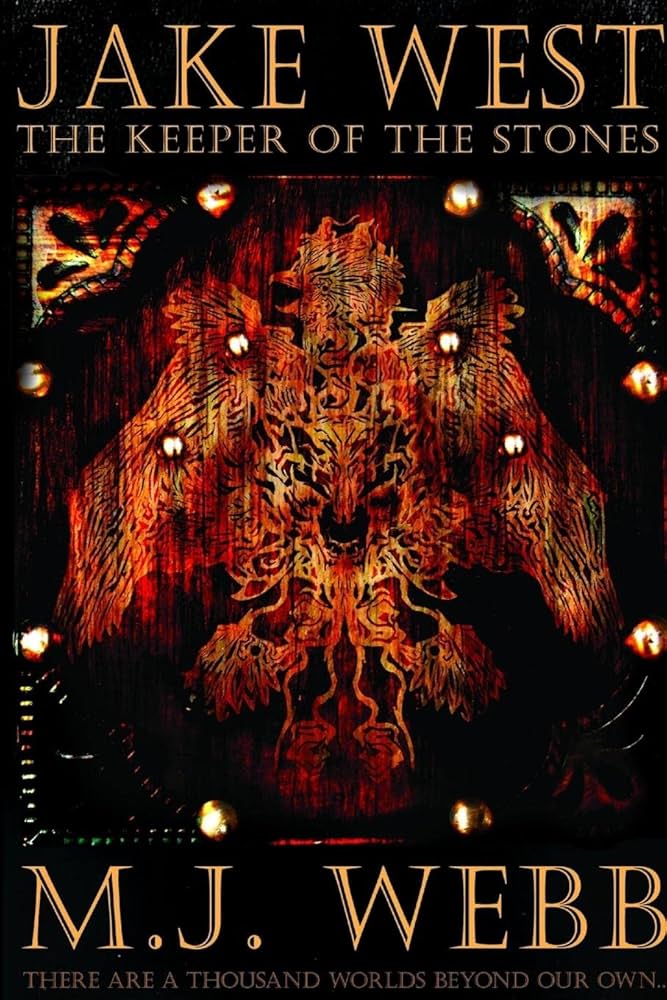
Jake West: The Keeper of the Stones by MJ Webb

Book One of the Jake West Trilogy

Jake West: The Keeper of the Stones by MJ Webb

As I delve into self-published and independently published novels, I am also exploring outside my usual genres. I won a giveaway of this trilogy from a FB Group and was thrilled to have a chance to read a fantasy, Young Adult series.

The Keeper of the Stones introduces readers to the world of Rhuaddan, another world that exists in parallel to our own. It is a world torn to shreds by war, and Jake West belongs to a rare clan of humans who have been blessed — or cursed — with the ability to travel between this world and our own. Jake and his friend Ben discover this rare talent while rummaging through Jake’s grandfather’s attic. The results are catastrophic — and adventurous! The novel leads the reader into a world of high fantasy, a quest-driven journey of these two human boys through a non-human world as they seek to protect stones which could lead to the destruction of worlds. I will leave the reader to discover the consequences and ending themselves (hint: there are two more books in the series!)

This Jake West novel would appeal to those who enjoyed the classic, The Lion, The Witch, and The Wardrobe by C.S. Lewis and the rest of the Narnia novels, as well as those who appreciate the classic fantasy realms in J.R.R. Tolkien’s Lord of the Rings novels. The Jake West trilogy draws from both of these classic series, producing a narrative along similar lines; though, of course, the world of Rhuaddan is unique.

The story aside, Webb’s prose is smooth and error-free. Some parts feel plodding, offering — in this reader’s view — a little too much exposition that does not add to the characters’ development or the development of the story. Its pacing was slower than this reader would have liked; in several chapters I wished for less exposition and world-building, and a more rapid unfolding of Jake and Ben’s story. But, this is likely because world-building is not a particular favorite subject; fantasy is not my cup of tea in general. That said, Webb provides ample world-building and a fully fleshed out landscape for the fantasy reader; as a historian I deeply appreciated the attention to Rhuaddan’s past to understand its present. Overall, Webb’s writing is sound and its language is well-suited to its audience of young adults.

Now, onto Book Two…

High Bias: The Distorted History of the Cassette Tape by Marc Masters

High Bias: The Distorted History of the Cassette Tape by Marc Masters

What I’m going to say is unusual for an academic, peer-reviewed book (brace yourself): I’m buying this book as gifts for my non-academia friends. Whaaaat? No one buys academic books for fun and certainly not for non-academic friends, people who couldn’t give a chuck about literature reviews and theoretical frameworks and nuances and problematizing blah blah blah blah….

While published by University of North Carolina Press, as a very well-researched, stunning piece of scholarship, High Bias makes for an amazingly refreshing, smooth, and interesting work of non-fiction. It is one of those rare books that is entirely suited to an academic audience as well as a general adult readership.

Some of this is due to the subject matter. Every generation has its nostalgic artifacts; music in particular — and here also, its mode, the cassette tape — is one that reaches across many divides. Regardless of our individual tastes in music, those of us who grew in its era can relate to the tactile use of one. The book triggers a muscle memory in both our brains and fingertips. As I read this book I could recall with vivid clarity how the grooves in my cassette tapes felt as I twisted it around to switch from Side A to Side B, or vice versa.

Sentimentality aside, High Bias delivers as a stellar piece of academic scholarship.

The book is divided into and introduction and seven chapters. The first two detail the physical history of the cassette, its development and rise; chapters three and four explore how music travelled in the real world, as dubbed music, from one hand to another. These chapters pay especial attention to the cassette and its involvement in the evolution of hip hop, rap, and DJ music. Chapter five takes this exploration further, beyond American shores, to trace the cultural impact of cassettes on music and its distribution in other places: Turkey, Southeast Asia, and so on. What struck me about these chapters is how the cassette functioned as a mode of connection between people in far flung places. Chapter six ends this discussion with the thing that most of us remember: the personal mixtape. Chapter seven leaves the future of the cassette open; aptly titled, “Tape’s Not Dead.”

Masters draws from oral histories, interviews, archival text, as well as published texts and articles from the last half of the twentieth century; this is a multiple material culture approach to the topic, one that is likely necessary due to the nature and era of the cassette. Masters’ scholarship has breadth, even while — as mentioned earlier — it deftly avoids the pedantism typical of most academic books.

Masters’ prose adds to the accessibility of this book. It reads like a podcast, something I might expect on cassette from a friend who says, “Hey, you gotta listen to this,” and slips it into my bag. The words flow and paint a palpable texture of the many lives that have created and been touched by the cassette and the music it contained.

I’m going to go now and put this book on my Wish List. I want a copy for my personal library.

The Skin and Its Girl: A Novel by Sarah Cypher

The Skin and Its Girl: A Novel by Sarah Cypher

The Skin and Its Girl is a creative feat, a unique novel even within its genre, literary fiction, a genre well known for its diversity and breadth. Perhaps for that reason, this is a novel for a selective reader, one who does not possess fixed expectations or a very firm hold on the physics of reality.

This is a book of metaphors. It is literary fluid.

The novel revolves around the existence of a girl who should not exist, a girl with blue skin. It is an epistolary novel, written by the girl to her aunt, a woman who has functioned as her mother, guardian, defender. The blue-skinned baby is born into a world, her personal individual world is marked by the disintegrating relationship of a man and woman, her father and mother. Much of the novel revolves around their sheltering of their child and the tensions produced by varying relatives’ opinions about the girl’s interaction with the world.

Being written from a child’s perspective, though in retrospect, the novel’s prose possesses a kind of surreal, dream-like quality. Conversations are sliced into snippets, images are partial and incomplete, events are smudged down to the primal feelings they invoked, much as things might be in memories. But — and this is where a mature, independent reader will find the novel intriguing — this incompleteness allows and challenges the reader to sift through these bits and pieces to find the connections that bind the protagonist to her aunt, to her mother, to the world at large “out there” that she is prevented from seeing.

I will leave it to the reader to see what becomes of this strange blue-skinned girl.

Overall, my review is a mixed one; its creativity is singular, but its delivery is difficult. Much of the story unfolds slowly and without a predetermined destination, yet, this mimics the life it documents — a life that is not meant to exist, has no purpose but to simply be and by being is an affront to others’ sense of being.

Contracted Together: A Novel by Jyoti Dhanota

Contracted Together: A Novel by Jyoti Dhanota

Contracted Together, a young adult romance novel, is a step (or two!) out of my usual range of reading; I encountered the novel via a Facebook group that runs regular reviews of independently published or self-published writing.

The novel revolves around a pair of ill-fated marriage partners. The term “lover” would be a stretch here, since Zavian and Mona’s union is premised on a legal arrangement, a contract lasting for a year, during which Mona agrees to play Zavian’s wife in public, with none of the private affection, sexual expectations, or even, friendship. This is a spin on the classic Hate to Love trope. Indeed, Zavian finds his bride — in his words — “annoying” even as he betrays a softness for those same characteristics. The pair’s relationship — strained though it already is — is beset by a strange set of circumstances: estranged parents, exes, their own proclivities towards workaholism or romanticism, expectations of the other. I will leave it to the reader to discover the end results and what happens to Zavian and Mona.

Out of a total possible 5 stars, my overall rating is ⭐️⭐️⭐️

My review of Contracted Together is mixed; on one hand, given Dhanota’s biography and stated intentions of the novel and their writing (as a whole), there is much I was left wanting. Yet, on the other hand, the novel has great promise and delivers on a number of other points.

The novel has been well-edited and is grammatically sound. Dhanota’s writing is technically very good, and the language and vocabulary chosen is suitable for its stated audience. The novel’s premise is also attractive. It opens with an immediate hook, framing Zavian’s life and relationship to his family in an unusual light; the premise of a contract marriage is also a successful lure.

The novel possesses a great deal of promise. However, the substance of the novel does not deliver. The novel’s detractions, in spite of the above positives, dulled the experience of reading it for me.

The novel, even as a Young Adult work of fiction, runs towards the superficial. Its main characters need deeper development. For example, Mona’s requirements of Zavian are shallow, and her motivations behind agreeing to a contract are unclear, leaving the reader incapable of understanding what Mona hopes to gain from this connection. Moreover, the absence of her own family and their opinions on her decision to agree to this contract is a noticeable gap in the story’s logic.

Some of this superficiality is conveyed to the reader through the characters’ dialogues, which lack individuality. Zavian’s narrative voice is too similar to Mona’s. Their conversations also, lacked depth, sounding more like teenagers’ casual conversation than that between two young adults (one being a CEO and the other a Kindergarten teacher). Zavian and Mona are petty in their arguments, their concerns betray a fundamental immaturity that readers may expect young adults to possess, or at least, be in the process of developing. The character’s narratives lacked interiority, and a sense of the character’s awareness of self. Ultimately, this surface-level characterization of Mona and Zavian failed to convey what was really happening in their hearts and minds, and dampened the romantic tension that would have made the hate-to-love trope here more successful.

Dhanota’s intent (as stated in their biography at the end of the novel) is to bring Indian culture to the fore, to examine and challenge Indian practices and societal norms; however, the novel itself does not provide context or direct allusions to those norms and societal expectations. The novel would have benefited from an inclusion of these ideas and Indian culture, not as a separate section, but woven into the fabric of the novel itself. Such descriptions would also have added more texture and individuality to the novel as a whole, as a uniquely Indian romance.

Readers who would like to read the novel for themselves, and draw their own conclusions, can find it on Amazon here where it is currently priced at $16.99 for the paperback and $4.55 for the Kindle ebook. It is also available via Kindle Unlimited.

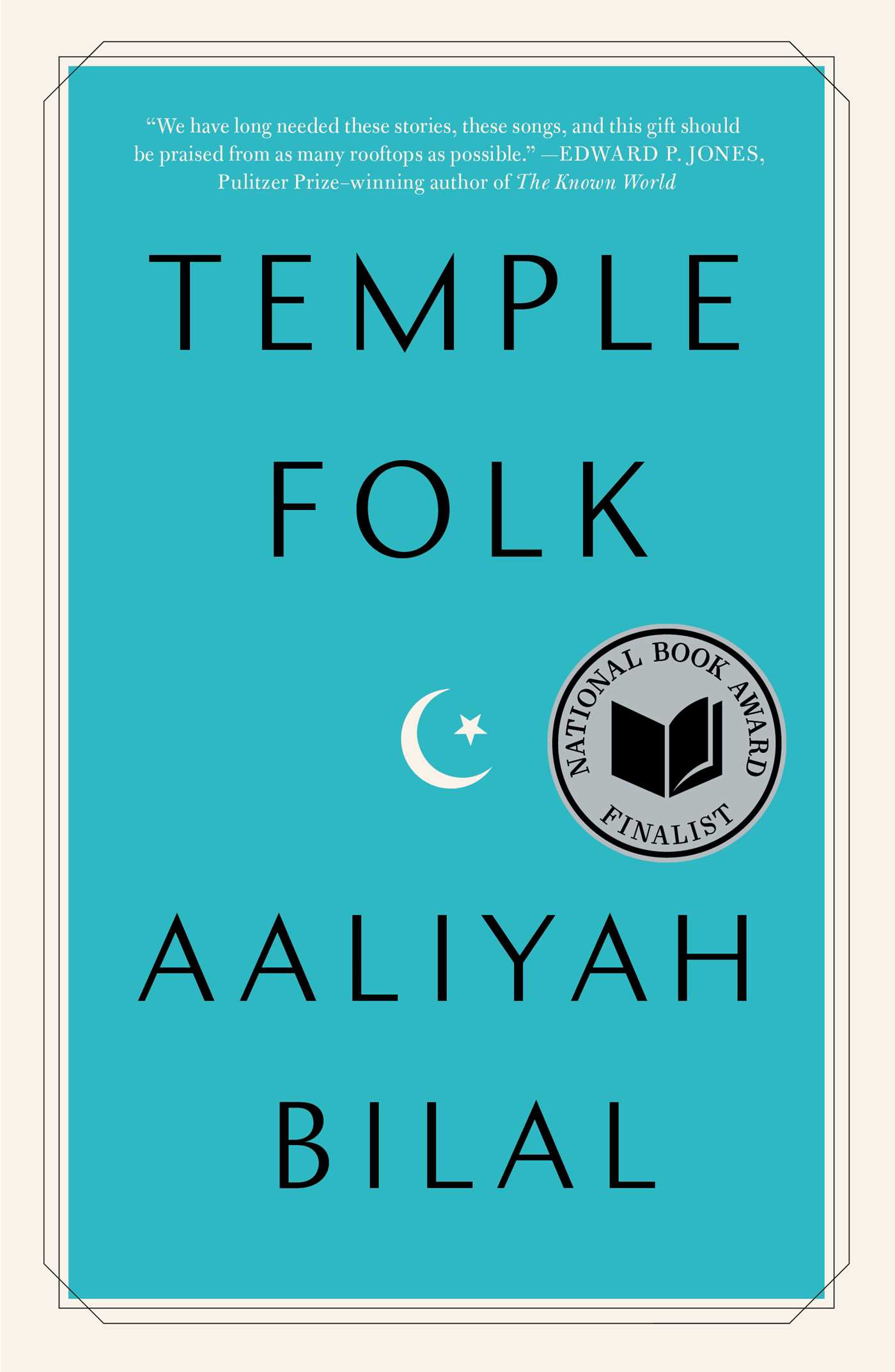
Temple Folk: Stories by Aaliyah Bilal

Temple Folk: Stories by Aaliyah Bilal

Marketing being often exaggerations, I rarely pay attention to the endorsement blurbs on covers; but, in this case, the quote is right and right on target. We — society as a whole, and especially readers of color — have long needed stories like these in Bilal’s collection, stories which reflect a way of thinking and life beyond the literal pale (read: whiteness) that has so long been taken as the norm in literature.

Literary canons still rarely feature writers and stories of diverse backgrounds, genders, and identities, and the term still conjures an Eurocentric image. Bilal’s collection is a balm, not a bandaid; a healing wound, not a scar; a mark of beauty, not a blemish. It highlights this paucity in modern literature and offers a concrete solution towards developing a greater oeuvre of our human experience.

The opening tale in Temple Folk orients the landscape of the collection as a whole: it centers on an interstate bus ride. The bus is filled with faithful black and white Muslim-American women, chartered to bring them from their small hometown, across a rural and white-dominated expanse, to Chicago where a Muslim conference will be held. This is a community unto itself, though it exists — consciously — as a part of white, Christianized America. Readers are given a privileged view into this world within a world.

The other tales highlight the daily, lived experiences of the citizens of the Nation of Islam. As a whole, these stories bring to the fore the intersection where NOI citizens, black denizens within their world, and the non-NOI, non-Muslim white world meet. Bilal presents the reader with scenarios where the whiteness of a child confronts the blackness of a woman, and what this might mean within the context of a religion that is often positioned adjacent and not central to the black/white politics of our era. Bilal pokes at the humor and seriousness of dating in the muslim world, knowing the gendered expectations of muslim women and men the reader is likely to filter her tales through. Bilal encourages a shift away from that pockmarked lens, offering a clearer view if the reader is willing to remove the glass from their eyes.

Indeed, most of my favorite stories were premised on a collision of modern, American ideas of empowerment and feminine identity, with Orientalist stereotypes of Islam and Muslims. But, the unique feature Bilal brings is a side-sweep which softens the collision and creates instead, a merger. Modern Muslim identity is not at odds with Islamic traditions and cultures (though it can be), nor do modern muslims (men, women, children, and all alike) need to make choices between their Blackness, modernity, and Islamic identities. In performing this clever maneuver, Bilal introduces the reader to a much more nuanced world of Black Islam, likely one that they have not seen before. Certainly, for this reader, this was the case.

The Blackout of Markus Moore: A Psychological Thriller (Novel) by Dan Grylles

The Blackout of Markus Moore: A Novel by Dan Grylles

As I expand my literary horizons out to self-published and independently published novels, I find myself also drawn to genres I wouldn’t normally choose for myself, in this case, thrillers. I’ve only ever occasionally read mysteries and thrillers, though in retrospect, after reading them I find I’ve deeply enjoyed the suspense.

Suspense is one of the appeals of The Blackout of Markus Moore and it has it in abundance. Indeed its mystery is spun out to the very end. For readers who enjoy domestic thrillers, reflective and tortured unreliable narrators, and edge-of-your-seat urgency, this is the novel for you.

The novel opens — and reads — like a blockbuster film, with a bang (literally) and the blackout of the its eponymous protagonist. Markus is blind to his past, to his present, and finds himself chasing who he is just as much as he finds himself being chased relentlessly by others. This is a man born under an unlucky sign, but there is the possibility that he has designed this complicated constellation himself — and is now the victim of his own making. Readers may find themselves both rooting for and against Markus; even he himself isn’t entirely sure of his role in all this mess. I will leave it to the reader to discover the outcomes themselves.

But they should know there is little time to catch their breath; the novel accelerates, rather than slows down. There is no lull in this thriller. Moreoever, it culminates in an unpredictable, surprise ending. At 256 pages, the novel delivers its payload quickly, which, for some readers who dread heart palpitations, this will be a relief. Though, I imagine, most readers who favor thrillers will love the breath-catching factor of this novel.

Grylles’ prose sets the quick pace of the novel; it is straightforward and succinct, even while it permits the reader — and the novel’s characters — time to ruminate and reflect on events. This is a plot driven novel which proceeds much as a film of its genre would, with one thing leading catastrophically to another. That said, its characters — Markus, Maria, Clark, and even Jackie — are fully fleshed out individuals, visible to the reader both in terms of their physical representations and as players in the fatal cat and mouse game that runs Markus into a frenzy.

Overall, The Blackout of Markus Moore is well-crafted, both in its delivery and conceptualization, a true seat-gripper of a thriller. Readers who would like to purchase it may find it on Amazon here in paperback for $11.99 or read it as an ebook via Kindle Unlimited (subscription required).

Late Bloomers: A Novel by Deepa Varadarajan

Late Bloomers: A Novel by Deepa Varadarajan

I absolutely loved reading this book! The story and the characters, wanting to see what happens next, what happens to them, and how the family members reconcile their differences, drove me to finish this novel in two days — only because I could not forestall sleep!

Late Bloomers is a novel about an Indian-American family: Mom, Dad, Son, and Daughter. Mom and Dad are immigrants from India, and after 36 years of marriage, they divorced. Son and Daughter are still trying to wrap their heads around that event, and accept that both parents are now exploring the world of Single Dating. Dad, in fact, is exploring the world of online dating, while Mum has gotten a job for the first time and is making new friends who may or may not have more romantic interests in her. Meanwhile, their eldest, Daughter Priya, is unhappily single-ish and caught in a tangled romantic loophole — and (horrors!) remains unmarried. Their son, a super successful lawyer in NYC, is married, partnered to an incredible woman, and the father of a bubbling infant. But, maybe that’s just the surface.

Indeed, surfaces and the depths they disguise is a major theme in this deliciously contemporary family drama. It revolves around traditional Indian motifs and cultural norms, but really, anyone can relate to the sentiments, concerns, emotional upheavals Late Bloomers brings to the fore. I loved that this focused on Indian-Americans, and the trials of living with a foot in two worlds. Indian culture was infused into the book, but in such a way as to tap into the universal experiences of people all over the world. Readers of all ethnic backgrounds will be able to relate to this novel and easily.

Varadarajan’s prose is smooth and natural, the characters live and breathe as if just inches away from us. We can feel their irritation, recognize it as an emotion we often feel – and often about those closest to us. Likewise, Varadarajan makes their love for one another palpable. These are people stumbling, bumbling, grasping at themselves and each other in the most lovable ways, trying to make sense of change in their lives.

For readers who love a bit of family drama, hilarious nonsense, and good endings, Late Bloomers is a fantastic read.

Cities of Women: A Novel by Kathleen Jones

Cities of Women: A Novel by Kathleen Jones

This is a historian’s historical novel, in every sense of the word. Not surprisingly, is is written by a former academic; Kathleen Jones began her writing career as a political scientist and professor, before turning to literary fiction. Cities of Women is a seamless blend of these two domains of their experience, reflecting a deep respect for the scholarly pursuit of history while offering readers a deeply textured and emotional perspective of the past.

The novel toggles between the modern present and the medieval past, beginning with a tenure track historian’s search for her place in the academia. Verity Frazier then encounters, by chance, that rare glimpse of an undiscovered history. This is the sort of thing historians dream of when they enter archives; Jones portrayal Verity’s hope and desire is palpable — or perhaps that is just my historian’s heart set aflutter. Buried, like so many women of his age, is the presence of a female illuminator, Anastasia.

The unfolding of Verity’s archival adventure draws the reader into a world that is both exotic and familiar. Verity and Anastasia (like us all) live in a patriarchal world, one which fails to take women seriously, which gaslights us, and forces us to make undesirable choices. This is a feminist novel, bringing to the fore these age-old prejudices and the battles women must fight to be heard, seen, remembered.

Then novel also contains more than one beautiful and flawed sapphic romance, highlighting the containment and self-sustaining world of womanhood. This is the beauty of Cities of Women; it is an illumination of women, an honest portrait of women’s struggles and successes, a tale of oppression and empowerment as the two sides of our collective experience. Readers should know this realist capturing of the female experience may trigger; who among us cannot point to some evidence of trauma in our lives?

Indeed, Jones’ characters are as made of flesh as ourselves, so well does her characterization reflect the depth of her historical research and her skill as an author. We can feel Verity’s pain, the elasticity of Anastasia’s tenacity, Christine’s boldness and pride. We can also recognize the women around them, the friends who succumbed to the status quo, the colleagues who share in the frustration of being a woman in a man’s world, the lovers who boost us and tear us down.

The novel revolves around these women and their lives, and as such, being character-driven, moves at a languid pace, stretching the length of lives for some characters and capturing mere months of others. Time, in fact, is fluid in this novel, a kind of ephemeral backdrop; the lives Jones tells us about cut across time, flatten it. Women have then, as now, experienced much the same things.

Dialogue between the characters is seamless, perhaps too much so sometimes; I was left wondering if people really talk like this? But then, the world is wide and there are many in it, so perhaps they do. Or perhaps Jones is referencing the physic unity between women, so One-Of-Mind are we that our words may zipper so flawlessly together. Overall, however, Jones’ prose is splendid, mature, and expressive; it is smooth, flowing, and sensuous in many parts. Readers will find themselves cradled in gorgeous text throughout.

Into the City: A Novel by E.J. Cook

Into the City: A Novel by E.J. Cook

Ooo! The twists in this novel! You think you have it figured out and then — WHAT was that? The ending leaves the reader feeling both vindicated and wanting more, the perfect cliffhanger for a series starter.

Into the City is a Young Adult novel, not my usual cup of tea, but I do enjoy the occasional dystopian read — and this is indeed a dark and crumbling world Cook portrays. The novel is set in the near future, in a world ravaged by an illness which attacked only its adults and left its juvenile and adolescent population intact. Intact but not unscathed. Children and teenagers left to their own devices and survival created a society in which there coexist the extremes of cruelty, embodied by the militant Lyths and drug-addled Crazies, and kindness, a small but growing community of Arkers.

Our protagonist, a young girl named Lexi and her friends, Aster, Nate, Ruby, Eden, and Marcus are inexorably pulled into this world of dangerous extremes, lured by the promise of a utopian society and their need for community. Into the city they must go. And it is there that they discover not only the origins of their fate and a new promise of their future, but also themselves. There, in the city, they must confront their past trauma, test their values, and — above all — survive.

Cook’s storytelling is on point, unravelling the tale at a quick and lively pace, matching the urgency of the characters’ lives. Likewise, Cook’s prose is well-crafted for a young adult audience, being straightforward and succinct, allowing for both the reader’s organic imaginings and providing ample description of the landscape of this dystopian world. On occasion there is the use of an overworked metaphor or simile, but this is a minor complaint given the audience it targets. These phrases have yet to jade the Young Adult reader, and indeed provide familiarity and structure to the tropes they are just learning to recognize.

A word on Cook’s characters. These too are well-developed, even as they are drawn from tropes of this genre: they are young, but mature in their self-awareness (no doubt as a result of their life experiences) and their inner reflections are both adult and childlike. The benefit for the reader is that these characters will appeal to both the teenager on the brink of Young Adult and the Older Adult, remembering their teenaged past. Their concerns are recognizable, and cross cut generational divides; we all understand the need to survive and to live with our traumas.

Into The City is a typical and atypical novel of its genre. It satisfies the genre-reader, with their expectations of the dystopian novel, but Into the City does also offer twists and revelations which will draw in the reader to end. There are surprises. What appears simple is not so, as readers will discover.

To purchase this novel on Amazon, click here. At present, this 287 page novel sells for $10.70 for the paperback and roughly $5 for the Kindle ebook. I bought my copy on Kindle for $0.99 during a sale.