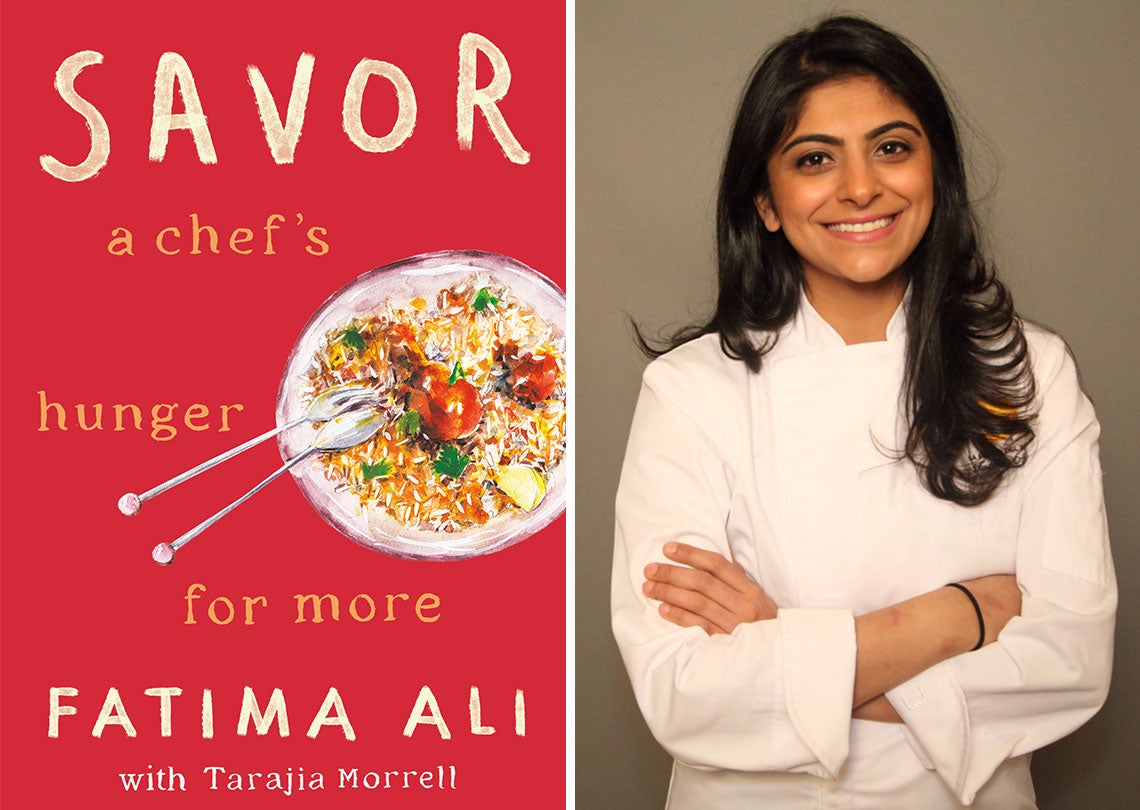
Savor: A Chef’s Hunger for More: A Memoir by Fatima Ali with Tarajia Morrell
It’s extremely difficult to write a review for this memoir. Aside from the tragedy of its author and subject dying from cancer, the content itself is emotionally fraught. But perhaps, for these same reasons, a review should be written as this would be an acknowledgement of Ali’s legacy.
For those who are not familiar with the author and subject, Fatima Ali was a chef and a celebrity one, competing on Top Chef. She sadly and tragically passed away in 2019, before the age of 30. This is her memoir, written with Taraji Morrell who completed it after Ali’s death. The memoir covers the breadth of Ali’s life, from childhood to the very end, with a substantial focus on her career as a chef. The memoir also incorporates Ali’s mother’s perspective, each chapter bounces between Ali and her mother, offering the reader a view into more than Ali’s life alone.
The inclusion of Farezeh Durrani, Ali’s mother and the complex and emotional story of mother and daughter, as Pakistani Muslim women, makes this memoir especially poignant and moving. Through Durrani’s eyes we experience not only the loss of a child and the grief of that event, but also the power and strength of being a woman and a woman of color in a deeply patriarchal and racist world. The intergenerational threads make this memoir, more than a memoir, more than the story of a single person. Savor captures modern experiences of divorce, immigration, transcultural identity, race and racism, gendered expectations and sexism, career and ambition. Ali leaves a legacy with her life and this memoir.
For readers who seek inspiration, emotional connections with their books, Savor will exceed your expectations.
In Daniel’s case, she moves from Nigeria on the coast of West Africa to England, and from there, to the United States. Across the span of three geographic zones, she also crosses into and between multiple cultures: Nigerian, Black-British, Black-American, coming to terms with herself as a bit of everything. Intersected between the racial and ethnic lines are the class lines and linguistic lines Daniel must also negotiate. This is a story of code-switching across multiple planes.
This is also a universal coming-of-age story about how we come to understand perceptions of ourselves from within and beyond ourselves. Who we are is not a singular explanation, but one refracted through a prism, the final view is ultimately dependent on the eye of the beholder and the position where they stand. What Daniel’s highlights in this memoir is both how dependent this view is on historical, cultural, class and geographic context.
For readers who enjoy memoirs and those which trace the processes of identity change, this is a winner.
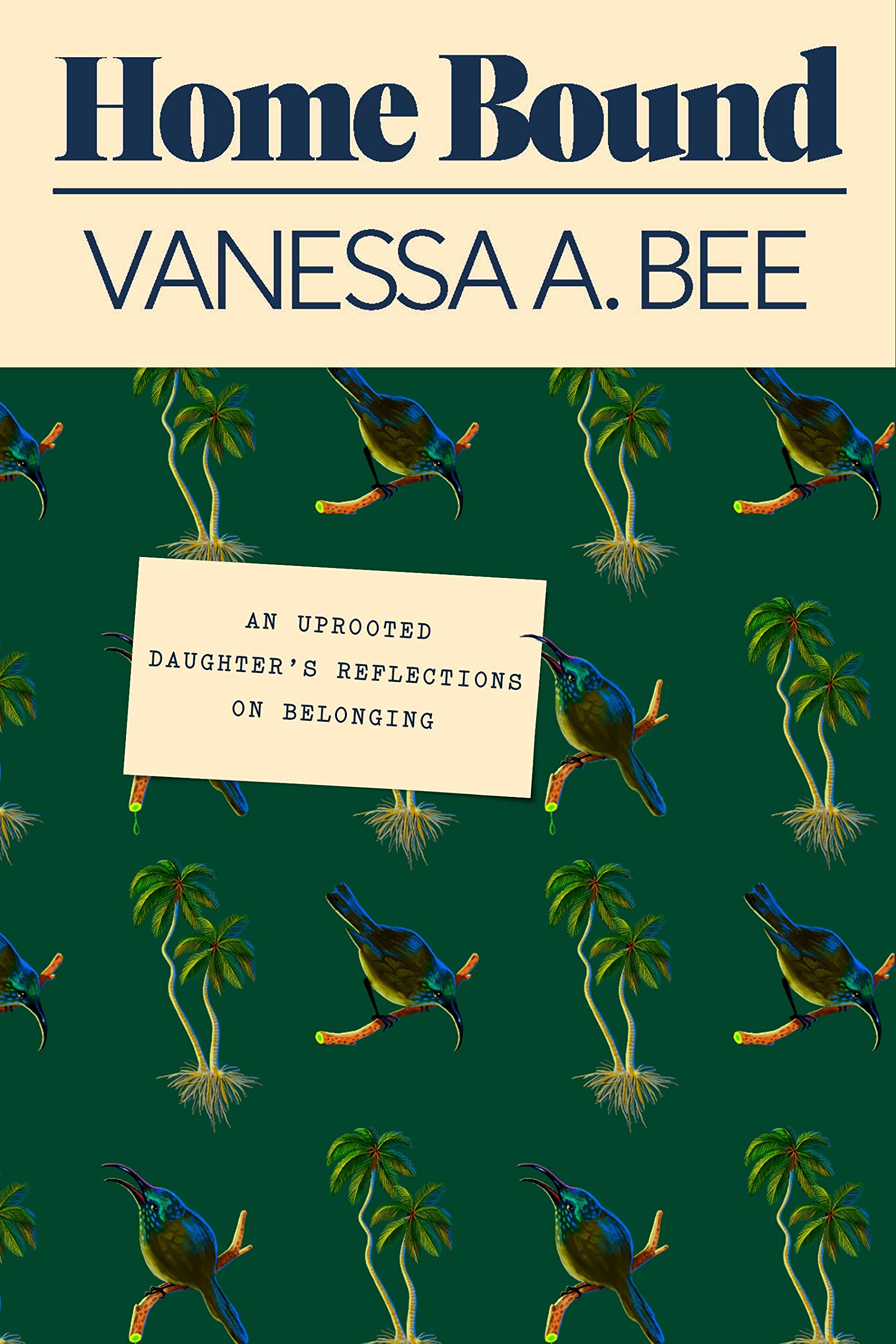
Homebound: An Uprooted Daughter’s Reflections on Belonging by Vanessa A. Bee
It’s been a few days since I finished reading Home Bound and I’m still mulling it over in my head, turning the things Vanessa — can I call her that? Is it too familiar? — has told me. On the one hand, it feels like she and I have much in common: the Spice Girls and Hey, Arnold! are part of the memorabilia of my own 90s teenage years. Vanessa’s memoir strikes a familiar note in many ways. Home Bound is a memoir of movement and migration, transcultural and transnational switching and code switching, and the conflict of culture between places and communities and within a place and a single community. I know that. I’ve experienced that before and now, still.
Home Bound traces Vanessa’s life from her childhood through to the present, across time as well as space. Her life begins in Cameroon, a place she is ever drawn back to (is she as uprooted as the title suggests), but she grows up in France, in a number of places, in a number of homes and neighborhoods. Vanessa disabuses us of any romantic notions of France and how the French live. But then, she makes the point in her memoir that she is only partially French. Her memoir takes us to London where she was more French than English, a mix of Cameroonian and French depending on the location. Then to America, where she becomes domiciled in one of the most American of American states, Texas.
But, of course, Home Bound is more than just a travel log.
The book takes us into deep discussions about gender and what it means to be a woman, what it means to be a sexual being, a sexualized being or object, and how to object to that objectification. It explores mothering and growing up, coming-of-age and what that means when it is done across multiple cultures. The book is also about faith, the religious kind and the internal, subjective kind (“believing in yourself”). Vanessa boldly brings up being of mixed race heritage, discusses adoption and parentage. Lineage is a major thread that winds through the book, guides the reader. Ideas are intergenerational, travel through blood as well as through proximity, from a caregiver to their charge. Education is not merely academic, formal, institutionalized. Home Bound makes it clear that it is more complex than that, it is pervasive within and out of the classroom.
The classroom is a large part of Vanessa’s memoir. I should say, education is a large part of her memoir. The classroom is the locale of her education, the formal kind and the ideological kind. It is here, in the discussion of education and upbringing that Vanessa’s story departs from my own and I feel like I am watching a film of someone else. Someone who feels familiar but is not me.
There is familiarity in the the demise of her American dream. Its death is similar in some ways to what happened to my own. She says in one part how she had thought of herself in some ways as white, having been raised and lived among white people for so long. It’s not an uncommon experience. Fanon was onto something universal when he warned us of masks and disguises that fool no one but ourselves. Vanessa and I both woke up. Then our American dream died, unable to sustain in the reality of 21st century capitalism and American privatization, without a trust fund to help keep it breathing. The classroom had a lot to do with the deaths of our dreams.
I realize now, as I write this, why I call her Vanessa. It seems like Bee isn’t her name. Shouldn’t it is be Billé? And why “A.” and not “Assae”? I suspect this has something to do with the subtitle, Uprooted. For me, the subtitle, AnUprootedDaughter’s Reflections on Belonging, strikes me differently, perhaps because of my academic background in history. The subtitle calls to mind Oscar Handlin’s The Uprooted, that magnum opus of migration history that centered the migrant, their “peasant” origins, and their struggles to find their feet — plant new roots — in American soil. Did Vanessa mean to infer a kind of transition from peasantry into… educated bourgeoisie? I don’t know. I don’t think so. I can’t see it. But uprooted means something. Perhaps it is the violence of being separated from one’s comfortable ideas, coming to terms with the deflation of an illusion; in Vanessa’s case, of her fathers, her faith, her marriage, her trust in men, her color and all that “color” means as it is used to define us in others’ eyes and as we use it to define ourselves.
This is a complex memoir, as complicated as Vanessa’s personal history. It sprawls, but its many parts and tangents cohere to a single theme: Home Bound is about figuring out who your people are and realizing that we will not find a perfect fit in any community. We will belong in some ways, be alienated in others. Some times it is a matter of chronology; we belonged in the past, we cannot belong in the present. Sometimes we belong with strangers, sometimes those closest to us are not those who should have our trust. If I sound bleak, I do not mean to; Home Bound makes it clear that the journey — perhaps for all of us — is complicated — and sometimes it really helps to see how someone else navigated it.
Home Bound is a profound, nuanced memoir well-worth the reading.


 Dr JoAnn LoSavio