American Gun: The True Story of the AR-15 by Zusha Elinson & Cameron McWhirter
This is the book you dread to read, not because you think it will not be interesting (it is) or because you don’t agree with the object its centered on (I’m not a gun owner), but because the subject matter is too real, too terrifying, too… unavoidable. I saw this book and I said to myself, “I have to read this. I don’t really want to, but I have to. I have to.”
I did. I read it. I felt disturbed by its contents. I cried uncontrollably through one of its chapters (on Sandy Hook), and I thought, “This is the history book of our present moment. I am glad I’m reading this.” And I am. I am glad I read it, but it felt like hell to do it.
I’m getting a copy of this book for my personal library. I have to.
Elinson and McWhirter have produced a very well-researched, deeply nuanced, and straightforward history of the AR-15, the ArmaLite semi-automatic rifle designed by Eugene Stoner in the 1950s, as the Cold War threatened to heat up. The first half of this monograph lays out the very mechanical, step-by-step process of politics and engineering that lead to the creation of this weapon and its eventual adoption by the American military. After the chapters on its use in the Vietnam War, the book turns to the political life of the weapon: its feature in the anti-gun legislation and Americans’ varied responses to it and those proposed bans. Here the writers also highlight the life of the gun as it was used in civilian situations, in mass shootings, which began far earlier than most people know in the 1970s and 1980s. It is here that the AR-15 becomes much larger than it is, becomes a symbol larger than itself. The monograph ends with the current debates around the use, ban, manufacture, and cultural life of the weapon.
This is a brilliant cultural history of the semi-automatic gun, from its inception, manufacture, to its bloom as a totemic idea, a fulcrum upon which other ideological debates flux and see-saw as society and its values fluctuate. Readers on any (every?) side of the aisle on the issue of gun control should read this.
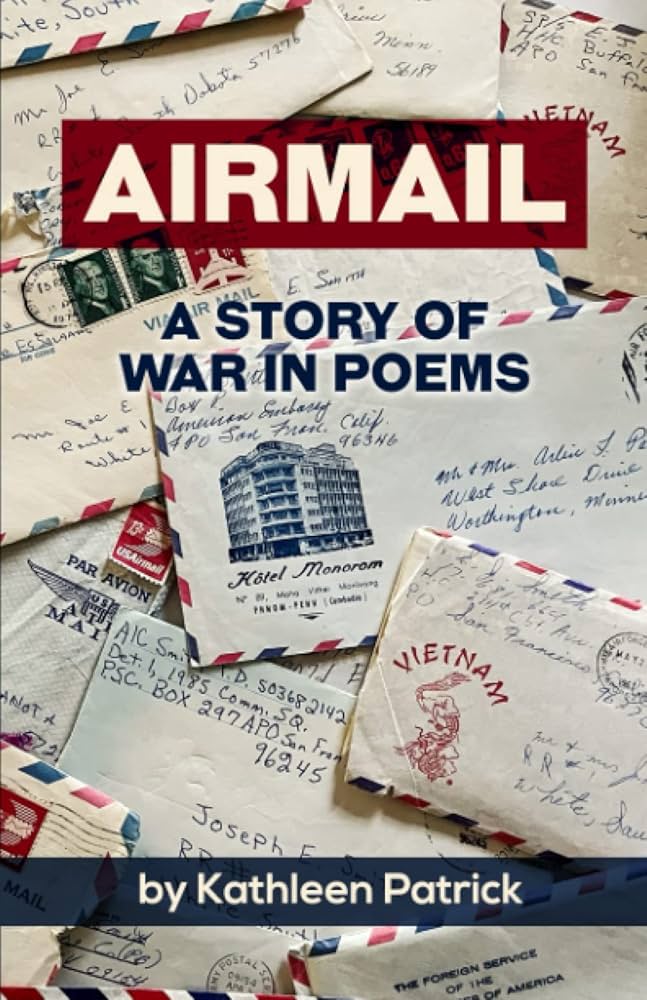
Airmail: A Story of War in Poems by Kathleen Patrick
This is a collection of poems about the experience of American soldiers off to war in Vietnam. It is about the family that they left behind in the United States. It is about the loss and gains of war, patriotism, the inevitable criss-crossing of cultures and people across oceans.
It has been a long time since I have read poetry, and especially since I have reviewed any. Poetry is harder, so much harder to assess. Or rather, its assessment — if that is the right word — is so much more subjective (in one sense) or so much more technical (in another sense).
I’ll start with this: The subject matter of this collection of poems makes an impression on me in ways particular to my personal heritage and profession. I am from Southeast Asia, though not from Vietnam or Cambodia or Laos, the places where the Vietnam War (or the American War, as it is also called in Southeast Asia) took place. I am also a historian of the twentieth century, of Southeast Asian history, of decolonization, and transnational connections between Southeast Asia, the United Kingdom, and the United States. The way I have read these poems — and the way in which I review them — is inevitably filtered through these twin lenses.
These poems are powerful, both as evidence of historical perspectives and subjectively, as pathways of emotion. These poems open up avenues for understanding and seeing the experience of war, beyond the political, beyond the combat, beyond the filter of news.
I especially enjoyed “Voices, A Collage” which spans years and tells us a soldier’s letters home. This is poem about regrets, but it is also about how a family remains connected in spite of the distance, in spite of the pain of war.
“Telegram”, a much shorter poem, was especially poignant; its truncated form permits the reader to come to their own organic feelings and expectations. There is an implication of regret or guilt; an odd thing to say, but I really enjoyed that about “Telegram.”
“Robert M. in the Doorway” struck me as being about the PTSD of war, and for that reason, it was also a favorite. Again, a short poem, but powerful and thought-provoking. “Picking Rock” and “Don’t Forget the Women” brought to light the consequences of war that are often left unsaid; the soldier’s experience is not the only one. These poems made that clear, and sadly so.
What can I say about these poems? They made me feel, and that is — to me — the only thing a poem should aspire to.
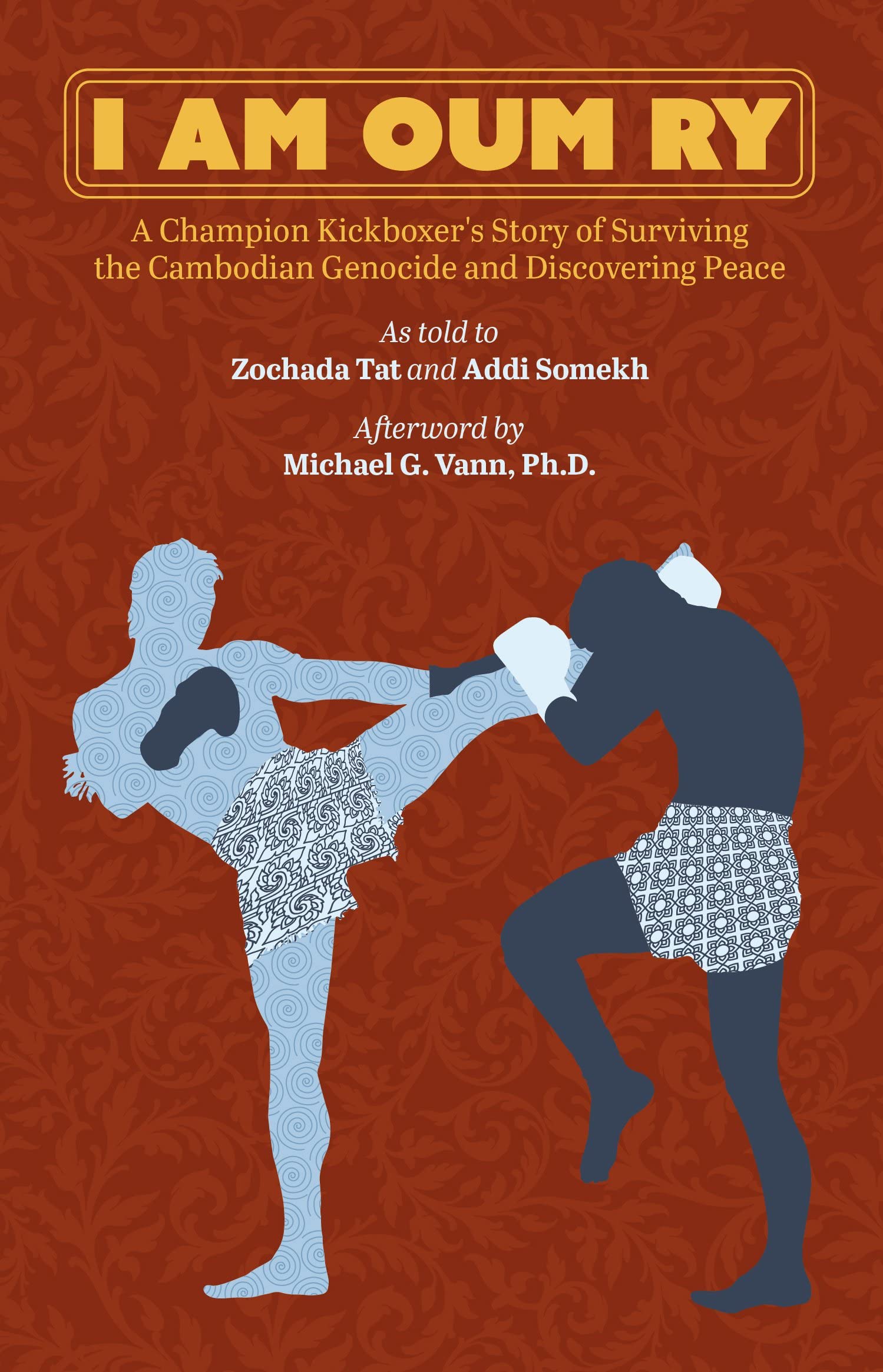
I Am Oum Ry: A Champion Kickboxer’s Story of Surviving the Cambodian Genocide and Discovering Peace by Oum Ry
This memoir strikes hard on multiple levels. It is a reflection of contemporary America and the transnational, transcultural, immigrant experience that many Americans live, whether themselves or vicariously (as Zochada Tat did), as the children of immigrants. Migration is a traumatic event, (sometimes positive, sometimes not, but always) one that reaches across several generations. Oum Ry’s memoir toggles forward and back in time, threading a connection in time between father (Oum Ry) and daughter (Zochada Tat). From this perspective, I Am Oum Ry is an emotional read, a subjective vacuum in which the characters are the primary focus, separate from the context of their world in a way. Tat and Somekh portray Oum Ry, his many lovers, his wife, his children, and the myriad of people who came, left, or stayed in his orbit, in all their flawed perfection; the logics behind his and their behavior as consequences of individualized trauma: parental abandonment, grief of loved ones lost or killed, sexual desire and exploitation.
But people do not exist in vacuum. The individuals in these pages are not ahistorical; they are deeply embedded in histories of patriarchy, Colonialism, the Cold War, the Khmer Rouge genocide, the American/Vietnam War, Cambodian traditions, and collective desires for modernity, belonging, and security.
The memoir takes the reader to Cambodia in the mid-twentieth century, beginning just after WWII. The French stubbornly cling to Indochina. Then ahead to the American War in Vietnam a decade later. It lingers on the five golden years of the 20th century when Cambodia perched on the edge of modernity, part of a larger Southeast Asian moment of revivalism and decolonization and prosperity in the early 1970s. After that the reader follows Oum Ry into the dark age of the Khmer Rouge genocide, and the suffering that followed as Oum Ry, like so many thousands of other Cambodians fled to Thailand to seek asylum elsewhere, anywhere. Oum Ry, like many other fortunate refugees makes his way to the United States where he finds both happiness and deep disappointment. The life of a migrant is bittersweet, filled with hope and longing.
The histories I Am Oum Ry excavates are powerful, a fisted punch to the gut. Oum Ry holds nothing back. The currents of forced migration, war, genocide, and racism that underpin Oum Ry’s words and experiences will knock the wind out of readers. This is an important memoir, not because it is unique — it isn’t, there are many Cambodian-American/Cambodian memoirs written by survivors of the Khmer Rouge — but because it neither indicts or glorifies the past or the present. The Khmer Rouge are not the sole villains of the genocide, though they are largely responsible for the horrors Oum Ry and other Cambodians experience; the Vietnamese and ordinary, fellow Cambodians are part of the horrific milieu of that moment too. America is not hailed as the land of milk and honey; it too is a dark land of racism, crime, poverty, and disappointment. But it isn’t all bad either; Oum Ry and his family find a place in California and become new Americans.
It is also significant in that it highlights pradal serey/muay thai, and centers around this sport. It is unique in this aspect. Oum Ry occupies a unique cultural position as a fighter, a sports icon in Cambodian history and 20th century Cambodian culture; his memoir gives us a rare glimpse into a world of sport and celebrity that was exclusive before the war and certainly much more so afterwards as a result of the loss of so many Cambodian stars.
For me, as a Southeast Asian scholar and a historian of Southeast Asian sport, I Am Oum Ry possesses academic significance. Sport is an often overlooked aspect of history and culture, seen as purely recreational. I Am Oum Ry proves how wrong this assumption is; pradal serey deserves attention as a historical artifact of a lost moment and in the present as a vital element of Cambodian-American identity and Cambodian cultural revival.
For almost every reader, I Am Oum Ry will evoke a multitude of emotions ranging from sad to inspired. Oum Ry’s life has been a rollercoaster in and out of the fighter’s ring. It has been dramatic in positive and negative ways. His is a life worth the reading.


 Dr JoAnn LoSavio