Heartland: A Memoir of Working Hard and Being Broke in the Richest Country on Earth by Sarah Smarsh
Heartland is a memoir at the intersection of Educated by Tara Westover and Nickel and Dimed by Barbara Ehrenreich. For readers who actively seek out trying on someone else’s shoes, Smarsh’s memoir will amply deliver.
Heartland explores the experiences of four generations of women and men in a working-class class family in rural Kansas, delving into their experiences of love, marriage, work, and education. The book is sectioned into thematic chapters, rather than being strictly chronological, covering her family’s peripatetic travels across the state for work, romance, love — and all too often, sanctuary and safety. Readers should know the book discusses abuse and neglect in a multitude of ways; violence is woven in the fabric of these women’s lives, both a symptom and cause of their poverty.
The book includes a massive cast of individuals from both sides of Smarsh’s family. [A family tree map would have been a helpful addition, but this is a minor detraction.] Through this account and interpretation of her family’s history, Smarsh makes an argument for greater attention to the social, cultural, and gendered reasons for poverty in America. She challenges the popular and misguided myth of meritocracy, especially highlighting the multiple ways spousal and domestic violence play an enormous role in this societal problem.
Smarsh’s delivery of this message lacks — thankfully — pedantism or blame, focusing instead on the interconnected web of cultural expectations and histories which have resulted in these outcomes. Her writing also is smooth, journalistic, and easily accessible; in fact, evoking an emotional response from this reader on more than one occasion.
Heartland is a fantastic non-fiction read on poverty, especially among the white working class, in middle America.
Without Children: The Long History of Not Being a Mother by Peggy O’Donnell Heffington
I read this over Mother’s Day, so it was particularly poignant for me as I reflected on the fluidity of my own womanhood and ideas concerning mothering. It’s a profound read; readers should be prepared to question their notions of womanhood and mothering.
As a mother, I found this history of mothering, motherhood, and childlessness to be an amazing read, and on multiple levels. First, in terms of its content, O’Donnell Heffington lays out a compelling history, arguing for a revision in the way mothering is perceived, valued, and recognized. This is a history for anyone and everyone, regardless of their position on child-bearing, motherhood, or womanhood at large. Each chapter addresses a form of mothering or motherhood, expectations around these roles as they have changed through time, and historical factors which have influenced our collective image of Mother today. Throughout Without Children there are stories of mothers — of diverse kinds — embedded, evidence of O’Donnell Heffington’s arguments and research. The result is an intimate narrative history, one which toggles seamlessly between micro-history, prosopography, and discussions of the larger contexts of religion, politics, and gender.
Second, Without Children impresses in terms of its prose and language; it flows at a comfortable, easy pace, delivering what is a deeply contentious issue in straightforward terms. O’Donnell Heffington clearly has an agenda; what writer and what non-fiction does not? — but the book, to its credit, lacks superciliousness, pedantry, and jargon. Given the controversial topic and the heated debates among many women and mothers regarding having children or not, Without Children performs a miracle of balance.
At the root of the debate and ultimately at the root of this book, is the question and discussion of the constituency of womanhood as it is understood in most Euro-American Western societies. What makes a woman? (Some would have us believe it is motherhood.) What constitutes a mother then? (Some challenge the notion of birth and biology.) In a moment of gender fluidity and revolution of gender identity, Without Children asks us to suspend our ingrained understandings of gender to consider other definitions of motherhood and womanhood.
This novel devastated me. From its start to its end, I could not look away, though I wanted to put it down so many times, needed to put it down so many times for my own peace of mind. The pain of the characters was so real and tangible that I felt if I put down the book I was doing them an injustice. If I could — and I did — put down this book, that is proof I am privileged enough as to be able to switch off their suffering. And that really is an important point here because the subjects of this story and their histories is not a thing of the past. Mikhail’s tale is not a fiction, but the reality of a several thousand women in the world today.
The Bird Tattoo is about suffering and war, and what happens to women and children in times and places of war. The main character is a young wife and mother, a Yazidi woman who is kidnapped from her home in Iraq and sold into slavery, to be passed over and over again as an unwilling wife among the Islamic militants who have taken over her country. In her agonizing wait for rescue and her journey to freedom, both she and the reader encounter other women and children who are enslaved — and the men who enslave them. The conflict that the novel is premised is on is not made explicit; it doesn’t need to be. What is important is that it is contemporary and could be one of so many that are happening right now. That is Mikhail’s point in fact.
You are reading the words of someone’s life right now.
Some of the men who rule this cruel war-torn world are as expected: cruel and indifferent. Others are kind, in relative terms. Each are trapped within a terror not of their own making, the terror of states and governments bent on power and hatred. Some of the women are equally as surprising; some have developed Stockholm Syndrome, some are defeated and have given up, others are defiant. They are prisoners all the same. They, like the men, exist at the whims of others — for them, at the whim of their male masters, their new husbands. There are children too, some of the women are not women at all, but are children.
The novel is about the trust and the lack of trust between these individuals. It is gut-wrenchingly sad, but it is also hopeful. It is about resilience of the human soul and the human drive to survive. It is about resilience of humaneness and the power of kindness.
The Bird Tattoo is like so many classic novels (indeed, I think it is destined for that category) in the vein of Elie Wiesel’s Night or Uzodinma Iweala’s Beasts of No Nation: necessarily painful to read. The pain the reader will feel is the liminal ritual, the necessary rite of passage that allows us to recognize hope and the privilege of being alive and safe. Books like these make us thankful for the peace in our lives.
Books like these also inspire us to action. That is the manifestation of hope.
If there is one book you read this year, read this one.
The description states this is a feminist tale, what happens when women are ostracized, “cast out” from their communities. It does not disappoint. The characters and their lives challenge typical narratives of women in this historical era. Despite being several decades past the so-called Women’s History turn in the discipline, popular depictions of European women in the 17th century remain stagnant as powerless, subjects in a patriarchal world, and largely passive. Of course, we have seen and heard of the warrior women (queens), daring women (aristocrats), extraordinary women (those who chose to challenge norms); what we often lack are narratives of truly ordinary women. They remain (largely) relegated to a passive role in society.
Not so in Elizabeth Lee’s Cunning Women.
In this tale women lead the way despite living under a patriarchal yoke. The characters here are not heroines, they do not dismantle patriarchy, they must live within in it (as we all do) but they resist. It is this reality that Lee folds the reader into. Mother and daughters, even the sons of the village are bound within a system not of their own making. What makes Cunning Women feminist is that some characters find ways to resist, even when knowing their reality cannot deliver on desire. They resist anyway. Other characters find ways to resist by scraping by, by working within the system and in these ways — by merely surviving — challenge the patriarchy which binds them. These characters, in their hanging onto life, raise a fist to “the Man” so to speak. Even the characters who bow to the patriarchy find themselves at odds with it when the women in this tale earn their vengeance.
Cunning Women is a complex tale, one which appears deceptively simple in its plot. It is for that reason (I believe) the story moves slowly. Lee allows the reader time to digest and mull over, to reflect as the main character does on the parameters of a woman’s life in an English village in the 17th century. The love story necessarily moves slowly; this is not a rush of lust but an intellectual and emotional growth of love. Note: this is not a romance. No, this is much more realistic than that. Cunning Women is an account of a realistic life with all its banality and uncertainties.
Seeking Western Men: Email-Order Brides under China’s Global Rise by Monica Liu
It’s been a minute since I’ve read an ethnography — and enjoyed it in the way I enjoy fiction. Liu does an amazing job making her subjects tangible for her reader and weaving story into the reality of her research. The result is brilliant academic anthropology; a portrait of women’s lives in modern China that transports the Western/Western-based reader into that world. This is a work suitable for all adult readers, those interested in the minute theoretical discussions of academia as well as a more general audience, those interested in simply knowing and witnessing a way of life foreign to their own.
Liu’s ethnography takes us to modern China and into the micro-world of online dating. The reader is specifically given entree into the kind of dating world that has been typically derided as disempowering for women, fostering unequal relationships between Western men and Asian women (or really women of color or those from less wealthy economies): (E)mail Order Brides. The popular narrative depicts the men as wielding both physical, material, and financial power over the women. The men “call the shots” and the women come a-running, lacking agency to refuse or to determine the parameters of the relationship.
Liu’s major point, and the one that makes this ethnography so appealing, is that this is absolutely not an accurate understanding of the power dynamics in China’s e-mail order bride and online dating world. I won’t give away Liu’s evidence or the ways in which Liu reveals this to the reader; that would spoil the fun of reading this! But suffice it say, Liu shows us how much more nuanced reality is.
Chinese women — and those of a particular age, class, and circumstance — possess far more agency and power in these relationships than we are trained to believe. As an Asian woman with East Asian descent, I was particularly intrigued by Liu’s work. In my own American world, women of my race and ethnicity remain stereotyped as submissive wives/girlfriends/spouses, as heteronormative sexual objects, or as “dragon ladies” or worse… simply invisible. Liu’s work was eye-opening and refreshing.
Liu’s work suggests a new world order in terms of Chinese gender and gender identity is coming, although, we should not expect revolutionary ideas necessarily. There are aspects of Liu’s findings that suggest the patriarchy is still strong in China, that the new world order is merely a reworking of it to fit into modern context. I don”t mean to be teleological, but “we have a long way to go” is still a valid comment.
The book is divided into short, easily digestible chapters, each one taking on a different perspective of the women studied. Liu discusses their class, their age, their personal goals in systematic form, allowing the reader to grasp the diversity of Chinese women in this world, from those who own the dating business to those who work for them, and of course, the women who are its customers and consumers. The men too, Western and Chinese, are included in this study, though their perspectives and voices are often filtered through the women. Geographically, Liu takes us into the heart of urban China, but also brings us along to America so we are able to follow along the full migration pathway of some of the women. Liu’s book possesses breadth in multiple ways.
Bravehearted: The Dramatic Story of Women of the American West by Katie Hickman
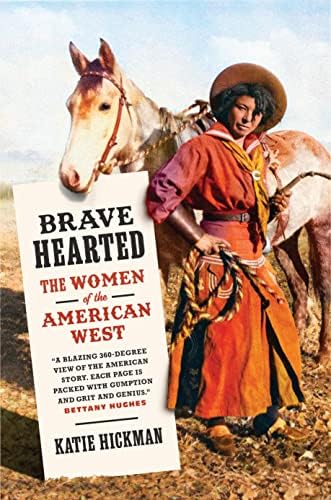
“Gripping,” “Exhilarating!”, “Captivating!” These are descriptors I often flutter my eyes at, chalking these up to marketing histrionics that serve solely to assuage publisher’s fears about book sales and authors’ egos. But in Hickman’s case, I was hard pressed to find more authentic adjectives for Bravehearted: The Dramatic Story of Women of the American West.
I was expecting no less, to be honest. I’ve read Hickman’s work before (Courtesans: Money, Sex and Fame in the Nineteenth Century (2003) and Daughters of Britannia: The Lives and Times of Diplomatic Wives (1999) specifically) and enjoyed her scholarship for many reasons. Bravehearted, however, was the first time I’ve read Hickman’s scholarship since I began and finished graduate school, becoming in my own right, a historian. I can now say I appreciate Hickman even more than I did previously.
Bravehearted (like Hickman’s other works) is, from the perspective of a general reader, incredibly easy and smooth to read. The facts (that is, the history) are woven so artfully into her prose that the reader never feels like there’s a history lesson embedded in it. (There is, of course. More on that below.) Instead, the women, men, and children — indigenous, white settler, and immigrant alike — feel like full-fleshed characters in a story set in an epic, sweeping landscape. I could not help but feel the tragedy and simultaneous hopefulness of their journeys across the United States. At times, the harshness of the wind, the damp of the rain, the aridity of the desert air seemed to tragic, and simultaneously hopeful whip my hair, slick my skin, burn my nose. Hickman achieves what all historians — storytellers that we are — aspire to do: transport the past into the dimension of the present.
Each chapter of the book focused on a different region, a different woman, a different route settlers took toward the Western coast. The Pacific Northwest, the Californian region, and the Southwest were all covered in succession in Bravehearted. Embedded within these pages were not only those perspectives of white settlers, but indigenous voices too; though, the focus of this book was primarily on the European, East Coast, Midwest, and White settlers who encroached, entitled and arrogantly, into Indigenous lands. There are mentions of other people of color, Chinese immigrants and Black women, but again, these feature less prominently than white women and men. It is worth noting that there are few Mexican/indigenous women in Bravehearted; indeed, as I attempt to recall the book from memory, I find myself unable to remember one. Of course, it’s possible I am just forgetting, but that in itself is telling: There weren’t enough of them mentioned to mark a place in my memory. (The index is absent in the ARC so I could not look up where I might have read about them in it.) This is a well-researched, brilliantly written work of historical scholarship for any audience, but, it is not a work of decolonization; its intent is not specifically aimed at disrupting dominant narratives of white settler colonization or to bring to the forefront the voices of women of color.
This is — and this is not a detraction so much as it is a neutral statement — a history for those who are interested in women and the gendered component of history of the American West. The lesson is a simple one, but one which still requires learning: white women were as much part of the making of the West into the WhiteAmerican West as white cowboys, sharp shooting lawmen, and male miners (there were female miners too!) In other words, white women (and women of color in lesser numbers) were there tooand they shaped White America in equal measure to their masculine counterparts.
The content of Bravehearted is not entirely divorced from race or ethnicity, but certainly the focus here is gender more so than race or ethnicity. Hickman’s inclusion of men and women of color and the indigenous perspective is not minor or token in any way; it is well done, but academic readers who may be expecting a stronger connection between or a deeper discussion of gender and race might struggle to locate it within this particular work. This is — and again, this is not a detraction — a work for a general audience. What Bravehearted offers the reader is breadth, indeed, a wide lens of the landscape of the American West in terms of the gendered experience of traversing it in the 19th century.
If, by now, my final verdict is unclear, let me end with it: This is a fantastic telling of American history worth any and every reader’s time.
A History of Women in Medicine and Medical Research: Exploring the Trailblazers of Stem by Dale Debakcsy
I loved reading this ARC (Advanced Reader’s Copy) so much I pre-ordered it! Eye-opening, superbly written, and well-researched. I cannot think of higher praise for a non-peer-reviewed non-fiction written for a general audience. I can’t wait for my copy to arrive so I can re-read it!
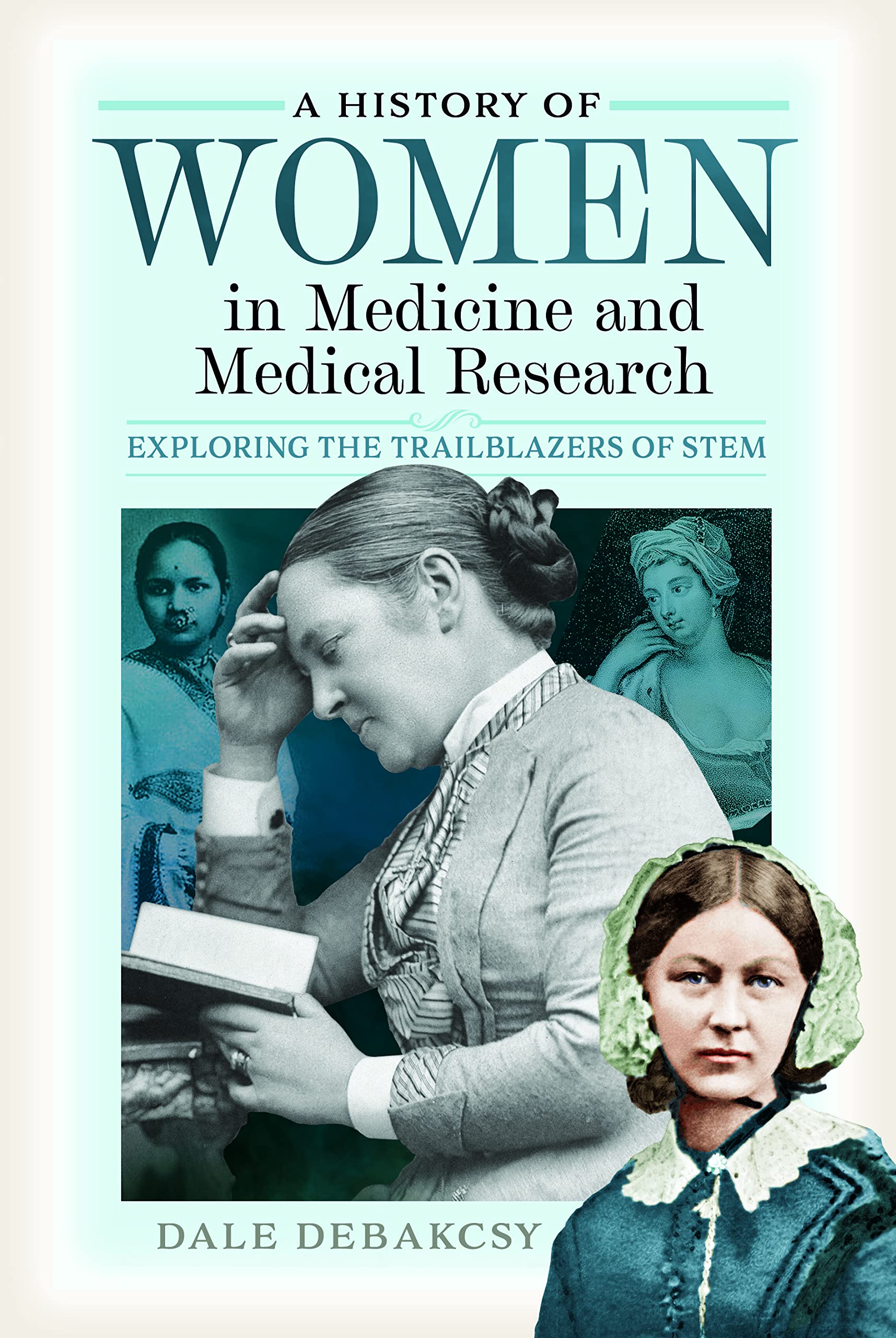
A History of Women in Medicine and Medical Research: Exploring the Trailblazers of Stem is broken down into several chapters, each one focusing on a specific woman, her personal background or life story, and her professional career in the sciences. The book progresses chronologically from the 16th century up to the near present, ending in the 1970s.
Each chapter ends with a section devoted to further reading and sources. While the book lacks citations and formal references, these inclusions are especially valuable. This kind of historiography is difficult to discover without a significant investment of time and effort making Debakcsy’s book all the more useful and appealing. I do not mind admitting this is a key reason why I have chosen to purchase my own copy.
These are not long or exhaustive studies of each individual; these historiographical sections allow the reader to explore further. That said, the brevity of each chapter is not a detraction. These are easily digestible chapters, perfect for classroom use or as readings for an undergraduate course. The chapters capture all they need to, leaving the reader satisfied but curious for more.
The women themselves are fascinating subjects, not only for their contributions to STEM, but also for their perseverance and resilience in the face of class, gender, and racial prejudices. Many of the women derive from the upper classes, but a significant number of them are working- or middle-class. Some were immigrants or enslaved (or lived just outside that category). Many had to break with their families to pursue their dreams. In many cases these women knew or knew of one another, interacted closely or within similar professional circles. A cohort of pioneering women in these fields is visible in the 19th century, particularly in the fields of medicine.
While the majority of women examined and brought to light in DeBakcsy’s book are white, European or American, there are also significant chapters focusing on women of color in the Western world. These are mostly (but not exclusively) black women who broke academic and professional ceilings.
This is a fantastic book for the classroom and any library (academic and home, alike). I cannot wait for my copy to arrive!




 Dr JoAnn LoSavio