I utterly love, love, love this book. I never knew about or read any of Ellen Cooney’s fiction before, but I am a fan now. And to think, I only found this novel by mere chance. I happened to visit a branch of my local library system that I used to go to quite a bit, but hadn’t for awhile, and I happened to walk past the new arrivals shelf. The title, so striking, so challenging immediately appealed to me. I picked it up, felt its heft in my hand (slim novel as it is) and decided it was coming home with me.
I read it in a day and half. I couldn’t tear myself away. I felt so connected to this woman, felt her latent simmering dissatisfaction so keenly, I had to keep reading.
The novel revolves around a woman who leads an ordinary life, as most of us do: she works for a local company, a office job, and she’s married with kids. She’s hitting her middle years. She’s good at what she does professionally. She is encouraged to and does apply for a promotion. She doesn’t get it, which would be devastating enough — but the kick in the head is that the job goes to a man who is clearly under-qualified for it. It all comes to a head at the company’s annual banquet, held at a famous, local restaurant.
The woman walks in one way, walks out another.
That’s all I’ll say. You have to read this book.
Cooney’s words are knives and silk ribbons. Perhaps they are silk ribbons with edges as sharp as knives; they slice and soothe all at the same time. Women of this age — or, really, of any age once they’ve had a taste of the patriarchal world in which we all must live — will find this novel tragically relatable. It is so nice to hear a chorus of voices bounce back to us, to know what sounds like an echo is not merely our own voice, but the sound of many others screaming same complaints, announcing the same snubs and hurts and disrespects that have been inflicted on ourselves. The isolation Trisha Donahue, the novel’s protagonist, lives is a dark we all know. Cooney shows us that though we may not see each other, she does.
The Shoe Box Waltz is the story of lives intertwined, each one shaped by the others it touches. Each of these lives is in turn shaped by single defining moments, a moment that we never expect to possess such impact. This is a novel of the power of such encounters, seemingly so fleeting and unimportant at the time, as they become amplified. While its author, Kathleen Patrick, labels this a psychological novel, I am inclined to class it as a literary fiction: character-centric and deeply reflective, rather than psychological in the academic or manipulative sense.
The novel revolves around a young woman, Cora, and takes us through three interlocking periods of her life: her youth, her childhood, and her adult life after a traumatic event. As she moves through these periods of her life, she encounters people whose decisions shape the course of her own experience: Nancy, Caitlyn, Maureen, and later, Ian and Ray. There is also an unnamed external narrator, perhaps a sentient persona in Cora’s subconscious. This reader found the novel to focus heavily on the experience of being a woman and the trials of womanhood; a topic I enjoy and appreciate as a woman. A note: Readers should be aware they may find elements of the novel triggering; but, as women generally know, a woman’s life in this patriarchal world is inherently fraught with trauma.
Divided in two parts, bifurcated as Cora’s life becomes, the reader is given a view into the inner perspectives of each of these individuals in Cora’s life, as well as a her own. Each chapter is narrated by a different individual, some also switch position from 1st to 2nd to 3rd, offering the reader a wholly different voice and understanding of Cora’s story. In some cases, the switch of perspective is jarring, but overall, the mechanism works to deliver an unusual reading experience.
Patrick’s prose is literary; thoughtful and evocative, stealthily drawing emotion from the reader. That said, some descriptions and phrases read poorly, dated, and somewhat cliché: “shapely legs” for instance, provides no real fleshy image for this reader. Despite this, I was compelled to read on, finishing the novel in the space of three days. Cora’s story — and Nancy’s intervention in it — was magnetic.
Readers who enjoy historical literary fiction, with a feminist tint, will be sure to find The Shoe Box Waltz a moving and emotional experience, well-worth the effort of reading it.
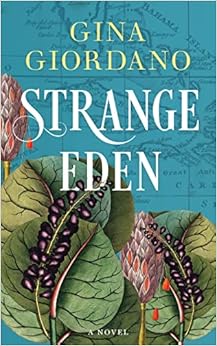
Strange Eden is a novel of many things. Foremost, it is a historical fiction set in the Bahamas in 1791, as the British Empire consolidates its colonies in the Caribbean and mourns the loss of its American ones. The story revolves around Eliza Sharpe née Hastings, a young English girl of the gentry class and her life as the bride of Lord Charles Sharpe, the scion of an old Colonial family and a Lieutenant Colonel in the British Army at Nassau. Their union is a relationship rife with hostility and repulsion; it is a core pillar of the novel, as is Eliza’s and Charles’ relationship with one of this old friends, Jean Charles de Longchamp.
Romance aside, the novel also possesses paranormal elements, political intrigue, and feminist assertions. Eliza is a young woman with many gifts, some which are less desirable in the highly hierarchical and patriarchal world of the Colonial 18th century: a fierce independence, a boldness of spirit and tongue, a sharp intelligence in matters spiritual and political, and an ability to see that which is beyond the visible. In her adventures on the island, Eliza encounters those who expand her view of the world and those who would seek to limit it. It is a diverse cast of characters: Lord Dunmore, the governor of the island, Charlotte and a host of aristocratic society women, Cleo, an enslaved obeah woman, pirates and smugglers, and a mysterious shadow man. Each one paints this Strange Eden in garish and sober colors. It is a paradoxical place for those who are free may also live in chains, though made of silk and gold, and only those who are enslaved know the notion of freedom is an illusion. The novel’s title is apt: what is a paradise for some is very often not a paradise for a great of many others.
This dissonance is what makes Strange Eden shine as a work of historical fiction. For this reader, the appeal of the novel is its attention to historical notions of gender, race, and class. Giordano includes a bibliography at the end, and it is clear that she has done a great deal of research. I hesitate to consider the novel appropriate for the classroom; it is not. The research is good, though not at a professional level. But it was not meant to be; Strange Eden is not a textbook. The historical research Giordano has done remains a positive attribute of the novel nonetheless.
Giordano highlights the expectations put upon women of Eliza’s aristocratic class, and the overarching misogyny women experienced in this era. This is a theme which threads throughout the novel. The expectations of white upperclass women are contrasted against those imposed on enslaved women, like her young maids, Celia and Lucy, and contrasted against the rights and privileges of powerful men like Charles, her husband, Jean de Longchamp, and Lord Dunmore.
Giordano also pays close attention to the slave trade in the Atlantic, racial hierarchies risen out of Europe’s Enlightenment, and the paternalistic racism of the so-called “Civilizing Mission” as it was inflicted on the indigenous and persons of color in the colonies. Britain’s slave trade was abolished in 1807 and the practice itself in 1833, several decades after the moment of the novel; the novel is bold in its recognition of the tension between abolitionists and slave-holders at this time.
Strange Eden delivers a powerful lesson about the gendered and racial notions of the British Colonial world.
The mode of its delivery unfolds at a languid pace. The novel’s prose is thick with description, rich like the molasses that were produced in the Caribbean islands the novel is set in. In some parts the prose, to stick with the analogy to molasses, is unrefined for this reader; on occasion its phrasing conveys cliché over clarity or is redundant, perhaps benefiting from further editing. These do not degrade the novel on the whole. Giordano delivers a cohesive narrative, tangible characters and dialogue, and — most importantly for this reader — weaves a textured fabric of the period. Readers will find the prose is performative of the heat, vibrancy, and slow pace of life inherent in the British colonies of the 18th century. The result is an immersive read.
Readers should also know Strange Eden is the first of a series. The novel ends on a cliffhanger, “to be continued“; however this should not dissuade readers for two reasons. First, the novel ends at 517 pages allowing one to meander through it at their leisure until the next in the series is available and second, the novel has the strength and narrative arc to stand alone without its sequel. The ending satisfies.
To purchase a copy of Strange Eden click here. At present, you can purchase it on Amazon for $19.99 (paperback) or $4.99 (Kindle ebook).
This novel devastated me. And in the most profound and satisfying way. I could not put this book down; despite being a hefty read at 368 pages I devoured it in a weekend. This novel is a serious contender for my Book of The Year.
Razak’s Moth is set in Partition era India and Pakistan, the former mostly. Its events unfold in the year leading up to India’s independence in 1947 and the year directly after it, a violent and terrible time when Muslim Indians and Hindu Indians violated each other’s homes, families, bodies, and holy places of worship. Moth does not shy away from the terror or the brutality of this history; its story is premised on gendered violence, sexual violence, the kind wrought on women and girls before and since Partition.
This is not a novel for the faint of heart. Readers should prepare to feel chilled to their marrows at the cruelty Razak lays bare.
At the same time, Moth is an empowering read. This is a feminist novel. Not only is it told from the perspective of a young girl desperate to become a woman, Alma, it revolves around the actions of the women in her life and in her community. Alma comes from a high caste Brahmin family, a pair of progressive-minded parents who are highly-educated and who view their India as a place of ethnic, class, and caste equality. But Alma is a victim of her own immaturity and her Brahmin, Hindu grandmother’s ambitions and traditionalism. The history of India at this junction of conflict between colonial rule and independence, Hindu and Muslim segregation or peace, traditionalism or modernity plays out in Alma’s family’s words and deeds. The story opens and hinges upon Alma’s wedding to a Brahmin man, much older than herself.
Here is the first of the gendered debates the reader will encounter in this novel. Marriage, in its traditional and modern forms, the domains of power which men and women occupy — according to their familial rank, their class, their caste, they religion — is one of the fascinating, golden threads of this novel. Alma’s mother is unique in her historical time and place: She is a lecturer at a university, she works. Her marriage to Alma’s father is a foil to to the other marriages in the novel where wives are beaten, raped, abused in other myriad ways.
Moth is also compelling for its frank discussions of caste and class. Ethnicity, religion, race, nativism and xenophobia also serve as the fabric on which the patterns of its stories are told. While Moth is a historical fiction, these threads are visible in India today; this is not merely a fiction of the past, but also a commentary on Indian politics and society right now. Moth is truly an intersectional novel, one which weaves history into the present, one whose characters are shaped by their age, their experiences, religion, gender, ethnicity, and caste.
The characters are complex and developed. Even Razak’s villains are soft and vulnerable. In this novel no one is who they seem, even to themselves. The primary cast consists of Alma’s immediate and servile family: Her father whom we meet mostly as Bappu, simply, “father” and her Ma, named Tanisi; her sister, fondly nicknamed, Roop; her paternal grandmother, a matriarch in their home and her dead husband, the ghost of her Alma’s grandfather, a silent but present and poignant character in the events of the novel; their servants, Dilchain, a Hindu woman and Fatima Begum, a Muslim woman.
Religion and culture shape these characters, give them their reasons for compliance and rebellion, motivate them in their actions. Community expectations and subjective desires come into conflict within these characters, in some cases these poles are reconciled or exist in uneasy harmony. Razak places the reader in the midst of palpable, relatable characters who walk us through their lives as if we were there in the room with them. In Razak’s prose we can taste India, envision the hot sun and the colors of its markets and streets, feel the moisture of sweat and floral fragrance on our skin. Razak brings the reader so close to the characters we might detect their bodily scent or feel their eyes on our skin. In the characters’ actions and thoughts we, the readers, can recognize universal needs and motivations: teenage longing, maternal affection, filial piety, desire for belonging and approval — even while we are treated to a view into a world that is not our own, one that is past and gone, an India of long-ago and far-away.
That said, Moth is brilliant in its nuanced portrayal of India and Indian life and culture. It rejects the exoticism that so often plagues Indian literature, colonial and postcolonial alike. Instead its honest portrayal of Indian people and their experiences connect them to others; we may not know anything of the first hand experience of war, but through Moth we get a real feel for what that might look like, feel like, smell like. Razak’s India is a terrible, beautiful place. Its people are inhuman and yet, all the more human for their cruelty. In these pages the reader will encounter suffering, but, also inspiration. I was awed by the strength of the women and men in Moth. I felt hope, even while I cried as a witness to their pain. They were transformed by their experiences, in good and bad ways.
Moth highlights the catalytic effect of history in the most bitter-sweet way. This is a book you will regret and never regret reading.




 Dr JoAnn LoSavio