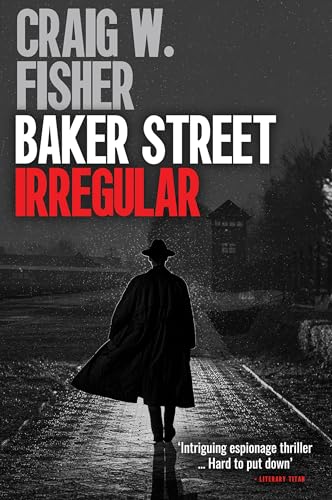
Baker Street Irregular: A Novel by Craig W. Fisher
Readers who love a good spy novel, immersive writing with fleshy details, and large casts of characters will find a gem in Baker Street Irregular.
The novel follows a WWII British spy, Bill Hoffman, as he navigates Nazi occupied Europe, attending to the missions he has been tasked with. His primary task is to track a Nazi official in Vichy France, but events lead him to a deeper mystery.
I have mixed thoughts about Baker Street Irregular. On the positive side, Fisher is adept at storytelling, weaving the historical fabric of WWII through an intricate interaction of historical details and dark, noir-ish mood-setting scenes. The story is compelling. And Fisher is a good writer, possessing a unique voice and style. Fisher’s characters too are clearly visible. The novel reads like literary fiction: deeply reflective and full of wartime shadows.
But, some of these same aspects of the novel lost me as a reader. The pace of the novel is slow; long and numerous pages flow without progressing the arc of the story, even as they contribute to making the grey landscape of war tangible for the reader. Pages and pages would pass without a clear direction of where things are headed. At 328 pages — not including Historical Notes and a Glossary of terms at the end — the meanderings within the novel induced torpor, rather than interest. There are also numerous characters; Fisher’s attention to detail suggests each one is one to remember, leading this reader to forget many of them for lack of memory to track them all.
All in all, Baker Street Irregular delivers on its promise. Readers who enjoy historical fiction set in WWII or languid, noir novels are very likely to find it gripping and satisfying.
What more could I say about this classic work of the Shoah? I’ll start with when and how I obtained my copy. I won it as part of a Goodreads giveaway in 2022, when Maus was hitting its school/library book ban (to date) and the book was featured in all sorts of news media, for better or worse, and copies of it were whizzing off online and physical booksellers’ shelves (a good thing!)
I was thrilled to get a copy as I had never read it, though of course, I know and teach the Holocaust in my classroom.
Reading it humbled me, as all novels and non-fiction of the Holocaust does and should, but the visual aspect of the graphic novel did it in ways I had not expected. As one can guess from its iconic and unforgettable cover, Maus is populated with mice, cats, and dogs rather than humans. The dehumanization of the Jewish people by the Nazi regime was no less poignant for this swap. Perhaps it is even more powerful; animals are an obvious metaphor: the hunters and the hunted, the obedient and the illicit.
Aside from the personal, intimate view into the Holocaust experience, I deeply appreciated Spiegelman’s portrayal of adjustment to emigration, and the struggle of the following generation to understand the depth and pain of those who had suffered through it. What happens afterward is equally worthy of attention as the event(s) of the Holocaust itself; really, these are not discrete events. These scenes made it clear the Holocaust is not a finished incident, but a deep intergenerational open wound spanning decades.
Facing the Mountain: An Inspiring Story of Japanese American Patriots in World War II by Daniel James Brown
I joined my local public library Adult Book Club and this was the first book I read with the group.
As an Asian and Asian American, I was immediately drawn the subject matter in Brown’s book. Given the rabid anti-Asian hate that has been on the rise in this country since Covid-19, non-fiction like this serves to do more than illuminate obscured histories; they emphasize the significance of diversity in American identity and entrench the idea that Asian American citizens — long held as “perpetual strangers/aliens” — belong in American society.
Facing The Mountain did not disappoint. While the book is a non-fiction history written for a popular press and a general adult audience, its methodology and archival research would more than satisfy any academic reviewer. Brown drew, not only from archives, but from oral histories and interviews to produce a historical monograph of significant breadth.
The book begins with the Japanese and Japanese American community in Hawai’i, but also explores the larger Japanese diaspora in the United States, on the mainland. Indeed, one of the highlights of the book is its attention to the diversity of voices within the Japanese American community: Mainlanders and Islanders came from very different cultures, sometimes held opposing views, and certainly cannot be assumed to be a monolithic society with a single voice. Its chapters explore the nuances of these different ideas within the community and how Japanese people across the United States, diverse in their social and economic class, gender, and generation, reacted to and handled the Presidential executive orders which sent them to internment camps and cast them out of American society as “enemy aliens.” Chapters document Japanese citizens’ resistance, compliance, sorrow, and joy, allowing the reader to witness the experience of WWII in many ways.
Facing The Mountain focuses heavily on the military experience as well, both domestically and abroad, which made the reading of this book novel for me. I do not typically gravitate toward military histories, finding many of them dry and clunky. But Brown turned this into a social history of the US military and the 442nd Regiment, making it a lively and very enjoyable read.
This was the very appealing part of Facing The Mountain for me; Brown made this political and military history feel intimate. It is, in fact, a prosopography. Facing the Mountain follows a cast of specific individuals and families who occupy different roles, careers, and places in the United States and American society. Through their experiences the readers views the entire landscape of the Japanese American perspective of WWII.
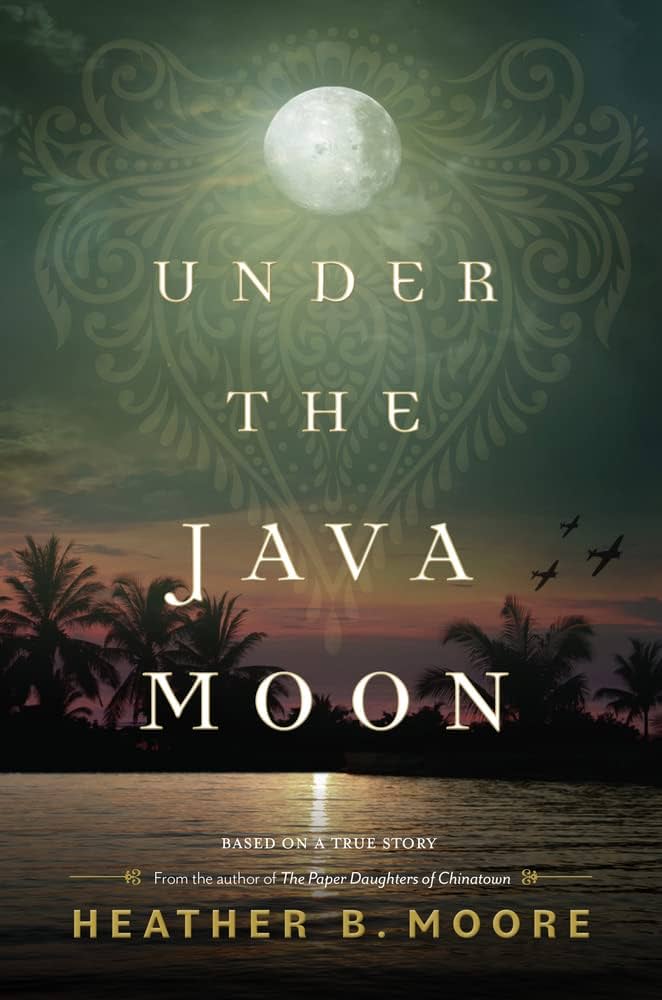
Under the Java Moon: A Novel of World War II by Heather B. Moore
For those interested in the Pacific theater of WWII and the lived experiences of Japanese occupation, Under the Java Moon delivers a poignant and moving story of loss and perseverance.
The novel follows the Vischer family, Dutch colonials living in Indonesia when the Japanese arrive and occupy the region. George, an engineer is drafted into service, separated from his family, who are marched out of their home and into the enemy alien camp at Tjideng. Told through the eyes of George, Mary, and their young daughter, Rita, the reader is immersed in the experience of living through war.
The novel and story is emotional and psychologically nuanced, but — for this reader — sanitized. While I felt sympathy for the Vischers, I felt no emotional pull, no real heart-wrenching, which — perhaps strange to say — I expect to feel from a story of this genre.
Moore’s novel is well-crafted as a historical novel; pertinent historical events serve as the structure of the story, without it turning into a history textbook. But it is unfortunate that we only see the Dutch perspective of WWII here, and very little of the Indonesian experience. I would have liked to seen a little more balance of perspectives.
Overall, an enjoyable read, though less profound that its subject suggests.
Fatherland: A Memoir of War, Conscience, and Family Secrets by Burkhard Bilger
Fatherland: A Memoir is a must-read for readers who gravitate to histories of the European theater of WWII. The book is a case study, illuminating aspects of the human side of these histories which are often left in the dark: here, what happened to those millions of Germans who were caught up in the Nazi machine, willingly or otherwise? Significant numbers of the German citizenry did not support the Nazi party, but as the regime gained power Germans were pressured into adopting or participating in its politics in both minor and significant ways. Thousands were caught between survival and their beliefs, others benefited from the regime’s policies, witnessing no ill-effects as so many millions of others did.
War and ideological divides produce so much more intimate conflicts and consequences than politics would suggest. Fatherland makes this complexity abundantly clear, and more importantly, without being apologetic or sympathetic to Nazism. Indeed, it highlights the different between Nazi party members, Germans, and the Nazi state, forcing the reader to see beyond the inaccurate and unjustified conflation of these constituents with one another.
Bilger dives into their own family history to produce a prosopography, one which explores the complicated consequences of surviving the Nazi regime before, during, and after the war, especially for those who were forced or otherwise minor participants in state operations. Their family derives from a region of Europe straddling the often fluctuating boundary between France and Germany, Alsace and the region around the Black Forest. This geography has — and continues — to produce a culturally and politically fluid community. Bilger also looks beyond their own family, including the personal war-time histories of other German and French citizens in their proximity: for example, mayors of the myriad of French-German towns who were caught in the Nazi and French crossfire, and women who were forced to interact (in platonic and other ways) with German soldiers or Nazi officials.
During the interwar and WWII years, citizens found themselves dispossessed of either their French or German identities, subject to changes in language, dress, and culture as politics blew one way or the other. After the war Germans and French alike found themselves needed to pick up the pieces of their lives, and grapple with former enemies living in their midst. Questions of culpability rent communities and families apart in the aftermath of WWII as war crimes were being prosecuted; to what degree was Life and the Need to Survive responsible for the choices that people made? To what degree was circumvention of Nazi policies a resistance against Nazism? Did local officials and citizens pander to Nazis out of genuine belief in the regime or were their actions made under duress? Did neutrality absolve people from being responsible for war crimes that occurred?
Indeed, the years following the end of war were some of the hardest, perhaps even harder than during the war for some Germans and French. This aspect of Fatherland is, to this reader, its most poignant and significant contribution; war does not begin with a declaration, nor does it end with a surrender and a treaty. War begins so much earlier, the combat and physical destruction being only its peak, and it lingers on for years, even decades, afterward. Bilger reveals that in the case of Germans, the effects of WWII remain today; it is a scar stretched across multiple generations.
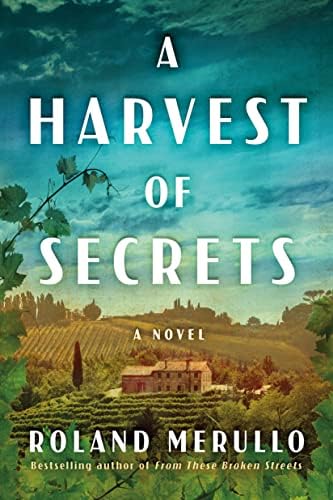
A Harvest of Secrets is a slow burner, then halfway it ignites like gunpowder and the end is an emotional and deeply satisfying explosion, uniting all the storylines of the novel together in a kind of literary bonfire.
The novel is set in WWII, fascist Italy when much of the country has fallen under the control of the Nazi regime. The story unfolds primarily in a rural northern village where an old, aristocratic family grows grapes and produces wine. The San Antonio family and their estate have been lords over the land and the people for generations. There are tensions between the family who own the winery and its workers, age old class-based tensions that threaten to erupt under the additional strain of wartime food shortages and unpredictable Nazi raids. The war has also brought about new factions and exacerbated pre-existing enmities: resistance fighters and saboteurs against Hitler’s Nazis and Mussolini’s Blackshirts, deserters from the Italian and German armies, Il Duce’s spies, and Nazi collaborators. Caught in the cross hairs between these conflicting factions are two young lovers: Vittoria, the daughter of the proud noble family and Carlo, the orphaned peasant boy she grew up playing with. There are also others who find themselves trapped on one side or the other of the war: Old Paolo, the foreman at the winery, Umberto San Antonio, the noble man who owns the land, Enrico San Antonio, his son and Vittoria’s brother, Eleonora, the Jewish woman in their midst. They each have their obligations to family, country, and to those who have sheltered, raised, and loved them. These obligations tear the lovers and their community apart — and bring everyone together in other ways.
Merullo’s novel is not only about the lovers; it also about the many individuals whose lives intertwine with theirs. Indeed, the novel is more of a broad panoramic view of Italian society in this fraught period of the twentieth century. Some of the people Carlo meets are sympathetic to Mussolini, others seek freedom from the politics that engulfs them all, others are victims of Il Duce’s ill-conceived plans and ambitions. Vittoria is likewise surrounded by those who would do her harm and protect her from it. There are resistance fighters, Nazi soldiers and officers, Nazi collaborators, and Mussolini’s spies lurking and active all over the countryside, waiting to strike or entrap her and other innocent Italians who simply want to do what is right for themselves and their families, and by their conscience. As a woman of this period, Vittoria’s options are limited. Italian patriarchy places shackles on her that are made for women alone. She is meant to be a good daughter, a good woman, a quiet woman — but in the chaos of the war Vittoria cannot remain silent.
Woven into this larger cultural, social, and political vista of Italian wartime life is a domestic drama and mystery. Vittoria’s dilemma is at the center of this. She must bargain her silence for her freedom, sacrifice her morals to be a good daughter. But she is also a product of a longer history of women like herself.
Secrets held for decades, the kind begotten by forbidden love, are as much a part of the estate and the fabric of life in the vineyards as the vines themselves. These unraveling mysteries push and pull Vittoria, Paolo, Umberto, and Carlo in all directions. The emotional and real famine of war force these long buried secrets to emerge on the surface. As the Americans and Allies bomb Italy in order to free it, Vittoria, Carlo, Paolo, Umberto San Antonio, and others scramble for safety and try, hard as they can, to keep these secrets under cover.
Overall, a good read, especially for readers who enjoy themes of class conflict, gender histories, and ensemble casts of characters, and domestic mysteries.
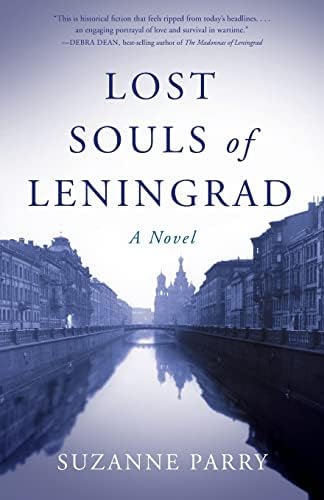
Lost Souls of Leningrad is a rare novel about the Russian civilian experience of World War II. Even rarer, its primary protagonist — and the character through whose eyes this experience is filtered — is a late-middle aged woman, a widow. (I am not a fan of romantic WWII novels that involve beautiful young women who all wear red lipstick, have perfectly coiffed hair, and fabulous clothes in the middle of wartime. Hello? Rations? I mean, COME ON.)
Parry’s novel possesses a more realistic portrayal of wartime. Its setting is Russia, a nation besieged by Nazis. There is a tightrope tension, drawn even tauter by dwindling supplies of food and medicine. Lost Souls of Leningrad does not romanticize war; events and experiences that other novels paint in sepia tone, Parry swathes in a more authentic grey. The sense of loss, a grieving for the world that was, is palpable in Lost Souls of Leningrad in a way that makes it refreshing as a novel of WWII.
The story revolves around an aging, widowed violinist and her teenaged granddaughter. But the novel is not about them alone. Lost Souls of Leningrad is a landscape of a European city at war. Parry reveals to the reader the swift and terrible death and decay of an urban place and its people when the trappings of civilization are ripped off by war. Food and the lack of it, water and the lack of it, the stench and the unavoidable abundance of it. Fear from all the dark corners, lives cast into darkness in the absence of street lights, electricity, law and order. The other characters are Russian soldiers, mothers, wives, and orphaned children. All of them are the lost souls of the title, each of them has lost something, whether a loved one or a parent, or simply their sense of security in ordered society that they once had, even if imperfect. Loss and grief, not only as a result of war, but through political upheaval, are themes that imbue the book. The novel draws a line between the time before and the time after, the time of war, and afterwards, even when war is over, there remains a division of before and after.
While the novel does not romanticize war, there are romantic threads in its storylines. There is love in this novel in various forms: nurturing and mothering love, parental love, innocent and childish love, romantic love, the kind of love that is weathered by life. While a defeating hopelessness pervades the novel (it is war, after all), there is also an uplift via its characters’ resilience. This strength manifests in many forms but most prominently through love and kindness.
As a historical fiction, it portrays a more social version of history than a military or political one. Readers should not expect dates or events, but an overall texture of life in wartime Russia. This is not a historical fiction that relies heavily on the facts of history, though the timeline of events does follow authentically in line with actual history; this is a novel about the human experience of war, lived and sensed through the skin, the eyes, the nose, the tongue.
This a beautifully written novel about surviving loss of different kinds and the love we need to do so.
In 2019, before the madness of the Covid-19 pandemic, I got the chance to visit Berlin for a conference. I wasn’t there for long, but it was magical. I got to walk the bridges, stand under the Brandenburg gate, see some castles, and eat currywurst (all kinds of wursts!)
So when I saw this novel, I was immediately intrigued. The contents did not disappoint. But, first, a caveat: This is a Young Adult novel. The primary characters around which the story revolves, the brothers, Rudi and Peter, are in their early-mid teens and the story does not progress far into their adulthood. The prose, language, structure and so on are clearly written for a YA reader, but the historical and emotional content is potent and will suit a more mature reader.
The story is told from the two brothers’ perspectives; it is the tale of their parents and their lives after WWII has ended and German society — Berlin society — has settled into a kind of uncomfortable holding pattern, caught between the two ideologies and cultures of the American West and the Russian-controlled East. Vesper focuses on the interior perplexity in the boys’ minds: in a period of their lives when they are already grappling with puberty and teenage crises of identity, they are forced to also wrangle with the localized manifestations of external pressures of international politics, Cold War propaganda, and collective post-WWII German angst. They struggle with what anti-semitism means in this age, what Nazism had been and is now (Vesper makes this point clear: the end of the Second World War was now the end of Nazism or the hate that that regime promulgated. It lives on and remains as insidious as was), what socialism is and truly is, what the Russian and American regimes represent.
One brother awakens to an understanding that the Russians are selling them a false promise. The other brother believes the Americans are doing the same. One brother seeks the freedom of the West, the other seeks the stability and order of the East.
In the mean time, they are struggling against one another as well; competing as siblings for the attentions of their parents, for a kind of childish glory, for a sense of belonging within their own world.
They wrangle with the more mundane things of teenage life as well: understanding love in all its conflicting forms. Their parents are products of the war as much as they are; their relationship is fraught with tension, not unlike the kind of tension between the East and West: irreconcilable, ideological, built on a history that was not of their own making and borne out of the War. The brothers are also young men, their minds and bodies are tangled in novel feelings of love and sexuality. They are on the edge of adulthood and are testing out how they might victorious in this new domain; they experience losses, betrayals, and grief as the story unfolds — and failure, that first, very painful sting of rejection that is inevitably accompanied by new experience.
The novel follows Rudi and Peter as they navigate their parents’ and the city’s divergence. They eventually find themselves on opposite sides of the Berlin Wall, erected one night in secret.
This is a powerful YA novel that is also fulfilling for an older, more experienced reader. The moral and ethical dilemmas embedded in the politics and social interactions in this novel are ones that might be introduced to us at the YW stage of life, but they remain tangled in later adulthood too, so much of the conflict will be recognizable and moving for a maturer reader.
It would be hard not to fall in love with this magic-tinged historical fiction. I loved this book so much I stayed up several nights to read it, refusing to bookmark it until I absolutely could not hold my eyes open any longer. The loss of sleep was worth it!
The White Hare is set in post-WWII England. The narrator, Mila, her daughter Janeska (Janey), and her mother Magdalena have left London and bought a large house in Cornwall, which Magda and Mila hope to refurbish and turn into a hotel. Mila also hopes the change of location will allow her to move on from a toxic relationship. Magda too has lost her husband of many years to the War and is seeking to rebuild a life for herself in a new place. The two women are Polish evacuees/refugees of the war; England is their home now.
As the story unfolds it becomes clear that it will not be so easy to shed the past for the three of them; it comes back to haunt them in real and imagined ways. The house and land too that they see as their revival brings its own hauntings and histories into the present. This magic interacts with Mila, Janey, and Magda in positive and less-pleasant ways; it becomes clear there is something afoot at the house at White Cove.
The White Hare is not only a tale of magic and myth; what drew me back to its pages night after night was the deep, terrible past between Mila and Magda, the angry relationship between Janey and her grandmother, and the wedge and glue that comes into their lives, causing friction and connection all at the same time, in the form of another character, Jack. In many ways, this is a novel of intergenerational histories; the ways in which understandings of the self and our place in the world are inherited. That said, Johnson does not suggest that the past dictates the characters’ present or future; there is hope for change.
And there is plenty of change in this story. (The plot revolves around the revival of a place and its new denizens after all.) The novel is not a vehicle to retell history; it is much more subjective than that. This is a novel about how a group of people who have individually suffered ordinary and terrible events struggle to reconcile their pasts with their futures. Every one of the characters’ actions and choices are imbued with a history, sometimes a good one, often a tragic one. As the novel progresses, the reader witnesses how the characters’ histories and their knowledge of another’s helps them shed those ghostly pasts and create a new future for themselves and each other.
The White Hare immerses the reader in a poignant lesson of how the past and present are ever intertwined. Lingering in the latent, vibrating background is the White Hare herself, a spirit that inhabits the land and the haunted history that comes alive in her presence. The novel suggests that there is a world beyond our own mundane one, in which we are embedded. In The White Hare this is the magical, historical world, a state of being in which the past and present are not constrained by the physics of time.
What was also very satisfying for me was the way in which the novel resolves. Not only do the characters come to their own organic conclusions, but history also is validated and finds a place of belonging in the present in a very real, tangible way. It emphasizes Johnson’s narrative: that the past is never as far away as it might seem, it is really buried — sometimes literally — in our contemporary moment. For readers who love long, nuanced resolutions and endings, The White Hare delivers in abundance; nothing is left hanging.
This is a novel that takes the reader on a rollercoaster of emotions, from sadness to anger to pity to redemptive hope. It is inspiring. It is queasy in some parts. Reader, be warned, there are mentions of abuse, gendered and sexual violence, violence and murder. Ultimately, for me, this was an inspiring tale of vindication and hope.
The Disappearance of Josef Mengele: A Novel by Olivier Guez
Like many people I have a deep personal fascination with World War II (much influenced by my professional interests in this time period), but I was unsure if I wanted to read a book — fiction or otherwise — centered on so evil a person, a human being capable of having inflicted so much suffering on others. Indeed, the first third of the novel made me rather queasy: Should I be more detached from this historical material? Should I be reading this with a massive grain of salt? Should I be enjoying this read?
And that’s the thing: The Disappearance of Josef Mengele: A Novel is a captivating, enjoyable read. Guez’s prose is irrepressibly smooth, the plot is compelling and thrusts the reader forward, his characterization of Mengele is fascinating, successful, human. I did not want to like him — and here I think is Guez’s brilliance — I did not end up liking this horrendous human being, in fact, my distaste for him was confirmed, but Guez prevailed on me to acknowledge Mengele as a member of my own species. By the end of the book, I could not deny that Mengele and I shared a common sense of existence, a common biology, that he and I were human. And I therefore must confront the real horror of Nazi eugnenics and racism: humanity is cruelest to its own and any study of our inherent nature must accept our own cruelty.
Josef Mengele — in all his aliases (Pedro, Peter, Helmut, Wolfgang, so many others) — was not the only character in Guez’s meticulously researched historical novel who brought me to this uncomfortable realization. Mengele’s first wife, Irene; his second wife and ex-sister-in-law, Martha; his unwanted lover, Gitta; his father, Karl; and his mother, Walburga are those who inflict cruelties — justified or not, minor or abusive — on Mengele. This does not excuse Mengele, but in terms of a fictionalized view, Guez gives us a window into his psyche,
This novel is not about Mengele per se, it is a layered dissection of the interaction of individuals, their subjective desires, and their collective obligations as these factors intersect with history and its unavoidable tides. Guez writes without pretending any unique insight into Mengele’s interiority. That which Guez assumes and invents is well within the parameters of fiction; his characterization of Mengele is plausible, the world Guez constructs is recognizable as our own. I want to note that Guez’s deep research into the topic is visible, appreciated, exemplary. If only most writers of historical fiction did this. For historians, professional, hobby, and emergent, Guez’s brief but detailed note on sources is a fantastic bonus. But, I digress, the book isn’t about Mengele; it is about all that made the disappearance possible.
Therefore, added to the above cast is the vast network of enablers that made Mengele’s escape and assimilation possible. These friends, politicians, extended family members, and indeed all the clerks, secretaries, and supporting unnamed persons make the horror even more palpable — as tangible as the sense of the person sitting in the office next to me, the odor of my fellow-commuters on public transports, the sound of a door closing elsewhere in my apartment building. These people are not the cowardly or indifferent Germans who made the Third Reich and its genocide of Jews, Roma, and so many others possible, no, what Guez forces the reader to recognize is that there are people who are willingly complicit in promoting and preserving the genocidal, racist ideologies of the Nazis — and others like it. Juan and Evita Perón and their institutionalized obsession with Nazism and Fascism, Alfredo Stroessner in Paraguay, officials in Germany from the highest levels of the state down to the municipality of Günzberg, where the Mengele family was headquartered and ran their multinational corporation from, and so many others were thrilled to be part of the Nazi machine, during and after WWII. Some were motivated by their own ambitions, others by a sense of loyalty, others by fanatical belief in Mengele’s work and Nazism. Guez brings this massive conspiracy to life, peoples it with individuals we recognize in our own lives.
There are also those individuals who were completely hoodwinked by Mengele, and therein lies the other side of this story. I hesitate to say this is the “redeeming” aspect of Guez’s novel; no, it is better described as a more recognizable payoff. Their stories are those which we expect to see in a novel like this; these are the characters whose snubs and betrayals serve as rewards for sitting through the horrors I have described above. When Mengele’s son, Rolf; his dog, Heinrich Lyons; his landlords, Geza and Gitta; and later, Elsa abandon Mengele, the reader is bound to exclaim, “Yes! Finally!” and feel a rush of tingly righteousness.
Still, mingled with this happier sensation is a sadness: it is not enough that Rolf Mengele refused his name, freezes out his father, it is bittersweet that Heinrich Lyons dies (no spoiler here, what dog outlives a man who lives into his late 60s?). I will not spoil what happens with Elsa, Geza, or Gitta. The reader cannot forget that an exhausted and geopolitically influenced Mossad had to redirect its efforts away from Mengele’s capture and lose the opportunity to deliver some closure and justice to the millions affected by the Shoah. The fact that Mengele’s story rolls on to the novels end is an unhappy reminder that the cruelties Mengele experienced were in no way comparable to that which he inflicted on others.
For all the nuance and complications woven into the characters interactions, the plot is straightforward: it is an account of how this sadistic individual got away with it and how he did not fully escape the consequences and punishment of a kind. There is a sense of satisfying comeuppance, though the degree to which any reader will feel vindicated will vary. I was glad that Mengele could not live in peace, but the measure of his penalties was small in comparison to the magnitude of his crimes. That too is Guez’s point: fate is not bound by any moral scale. There is no equilibrium in justice.
A note on audience: Because of the multiple meanings this novel could convey its merits could be misconstrued, its story could be twisted to serve neo-Nazi tendencies if read without some guidance or instruction for some readers. For that reason, I would not recommend this as a book for novice historians, undergraduate students, or for use in a classroom — except, perhaps, a graduate seminar. The Disappearance of Josef Mengele: A Novel requires dissection with historical guidance for readers who have less experience working with or knowledge of the histories this novel is built on.






 Dr JoAnn LoSavio