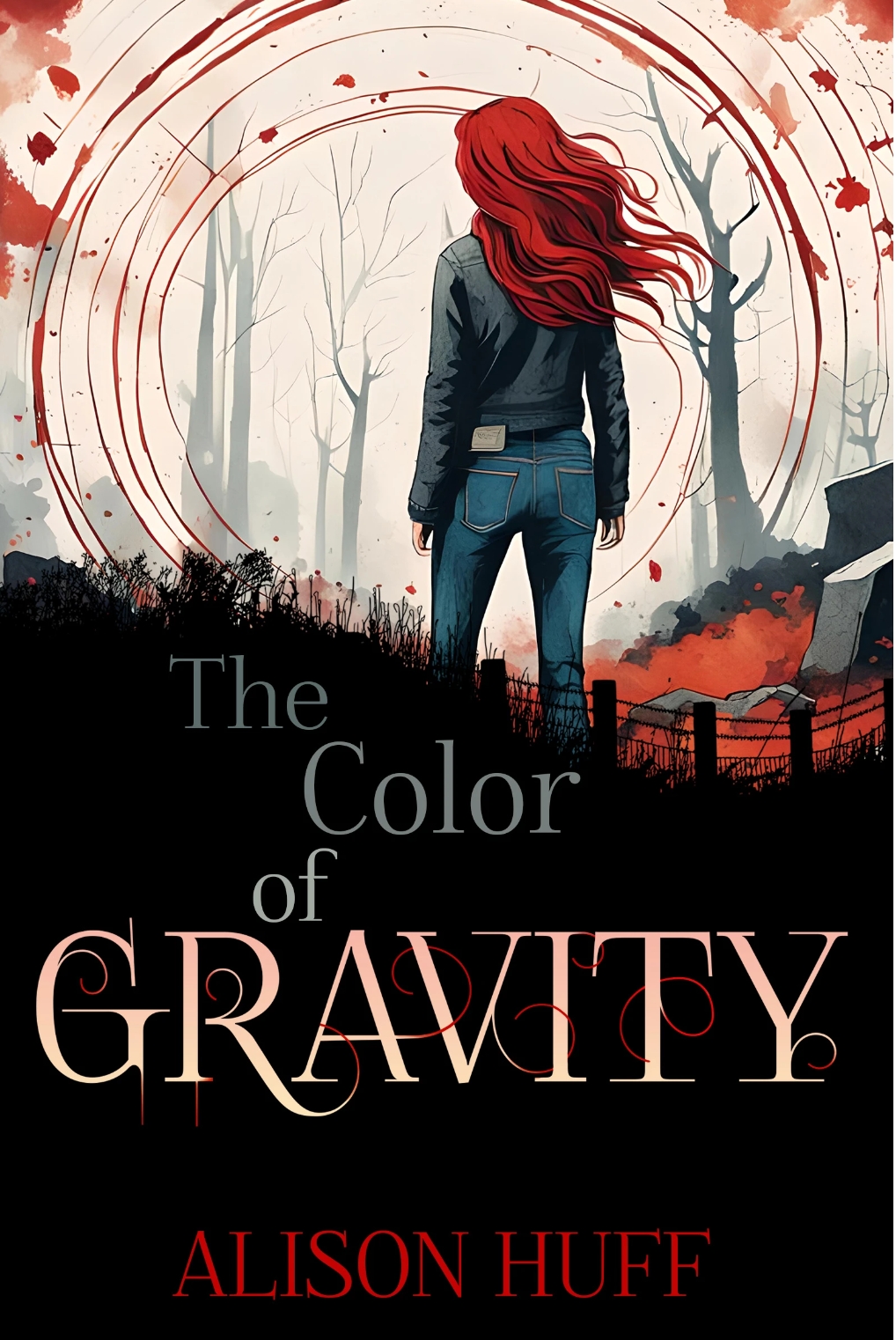
Fans of Young Adult fantasy who love the genre, with its emphasis on the discovery of self and coming-of-age stories, but who prefer a more mature protagonist will find The Color of Gravity a perfect read!
Seralynn and Bellamy are adult sisters, torn apart by the latter’s sudden and mysterious disappearance. Seralynn tries to come to terms with the loss of her sibling and her grief, but is finding it hard to let go. Then she encounters a rift in the world, one which offers her the possibility of finding Bellamy. Though torn between her grief and yearning for her sibling and fear of the unknown, Seralynn finds herself in a strange and magical world, one that is both wondrous and dark.
At the heart of this novel are the two sisters, connected together and yet, at odds, with one another as each woman seeks her own path, sometimes at the other’s expense…
Huff takes the reader into a fantasy realm; there is significant attention to world-building here — and at times the story is buried — but readers are likely to appreciate the depth Huff creates. And ultimately, the story of Seralynn and Bellamy re-emerges. Woven into their story are others Seralynn encounters on her journey: Fadrial, Asmodeus, and Tobian, among others. The novel creates a sense of community among these strange bedfellows: demons, humans, monsters, and magical creatures.
Huff’s novel is the first book in a series. I am not usually a fan of books series, simply because I do not have the attention span for it. That said, the sisters’ adventures — together or apart — will likely yield a fascinating sequel.
Yolk made me feel things, not all of which was pleasant. Nonetheless, I was drawn to finish it, indeed, compelled to finish it.
The novel revolves around two twenty-something Korean American sisters, June (the elder) and Jayne (the younger) living in New York City. June has graduated from college and begun what appears to be a flourishing, successful career, while Jayne is struggling through college. Both are new adults, learning how to navigate relationships and new responsibilities. Both fail the task. But find themselves needing and relying on the other to come to terms with their limitations, desires, their shared history of being yellow and first generation immigrant kids. The reader is treated to a front view of the wreckage of their attempts, watching the sisters bungle every decision as they try to find their way in the world and figure out who they are.
There were parts of this novel I loved, and parts I utterly despised.
I liked the focus on family, and the ways in which being a child of immigrants and the immigrant experience unfolded here, not in a pedantic way that highlights only the awful or only the positive, but all of it. I liked that. But I loved how Choi turned this multifaceted way of looking at the immigrant experience — already great — into a journey that reveals belonging as both a positive and negative transformative factor. I love that Choi acknowledges there is no reconciliation here, no transcending “final” outcome that makes it all perfect in the end.
I liked Jayne and June’s closeness, the assumption of sisterhood. I enjoyed being a voyeur to their dysfunctional relationship.
I hated their privilege, and their obliviousness to it. To be blunt, I hated Jayne. Jayne reeked of “I am the main character” vibes and I couldn’t stand her immaturity. June wasn’t a favorite either. But that said, I appreciated Choi’s ability to make such a horrible characters so readable. Much as I hated the sisters, I had to know what happened to them, how it all resolved in the end.
I don’t think I’d ever want to read Yolk again, but I’m glad I did read it once.
Ooo! The twists in this novel! You think you have it figured out and then — WHAT was that? The ending leaves the reader feeling both vindicated and wanting more, the perfect cliffhanger for a series starter.
Into the City is a Young Adult novel, not my usual cup of tea, but I do enjoy the occasional dystopian read — and this is indeed a dark and crumbling world Cook portrays. The novel is set in the near future, in a world ravaged by an illness which attacked only its adults and left its juvenile and adolescent population intact. Intact but not unscathed. Children and teenagers left to their own devices and survival created a society in which there coexist the extremes of cruelty, embodied by the militant Lyths and drug-addled Crazies, and kindness, a small but growing community of Arkers.
Our protagonist, a young girl named Lexi and her friends, Aster, Nate, Ruby, Eden, and Marcus are inexorably pulled into this world of dangerous extremes, lured by the promise of a utopian society and their need for community. Into the city they must go. And it is there that they discover not only the origins of their fate and a new promise of their future, but also themselves. There, in the city, they must confront their past trauma, test their values, and — above all — survive.
Cook’s storytelling is on point, unravelling the tale at a quick and lively pace, matching the urgency of the characters’ lives. Likewise, Cook’s prose is well-crafted for a young adult audience, being straightforward and succinct, allowing for both the reader’s organic imaginings and providing ample description of the landscape of this dystopian world. On occasion there is the use of an overworked metaphor or simile, but this is a minor complaint given the audience it targets. These phrases have yet to jade the Young Adult reader, and indeed provide familiarity and structure to the tropes they are just learning to recognize.
A word on Cook’s characters. These too are well-developed, even as they are drawn from tropes of this genre: they are young, but mature in their self-awareness (no doubt as a result of their life experiences) and their inner reflections are both adult and childlike. The benefit for the reader is that these characters will appeal to both the teenager on the brink of Young Adult and the Older Adult, remembering their teenaged past. Their concerns are recognizable, and cross cut generational divides; we all understand the need to survive and to live with our traumas.
Into The City is a typical and atypical novel of its genre. It satisfies the genre-reader, with their expectations of the dystopian novel, but Into the City does also offer twists and revelations which will draw in the reader to end. There are surprises. What appears simple is not so, as readers will discover.
To purchase this novel on Amazon, click here. At present, this 287 page novel sells for $10.70 for the paperback and roughly $5 for the Kindle ebook. I bought my copy on Kindle for $0.99 during a sale.
In 2019, before the madness of the Covid-19 pandemic, I got the chance to visit Berlin for a conference. I wasn’t there for long, but it was magical. I got to walk the bridges, stand under the Brandenburg gate, see some castles, and eat currywurst (all kinds of wursts!)
So when I saw this novel, I was immediately intrigued. The contents did not disappoint. But, first, a caveat: This is a Young Adult novel. The primary characters around which the story revolves, the brothers, Rudi and Peter, are in their early-mid teens and the story does not progress far into their adulthood. The prose, language, structure and so on are clearly written for a YA reader, but the historical and emotional content is potent and will suit a more mature reader.
The story is told from the two brothers’ perspectives; it is the tale of their parents and their lives after WWII has ended and German society — Berlin society — has settled into a kind of uncomfortable holding pattern, caught between the two ideologies and cultures of the American West and the Russian-controlled East. Vesper focuses on the interior perplexity in the boys’ minds: in a period of their lives when they are already grappling with puberty and teenage crises of identity, they are forced to also wrangle with the localized manifestations of external pressures of international politics, Cold War propaganda, and collective post-WWII German angst. They struggle with what anti-semitism means in this age, what Nazism had been and is now (Vesper makes this point clear: the end of the Second World War was now the end of Nazism or the hate that that regime promulgated. It lives on and remains as insidious as was), what socialism is and truly is, what the Russian and American regimes represent.
One brother awakens to an understanding that the Russians are selling them a false promise. The other brother believes the Americans are doing the same. One brother seeks the freedom of the West, the other seeks the stability and order of the East.
In the mean time, they are struggling against one another as well; competing as siblings for the attentions of their parents, for a kind of childish glory, for a sense of belonging within their own world.
They wrangle with the more mundane things of teenage life as well: understanding love in all its conflicting forms. Their parents are products of the war as much as they are; their relationship is fraught with tension, not unlike the kind of tension between the East and West: irreconcilable, ideological, built on a history that was not of their own making and borne out of the War. The brothers are also young men, their minds and bodies are tangled in novel feelings of love and sexuality. They are on the edge of adulthood and are testing out how they might victorious in this new domain; they experience losses, betrayals, and grief as the story unfolds — and failure, that first, very painful sting of rejection that is inevitably accompanied by new experience.
The novel follows Rudi and Peter as they navigate their parents’ and the city’s divergence. They eventually find themselves on opposite sides of the Berlin Wall, erected one night in secret.
This is a powerful YA novel that is also fulfilling for an older, more experienced reader. The moral and ethical dilemmas embedded in the politics and social interactions in this novel are ones that might be introduced to us at the YW stage of life, but they remain tangled in later adulthood too, so much of the conflict will be recognizable and moving for a maturer reader.



 Dr JoAnn LoSavio