The World’s Greatest Sea Mysteries (Non Fiction) by Mollie and Michael Hardwick
This title lit up the 8-year old in me when I saw it. I remember loving those DK trivia books and collections of mysterious events. I am still a sucker for a book on sasquatches or sea monsters. The Hardwick’s collection did not disappoint. Each chapter recounts the tale and history of a vessel lost at sea, a spate of sea monster attacks, ghostly ships, and the like. The chapters are short, succinct, and leave the reader wanting to know more — and isn’t that the purpose of a mystery?
The prose is a bit dated — the Hardwicks wrote the original back in the 1967 — but there is nothing wrong with this. Indeed, that kind of syntax adds a little historicity to the collection. There is something familiar about it and nostalgic in a way. But maybe that’s just me remembering my childhood and the long, lovely hours I spent reading books like these that let my imagination fly wild.
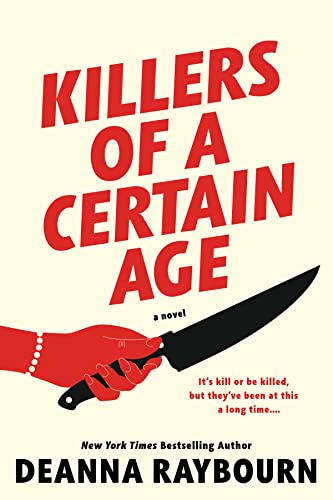
Killers of A Certain Age: A Novel by Deanna Raybourn
Oh, this was such a fun book to read! This novel plays out like a film. It’s got the panache of Ocean’s Eleven, the humor of Mr and Mrs Smith, and oozes a middle-aged version of the familiar camaraderie of The Golden Girls. It’s perfect.
The story traces the lives of a clannish posse of retirement-aged Charlie’s Angels, assassins who work for a clandestine international organization intended to keep the world’s evil at bay through extralegal and morally questionable means (murder). These women have devoted their lives – professional and personal – to this cause and vocation. They’re ready to throw in the proverbial towel, trade in the excitement and the deception for some much deserved rest and relaxation when they realize they’re the targets of assassination themselves.
Now they’ve got to figure out who, why, and what the hell.
And that’s the rest of the novel. It’s humorous and mysterious. It’s stylish and spy-savvy. It’s Jane Bond, darling. This reader was driven by the desire to find out who had set them up and why. There was no doubt they’d succeed, but the thrill was in reading how these feminine Chuck Norrises were going to get it done.
Like a film, this novel moves swiftly, propelled by witty prose and cutting dialogue between its the sharp-edged characters. The women in this story are nuanced, fleshy, sinful and deliciously flawed, but the reader should not necessarily expect depth; simply put, this novel isn’t about depth as much as it is a much needed op-ed on the awful way in which women are made invisible on account of their age in our patriarchal society. The onset of menopause — no, even just the briefest mention of hot flashes –and women middle-aged (and older) are suddenly recast in a dimmer light. Where once they were all-powerful Women, they suddenly are under-estimated, dismissed, erased. This novel does not seek to redress the issue, but does highlight it. As I said, an excellent comment on what is an on-going problem in our youth obsessed society. It weaves in a feminist commentary in parts, but this is not a serious work of feminist disruption.
This is a fun, entertaining read. And one I recommend.
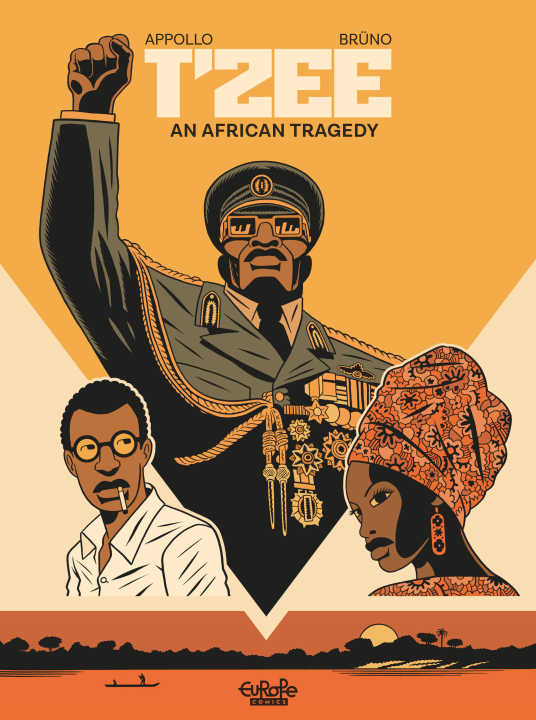
T’zee: An African Tragedy (A Graphic Novel) by Appollo (script) and Brüno (art)
T’zee is an action-packed, noir blockbuster in a graphic novel. It has all the makings of a Hollywood or Nollywood film: Post-colonial angst, corruption, family drama, illicit romance, sabotage, political violence. T’zee lacks actual history – it is all fiction — but its premise is grounded in real events of the twentieth century.
The story starts and ends with T’zee, the amoral dictator of an unnamed African nation struggling through its traumatic post-colonial afterbirth, but revolves around his young wife and youngest son, who each are coming to terms living with their larger-than-life husband and father and the roles they are supposed to play in this political drama. The former is a member of the new elite — but the limitations of gender and patriarchy force her into positions she might later regret. The latter is also a member of the new elite, the intellectual elite. During the typical educational sojourn young men of his class make in this era, T’zee’s son finds himself torn between his family and his morals. Politics, power, and ambition rule over both of them, force the wife and the son into decisions that are less of their own making than orders carried out under duress.
In three acts the reader witnesses the ebbs and flows of T’zee’s power, how his family fares in the pressure house of his politics, and the swiftness by which all their fates can change course.
This is an entertaining read. However, elements of its narrative promote a colonial logic which need to be addressed. T’zee is portrayed as a cruel and inept leader, one focused solely on his own aggrandizement and accumulation of wealth, at the expense of his people. His wife too is a woman focused solely on her own selfish advancement and fulfillment. The son is feckless and weak. Scenes of the city and the rural areas of this nation are memes of poverty and crime too often associated with the so-called “developing” or “under-developed” world, what has been classed so disparagingly as the “third world.”
I balk at depictions of African nations as cesspits of corruption, poverty, and crime. The implication that African peoples cannot rule themselves is one grounded so obviously in the so-called Civilizing Mission, that lynchpin of colonial logic; this is wholly inaccurate and stereotyping. I wish that elements of the story had addressed T’zee and his regime with more nuance; I wanted more decolonization in these pages. I cannot help but read as a historian, especially on a subject so close to my heart.
Still, this was a fun read and one I would suggest for casual consumption.
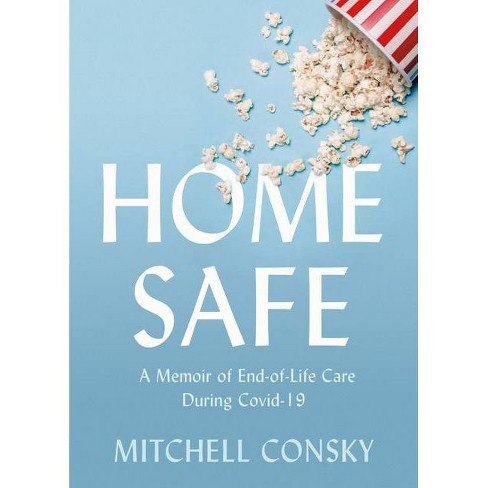
Home Safe: A Memoir of End-Of-Life Care During Covid-19 by Mitchell Consky
This memoir was a bit out of character for me; but, I’ve been reading quite a few memoirs this year and this one caused me to pause. Is it too soon to read about Covid-19? We’re not quite past it yet, are we? Given that Covid-19 remains looming in so many places and may very well make a comeback, I figured it might help my own healing to read about someone else’s pandemic experience. Admittedly, mine was mild, privileged, and uneventful in comparison to so many millions of others on this planet. What did others feel? How did others live through this? We talked amongst each other, but too often we said a lot of nothing to avoid the anxiety that a deeper, more nuanced conversation could too easily trigger.
From a historian’s perspective, memoirs like this — indeed, the millions of posts, tweets, blog posts, articles, stuff — that we produced in the past few years say something poignant about this strange and traumatic moment in our individual and collective lives. What was this moment in our history? Memoirs give us entrée into others’ internal lives, see how others experienced this.
Consky’s account of the past couple of years, encompassing the dying and death of his father and others, delivered on both points. What was living and dying in the pandemic like?
But readers should not expect a litany of statistics or a step-by-step replay of WHO’s or the American CDC’s decisions and policies. This is a memoir, a deeply personal and individualized account of a global experience. Death is always subjective, always individual, always very personal. Readers should not expect this book to discuss everyone’s experience of Covid-19. The deaths in this book are not coronavirus related deaths necessarily; this book is about the non-pandemic deaths that occurred during the past two years. Ordinary life and ordinary death did not pause for the pandemic. Pandemic deaths eclipsed the distress of other kinds of deaths, but only insofar as their appearance in the news, social media, public forums. The trauma of those passings remained, but was invisible in contrast.
That said, this book is about life too. It is about resilience and the ways in which we communicate those important things in life that need to be said and done before death makes it impossible to do so. This memoir is about memory, not only Consky’s but those of his father’s and the surviving friends and family of those who lost loved ones — during the pandemic and at other times too. Life and death during the pandemic of 2020-2022 was unique in our lifetimes, but also… not. Life and death was also familiar… too familiar? Scarily familiar. Comfortingly familiar. I cannot decide. Neither can Consky, I think.
This book is also about memorializing and the ways in which we do this, for ourselves and for the dead. One act struck me in particular: when a group of friends gathered their memories of another among them who had passed away and gave the resultant artifact to the deceased’s family. This book is about how we can commune over death, that common event, that inevitable process that erases (or should) differences and animosities among us.
The end of life care Consky refers to? I think he means us, the surviving family members and friends of the ones who have passed away. For that reason, the book transcends the pandemic. The pandemic is (was?) a great thing, a momentous thing, but life and death will go on with or without it.
Medieval Royal Mistresses: Mischievous Women who Slept with Kings and Princes by Julia A. Hickey
This is a compendium of salacious scandals highlighting a handful of women who possessed power and agency in a world where their gender and sex were deemed inferior to men. For readers who enjoy the political maneuverings rife in European medieval history, this is a fantastic work to add to your collection.
Each chapter focuses on a specific woman, her immediate world, and a narrative charting of her political and public life as it was recorded in the historical archive. There are the usual mentions of the usual heavyweights of Medieval women’s history: Elizabeth Woodville (who became Edward IV of England’s queen), Katherine Swynford (who became the Duchess of Lancaster and the wife of John of Gaunt), Rosamund Clifford (the mistress of Henry II and the object of many romantic poems), and Saxon queens, like Emma or Ælfgifu of Northampton. But the book also brings to the forefront other, lesser known women who came to wield sexual and political power: Maud Peverel (the mistress of William the Conqueror), Herleva of Falaise (the mistress of a Duke of Normandy), Edith Forne Sigulfson, and numerous other unnamed women who bore royal children.
Many of the women in these pages were powerful in their own right as heiresses or bearers of royal blood, but invariably most were eventually cast aside or somehow lost their influence over the men who ruled this world and time. For all their power, Medieval Europe was a patriarchal world.
Medieval history is — to me at least — infinitely intriguing, but the archival evidence on women in this age and the internal lives of individuals is so sparse that monographs are often dry and lack the kind of micro- and prosopographical history I personally enjoy. There is a great deal of historical tennis volley of “Duke So-and-So met Earl Such-and-Such in battle” or “Lady Blah Blah was then wed to the second son, Henry (always a Henry somewhere), but died alone the way” and so on and so on, so on, so on, etcetera, etcetera. But to Hickey’s credit, the prose and style of this book make what might be a dry topic of political intrigue interesting.
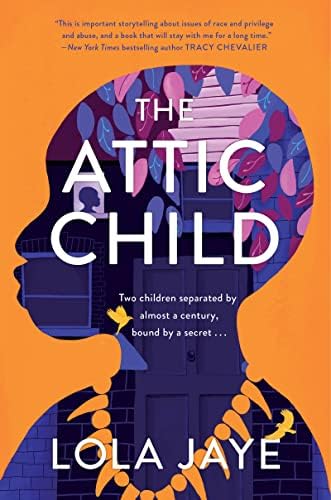
Something draws me to themes of tragedy and darkness in my choice of reading. The Attic Child might very well be one of the darker — if not darkest — novels I’ve read this year. This is a novel about strength, resilience shaped by necessity of survival and trauma; but it is not only the characters who must cultivate and wield this kind of strength, the novel requires the reader to be brave and hardy too. The reader must be to bear the suffering of reading about the suffering of others.
The pain is intentional. Jaye’s novel addresses, with unflinching realness, the lived trauma of colonialism by highlighting the literal theft of human beings European colonizers forced People of Color and colonial subjects to endure. The novel forces the reader to see how this history is very much present in our contemporary moment, that it is has caused intergenerational harm beyond measure.
As a historian of decolonization I am grateful for a novel like this — and happy to see that it was distributed on a platform as wide and well known as The Book of The Month Club (which is where I obtained it). We — those who come from parts of Europe’s former empires and those whose ancestors benefited from those empires, that is, everyone — need books like this, stories like this, voices like Jaye’s to declare that the grief and loss and wounds of colonialism are still not healed, closed, “over.”
The novel spans many generations and decades, beginning at the start of the twentieth century with a young boy who lives with his family on the African continent. He becomes the Attic Child, the first of many — children shut away, abused, neglected. He is robbed of his identity and his heritage. The story of a young woman who lives in a time closer to our present intertwines with his. The reader is aware there is a connection between the two, something hidden in the attic and the house in which both of these characters grow up, both of them “attic children.” The mystery the reader will find themselves embroiled in is how they are connected and why.
As the mystery unfolds it also deepens, its roots are long and twisted and dangerous. The mystery exposes the characters to pain and the possibility of new emotional wounds. The threat of scarring is real. But they are both hurtling through history and time and must live their lives. If there is a history lesson here, it is that we cannot escape history or making history, as we do so simply by living.
The novel does not pretend to heal the pain of this history. Reader should not expect to be bandaged or coddled in any way. But the novel does end as a historian might expect, with the lesson that history does not end, it goes on and on and therefore, that is itself a kind of closure. Perhaps, the ending is something more of a suture than a healing.
This is a tough and exacting book to read, but one which will not fail to provoke emotion. This is a significant novel.
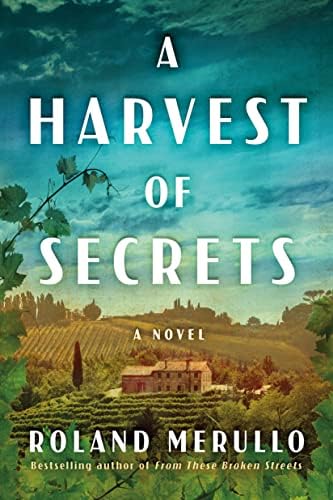
A Harvest of Secrets is a slow burner, then halfway it ignites like gunpowder and the end is an emotional and deeply satisfying explosion, uniting all the storylines of the novel together in a kind of literary bonfire.
The novel is set in WWII, fascist Italy when much of the country has fallen under the control of the Nazi regime. The story unfolds primarily in a rural northern village where an old, aristocratic family grows grapes and produces wine. The San Antonio family and their estate have been lords over the land and the people for generations. There are tensions between the family who own the winery and its workers, age old class-based tensions that threaten to erupt under the additional strain of wartime food shortages and unpredictable Nazi raids. The war has also brought about new factions and exacerbated pre-existing enmities: resistance fighters and saboteurs against Hitler’s Nazis and Mussolini’s Blackshirts, deserters from the Italian and German armies, Il Duce’s spies, and Nazi collaborators. Caught in the cross hairs between these conflicting factions are two young lovers: Vittoria, the daughter of the proud noble family and Carlo, the orphaned peasant boy she grew up playing with. There are also others who find themselves trapped on one side or the other of the war: Old Paolo, the foreman at the winery, Umberto San Antonio, the noble man who owns the land, Enrico San Antonio, his son and Vittoria’s brother, Eleonora, the Jewish woman in their midst. They each have their obligations to family, country, and to those who have sheltered, raised, and loved them. These obligations tear the lovers and their community apart — and bring everyone together in other ways.
Merullo’s novel is not only about the lovers; it also about the many individuals whose lives intertwine with theirs. Indeed, the novel is more of a broad panoramic view of Italian society in this fraught period of the twentieth century. Some of the people Carlo meets are sympathetic to Mussolini, others seek freedom from the politics that engulfs them all, others are victims of Il Duce’s ill-conceived plans and ambitions. Vittoria is likewise surrounded by those who would do her harm and protect her from it. There are resistance fighters, Nazi soldiers and officers, Nazi collaborators, and Mussolini’s spies lurking and active all over the countryside, waiting to strike or entrap her and other innocent Italians who simply want to do what is right for themselves and their families, and by their conscience. As a woman of this period, Vittoria’s options are limited. Italian patriarchy places shackles on her that are made for women alone. She is meant to be a good daughter, a good woman, a quiet woman — but in the chaos of the war Vittoria cannot remain silent.
Woven into this larger cultural, social, and political vista of Italian wartime life is a domestic drama and mystery. Vittoria’s dilemma is at the center of this. She must bargain her silence for her freedom, sacrifice her morals to be a good daughter. But she is also a product of a longer history of women like herself.
Secrets held for decades, the kind begotten by forbidden love, are as much a part of the estate and the fabric of life in the vineyards as the vines themselves. These unraveling mysteries push and pull Vittoria, Paolo, Umberto, and Carlo in all directions. The emotional and real famine of war force these long buried secrets to emerge on the surface. As the Americans and Allies bomb Italy in order to free it, Vittoria, Carlo, Paolo, Umberto San Antonio, and others scramble for safety and try, hard as they can, to keep these secrets under cover.
Overall, a good read, especially for readers who enjoy themes of class conflict, gender histories, and ensemble casts of characters, and domestic mysteries.
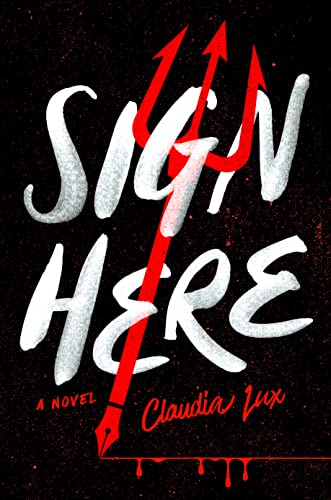
A departure from the more serious novels I’ve been reading lately, and perfect — if a little late — for the Spooky season. Still, if you are a horror fan, any time is a good time for a paranormal mystery, which is exactly what Sign Here is, with a generous injection of humor.
Sign Here is a combination of the television show, “The Good Place” and one of Simone St. James’s paranormal mysteries, the kind which unravels to reveal a multi-generational history. It’s laugh-out-loud funny and also deadly serious at the same time. I couldn’t have asked for a better post-Halloween read than this. It gripped me to very end.
The novel is set in two dimensions: Hell and Earth. The former is a bureaucrat’s heaven, a place where the radio station is constantly on commercial break and the music is every genre you can’t abide. There’s fun to be had in Hell, but no peace, utterly no reprieve from annoyance. Ever. One of the main protagonists of the novel is a demon who long lost his humanity and now deceives or manipulates souls in order to collect them for his hellish quota. His goal is to complete a “full set” of a family, one soul from each generation. And to find some measure of peace in the afterlife. The two objectives are not exclusive.
The family he has targeted is a wealthy and dysfunctional one, a collection of questionable traits has passed down from one generation to the next. They have a long history with this demon, a transactional history of quid pro quo. There is also trauma, murder, abuse, and just downright immorality in the family’s past; one might say, the stuff that Hell is made of. But they are lovable too. Their flawed histories and personalities make them all the more human, all the more recognizable, for all their privilege and wealth. The reader will get the impression there is something not quite right about them though, and as the novel progresses, it becomes clear that several of them have something to hide — even from the demon himself.
The novel is set at the start of the annual family vacation, a dreaded and welcome event. There’s a newcomer to the lake house with them: the new best friend of the daughter. She’s bright and curious — and may just force the family’s dark secrets into the light.
The two storylines intertwine: Will our demon be able to exploit the family to meet his quota? Will he ever escape his Hell? Will the family be able to keep their horrors safely hidden in the past? Someone’s soul is at stake. Will it be the father? The mother? One of the kids?
Sign Here ends explosively and satisfyingly. Everyone gets what they deserve.
The Master is a stark novel, the kind that is absent of luxurious words and descriptions, but whose minimal lines imply a lush intellectual interior may lie beyond the text, if the reader is willing to linger on the line just a little longer than necessary.
The protagonist is Zhuang Zhou (also known as Zhaungzi), an actual historical figure, a Chinese philosopher who lived circa 369 BCE to 286 BCE and contributed greatly to the philosophy of Taoism. He is the eponymous master of this novel. It begins with his childhood and recounts the fictionalized events of his life, with especial attention to Zhaung’s moments of philosophical enlightenment. Zhuang is propelled, by his choice or by the whims of others, from one kingdom to another, finding his life and livelihood tied to the court, a recipient of a benefice from the king. In some periods of his life he welcomes this privileged position, living the abstracted life of the mind. At other times he rejects this and delves into more material pursuits. His experiences lead him to write the piece of scholarship he is known for, The Zhuangzi.
The novel reads like an ancient epic moving swiftly from one event to another. It does allow the reader some interiority into Zhuang’s mind, but only his, and only insofar as it pertains to his judgements on morality and ethical behavior. This is not a personal account of the interiority of his life in an emotional sense; the reader should not expect entree into Zhuang’s feelings, so much as his intellectual musings on morality and correct ways ruler should govern. (Indeed, the reader may get the impression Zhuang was a less than stellar parent and romantic lover.) Rambaud delivers the character with a kind of detachment, as if merely filtering a series of observations for the benefit of the reader and for the reader to analyze and judge Zhuang for themselves.
The purpose of the novel seems to be less focused on the man than his scholarship. I have the distinct impression I am meant to walk away with a fuller view of what the sage intended for us to understand about Taoism. But I admit, I was less impressed with Zhuang’s heavy handed pedagogy and deliberate elusiveness, and so the lesson missed me.
As a result, this reader notices a pedantic aspect to the book, which while it performs the conventions of Chinese philosophical writing authentic to its setting and protagonist, may read as supercilious to the modern reader. But then again, the philosophy of ethics is about passing judgement and imposing moral watermarks on society, so… I am left wondering if a book on a topic like this can ever be written without an element of condescension baked into it. If so, Rambaud is excused from any accusation of arrogance; indeed, Rambaud’s role in this novel is exemplary otherwise.
Rambaud’s portrayal of Zhuang follows an expected patriarchal narrative that is likely accurate; we are not given any historical evidence that the real Zhuang was a feminist, after all. To portray him as such would have been inauthentic (if satisfying as a disruption, a revolution). We can understand Rambaud’s role here as a messenger. His prose is beautiful in its sparseness; with few words an image of Zhuang — not his physical being but his essence — is apparent to the reader, as are his friends who accompany him, betray him, befriend him on the journey of his life. Rambaud delivers the tensions of the social landscape of ancient China well, without romanticizing or Orientalizing the place or people. It is a harsh world: peasants live and die at the whims of their lords, people live and die at the whims of nature via its tantrums in the form of floods or droughts. Rambaud transports the reader to this moment and place well.
Overall, The Master is an enjoyable read, one that informs and does what historical fiction ought to do: transport the reader across time.
The Nurse: Inside Denmark’s Most Sensational Criminal Trial by Kristian Corfixen
Reading nonfiction true crime is one of my favorite guilty pleasures. I enjoy it with a professional historian’s interest: the analysis of evidence and its presentation in text, the exploration of the social and cultural impact on the communities in which these events occur, and the dissection of the institutions and the systems that enable or hide the crimes and the criminals. Corfixen’s The Nurse, about a young woman’s murder of four of her patients in Denmark and her conviction for these crimes, delivers on all three points. It is a well-researched book on the crime, the criminal, and the Danish healthcare, law enforcement, and judicial systems.
Corfixen interviewed the nurse herself, Christina Aistrup Hansen, her colleagues, detectives, victims’ families and friends, as well as one of the survivors. It presents a fleshed out, rounded account of the events. [If you’re interested in news of the case, you can read more here.]
The Nurse: Inside Denmark’s Most Sensational Criminal Trial begins well before the case and the trial itself. This first section of the book provides the reader with the necessary background knowledge to understand Hansen as well the hospital system in which she committed her crimes. (The book is published in English, presumably for Danish and non-Danish readers.) This part is told through the experiences of Hansen’s colleagues, one in particular. In subsequent sections, Corfixen takes us back in time to Hansen’s childhood and into her personal life, then into her professional life, through the period of her nursing education, and finally into the microcosmic society of the hospital. The reader is immersed in the community and culture of nurses and medical staff at the Nykøbing Falster Hospital. The book continues on to detail the crimes themselves and the investigation that was initiated against Hansen. The Nurse ends with the trial and Hansen’s incarceration. These parts of the book are especially intriguing as Corfixen is given rare access to Hansen herself. The reader is treated to a perspective often absent in true crime accounts.
Corfixen’s prose and the way in which they exhibit these diverse perspectives is a critical part of the book’s success. The writing is smooth, but more significantly, it is seamless as it moves from one point of view to another. The reader gets a privileged view of the events from Hansen as well as from her former colleagues, from the family members of her victims. These are often conflicting — Hansen maintains her innocence throughout — but Corfixen manages to give each perspective time, space, and voice in a balanced way.
The result is an engrossing read that captures the reader’s attention and offers them a textured sense of the macro Danish world and the micro-culture of the Nykøbing Falster Hospital in which Hansen lived, worked, and committed her crimes. From the book’s beginning to its end, despite knowing the final outcome, I was compelled to keep reading, not to know what happens, but how it happened and why.





 Dr JoAnn LoSavio