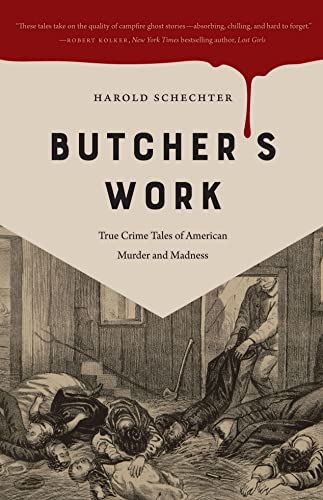
Butcher’s Work: True Crime Tales of American Murder and Madness by Harold Schechter

Butcher’s Work: True Crime Tales of American Murder and Madness by Harold Schechter

The premise of Schechter’s Butcher’s Work is intriguing enough to entice any fan of true crime to pick it up: Serial killers and murder are nothing new, why have we forgotten some crimes and remembered others? And, more curiously, what are those cases which we have forgotten? The easy answer is that they weren’t horrendous enough, disgusting enough, criminal enough to earn a place in our long, collective memory. But the cases in Butcher’s Work dismisses that possibility quickly; the crimes highlighted in this work are all that and more chilling. The fact that they have disappeared from our remembrance is itself quite a horrific notion.

Butcher’s Work is divided into four sections: Butcher’s Work, The Poison Fiend, Lady-Killer, and The Ragged Stranger. As their titles suggest, each one focuses on a particular method or victim of murder. There is a featured case of each, but interspersed within the pages of the chapters are cameos of other criminals employing the same method. Collectively they form a creepy landscape of crime, where trusting another human being is something to fear. Lady-Killer was one of my favorite sections. Marriage and murder form the central focus here, a gendered violence perpetrated by men against women. I won’t spoil it for anyone, but DANG, how did these men get away with this? Oh, right, but still!

Schechter is a marvelous story-teller. The prose flows, as compellingly as the stories and characters. And, as a researcher myself, I deeply appreciate the depth and details Schechter has excavated in this work. The result is not only a focused, historically rich, and keen archival piece of work; Butcher’s Work is also a nuanced landscape of American life in the 19th century. Schechter brings to the reader’s attention how it is not only the ambition of the criminal, but also the systems and structures of society that permit and foster these crimes. How else might a man such as Hoch in Lady Killer commit bigamy and murder so successfully and remain for so long undetected? What gave him the confidence to believe in his own acquittal? Of course, the criminals here were apprehended, so there is a more optimistic ending. We can rest knowing the authorities — police, witnesses, lawyers, courts, etc — did succeed in forcing them to confront their crimes. But, I could not help but wonder how many others got away with it altogether? The idea is spine-chilling.

Butcher’s Work is a fantastic read for any fan of true crime and 19th century American history.
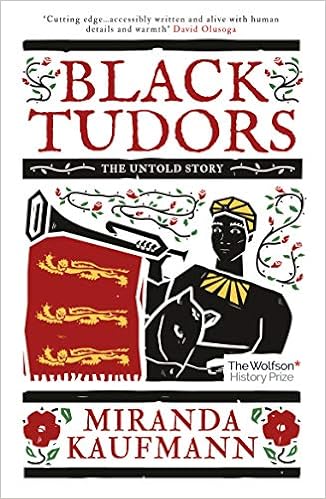
Black Tudors: The Untold Story by Miranda Kaufmann

Black Tudors: The Untold Story
by Miranda Kaufmann

This is the kind of history and historical writing that excites me! Kaufmann’s Black Tudors is a gem because of its topical focus, that is, centering black history, its accessible language, and smooth, flowing prose. I was very excited to read this book and it exceeded expectations!

Black Tudors is split into ten content chapters, bookended with an introduction and conclusion. Each chapter focuses on a specific individual, a black person who left a mark — sometimes a small one — in the historical record for us to find. These individuals were not lords or aristocrats (like Alessandro de Medici, Duke of Florence), but ordinary working folks who came to England through a number of avenues: trade, servitude, attached to diplomatic entourages, etc. While each chapter focuses largely on the individual who lends the chapter their name for its title, Kaufmann also includes evidence of other Black individuals from North and West Africa, the Southern Mediterranean, the Middle East. The result is a rich historical landscape of a hidden minority community and the cultural, social, and political context of their Tudor world.

The reader gets a textured, almost tactile experience of Tudor life, not from an aristocratic or royal perch, but from below. Kaufmann grants the reader entry into the working, merchant classes, into the world of the laborer, the Tudor servant class. This is a culture without a “middle class” in the way in which we understand the term, but there is a servant class, a working class, a peasant class, a mercantile class. Kaufmann gives us a view of these worlds from within and through the lens of foreigners, Africans, and Muslims.

Kaufmann adds to a growing number of histories which add color to the whiteness of European history. It joins the work of Marc Matera, Olivette Otele, and others which have and continue to excavate blackness in a traditionally white-centric history. That said, this is hard work; the act of research in these kinds of histories is difficult as so many layers need to be peeled off to discover hidden individuals in the historical record. I fully acknowledge Kaufmann’s effort and applaud their thorough research.

As an example of historical method and empiricism, Black Tudors shows the reader how to weave a history and a prosopography from very little archival material. This makes this book an excellent historiographical case study for an under– or graduate level seminar on historical methodology.

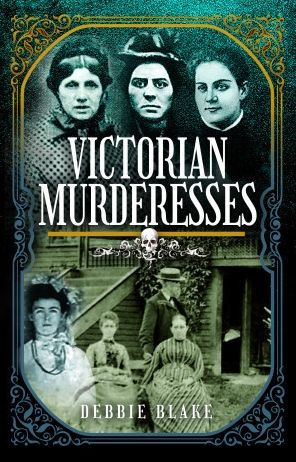
Victorian Murderesses by Debbie Blake

Victorian Murderesses by Debbie Blake

I am sucker for a good true crime non-fiction, any time — and Blake’s Victorian Murderesses absolutely satisfied my every expectation of the genre. It was gory and chilling, all the more so because of the historical grounding of each case covered here.

Each chapter — there are seven of them — examines a specific killer and the details of her crime(s). Four of them focus on British murderesses: Sarah Drake, Mary Ann Brogh, Kate Webster, and Mary Ann Cotton, while the remaining three cross the Atlantic to provide accounts of the disturbing murders perpetrated by Kate Bender, Lizzie Borden (of course), and Jane Toppan. I was grateful that Lizzie got only a chapter; the fame of her crime has sullied my interest in her case. I’ve simply read it too many times for it to invoke any novel shock, but I acknowledge that the Borden murders warrant a place in a book like this.

What makes Victorian Murderesses such a fantastic read is the way in which Blake colors in the context of these women’s lives; not only do we get a rare glimpse into their worlds, but the Victorian world as a whole, especially as it was for women of a certain working and middle class. The reader also gets to see how these women got away with their crimes for a significant part of their lives and how police operated to discover them. In some cases, like with Sarah Drake, I could not help but feel a bit sorry for the murderess as much as the victims; institutionalized sexism drove some of these women to extreme lengths — though I cannot say I condone their decisions to take innocent lives. In some cases, like Cotton’s and Webster’s I found myself wondering how it was possible for them to commit so many crimes without getting caught earlier! I wonder at how it was that Lizzie Borden became so famous when these other women committed so many more criminal acts.

Kate Bender and the Bender family were — for me — the most dastardly, the creepiest of the seven chapters. Their crimes were like those out of a grisly, B-rated horror where a family of four drives down a lonely farm road… and is never seen again… Brr. I feel shivers thinking of it now.

This was a fantastic true crime read, fun and gore all around, enough to keep you wanting more.

The Beckoning World: A Novel by Douglas Bauer

The Beckoning World: A Novel by Douglas Bauer

The Beckoning World is a complex novel: intelligent and sentimental in equal measure, carefully restrained and yet brimming with emotion, grounded in reality but fanciful in its fantasy of baseball celebrity. This is a tale of ordinary desire, ambition, failure, and the sacrifices of love that we can recognize in others and in the society at large, and yet there is enough fiction here to allow us to deny the existence of this tragedy in our own lives.

If you love Stoner by John Williams or Pnin by Vladimir Nabokov, Reader, you’ll appreciate the agony of life Bauer portrays here, the quotidian kind, the slow descent into ordinariness that we all must confront, whether we accept it or not. The Beckoning World is as much a tale of the world beyond our borders as it is the world within our constraints that we cannot escape. The call is not always one to adventure, but a tether.

That is not to say this novel lacks adventure for it does not, it has adventure in buckets. The Beckoning World is also a coming-of-age journey, tracing that phenomenon’s mental and physical challenges and explorations. There is a real adventure here — and the kind of fantasy that some of us only dream of. Reader, you’ll live vicariously through Henry’s eyes, live through the fantasy of childhood — his and perhaps your own.

It is hard to pinpoint what The Beckoning World is about for to outline its plot captures only a small part of its appeal. Its characters are the real attraction here: Earl, Emily, Henry, Babe, Gehrig, Walsh, Lottie, Rooster. They are manifestations of persons in our lives; flawed and perfect. Bauer develops them with succinct, incisive prose that, in silences, invites the reader’s imagination to participate. Bauer captures our investment quickly, and Reader, you’ll be rewarded quickly; the story moves at a steady pace even as it lingers in some moments longer than others. Like Williams and Nabokov, novels of that mid-20th century period, Bauer’s prose is the sort I enjoy: narrative, descriptive (but not overly so), structured.

The novel is set in Midwest America in the early 20th century. There is a pastoral quality to it, one that is generic, recognizable, comforting. This element of the novel is cast in a sepia light, historical and still otherworldly: this is a time and place lost to us and only visible through a veil of nostalgia. It begins with Earl, a young man from the Midwest who — like many of us — is faced with the choices of adulthood and responsibility. Emily, a young woman from the same rural background must make the same decisions, balance desire with practicality. The result is Henry, who becomes the central focus of the novel and who is the focus of the great baseball adventure that ensues.

Through a fantastical encounter with baseball, Babe Ruth, and Lou Gehrig and a journey across the country Earl and Henry come to terms with their loss, life, and future. This is a bildungsroman of the American kind.

A highly enjoyable, thoughtful read. The Beckoning World is a wonderful addition to the genre of the classic American novel.

Water’s Edge: Writing on Water Edited by Lenore Manderson and Forrest Gander

Water’s Edge: Writing on Water Edited by Lenore Manderson and Forrest Gander

Lenore Manderson was one of the primary appeals of this collection for me. Having read some of her historical scholarship I was intrigued about this diversion into water as a subject. Her collaboration with the poet, Forrest Gander, also made me pause over this title.

I am not sure what I expected, but was pleasantly surprised to find that Water’s Edge is less a work of scholarship than an academic, literary contemplation on climate change, the significance of water, and the role of water in the intimate spaces of our lives. The collection is vast in its scope, though narrowly focused on its topic, water: poems, visuals, images, photographs, sociological and anthropological essays on researching water, and essays on the ways in which we move water and how it moves us.

My favorite — and indeed one of the most surprising essays — was not on water directly, but on chickenshit. I will say no more, but that incongruity may intrigue you as much as it did me. The reward was immediate. There is more connection between water and chickenshit than I gave credence to before reading this essay, not that I paid much attention to chicken excrement…

Indeed many of the essays and poems in Water’s Edge are rewarding and quickly so; they are short, spanning only a few pages each at most. Their length makes this a quick and flowing read, not unlike a river (perhaps that was intentional!)

As for the intended audience of this work… It is academic; its language and form are designed for an aesthetically sensitive mind, one that is poetic and will appreciate the nuances of a breath or the sensation of a light spray of water. The reader should expect to work for their reward. The content is intellectual and demands a certain degree of effort to excavate some of the deeper meanings embedded in the text. I would expect no less from poets and scholars. That said, I could see this text yield fantastic discussion and organic analysis in a social science graduate or upper level undergraduate seminar. The content, language, and complexity allow for reflection on multiple levels. Poetry and literature are excellent fodder for analysis; I use novels in my history courses frequently.

A very thoughtful read on water and our future with this quotidian, essential substance.

Valley of Shadows: A Novel by Rudy Ruiz

Valley of Shadows: A Novel by Rudy Ruiz

Valley of Shadows was WOW, a great slow burn paranormal mystery. The ghostly element really kept me on my toes, you never could tell which way something was going to go. I was hooked from the first page!

There are so many reasons I love this novel. First, the historical landscape had nuance and depth; the perspective decolonized the past, highlighted the transnational experience of the American-Mexican borderlands through the eyes of the Mexicans and the indigenous peoples who lived there. Ruiz did not shy away from the racial tensions, the ethnic conflicts, and the histories of colonization that were part of the fabric of life on the borderlands in the 19th century — and I deeply appreciated that. Indeed, much of the plot revolves around those very transcultural tensions. This grounded this paranormal western/mystery/horror in a historical reality that made the events all the more horrific; they were real. The violence of this time was real, not a fiction of Ruiz’s imagination.

Second, Ruiz’s use of linguistic and ethnic markers is significant. Yes, this is a novel, but it is also a work of decolonization. Ruiz disrupts the whiteness of the Western genre with Valley of Shadows. The primary protagonist is Solitario Cisneros, a Mexican man who used to be sheriff — and could still be. Onawa is a young half Mexican, half Apache woman who assists Solitario in his investigation of a series of murders. The living and the dead show up in various parts of the story, some from Solitario’s past which is never far behind him. History in this novel is very much a dynamic, fluid factor in this novel; it is almost as alive as the characters.

There is a mix of white, Mexican, mixed-race, and indigenous characters in this novel, mimicking the historical and contemporary reality of North American borderland communities; nothing is ever cut-and-dry, black or white in such places, then or now. This diversity of identities makes the characters more recognizable; their ethnic and historical diversity mimics our own multiple identities and ways of being. Race, ethnicity, class, and history shaped these characters, making them palpable, their decisions and actions authentic and borne out of subjective needs and ambitions as much as they were shaped by social and historical factors.

Third, Ruiz unfolded the story with skill. Tension and mystery were embedded in the plot, compelling me to read on, but it was the way in which Ruiz slowly unravelled the plot. At the end the reader will see that all the threads of the mystery were there, almost from the very start, waiting for us to weave them into fabric. The story revolves around a series of gruesome, brutal murders. There is very real, physical horror here; the idea that these could be done by a human being on another is scary enough — but there’s the possibility this could be something more supernatural. Which is more sinister?

Valley of Shadows is Solitario and Onawa’s adventures in this realm and the next as they speed against time to save the other potential victims, apprehend the murderer(s), and deliver justice to the victims and their surviving families.

This was a fantastic Halloween Horror read, perfect for any time of year, really. If you’d like to see my others, check out: A Fig For All The Devils: A Novel by C.S. Fritz, The Ghosts That Haunt Me: Memories of a Homicide Detective by Steve Ryan, Gallows Hill: A Novel by Darcy Coates, A Fig For All The Devils: A Novel by C.S. Fritz, Anybody Home? A Novel by Michael J. Seidlinger, and Ghost Eaters: A Novel by Clay Mcleod Chapman

Hester: A Novel by Laurie Lico Albanese

Hester: A Novel by Laurie Lico Albanese

To fans of feminist stories, witchy tales of realistic romance, and Nathaniel Hawthorne’s The Scarlet Letter, this is the novel for you! As the eponymous name implies, Hester is about the woman behind Hawthorne’s famous heroine. Albanese begins with the premise that she was a real woman, that the Hester Prynne of Hawthorne’s fame was based on a person from his own past, fantasized into the character of The Scarlet Letter.

In this backstory, Hester Prynne is a young Scottish woman, Isobel Gamble, who arrives in the New World for the express purpose of leaving behind the old one. It is an adventure tale, interspersed with romance, lust, avarice, and desire for belonging. The novel follows Isobel through her first few years in the northern colony, around a hundred years after the terrible witch trials at Salem, in the early 1800s.

But the magnetic charm of Hester doesn’t hinge on this legendary and vile history, even though the witch trials still bestow both a lurid glamour and an ugly stain on those whose ancestors took part in it. The community as a whole has a long memory and a store of dark secrets: the witch trials and the African slave trade (though illegal, the formerly enslaved and the enslaved still feel the manacles of bondage in all kinds of social, cultural, and institutionalized ways).

Simultaneously, the novel does not stand on the appeal of the fictionalized Hester or the “real” Isobel, though the characters in Hester are well-crafted as complex, nuanced individuals filled with flaws and virtues. No, the real pull of this story is its vivid portrayal of Puritan life as a gendered, stratified, prestige-hungry society. Hester spreads out for the reader a vast and complicated landscape of social politics. The world Albanese crafts is a real one. The reader gets a look into the world of Puritan men and women that lies beyond the stereotypical discussions of marriage and sexlessness and religion; Albanese’s Isobel is a working woman — a seamstress — and we see through the eye of her needle into the labor women do, both socially as the pillars around which society is upheld and economically as employers, employees, merchants, and consumers. We also see the emotional labor women are tasked with, according to society and their men — husbands, brothers, fathers, and so on.

The women of Hester are not powerless as a result of their labor. They do, in fact, wield immense influence and can — in some circumstances — exercise a great deal of agency. They work within the patriarchal framework of Puritan society to defy it, uphold it, mold it to their needs and ambitions. Isobel Gamble is only one of the women in Hester around whom the novel revolves. There is also Isobel Gowdie who is Isobel Gamble’s ancestress; Mercy, a woman of African descent, formerly enslaved; Felicity, a shrewd merchant in Salem; Nell, a fellow immigrant; and the Silas women, members of Salem’s old guard elite. Hester is about all these women and the world they lived in and shaped like clay through their ambitions and circumstances.

The story takes all the way to Pearl, the narrator in Hawthorne’s novel, but it is not the Pearl that he created for us; she is Isobel’s Pearl. Any fan of The Scarlet Letter will find continuity and novelty in Hester.

This is a gorgeous novel; its prose is simple, succinct, and sharp, much like the crisp starkness of Puritan collars and its story is ornate, a twist of knots and tiny stitches like the floral embroidery of Salem’s women.

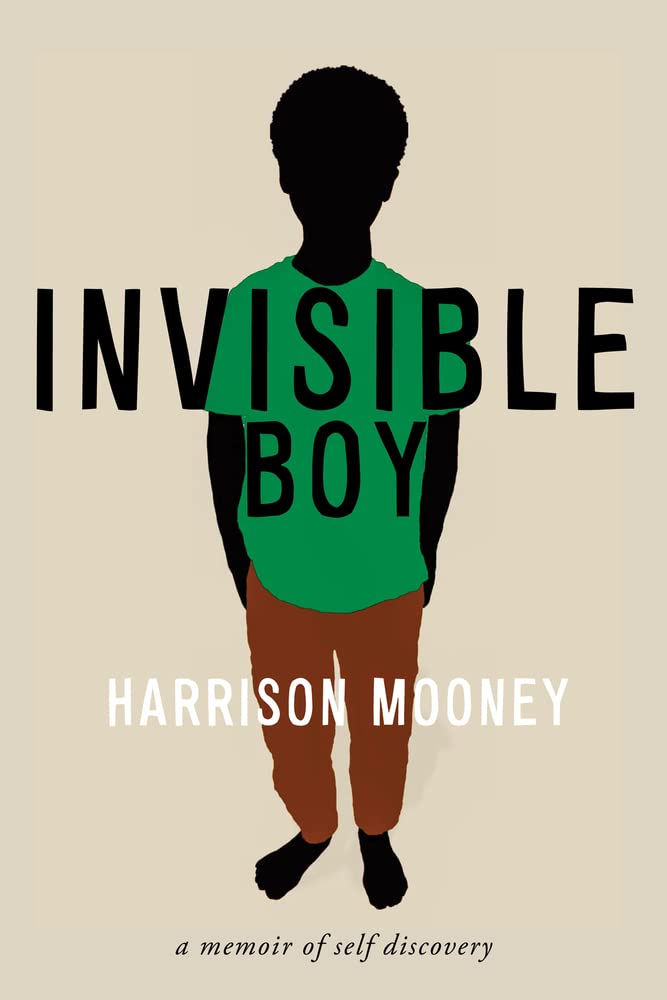
Invisible Boy: A Memoir of Self Discovery by Harrison Mooney

Invisible Boy: A Memoir of Self Discovery
by Harrison Mooney

Holy not-so-micro-aggressions. Holy GASLIGHTING. Invisible Boy was incredibly difficult to read without weeping. Every time Harry’s mother or other family members gaslighted him I wanted to scoop him out of the pages of his past and take him far, far away to people who would love him as he is, for who he is, for what he is.

I cry for all the children, teenagers, people who are where he was right now.

For all its pain, I do not regret reading Invisible Boy… because the pain embedded in Harrison Mooney’s past is insidious, latently seething, and all too common still. Decolonization is an eternal task, its end is nowhere in sight. Memoirs and works like Invisible Boy remain relevant and necessary in our collective, societal process towards decolonization. Like Fanon’s Black Skin, White Masks, Mooney’s Invisible Boy is a call to action. It is a reminder that we still need a rebellion of the mind and soul.

Invisible Boy relates the path of Mooney’s awakening to his race and the ways in which racism hides behind a myth of colorlessness. It begins with his childhood and ends in his early adulthood. His memoir exposes to the reader how racism seethes in the most intimate places, in the places it should not exist — in this case, within a family. Families are supposed to be safe. They are supposed to be supportive, loving, nurturing. Invisible Boy tells a sad tale of how racism is the silent reaper within, turning the sanctuary of the family into an emotional, mental prison.

What makes Mooney’s Invisible Boy unique from other works like it (Sam Selvon’s Lonely Londoners, George Lamming’s novels, Franz Fanon’s memoirs and works, James Baldwin’s calls to action, among others) is Mooney’s attention to a community that is little attended to: adoptees of color with white adopted families. As in Mixed-Race Superman, Will Harris’ essay on the transcultural ways of being mixed race, Invisible Boy highlights a different kind of process of decolonization that confronts adoptees of color in white families and white communities that hold onto racist beliefs.

I do not know if I can re-read Invisible Boy for the sake of my own peace as a person of color who has grappled with my own decolonization; but, I am glad I read it at least once and I am privileged to have the ability to choose to only read it once. I am privileged to have been given a rare glimpse into another’s experience of racial awakening. I am privileged that my own decolonization was less traumatic. In truth, Invisible Boy is a book that demands re-reading and reading again. One day I will summon enough courage to read it again.

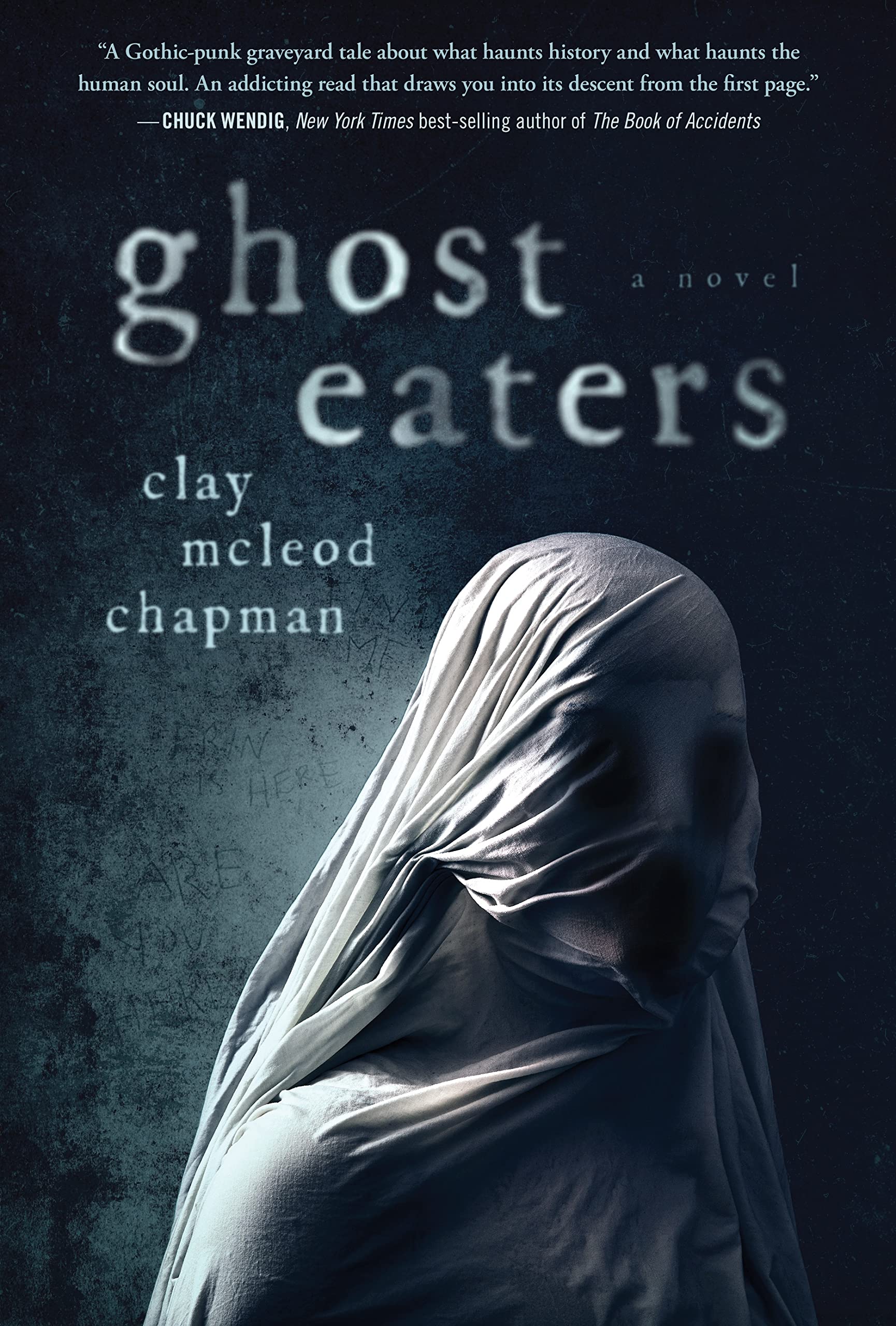
Ghost Eaters: A Novel by Clay Mcleod Chapman

Ghost Eaters: A Novel by Clay Mcleod Chapman

I was fully expecting a traditional ghost story. Maybe a haunted house. Something that is tried-and-true in the ghost story genre. And I don’t mean that as shade; I like ghost stories that follow a formula. They are still scary as F if they are written well. The creepy ethereality of gothic horror is my jam. And that’s what I thought Ghost Eaters was going to deliver.

Was I wrong in the most deliciously skin-crawling way! Ghost Eaters reads like a mature Young Adult novel that merges the horror of fresh-out-of-college, emergence-from-the-chrysalis loss with the ghostly supernatural. Chapman’s prose fits the YA genre; this novel borders on YA and contemporary adult horror. It feels like YA to me because, well, I’m not in my early twenties like the characters are. But the events and themes in the novel are better suited for an adult (if young adult) audience. There are mature themes here of death, grief, the loss of friends, parents, and loved ones. There is the threat of loss of the self: perception is a two-way mirror in this novel, and you’re never quite sure which side of the glass you’re on.

The story follows a young woman and is told from her perspective. Erin is a privileged, educated woman. She has family, family money, family connections, but despite this, she flounders in life. That’s the first horror, one that is banal and familiar to many. Erin is part of a group of friends; their leader has floundered in worse ways than Erin. Silas seems to be drowning in a drug-induced depression. When their social circle falls apart as the result of an untimely death, each one of them seeks to find meaning and reconnection in different ways.

Some of them take the task literally.

And that’s the second horror of this novel. The dark mental and physical adventure that ensues as Erin, Amaya, and Toby play dangerously with the line between living and dying, the present and the afterlife. I won’t ruin this for the reader. Just know that “ghost” in this novel has multiple meanings, and the loss that one associates with death is more than never seeing someone again.

A worthy Halloween horror read that haunts in multiple ways!

See my other early Halloween Horror reviews here: The Ghosts That Haunt Me: Memories of a Homicide Detective by Steve Ryan, Gallows Hill: A Novel by Darcy Coates, A Fig For All The Devils: A Novel by C.S. Fritz, and Anybody Home? A Novel by Michael J. Seidlinger

Berliners: A Novel by Vesper Stamper

Berliners: A Novel by Vesper Stamper

In 2019, before the madness of the Covid-19 pandemic, I got the chance to visit Berlin for a conference. I wasn’t there for long, but it was magical. I got to walk the bridges, stand under the Brandenburg gate, see some castles, and eat currywurst (all kinds of wursts!)

So when I saw this novel, I was immediately intrigued. The contents did not disappoint. But, first, a caveat: This is a Young Adult novel. The primary characters around which the story revolves, the brothers, Rudi and Peter, are in their early-mid teens and the story does not progress far into their adulthood. The prose, language, structure and so on are clearly written for a YA reader, but the historical and emotional content is potent and will suit a more mature reader.

The story is told from the two brothers’ perspectives; it is the tale of their parents and their lives after WWII has ended and German society — Berlin society — has settled into a kind of uncomfortable holding pattern, caught between the two ideologies and cultures of the American West and the Russian-controlled East. Vesper focuses on the interior perplexity in the boys’ minds: in a period of their lives when they are already grappling with puberty and teenage crises of identity, they are forced to also wrangle with the localized manifestations of external pressures of international politics, Cold War propaganda, and collective post-WWII German angst. They struggle with what anti-semitism means in this age, what Nazism had been and is now (Vesper makes this point clear: the end of the Second World War was now the end of Nazism or the hate that that regime promulgated. It lives on and remains as insidious as was), what socialism is and truly is, what the Russian and American regimes represent.

One brother awakens to an understanding that the Russians are selling them a false promise. The other brother believes the Americans are doing the same. One brother seeks the freedom of the West, the other seeks the stability and order of the East.

In the mean time, they are struggling against one another as well; competing as siblings for the attentions of their parents, for a kind of childish glory, for a sense of belonging within their own world.

They wrangle with the more mundane things of teenage life as well: understanding love in all its conflicting forms. Their parents are products of the war as much as they are; their relationship is fraught with tension, not unlike the kind of tension between the East and West: irreconcilable, ideological, built on a history that was not of their own making and borne out of the War. The brothers are also young men, their minds and bodies are tangled in novel feelings of love and sexuality. They are on the edge of adulthood and are testing out how they might victorious in this new domain; they experience losses, betrayals, and grief as the story unfolds — and failure, that first, very painful sting of rejection that is inevitably accompanied by new experience.

The novel follows Rudi and Peter as they navigate their parents’ and the city’s divergence. They eventually find themselves on opposite sides of the Berlin Wall, erected one night in secret.

This is a powerful YA novel that is also fulfilling for an older, more experienced reader. The moral and ethical dilemmas embedded in the politics and social interactions in this novel are ones that might be introduced to us at the YW stage of life, but they remain tangled in later adulthood too, so much of the conflict will be recognizable and moving for a maturer reader.