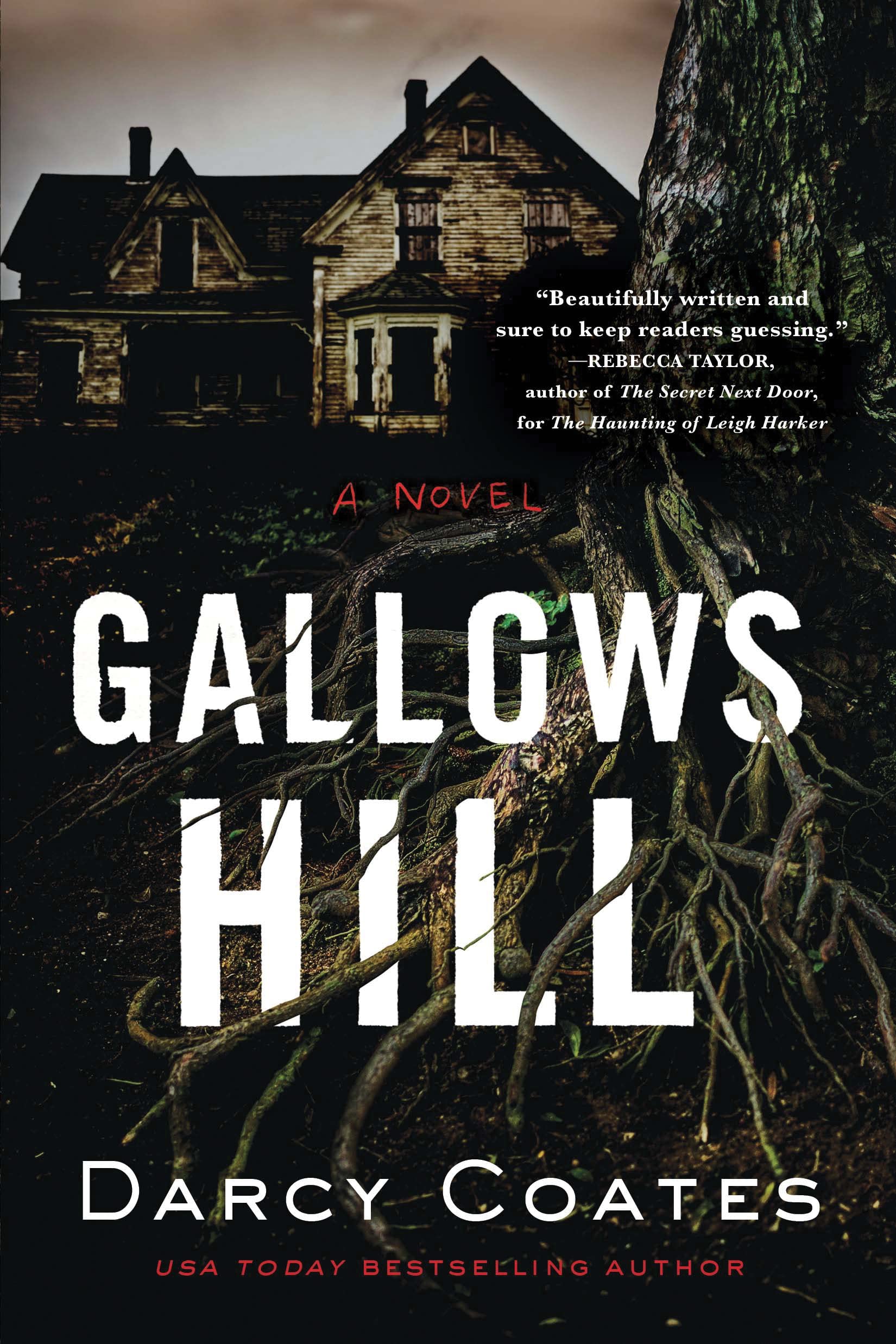
If you love horror movies and gothic horror this is a book for you. Gallows Hill reads like an independent, low-budget horror film that successfully builds tension out of nothing but silences and thoughts that teeter on the edge of madness.
The story begins with Margot at the funeral of her parents whom she’s never met. And no, she’s not adopted. That’s the first mystery. The rest is classic haunted house and horror flick stuff. Very gothic horror; the scares are all Margot’s. The story is told from her perspective, though in 3rd person not first. The readers are silent witnesses, like ghosts trailing her in her every move, watching her. Nothing is left out of the reader’s sight; chapters pick up exactly where they’ve left off. Every detail is accessible to the reader.
Coates evokes a proper sense of dread with well-chosen words; her descriptions are succinct and sparse, giving the images that are spun in the mind an appropriate filter of blue-grey darkness. There’s always a sense that Margot could escape this, that this is just all in her mind, and real life is just beyond the gate, down the road, in the town nearby. But the reader becomes quickly acquainted with Margot and knows that that’s not possible; like Margot, we are compelled to read on to discover the history of her, her family, this place.
The story unfolds in a matter of days. Most of the events take place at Gallows Hill and the house; it is the hill on which the house is built, the hill in which the cellars of the winery were dug. She inherits Gallows Hill, a winery and an estate that has belonged to her family for hundreds of years. That’s the second mystery; the people who work and live on the estate are a strange cast. Even the townsfolk are an odd bunch. Their interactions with the estate and the land will compel the reader to read on: What happens after dark? Why does the land need a blessing? The reasons given are mundane and reasonable; there’s a normal explanation for everything, but the reader — like Margot — will find them unsatisfactory.
The ending is satisfying. It is explosive and a tad Hollywood-esque. But it does answer every question and its brings the story to a complete and organic close. You’ll close the book feeling like Margot got what she needed. A really great, creepy Halloween read!
Africa Is Not A Country: Notes on a Bright Continent by Dipo Faloyin
Slow clap, folks, slow clap. I’m standing up for this one. Africa Is Not A Country: Notes On A Bright Continent is everything it aims to be: a sharp, well-researched critique of white-centric historical narrative and a sharp, well-researched critique of racial “enlightenment” today. For all the progress the world collectively has made in the direction of decolonization, we have not gotten very far. In so many ways, we’ve just gone in circles, retracing the road of colonialism with new vehicles. The route of racism is well-worn, a hard path to diverge from. What’s that phrase…The road to hell is paved with good intentions… that’s the one. That’s what Faloyin highlights in Africa Is Not A Country: the fact that colonization has continued to perpetuate, only in different modes — and still insidiously, under a familiar guise of tolerance and progressivism. Ugh, now that I write that I can see nothing has changed, even the veneer of human compassion.
The “Civilizing Mission” lives. Paternalism thrives in our media-frenzied, self-care touting, feel-good-no-matter-who-pays-for-it society. For the love of biscuits, will it ever just die? No. No, it won’t. That’s Faloyin’s message. It is a dismal one, but Africa Is Not A Country delivers it with witty, authentic, impassioned prose that balances intellect with humor. Faloyin does not hold back; words are weaponized in this work, they aim with accuracy at whiteness and the continuing erasure of Africa in all its dimensions. This use of language is especially poignant; it has been for so long used against the “formerly” colonized world, it is refreshing to see the ammunition firing from the other side.
On that note: The language is highly accessible and the case studies within appeal across generations. I am seriously considering assigning this in my courses on the history of racism. It is is not academic in the strict sense, but the historical content is sound and importantly, it communicates without pedantism, without supercilious lordliness. It’s downright funny in parts (well, as funny as history can be.) The case studies Faloyin examines are recognizable; students will be able to relate to this material with little explanation. For example, Africa Is Not A Country discusses white saviorism in entertainment, film, and on social media. Even if they are unfamiliar with specific events, they are savvy enough with the world of entertainment and social media to understand the historical implications and contemporary consequences.
The structure of the book is also well-suited to the classroom (and for any reader). It maps a chronological logic for the reader. The first chapters are focused on history, giving the reader ample and necessary context to understand what follows. Specifically, it provides necessary context about the Berlin Conference of the 1880s in which the powers of Europe literally carved up the African continent to assuage their imperial satisfaction. Prior to this international conspiracy and violation, the continent was autonomous and its peoples organically organized, if not always harmoniously, then at least according to their own choices and actions. The eradication of African sovereignty, identity, complexity, and visibility occurs rapidly from that point, undergirded by a much older and very established historical foundation of Orientalism and pseudo-scientific racism. The remaining chapters reveal to the reader how such erasure has continued and been actively perpetuated, purposefully and unintentionally. The division of these chronological events into short, assignable chapters serve classroom/course use well.
My courses are built for students of color, students who come from immigrant backgrounds, are first generation college students, and generally have little experience with academia and the culture of the academic elite. Africa Is Not A Country is perfect for the student population I serve.
Africa Is Not A Country is written with the African continent and its peoples in mind, but coming from a former British colony I found deep connection with this historical/contemporary commentary. Faloyin is Nigerian; in parts where he brought forth his own history I smiled at particularly British colonial references and uses of language. I could almost hear my mother’s voice in some of the words… I could not help but laugh out loud sardonically every now and then. The chapter on “We are the world” (yes, that ubiquitous song touting a generic Let’s-all-get-along-we-just-have-to-try message) summoned up memories and a bit of shame; I loved that song, sang it at all my family’s karaoke-pot-luck parties as a child. I remember believing so wholeheartedly that I was that future.
And that’s the horror of white paternalism. Colonialism was so successful; we are all complicit in it, regardless of our heritage, our race, our histories. That too is Faloyin’s message.
That said, ultimately, Africa Is Not A Country is also about keeping up the fight. Despite everything and all the obstacles we all must continue to work towards decolonization. This book serves as a necessary eye-opener for everyone. For some readers it is a reminder, an epiphany for others. This is a book for everyone: People of color, from any “former” or current colony, for those of European descent, for those at the beginning of their decolonization or those in the thick of it (who might need a jolt or encouragement). We are all descendants and inheritors of colonial culture.
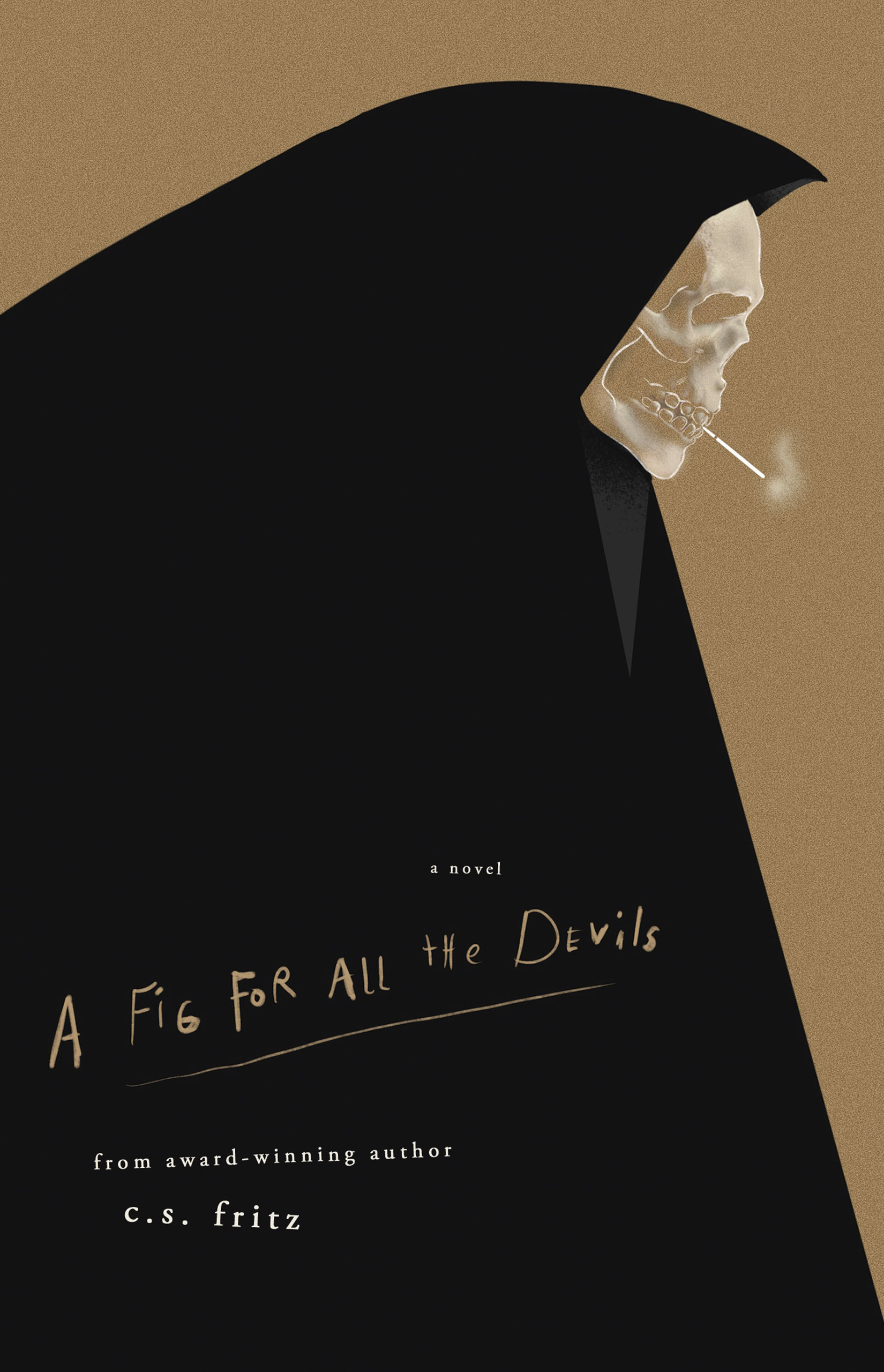
The cover got me, I admit it. The Grim Reaper is one alluring fellow, I couldn’t help it. I buy my wine the same way too: the more morbid the label — reds, black, and intricate patterns of monstrous or predatory creatures — the more likely I’ll buy it. And if it’s under $10, so much the better, NGL.
A Fig For All The Devils delivers too. Like a robust cheap wine, it was dark — almost bloody — with scents of dark foggy Oregon pine (the novel is set in Tillamook), oaky smokiness (well, more like cigarette smokiness, but go along with me in this metaphor play), and a generous injection of alcohol (cigarettes aren’t the only narcotic drug in this novel). And, just like when you bring a cheap oversized bottle of wine to the party, A Fig For All The Devils is fun in a package.
The novel is spun around a teenaged boy, Sonny, who is unfortunately saddled with a less than stellar family life. His father is gone. His mother is… not present (to say the least). Sonny is left to his own devices, grappling with grief of loss of one (but really both) of his parents. The Grim Reaper finds his cue here. In need of an apprentice, the Grim Reaper makes himself and his proposition known to Sonny. The novel is premised on this encounter.
A Fig For All The Devils reads as Young Adult fiction, a dark bildungsroman. Sonny’s problems are appropriate for an adult world, but to be fair, the kinds of dilemmas Sonny encounters are probably commonplace for teenagers today (anthropomorphized, embodied Death excepted). The prose fits a YA reader as well, easily accessible and authentic in its teenaged voice. The story flows at a fast pace, yet slows at key points for the reader to engage with the interiority of the protagonist, Sonny. On that point, while Sonny is the main character and it is through his eyes that we witness this novel, the other characters are vivid. They are all tangible, visible to the reader in their flaws and virtues. Death even, a mythical being, comes to life (pun!) in this novel in a very human manifestation.
More horror to follow (for example, Gallows Hill by Darcy Coates and Valley of Shadows by Rudy Ruiz — both coming out in September, 2022 — and more!) Follow me to get updates!)
Despite Ian McEwan’s apparent success in the literary and film worlds, I’ve never read any of their novels. I do veer towards literary fiction, but McEwan was never on my radar. Until “Matt”, a staff member at my nearest public library branch chose it for one of their Staff Picks last month. I typically review newer, about-to-be-published books here, but every once in awhile a backlist is worth a review. This is one of them.
So that’s how I came across this slim, unassuming novel. The title suggests romance. It’s not. (Well… not a traditional romance anyway.) The cover, an image of a hot air balloon in a clear sky, suggests flights of fancy, a pleasant day out in nature. It’s not. (So easily do we forget that nature is not the sanguine overlord as we anthropomorphize it to be. If it were a being it would be a vicious beast, not a nurturing mother.) But, something encouraged me to slide it off the shelf and turn it over for the synopsis.
Before reading further, you must know I enjoy perusing the library, literally just meandering the stacks and sliding interesting books into my arms. Going to the library is better than midnight shopping on Amazon, better than a trip to my local bookstore even — because it’s FREE! I can load up my bag and literally be the richer for it.
The words “hot air balloon accident” and “obsession” caught my eye. Hints of a moral and mental disintegration. Hmm. Intrigued. “Matt’s” pick did not disappoint. I was hooked from the first three pages and I could not rest until Joe’s dilemma had been resolved somehow.
I prepared myself for a hideous ending. I got it.
Reader, if you enjoy unreliable narrators, epistemological head twists, and stories of encounters with the utter strangeness of life, Enduring Love has it. From the start the story is a deluge, an unstoppable interior pouring of thoughts expressed in sharp, authentic prose. Joe is the narrator, a witness and involuntary participant in the hot air balloon incident. A survivor, you might say. But it is what happens afterward that is truly disturbing. Reader, you might be tempted to exclaim, “How many odd things can happen to one person?” But, there is where McEwan’s skill lies, the oddness of it all is entirely believable. Things like this do happen, all the time. Just watch the news. And what happens after with Jed Parry? That too is as mundane as the Monday evening edition. (I won’t recount the plot details since this is an older novel. Find it here.)
The thing that draws us into this novel is this: We might surmise that our actions in the face of such tragedy and dissonance might be different, but Joe’s authenticity as a human being (some brilliant character development on McEwan’s part) forces us to consider that we might feel the same, even if we might react the same way. (There is so much to unpack in this novel, this review is just one possible view of the thing.) Who is mad and who is sane here becomes confused. What constitutes madness and sanity are questions left unanswered. Reader, you’ll wonder where the line between the two exists — if it exists.
At the end of this you might find yourself shying away from social interaction, feeling a bit of anxiety about what someone at the grocery store might want of you if they smile at you. You might stop smiling back for awhile. Most of us have a tinge of social anxiety; this novel reminds me why that can be a good thing. It also made me a tad more paranoid than I usually am about whether I should leave my blinds open or not.
I’ll leave it at that. Read this novel. Gorgeous prose and a compelling plot propel this novel forward inexorably (much like the wind behind a hot air balloon…) Recognizable characters leave the sensation of voyeuristic experience; Reader, you’ll have a front seat view of a journey to madness.
It would be hard not to fall in love with this magic-tinged historical fiction. I loved this book so much I stayed up several nights to read it, refusing to bookmark it until I absolutely could not hold my eyes open any longer. The loss of sleep was worth it!
The White Hare is set in post-WWII England. The narrator, Mila, her daughter Janeska (Janey), and her mother Magdalena have left London and bought a large house in Cornwall, which Magda and Mila hope to refurbish and turn into a hotel. Mila also hopes the change of location will allow her to move on from a toxic relationship. Magda too has lost her husband of many years to the War and is seeking to rebuild a life for herself in a new place. The two women are Polish evacuees/refugees of the war; England is their home now.
As the story unfolds it becomes clear that it will not be so easy to shed the past for the three of them; it comes back to haunt them in real and imagined ways. The house and land too that they see as their revival brings its own hauntings and histories into the present. This magic interacts with Mila, Janey, and Magda in positive and less-pleasant ways; it becomes clear there is something afoot at the house at White Cove.
The White Hare is not only a tale of magic and myth; what drew me back to its pages night after night was the deep, terrible past between Mila and Magda, the angry relationship between Janey and her grandmother, and the wedge and glue that comes into their lives, causing friction and connection all at the same time, in the form of another character, Jack. In many ways, this is a novel of intergenerational histories; the ways in which understandings of the self and our place in the world are inherited. That said, Johnson does not suggest that the past dictates the characters’ present or future; there is hope for change.
And there is plenty of change in this story. (The plot revolves around the revival of a place and its new denizens after all.) The novel is not a vehicle to retell history; it is much more subjective than that. This is a novel about how a group of people who have individually suffered ordinary and terrible events struggle to reconcile their pasts with their futures. Every one of the characters’ actions and choices are imbued with a history, sometimes a good one, often a tragic one. As the novel progresses, the reader witnesses how the characters’ histories and their knowledge of another’s helps them shed those ghostly pasts and create a new future for themselves and each other.
The White Hare immerses the reader in a poignant lesson of how the past and present are ever intertwined. Lingering in the latent, vibrating background is the White Hare herself, a spirit that inhabits the land and the haunted history that comes alive in her presence. The novel suggests that there is a world beyond our own mundane one, in which we are embedded. In The White Hare this is the magical, historical world, a state of being in which the past and present are not constrained by the physics of time.
What was also very satisfying for me was the way in which the novel resolves. Not only do the characters come to their own organic conclusions, but history also is validated and finds a place of belonging in the present in a very real, tangible way. It emphasizes Johnson’s narrative: that the past is never as far away as it might seem, it is really buried — sometimes literally — in our contemporary moment. For readers who love long, nuanced resolutions and endings, The White Hare delivers in abundance; nothing is left hanging.
This is a novel that takes the reader on a rollercoaster of emotions, from sadness to anger to pity to redemptive hope. It is inspiring. It is queasy in some parts. Reader, be warned, there are mentions of abuse, gendered and sexual violence, violence and murder. Ultimately, for me, this was an inspiring tale of vindication and hope.
This novel is creepy AF. I really hope none of the home invaders in this story exist, but that’s the thing that makes this so terrifying: they probably do. Seidlinger’s Anybody Home? has no named narrator, no named characters at all, no named locale, and no loci in time; the events in this slim, punchy novel could happen anywhere and to anyone. That’s what makes it a successful horror story. Seidlinger lets the reader’s imagination do the work — some of the work — for him.
Some. The heavy lifting is done by Seidlinger. The prose is sparse, but accurate like a puncture to the jugular. A hanging question, a sentence left unfinished — the words in this novel function like a silent slice of a knife through air; they draw a spurt or an arc of blood, as desired. Seidlinger delivers enough to elicit pain, but not enough to kill; reader, you’ll live to read on. You’ll be compelled to read on to deliver yourself from the suspense.
Anybody Home? is about a home invasion, a carefully planned crime and its implementation. The story is told from the interior perspective of the mastermind of this crime.
Despite the facelessness of the narrator, the protagonist in this tale is not a mystery to the reader. This is, I think, part of Seidlinger’s brilliance. The reader is treated to the full landscape of insanity in the narrator’s head; what you’re not sure of is who they are talking to and what the relationship is between the narrator and the others of their kind. This unreliable narrator adds to the sensation of dis-ease; the further the reader gets into the book and into the narrator’s head, the more infectious the madness becomes. Things start to make sense. You can’t help but respect the madness a bit. In fact, it does not feel quite so mad. There’s a logic — even a sense of justice or nobility — to the plan the narrator has in mind. Almost.
Reader, you might begin to wonder if the madman is the hero here. But that feels squeamish; you can’t quite reconcile the deontological unfairness of this cruel act with some kind of enlightenment. You can’t quite call the ending “happy”, but you might be tempted to ponder on it. You might creep yourself out a bit when you realize your own moral compass may not point true north… Maybe.
I am adding this to my Halloween Horror reads for 2022. It warrants a place of pride on my list. For those of you following my reviews, I’m starting my Halloween Horror reading early this year (because why not?).
Kitty Fisher: The First Female Celebrity by Joanne Major
If Major’s book, Kitty Fisher: The First Female Celebrity was turned into a reality television series depicting the lascivious 18th century — and if time travel could be achieved — Kitty Fisher would have a hit show called, “Keeping up with Kitty.” It would include an extended cast of rival courtesans and other infamous women on Harris’s famous list of loose and exciting women about London. Video clips of Kitty’s horsing accident in the Mall would have broken the internet, shut TikTok down, gone viral.
The World of Kitty Fisher and women like her, courtesans of Britain’s aristocrats and wealthy merchants, with its alcoholic rivers of champagne and deep, rich wine, gluttonous helpings of animal roasts, buckets of gravies, mountains of puddings, and voluptuous flesh in resplendent velvets and silks far outshines the grotesque excesses of our modern times. The ratings of Housewives of Who-Cares-Where and the Bros of Spoilt-Rich-Baby-Daddies would pale to a grey in comparison to a show about Kitty Fisher and her world.
But alas! No such reality shows exists and time travel is still science fiction. Major’s book, Kitty Fisher: The First Female Celebrity, however, does give us a tantalizing glimpse into what might appear on the screen. In nine short chapters — this history book is succinct at 145 pages (minus notes, index, and bibliography) — Major gives the reader a fleshy, tangible sense of the English sex-fueled 18th Century. The first few chapters give us an overview of Kitty Fisher’s world and her personal history. These chapters also chronicle Fisher’s rise to fame and the path to her profession. Chapter 4 focuses on one of the most enduring events of her career, her horse accident and discusses the effect of publicity on her life and career. Chapter 5 gives the reader a closer view into the business aspects of courtesan-ship. In a way, we can see clear connections between the influencers of today and the women of this world. The modes in which women like Kitty Fisher monetized themselves is the subject of chapters four and fives. Chapters 6 and 7 examine how Kitty and other courtesans or kept women segued into comfortable and profitable existences for the long term. Marriage, servitude, and dismissal were all possible endings to these women’s careers; how did women establish security for themselves? The final two chapters discuss what happened after Kitty Fisher left the stage (and this world) and how she became imbued with a legendary status. Kitty Fisher follows the physical lifetime and historical trajectory of the eponymous subject.
While Kitty Fisher is the central heroine of this prosopography, it includes the tales of many other women with the same vocation and the men who served them, worshipped them, paid for them, kept them, maligned them and took advantage of them. Kitty Fisher allows the reader to envision the full landscape of sex work in this era, from those — like Fisher — who proved the exception, to those who proved the rule and have fallen into anonymity.
Their histories and careers, whether illustrious or tragic, forgettable or infamous, reveal an aspect of historical womanhood that is rarely illuminated. The women of Kitty Fisher are far from piteous. Major reveals to us how human they could be, as emotional, youthful, desirous beings. She also shows us how ruthless and powerful they were. These women were not the mere playthings of men, they were businesswomen, shrewd, and canny, educated and intelligent, cognizant of their own agency and unafraid to use it. Of course, patriarchy and its constraints on women were tight around these women, but they learnt how to use the tools and avenues open to them to their own ends. Two of Kitty Fisher’s rivals rose above the others of their profession to marry into the aristocracy.
The book also shows the reader the less glamorous outcomes. Some women died in penury, in debt, in the most awful circumstances. Many women faded away into nothingness, used and abused, broken. In this the book is well-balanced, giving the reader a wide view of the landscape.
As Kitty Fisher is a historical biography written for a general audience and not an academic one, it provides little perspective on the wider social, political, imperial, and economic matters of the era. It does not delve into historiography. This is a public-facing cultural history and is more narrowly focused on the individuals and the immediate milieu of their world. The effect makes for pleasurable reading; Kitty Fisher is very accessible in terms of language and prose, their (hi)stories unfold without requiring the reader to have much pre-existing historical knowledge. I thoroughly enjoyed reading this.
Truth is a Flightless Bird: A Novel by Akbar Hussain
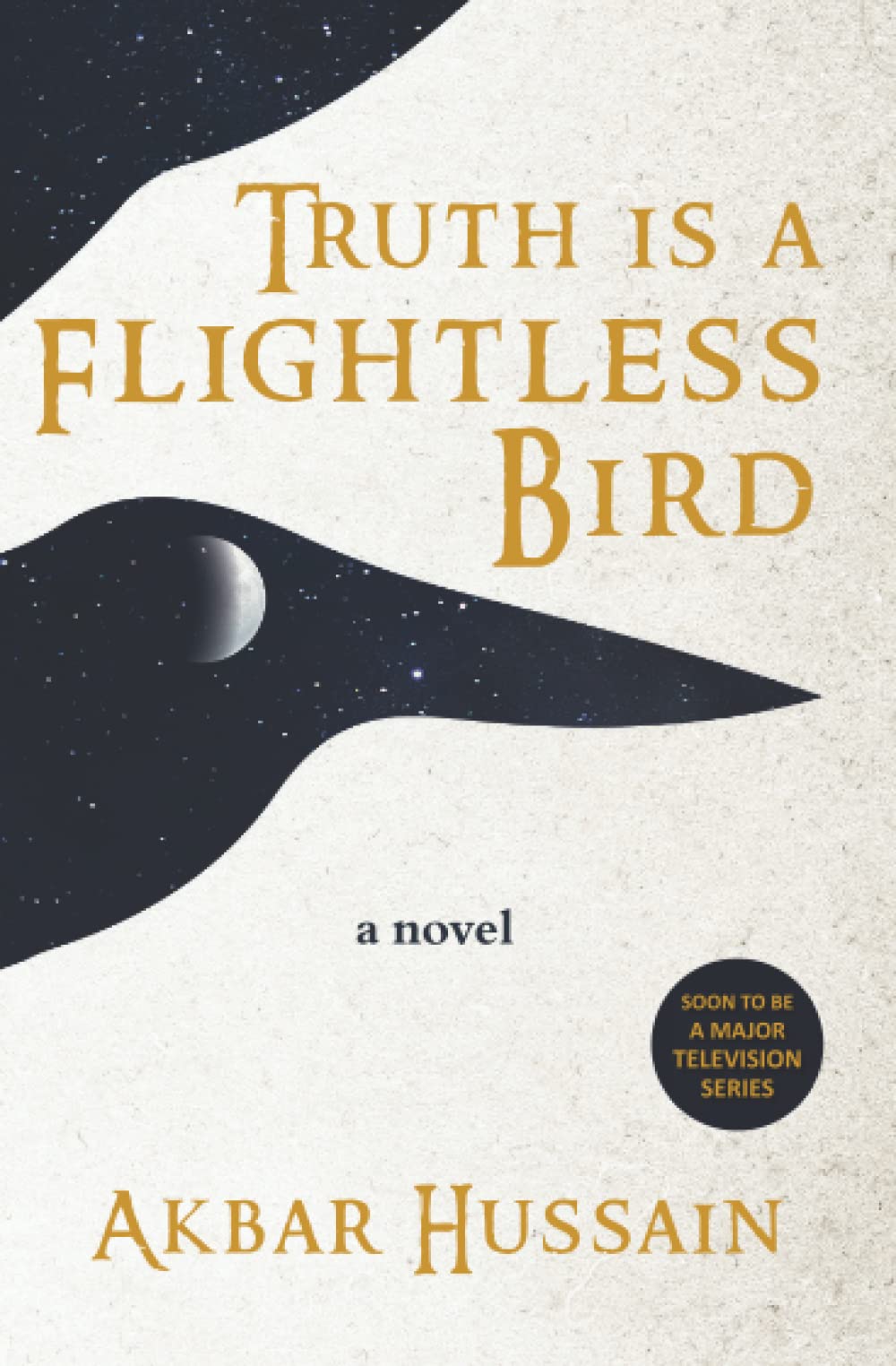
Thrillers are not usually my jam, but after reading Truth is a Flightless Bird I wonder if they should be! This novel was a breathless rush from beginning to end. I can see how this would make a fantastic television series and I am looking forward to seeing the unravelling around Duncan, Ciru, and Nice on the screen. I even want to see Toogood — which is a commendation to Hussain’s skill at writing terrific flawed villains.
The novel is explosive from the get-go. Nice is a drug mule flying from Mogadishu (Somalia) to Nairobi (Kenya) and Duncan, her friend and a pastor, is unwittingly dragged into the mess that she has made of this illicit mission. The story revolves around Duncan’s nightmare as drug dealers, corrupt officials, petty thieves, and others attempt to take advantage of Nice and the dangerous situation which naturally results from ingesting and walking around with drugs in your body. Ciru is one of those individuals who attempts to use Nice and the drugs to further her own agenda. She is a witch doctor, a con-woman, a mother who has lost her wayward child due to the machinations of others further up in the drug-smuggling world. Toogood is a Somalian gangster, also trapped in this convoluted drug-criminal world trying to make amends for a past he had little control over. Then there is Edmund, a young man deported from the United States, and Hinga, a corrupt police officer, and a crew of other characters who each come into the tale with their own ambitions.
As a thriller, there isn’t much interiority to these characters, but the reader will discover that no one is who they seem to be on the surface. The truth matters very little in this underbelly world; what matters is using what you have to get what you need or what you want. I don’t usually try to read too much into thrillers; but, it is here — in this discussion of the utility of truth — that Hussain’s title has to give the reader pause to reflect. There is something being said here about the futility of struggling against tides that are out of our control. Truth is one of those obstacles, or at least, the idea that there is a single Truth, capital T. All the characters of this novel, Duncan, Nice, Ciru, and Toogood, have found themselves in situations less than ideal, despite their best efforts. The truth, their truth, does not matter to the forces and people who hold the reins of their lives. It should not even matter to themselves; to survive Nairobi they’ve got to let go of the idea that there is only one truth, one version of events, one version of a person. They have to let go of an idea of themselves that either doesn’t really exist or will drag them down. In a way, their blind pursuit of truth stifles them, prevents them from taking flight — being free.
The novel also makes a subtle comment on the corruptibility of the human soul — and the possibility of redemption. As events unfold, it becomes clear that the characters are more than what they appear. They are flawed, corrupted, but that doesn’t mean they are wholly bad people. The bad decisions they’ve made in their lives should not define them, but inevitably do. The novel is about their attempts to right their wrongs. Some of them succeed, some of them fail — and spectacularly. Entwined in a drug-smuggling mess the characters find that one error leads to another one, deeper and darker and more dangerous than the last.
Plot and characters aside, Truth is a Flightless Bird is a fantastic novel of place. It gives the reader a view into a world most of us will never get to see or experience in person: the seedy underworld of Nairobi and Mogadishu. I don’t doubt these worlds really exist. Every city in the world has its unsavory parts, its criminal societies, and there are good people everywhere who are drowned in it. People like Nice and Duncan and Ciru. Even Hinga and Toogood. The interactions of the characters, the crimes committed, and Hussain’s prose take the reader there, immerse them in it for a brief moment.
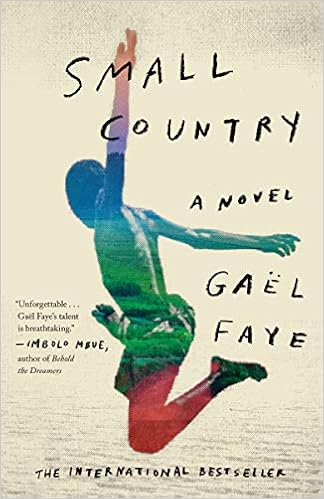
I have been keen to read this book for some time. Small Country was published in 2016 in France and in French, and translated into English by Sarah Ardizzone in 2018. I saw it on the Book of the Month website and it immediately caught my eye. It’s not often that African literature — especially a novel focused on something as horrific as the Rwandan Genocide and the Burundian Civil War, both connected in their origins of ethnic conflict between the Hutu and Tutsi — finds a way into mainstream, popular book culture.
It was worth the wait. Small Country delivers a powerful, immersive, historical experience. I felt as if I were there, transported back to the early 1990s, growing up with Gaby, a silent witness to the terror and happiness of his childhood. We are not so far apart in age that his childhood feels foreign to me, and there is a common experience in living in former colonies, French or British, that pervades the postcolonial world. Faye’s prose helped a lot; I could smell the fruity air of tropical Burundi, sense the light dusting of brownish-red earth on my skin as Gaby and his crew ran down the roads of their neighbourhood, the scorching heat of the sun, a trickle of sweat run down my neck.
But of course, Gaby’s path and my own diverge wildly on the occasion of war. Faye’s portrayal of that period of time and conflict was palpable. By that point in the novel, the characters felt like friends: ordinary and familiar like those who populate our own worlds. They were likeable and hateful, annoying and lovable, flawed and perfectly so — and then they were thrown, involuntarily, into an unimaginable violence. Much like Gaby and his family and friends, the war approached slowly, then arrived suddenly. The effect is jarring — purposefully — on the reader. The events of the novel force the reader to wonder, “What if this were me? What would I do?”
The story follows the chronological path of Gaby’s life, a mixed-race boy of French and Rwandan parentage, growing up in Burundi. It spans his early life from about age four or five to the time of the Genocide, when he is a teenager and evacuated to France. The novel is one that revolves around the nuances of race and interracial relationships, the push and pull that is inherent in transcultural lives, and the desire for a sense of place when one is trapped in a Venn diagram of multiple belongings. Gaby’s mother is one of these out-of-place women, French by marriage and in part by design, but also Rwandan and not-Rwandan, Burundian by default and yet rejected by Burundians on account of her Rwandan origins. Gaby’s father also straddles multiple worlds, first as a colonial settler in a time when such settlements can no longer exist as they were; he is out-of-time, rather than out-of-place. Second, in the matter of class, Gaby’s father possesses status, but only on the African continent, not in France. Gaby, the protagonist of the novel, is also caught between worlds on account of his mixed-race, his socio-economic class as the son of a middle-lower-upper-class businessman, and because of his nationality being a French passport-holding Burundian. The characters exist in a kind of suspension. This uncertainty is, on the one hand, brought on by the war, but it existed before as well, as people in this community reconcile their ethnic history or their settler status with the new postcolonial order of things.
Small Country is about the loss of one place of belonging when another one exists. It is about loss of the things (including people and practices and languages) that bind us to one another and to ourselves. It is about how we individually must grapple with that loss, how we deal with it or how it deals with us. Every character in this novel loses something or someone (a spouse, a child, a family member, or themselves), gains something (freedom, independence, clarity of self, madness, grief), and plods onwards in life because there is no option to do otherwise. The reader cannot help but recognize their suffering and their experience.
Small Country is about refugees, both the kind we see in the news and the kind we do not see, those who occupy our own worlds and are, in a sense, “hidden in plain sight.” Faye presents to the reader a reflection of themselves, turning the refugee of the news into an all-too-familiar face, our own. Perhaps as we encounter refugees in our lives, those of the news-kind as well as others, we might find common ground with them on the basis of this shared humanity.
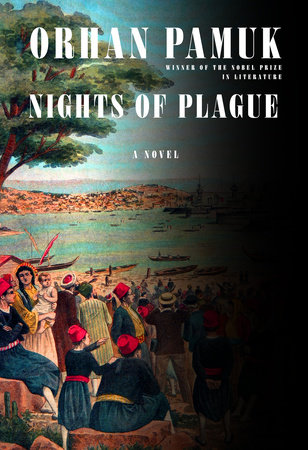
Pamuk’s latest translation from Turkish into English, Nights of Plague (coming out October 4th, 2022) is an epic both historical and contemporary. I need not remind anyone reading this that we are still, as a global community, navigating the Covid-19 pandemic (and monkey pox is making rounds again as well!) The timing must be viewed as deliberate; Pamuk’s commentary embedded within this novel can only be seen as prescient or proof of an uncanny insight into the human psyche as it relates to existential threat.
In short, Nights of Plague is epic.
The stories that unfolds within its pages are reminiscent of epic prose as well. Pamuk’s novel is spun around a royal Ottoman princess, Pakize and her husband, Prince Consort and medical doctor, Nuri; however, the tale is more accurately about the unravelling of a community and its denizens as they face possible annihilation and suffering from a breakout of plague. The locale of this event is a fictitious island, Mingheria, an outpost of the Ottoman empire that reflects the empire as a whole: multicultural in its constitution with ancient and new settlers of Greek, Muslim, Eastern European, African, Christian, and Colonial European descent; in precarious harmony with the multiple discordant voices, needs, and ambitions of politicians, medical professionals, ordinary citizens, foreign heads of state and their ambassadors, Ottoman royals, and immigrants; and gorgeous and complex in its rich history. Mingheria is a plague-beset limb of an empire popularly described as “the sick man.”
Pamuk’s tale of Mingheria does not confine itself to the accounts of elite royals, though it is ostensibly based on recently unearthed archival records and it is told as a historical monograph, through the eyes and pen of one of Princess Pakize’s descendants. Pamuk regales the reader with stories of its other denizens too: its merchants and common folk. There is the security guard of the local prison and the tale of him and his family as they struggle to survive and live their lives in the wake of plague and death. There are the doctors who work to eradicate the plague, demand quarantines. There is the governor too, all too human in his own ambition and fear.
Nights of Plague is about Mingheria and its people, how their present fears and dilemma(s) are shaped by their history of ethnic division and unity, religious and ideological differences, their universal humanity. They react based on their subjective desires, but are also creatures of their communities, their actions are shaped by the expectations of those around them, their enemies, their allies.
Our unknown narrator writes as a historian might do, providing context where necessary, but imbues the academic narrative with a novelist’s attention to texture, aroma, and the sensation of place. Mingheria is as real as the Ottoman Empire can be to a modern reader: the spicy, heady fragrance of a time and place that no longer exists is palpable.
Nights of Plague is a more gorgeous, more exotic — and historical — reflection of our own contemporary experience with Covid-19. The arguments between medical professionals, politicians, and the citizenry in this novel are all too familiar to anyone who has been watching the news for the past three years. The heated debates, the refusals to quarantine, the seeming indifference of the populace to the threat of death and suffering might make a reader feel queasy. The Lacanian recognition is jarring. But perhaps, for all of us, this is a necessary cognitive event in order to reconcile the past with the present and future. Pamuk delivers that lesson with poetic grace in Nights of Plague.





 Dr JoAnn LoSavio