
Almost Brown: A Mixed Race Memoir by Charlotte Gill

Almost Brown: A Mixed Race Memoir by Charlotte Gill

As a historian I deeply appreciate Gill’s memoir, and for multiple reasons. Gill’s childhood experiences and those of her parents, captured from her memories and filtered through an adult lens retrospectively, highlights mid-twentieth century tensions of empire and our global journey towards decolonization. Moreover, Gill does it with a sensitivity to the internal, subjective conflict “colonials” often face as they grapple with their identities. The frustration of Self that Gill reveals to the reader, through her parents and her own struggles, is not an artifact of the past, singular to the decades of peak decolonization in the mid-twentieth century; these are still liminal spaces individuals occupy and traverse today.

In that respect, Gill’s memoir not only captures a particular zeitgeist of the 1950s-1980s — decades which saw a mass migration of colonials across the world, decolonization and independence movements coming to fruition, and a general cultural revolution across the world in terms of race, racism, and anti-paternalism — it also makes the reader aware of the continuity of this historical spirit and its legacy as it is lived today.

The success of this memoir is in large part due to Gill’s self awareness and willingness to see her parents (and herself) for the people they are; Gill examines them with an academic eye, as historical subjects, but also as emotional, affective beings whose desires and needs are universal across time and cultures. The result is a very relatable, human memoir, one which draws the reader into the nucleus of Gill’s family as well as the age in which they lived.

Some of Almost Brown‘s success must also be attributed to the fanciful and (for their time) outrageous characters her parents are, for the daring ways they each challenged the norms of their age in terms of race/racism, gender, and transnationality. This is where Gill’s memoir appeals to more than the smallish subset of readers whose interest is in post-colonial subjectivities; for while the memoir hinges on post-coloniality as its primary locus, it is also about the oppressions we inflict upon each other, the intersectionality of our daily lives, and the myriad of ways in which power flows or not even within a family. Gill’s mixed-race family serves as the perfect case study in which brown people and white people — that is, race — can be upended by gendered expectations, or vice versa. Gill’s white mother was submerged under her brown husband, even while he was marginalized by a society that saw him as inferior by dint of his skin color. She, in turn, was snubbed by both her husband and society for daring to be that which society deemed heroic: an independent-minded mother.

In short, Almost Brown is a memoir well worth the reading.
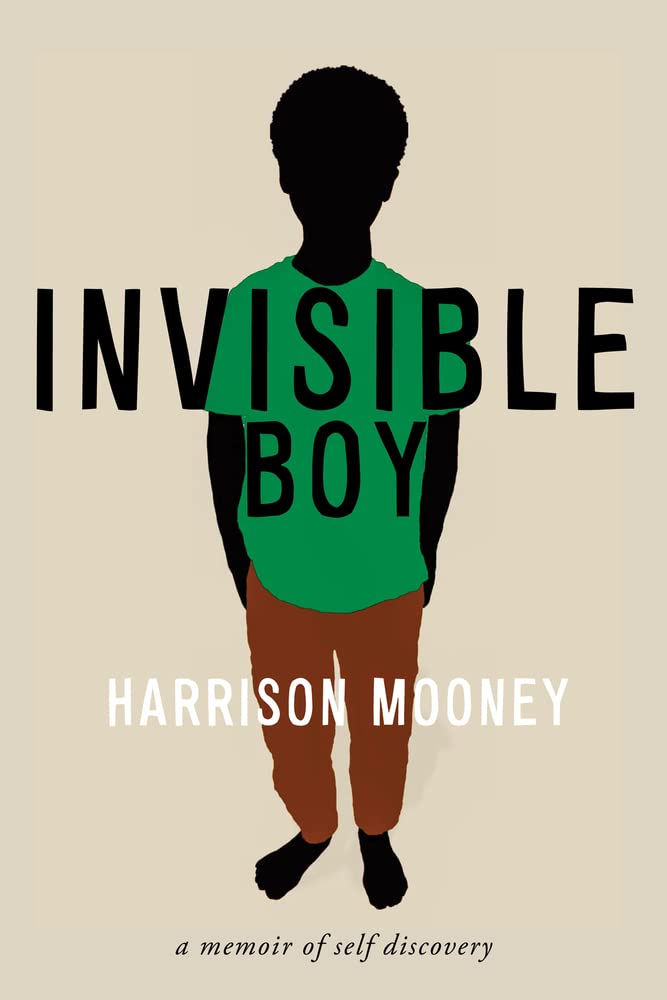
Invisible Boy: A Memoir of Self Discovery by Harrison Mooney

Invisible Boy: A Memoir of Self Discovery
by Harrison Mooney

Holy not-so-micro-aggressions. Holy GASLIGHTING. Invisible Boy was incredibly difficult to read without weeping. Every time Harry’s mother or other family members gaslighted him I wanted to scoop him out of the pages of his past and take him far, far away to people who would love him as he is, for who he is, for what he is.

I cry for all the children, teenagers, people who are where he was right now.

For all its pain, I do not regret reading Invisible Boy… because the pain embedded in Harrison Mooney’s past is insidious, latently seething, and all too common still. Decolonization is an eternal task, its end is nowhere in sight. Memoirs and works like Invisible Boy remain relevant and necessary in our collective, societal process towards decolonization. Like Fanon’s Black Skin, White Masks, Mooney’s Invisible Boy is a call to action. It is a reminder that we still need a rebellion of the mind and soul.

Invisible Boy relates the path of Mooney’s awakening to his race and the ways in which racism hides behind a myth of colorlessness. It begins with his childhood and ends in his early adulthood. His memoir exposes to the reader how racism seethes in the most intimate places, in the places it should not exist — in this case, within a family. Families are supposed to be safe. They are supposed to be supportive, loving, nurturing. Invisible Boy tells a sad tale of how racism is the silent reaper within, turning the sanctuary of the family into an emotional, mental prison.

What makes Mooney’s Invisible Boy unique from other works like it (Sam Selvon’s Lonely Londoners, George Lamming’s novels, Franz Fanon’s memoirs and works, James Baldwin’s calls to action, among others) is Mooney’s attention to a community that is little attended to: adoptees of color with white adopted families. As in Mixed-Race Superman, Will Harris’ essay on the transcultural ways of being mixed race, Invisible Boy highlights a different kind of process of decolonization that confronts adoptees of color in white families and white communities that hold onto racist beliefs.

I do not know if I can re-read Invisible Boy for the sake of my own peace as a person of color who has grappled with my own decolonization; but, I am glad I read it at least once and I am privileged to have the ability to choose to only read it once. I am privileged to have been given a rare glimpse into another’s experience of racial awakening. I am privileged that my own decolonization was less traumatic. In truth, Invisible Boy is a book that demands re-reading and reading again. One day I will summon enough courage to read it again.