
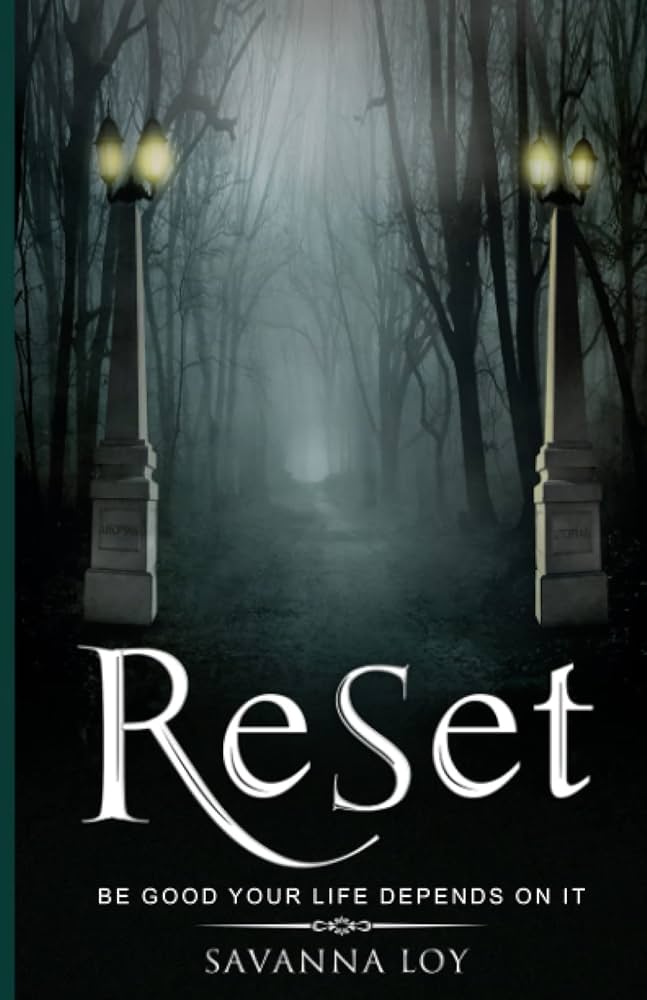
ReSet: Be Good, Your Life Depends On It by (A Novel) by Savanna Loy

ReSet: Be Good, Your Life Depends On It by (A Novel) by Savanna Loy

A horror/dystopian novel premised on a popular trope — but delivered from a novel perspective. In ReSet the world as we know it has come to an end and a new oligarchy has come into power. A committee of a few men now decide who lives and dies and the terms which everyone must now abide. Failure to do otherwise results in the collective execution of whole communities, a reset. The novel reveals all through the eyes of one of its elite families, those chosen to plan and carry out the gruesome task of resetting.

The premise is inherently intriguing, given the climate change, political and social turmoil of the American nation at present; one cannot help but wonder what consequences we may need to confront — and perhaps sooner than we would like to admit. ReSet plays on those fears. In that vein, the novel is reminiscent of Margaret Atwood’s Handmaid’s Tale and the eugenically driven political world of Gilead. A central theme of the novel is the corruption of power and the terrible consequences this can lead to.

For all its unique perspective, I found the narrative arc of the story predictable and the peak of the novel, its crescendo, slightly disappointing and less explosive than promised. The drama of that moment is confined to a small circle, decreasing the visibility of its larger impact on society. Given the drastic shift in culture that the apocalypse created, I expected a greater dramatic backlash or swing in equal measure. The ending suggests a sequel, and perhaps this is where the novel leads — rather than to a terminal ending.

On the whole, the novel was well-written, though there were some parts which unfolded in confusion — deliberately, I suspect — which detracted from the flow of the novel for this reader. Nonetheless, this is a minor complaint. Likewise, characters are well-developed and tangible, though some better than others. On the whole, an intriguing read for readers who enjoy dystopian possibilities.

Into the City: A Novel by E.J. Cook

Into the City: A Novel by E.J. Cook

Ooo! The twists in this novel! You think you have it figured out and then — WHAT was that? The ending leaves the reader feeling both vindicated and wanting more, the perfect cliffhanger for a series starter.

Into the City is a Young Adult novel, not my usual cup of tea, but I do enjoy the occasional dystopian read — and this is indeed a dark and crumbling world Cook portrays. The novel is set in the near future, in a world ravaged by an illness which attacked only its adults and left its juvenile and adolescent population intact. Intact but not unscathed. Children and teenagers left to their own devices and survival created a society in which there coexist the extremes of cruelty, embodied by the militant Lyths and drug-addled Crazies, and kindness, a small but growing community of Arkers.

Our protagonist, a young girl named Lexi and her friends, Aster, Nate, Ruby, Eden, and Marcus are inexorably pulled into this world of dangerous extremes, lured by the promise of a utopian society and their need for community. Into the city they must go. And it is there that they discover not only the origins of their fate and a new promise of their future, but also themselves. There, in the city, they must confront their past trauma, test their values, and — above all — survive.

Cook’s storytelling is on point, unravelling the tale at a quick and lively pace, matching the urgency of the characters’ lives. Likewise, Cook’s prose is well-crafted for a young adult audience, being straightforward and succinct, allowing for both the reader’s organic imaginings and providing ample description of the landscape of this dystopian world. On occasion there is the use of an overworked metaphor or simile, but this is a minor complaint given the audience it targets. These phrases have yet to jade the Young Adult reader, and indeed provide familiarity and structure to the tropes they are just learning to recognize.

A word on Cook’s characters. These too are well-developed, even as they are drawn from tropes of this genre: they are young, but mature in their self-awareness (no doubt as a result of their life experiences) and their inner reflections are both adult and childlike. The benefit for the reader is that these characters will appeal to both the teenager on the brink of Young Adult and the Older Adult, remembering their teenaged past. Their concerns are recognizable, and cross cut generational divides; we all understand the need to survive and to live with our traumas.

Into The City is a typical and atypical novel of its genre. It satisfies the genre-reader, with their expectations of the dystopian novel, but Into the City does also offer twists and revelations which will draw in the reader to end. There are surprises. What appears simple is not so, as readers will discover.

To purchase this novel on Amazon, click here. At present, this 287 page novel sells for $10.70 for the paperback and roughly $5 for the Kindle ebook. I bought my copy on Kindle for $0.99 during a sale.

The Black Cell by Wendy Shaia

The Black Cell by Wendy Shaia

This is the dystopian novel of our time. Set in the near future, 2024, in Baltimore, MD, The Black Cell is a novel about blackness, racism, and revolution. The novel centers on the development of a Black Resistance Movement in Baltimore and revolves around the experiences of four Black protagonists, who become involved in some way in this movement. Tasia is a young black single mother, a university student, a young woman trying to understand how to live her life and raise her daughter. Lisa is a young married woman, a wife and mother to two black children, a woman who has internalized the racism of the world, turned that knife inward. She comes to terms with how whitewashed her life has become. Donovan is her male/masculine counterpart, a young, professionally successful black man who has a penchant for white women and who is ashamed of his black culture and heritage. He too comes to a confrontation with himself. Corey is a young black teenager, Tasia’s counterpart, trying to figure out his place in the world and what he can do to make it better.

This novel is ideal for young adult readers, university and high school students, anyone who is at the beginning of their journey towards decolonization, regardless of their own personal heritage and background.