The Vales: A Story of Love, Evil, and Redemption by George Graziani

The Vales: A Story of Love, Evil, and Redemption
by George Graziani
I encountered The Vales through a Facebook group I'm in, where I serve as a reviewer of (mostly) independently published books. Organized by the admins of this group, the review event takes place bimonthly, and involves reviewers submitting a short biography to the organizer. Authors who are looking for reviews of their work reply to the organizer, selecting the reviewer of their choice. Reviewers then select which authors and books they'd agree to review based on the descriptions of the books. 

My review: ⭐️⭐️⭐️⭐️ for prose and writing, ⭐️⭐️⭐️ for storytelling. ⭐️⭐️⭐️⭐️⭐️ for character development. An overall rating of ⭐️⭐️⭐️.75

The Vales is an intensely character-driven novel revolving around two, intertwined stories, and taking place over the course of a long weekend. The first centers on a family gathering at the home of the grandparents, while the other is a criminal misadventure. Both stories run parallel — until they collide, drawing the innocent family into chaos. Both tales unfold through first person accounts of the events in real time, each chapter devoted to the perspective of one of the characters.

The Vales comprise of Grace and Joseph, the matriarch and patriarch of the family. It is their home where the weekend gathering takes place. Their children, Eva and Bobby, are middle-aged adults with families of their own. Eva has her husband, Adam and a wild teenage daughter, Ziggy. Bobby has his wife, Renata, and two boys, Danny and Roland, who are a little younger than their cousin.

This is a novel seeking to excavate the layers of motivation — emotional, cultural, and pragmatic — behind an individual’s actions. Each narrator exposes their most vulnerable selves in these pages, with a deeply intimate result. The reader is privy to each narrator’s desires, secrets, and fears — even those they are unwilling to acknowledge themselves. The flawed natures of the characters are sure to evoke a sense of empathy in the reader; there’s someone we recognize in each of them, our own mothers, aunts, uncles, friends.

The prose throughout the novel therefore changes voice frequently; the pitch and tone of Danny’s chapters reflect the concerns of a boy on the edge of puberty, while Bobby’s are the stuff of adult-sized angst. The prose is very well-crafted, but this reader found this recurrent shift in voice created a superfluousness that did not pay an eventual reward. This was also due, in part, to the content of each narrator’s chapter.

Because of the story unfolds through the eyes of several narrators and each one provides an account of events in the present tense, there is a redundancy in the retelling of events which the reader already knew about. The telling and multiple retelling of the same events by different narrators did not progress the story. Instead this tendency caused the novel to sag in several parts. It was unfortunate that the different perspectives did not add conflict or dramatic effect to the events.

The intense interiority of each narration also produced other jarring effects. Perhaps the author submerged this reader too well, too deeply, with their intimate prose because the the shifts in narrators pulled this reader from the depths of a character’s mind too soon, leading to breaks in the mood of the moment. The other effect, also a consequence of the deep interior view into the character’s mind, was the character’s mental wandering into tangential domains; the result was the introduction of many supporting characters, too many for this reader to keep track of. Were they important enough to remember? This reader found that many of them were there to serve as foils to the characters themselves, and as such they did not add to the story significantly.

My verdict on The Vales is therefore mixed. On the one hand, it is very well-written and full of well-crafted characters. The character-driven aspect of the work is apparent and very much appreciated. On the other hand, the delivery of the story stagnated at several points and ultimately did not pay out on the promise made in the subtitle: Love, Evil, and Redemption. Of the three, love was most visible. Evil was present, though the events did not quite merit that extreme of a description. Redemption felt rushed at the end; the point at which the two stories slam into each other possessed a moment of conflict that was (to this reader) under-dramatized. The events bringing the Vales into contact with a sordid reality deserved greater attention, not in terms of a play-by-play of the events themselves, but in terms of their meaning to the characters involved.

I am nonetheless glad for the experience of reading it. If you would like to, you can find the novel for sale here. Currently, The Vales is available for purchase at the price of $29.99 for a hardback, $14.93 for a paperback, and $7.46 for the Kindle ebook version. To learn more about the author, you may click here.

The Nakano Thrift Shop: A Novel by Hiromi Kawakami

The Nakano Thrift Shop: A Novel
by Hiromi Kawakami

I saw this book at the library and the cover was so cute, I just couldn’t resist checking it out. I know, I know, I shouldn’t judge a book by its cover, but who doesn’t? Really? That said, the description also hooked me: I love thrift stores and I love Japanese fiction.

The Nakano Thrift Shop did not disappoint. The novel follows in that great Japanese literary tradition of deeply intimate writing. The story was simple, but poignant; it was recognizable and human in its simplicity, in its ordinariness. The events of the novel could have happened anywhere and to anyone, and that’s what makes it so relatable and so touching. Readers will find a part of themselves here in some way.

The novel revolves — unsurprisingly — around Nakano’s thrift store, a kind of junk store that sells amazing and banal things, and its employees. A young woman, a worker at the store, is the protagonist through whose eyes we view this small world. Her interactions with Nakano, a quiet young man who is her colleague, the shop owner’s sister, customers, and others within the orbit of the shop are the focus of the novel. This novel is about capturing a short moment in time, a time and world bracketed by the opening and closing of the store; it is a slice of their interconnected lives.

The events that take place are mundane: sales, returns, fixations on objects in the shop, the comings and goings of certain customers, falling in and out of love, the opening and closing of the store. Nothing “happens” but the slightest of events change the dynamics of the shop and its denizens, revealing a new perspective. The novel reveals how thin our veneers are, and how small actions can suddenly strip away our layers. The reader is treated to that peeling away, gets to witness characters in their most human and vulnerable form. That is the brilliance and appeal of this novel.

Puppet Flower: A Novel of 1867 Formosa by Yao-Chang Chen.

Translated by Pao-fang Hsu, Ian Maxwell, and Tung-jung Chen.

Puppet Flower: A Novel of 1867 Formosa by Yao-Chang Chen.

A historian’s historical novel! Puppet Flower is a narrative novel based on real events, a watershed moment in Taiwanese (Formosan) history when the United States and Western colonizing powers begin to encroach on Taiwan in earnest. The novel begins with an unfortunate event, wherein an American ship encounter one of Formosa’s indigenous tribes after surviving a storm at sea. The surviving crew — including a woman — are murdered by the Formosans, triggering a series of investigations and the arrival of more Western ships and military.

What makes Chen’s novel special in this genre of historical fiction is that Western perspectives are well-balanced with indigenous ones. It is rare to encounter fiction focused on Taiwan’s indigenous community, historical or otherwise; in highlighting their unique experience here Chen offers readers and the world at large a rare and unique literary opportunity. The result is a fantastic novel that — in my opinion — would do well in the classroom for a number of reasons aside from its historical focus:

  • The story arc is peppered with references and information about Formosan culture, providing a context for the historical events themselves. Unlike many historical novels, which rarely explain the cultural references they point to, Chen writes for the non-expert.
  • Puppet Flower offers multiple perspectives rather than focusing on a single protagonist. In this case, the novel allows us to see the event from an indigenous and Western point of view.
  • The prose is straightforward and not superciliously literary, making this an ideal undergraduate book; it does not require a great deal of knowledge about literary tropes, metaphors, and other devices typically used in novels. This is, truly, a history novel.

Overall, a novel of great historical value, not only in terms of its content, but in its production. This is decolonization at work, a piece of scholarship that highlights the indigenous perspective, a view of the imperial encounter from those who were colonized.

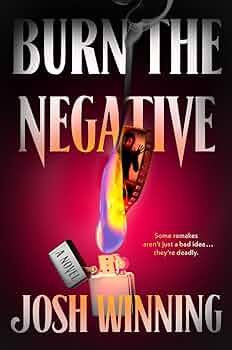
Burn The Negative: A Novel by Josh Winning

Burn The Negative: A Novel by Josh Winning

It’s such a cliché to say “I couldn’t put it down!” but with Burn The Negative it was so true! Thrillers set in contemporary digs are rarely my chosen genre, but every once in awhile a little thrill appeals to me and relieves me from the setting and character-driven interiority of historical or literary fiction. Burn The Negative had everything I wanted in a thriller: compelling characters with flawed, awful motives; a fast-paced plot that left me thinking “Oh no, what the WHAT?” as things go from horrendous to abysmal; mysterious hints that led me to announce “Aha!” far too early; and, the cherry on top: a twisted ending.

The novel opens with a fabulous line, immediately a portent of fuckery on a grand scale. A young women is headed somewhere she’d rather not be. It’s for work, but it isn’t really, and she’s having a bit of a nervous breakdown over it. The woman is the novel’s protagonist, Laura, who is a former child actor, now tasked with rehashing her Hollywood trauma as a journalist writing an article about the remake of the horror film that killed her career and ended her normal psychological development as a teenager. This is a novel that revolves around the drama of Hollywood on multiple levels, leaving the reader feeling very much like they are watching a Netflix Original horror film unfold in text.

As the remake of the film progresses, things go unbelievably wrong. But is this marketing? Is this the curse of the original horror film? Is it Laura herself? Both the remake and Laura’s memories of her Hollywood nightmare disintegrate into a surreal soup, leaving the reader wondering if there is something paranormal at foot or not.

The story alone is not the only draw of the novel. Winning’s prose is witty and the book includes fun elements — flashbacks, articles, ephemera, movie lore — which flesh out the story arc, provide context, and make the novel feel deliciously kitschy. This book is fun.

Fans of horror films, horror film lore, haunted media, and fast-paced mysteries can fully expect to enjoy Burn The Negative.

Welcome Me To The Kingdom: Stories by Mai Nardone

Welcome Me To The Kingdom: Stories by Mai Nardone

It is so rare to find novels and creative fiction that is not only set in Southeast Asia, but written by Southeast Asian authors (rare, not impossible!) that when I saw this coming out in 2023 I JUMPED on it! And I am so glad I did. This is a book that makes my heart sing!

Nardone’s Welcome Me to the Kingdom is a novel woven in stories, revolving around the lives of Thais who live in Thailand or beyond in the diaspora, transnational and transcultural Thais. This is a book about people, individuals as they navigate the multiethnic and multicultural world of Thailand, and what it means to be Thai for them. The characters, as diverse as they are in terms of ethnicity, class, and gender, are connected together in this novel; they and their lives serve as a microcosmic diorama of Thai realities where muslims of the south grapple with discrimination, poverty stricken girls from the village migrate to the city, mixed race Thai/White kids straddle two worlds and belong not quite fully into either one.

The stories span across several decades and generations, allowing the reader a view, not only into modern Thainess, but also how the concept has changed over time and the ways in which being Thai is differently defined for individuals of different religions, classes, genders, etc. Language is a significant element in these stories, not surprisingly since Thailand (like so many other parts of Southeast Asia) has and remains affected by colonialism and its invasive culture (though it was never politically colonized). Welcome Me to the Kingdom is about the rubbing together of cultures, the tension and chafing as multiple perspectives collide. This is a historical novel offering readers a textured, multi-faceted sense of contemporary Thailand, a place in which tradition and modernity coexist, sometimes contentiously, sometimes not.

My favorite characters were Nam and Lara, their story, interwoven with Pea’s and Rick’s, was my favorite, though I probably identified most with Ping. I think readers will find a little bit of themselves in these pages, whether they are Thai or not, as the emotion driving these stories is universal. Nardome’s stories are about desire, ambition, longing, and fear — that inevitable friction between parents and children, within families, the old(er) and new(er) attempting to find common ground.

For readers who enjoy anthropology, history, and postcolonial literature, Welcome Me to the Kingdom will be an especially enjoyable read.

How to Sell a Haunted House: A Novel by Grady Hendrix

How to Sell a Haunted House: A Novel by Grady Hendrix

Yes, Grady Hendrix’s books are kitschy. Yes, they are gimmicky. Yes, they are never what they seem — and isn’t that a great thing for a horror novel? Yes! This novel is nothing like what the title might seem. The horrors run far deeper than the house itself; like most of Hendrix’s horror stories, it is the past, relationships and families gone awfully awry that are the real terror.

The novel begins with a woman who dreads facing the task of cleaning up her childhood home with her estranged brother. The brother who is an utter assH*le. As they delve through their inheritance it becomes clear that there is an entity between them, something old and ancient, and malicious. This novel is not what it seems, but there really a haunted house in it!

What makes How to Sell a Haunted House so compelling though is not only the story arc, which is fairly straightforward, but the characters Hendrix creates. The characters are flawed in ways that are intimately familiar (everyone knows someone like the assH*le brother); I felt a real tension between wanting to slam the book shut on some of these people and desperately wanting to read on to find out if they got their comeuppance. That tension is Hendrix’s brilliance as an author; Hendrix creates people you love to hate or hate to hate… and who eventually, you hate to love. The heroes are villains in as much as they as are the neighbor next door, your sister in law, your mother, your teacher.

The novel is one of transformation; dare I say it? It is the story of an exorcism. But while there is a kind of fluff about the novel, it is also dark and its subject matter is deeply disturbing. This is the kind of horror that is so real, so plausible, that it seeps under your skin and make you wonder how things that can happen every day can morph into a tangible darkness. Readers, be prepared to feel creeped out, heartbroken, angry, and disgusted all at the same time.

How to Sell a Haunted House was Hendrix at their best (and I couldn’t imagine how they’d top My Best Friend’s Exorcism or The Southern Book Club’s Guide to Slaying Vampires (my two favorite Hendrix novels), but they did!)

The Last Heir to Blackwood Library: A Novel by Hester Fox

The Last Heir to Blackwood Library: A Novel by Hester Fox

If you enjoy books about books, especially of the quasi-historical/paranormal/mystery/romance variety, then The Last Heir to Blackwood Library will check all your boxes. The story revolves around Ivy Radcliffe, a young woman left devastated and alone by WWI in England. She finds herself leaving the loneliness of London for Blackwood Abbey in Yorkshire — and a seat among the gentry as Lady Hayworth.

Not only must she learn to navigate her inheritance, which includes the abbey and the eponymous library, but also her new servants, the village, neighbors, and…. herself. Ivy undergoes strange changes to herself that she cannot account for, though she is amply aware of them. The oddness and feeling of foreboding is amplified by the history of the abbey and the library.

The library becomes the focal point of all the madness and Ivy realizes she must make hard choices about what she wants from her new life and what part of herself she is willing to lose to obtain that.

The appeal of this novel is not only in the mystery of Ivy’s inheritance, built into the story arc, but Fox’s ability to inject a modern feminism into Ivy’s motivations and the old-fashioned world of the English gentry in the late Edwardian/Interwar period of the mid 1920s. The result, though somewhat anachronistic, is a very contemporary and appealing leading character and an inter-generational, inter-cultural kind of tension, the kind that pits traditionalism against modern sensibilities.

Old Babes in the Wood: Stories by Margaret Atwood

Old Babes in the Wood: Stories by Margaret Atwood

I’m not a huge fan of short story collections, especially those by a single author… but Margaret Atwood! It’s Margaret Atwood! So I was thrilled to read and review this.

As it turns out, Old Babes in the Wood includes a set of stories that unfolds like a novel told in segments. There are also some standalone stories in this collection, but several which incorporate the same characters and, combined, offer the read a novel-like narrative arc. This novel-in-stories revolves around a mature couple and their engagements with one another and others of their mature social circle. They are “empty nesters”, finding themselves now in a moment of their lives that is somewhat unfamiliar.

Other stories are also peppered with similarly mature life-stage themes and concerns. One of my favorites in this collection revolves around the hot topic of motherhood and mothering. As usual, Atwood delivers very creative approaches to each one, turning the perspective inside out, and presenting the reader with a novel experience.

That said, many tales here have been published in journals earlier, so readers should not expect a wholly new collection of stories. Their cohesiveness here, however, appears to mimic Atwood’s own life journey: these tales are concerned with change from one life-stage to another, mature themes and concerns (by which I do not mean X rated spice, but concerns of older adults). Atwood is, after all, an old babe in their own wood (no offense, Mx Atwood!) and like us all, navigating our own paths through life.

Mercy: A Novel by Kathleen Patrick

Mercy: A Novel by Kathleen Patrick

A profoundly moving novel, with a story so powerful as to cause me to pause every few pages to wipe away tears. Mercy packs an emotional punch along the lines of Tinker by Paul Harding or Annie Proulx’s Brokeback Mountain. This is an impressive debut novel, one well-worth the grief and tears it is sure to evoke.

The novel revolves around Sadie, a twelve-year old girl abandoned by her parents and her subsequent landing on her Uncle Charlie’s farm in South Dakota. Mercy is both what she finds and what she delivers to those in her life, whether they are deserving of forgiveness or not. This is literary fiction at its best: raw and rich characters; humanity at its flawed worst and inspiring best.

Patrick is an excellent writer; her prose is evocative and succinct, creating an affect that strikes the reader deep in the gut with very few words. In the space of 154 pages, Patrick immerses the reader in Sadie’s juvenile, but deeply adult and complicated world. The reader follows Sadie’s journey as she navigates the traumatic events of her abandonment, her memories of the past, her fears for her future. Patrick very successfully channels the emotions of a 12-year old, whilst balancing the very mature context of her circumstances; this is not a novel for a teenaged audience necessarily, its themes cross age-oriented literary boundaries.

The novel could use a professional editing, as there are some inaccuracies in turns of phrase; “Martha could have cared less” on page 23 for example. Indeed, it appears that Martha could not possibly have cared any less. [Some of the lack of professional editing may be due to the novel being independently published.] Still, despite the occasional typographic error, Mercy remains irresistible. I read it in an afternoon, I could not put it down.

I encountered this book via a Facebook Group, in which I serve as a reviewer for ARCs and independently published novels. I have previously read and reviewed another of Patrick’s books here, Anxiety in the Wilderness: Stories. If you are interested in Patrick’s work, please see her Amazon author page here. You may purchase Mercy there, currently priced at $9.99 for a paperback, $15.99 for a hardback, and $2.99 for the Kindle ebook format.

A Ricepaper Airplane: A Novel by Gary Pak

A Ricepaper Airplane: A Novel
by Gary Pak

Unlike my usual reviews, this is an older book, published in 1998. I found it on sale from the University of Hawai’i Press and since I enjoyed Pak’s other novel, Children of a Fireland by Gary Pak I had to read it. Like Pak’s other works, A Rice Paper Airplane is set in Hawai’i and revolves around one of its communities. In this case, the story centers of Koreans who migrated to the islands to seek better employment or escape from Japanese persecution during the period of the latter’s occupation of the former’s country.

The novel unfolds like origami, turning backwards and forward in time according to the scattered memories of an old man, Uncle, as he recounts his life for his nephew. Threaded through his memories are histories of Hawai’i and its many residents, Korean, Japanese, White, Indigenous. The novel also folds across geography, taking place in both Hawai’i and Korea. This is a novel about conflict, both cultural and political; desires, both of the individual kind and the ambitions of states; resistance and fighting spirit, in body and mind, through success and failure.

This is an emotional novel. Readers should expect to feel grief and sorrow. But also the hope and resilience of Korean migrants in cultures, circumstances, and places not of their own making and wholly according to history and fate.

For these reasons alone, this is a very worthwhile read. It is little known, but ought to rank with the best sellers of today in the vein of intergenerational, multi-generational historical fiction: Yaa Gyasi’s Homegoing for example.

But that is not the only reason to read A Ricepaper Airplane: Pak’s prose is also an appeal. The novel’s dialogue is written in Hawai’ian pidgin, a creole language that is unique to the islands, lending authentic voice and substance to the characters and the story itself. The exposition is unfussy, straightforward, yet also flowing. Pak leaves the reader with poetic silences that fill with organic emotion.

This is an incredible novel, one which deserves greater recognition.