
Land of Milk and Honey: A Novel by C Pam Zhang

Land of Milk and Honey: A Novel
by C Pam Zhang

Land of Milk and Honey is a haunting novel, the kind that consumes you long after you think you’re done with it. Certainly, it reverses the usual process: where a reader typically consumes, by the end, I felt consumed.

That said, for this reader, my initial attempt to read it caused a slow and uncomfortable indigestion, and I was tempted to abandon the book several times. I found Zhang’s prose felt overwritten, pretentious, too academically literary as if it had been pummeled, shaped, and reshaped in an MFA workshop where Zhang had been too eager to please an implacable professor. The food too, its descriptions and imagery, was overly reminiscent of the kind of unsatisfying fare one might find at Alinea or on Top Chef Season 2,349,349, pretty without satiety. But, in retrospect, having reached the end of the novel: that was the point.

I am glad I did not DNF the novel, and followed it through to the last “course.” It was well worth the patience.

Land of Milk and Honey is a speculative, near-future earth-bound science fiction. Written during the 2020-2023 Covid pandemic when the world had shut down and shut in, Zhang built an insular microcosm of our contemporary world. It is the same, yet different: more intensely bleak, more virulently violent, more callous. Readers, myself included, will easily recognize our pandemic selves in the characters of the novel.

The events of the novel take place in a bleak “what if” landscape, a world which is ravaged by climate change and late-stage capitalism, having never progressed further in its decolonization than our present. Food as we know it is scarce, GMO crops abound out of necessity. Nationalist and populist fears of scarcity have made political borders impermeable, except where power and money create porosity. A young Asian American professional cook trapped in immigrant, stateless limbo in Europe finds herself posing as a chef and working for a strange and shady corporation, one whose mission is evolutionary revolution. This is eugenics gone awry (as it historically has, no surprise here).
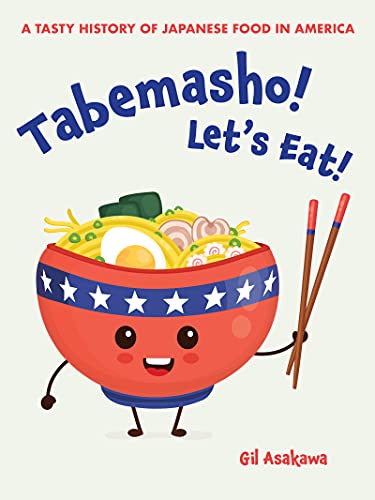
Tabemasho! Let’s Eat! A Tasty History of Japanese Food in America by Gil Asakawa

Tabemasho! Let’s Eat!
A Tasty History of Japanese Food in America by Gil Asakawa

Tabemasho! Let’s Eat! reminds me of one of the very first times I went out to eat in America. I’d been in the country for a few days, maybe a week, and I was taken out to dinner at a local Chinese American restaurant. I was thrilled, having never had Chinese American food before. At the end of the meal my hosts asked me, “What kind of fortune cookies do y’all have over there?” I was stunned. “We don’t have them in Asia.” Then they were shocked, having always assumed that fortune cookies were authentic desserts from the exotic East. The culture shock on both sides of that encounter and the histories behind the assumptions made around food are what Asakawa’s Tabemasho! Let’s Eat! brings to the forefront.

Though there is a serious side to Asakawa’s Tabemasho! Let’s Eat!, the book is a fun, fun read. Asakawa’s prose is super-casczz, chummy, and hilarious. Reading him is like having a beer with a friend who’s found a great place to eat and can’t wait to take you there. Asakawa was quick at the elbow with a witty comment. He was there to give me the low-down tale behind a (his)story.

I appreciated was the book’s serious side too. I enjoyed how unafraid Asakawa was to speak his mind on the tougher topics of cultural appropriation and America’s racist history of Asian exclusion. Indeed, much of Asakawa’s point is that Japanese American cuisine and culture is borne out of that dark period.

The book is split into thematic chapters, each one taking on a different dish like Noodles or Bowls of Rice (don), or Sushi. Asakawa also devotes a chapter to Japanese American history and the ways in which transcultural cuisine develops through migration, separation, and racism. The sushi and noodle chapters are especially extensive, providing the reader with tips on where to go and what to expect, types of dishes, the differences between Japanese and American interpretations of various dishes, as well as histories of these dishes from both sides of the Pacific Ocean.

There are also chapters on lesser known delectables such as Japanese soft drinks. I was so happy to read about Pocari Sweat — one of my childhood favorites, sold in Southeast Asia by the case! — which is (I think), the inspiration for one of my favorite fizzy drinks, 100 Plus. I can’t describe how they taste; they’re a cross of salty and sweetness, their appeal much like chocolate-covered pretzels. I grew up in South Korea for a time as well; it was there I became familiar with Yakult, Calpico and the whole plethora of yogurt-based drinks that are so popular in East Asian culture. Reading these chapters was like sipping at a memory of my childhood.

The chapter on baked desserts and pastries made my mouth water. Stopping at a Chinese, Korean, or Japanese bakery is one my favorite weekend excursions. The soft, sweet, white bread that melts in your mouth is a paradise. The red bean pastes, creams, and the custards are unique interpretations of Chinese, French, and European treats.

Asakawa also provides the reader with an extensive (though non-academic) bibliography and reference list so the reader can let themselves wander further on this culinary path.