South of Sepharad: The 1492 Jewish Expulsion from Spain (A Novel) by Eric Z. Weintraub

South of Sepharad: The 1492 Jewish Expulsion from Spain (A Novel)
by Eric Z. Weintraub

While early modern Europe isn’t my area of expertise, the Spanish Inquisition — as it is for many people — is an event of especial morbid and humanitarian interest. As a scholar of decolonization and the related topic of race and racism, this period in Jewish and Iberian history intrigues me endlessly.

South of Sepharad delivers the history, as well as telling a profoundly moving story, one whose historical subjects are tangible and human and fully recognizable to contemporary readers. Readers who are unfamiliar with this history are likely to find the novel a fantastic introduction to the topic; instructors will find it is perfect for an undergraduate course as it palatably delivers the history and offers multiple points for discussion and debate in the classroom.

The novel revolves around a Jewish family, whose patriarch is one of Granada’s physicians. When the Moorish city falls to the Catholic Kings (though they are not yet called by title), Isabel, Queen of Castille and Ferdinand, King of Aragon, the Jewish community is forced to evacuate, having been given an ultimatum to convert to Christianity or forfeit their right to live within the kingdom. The ha-Rofeh family is torn between the two choices they face, and the novel focuses on the outcomes of their decisions. The family must also face the ways in which this decree destroys their community and their collective sense of Jewish identity. Theirs and their leaders’ ethics are tested, leading to a myriad of personal and collective grief.

Weintraub’s characters, while not as internally reflective as I usually like in my fiction, bring this history to life. Their motivations are much like our own; we can see ourselves reflected in their actions and words. Readers will find themselves understanding the texture of this history, as they experience the expulsion with the ha-Rofehs.

Almost Brown: A Mixed Race Memoir by Charlotte Gill

Almost Brown: A Mixed Race Memoir by Charlotte Gill

As a historian I deeply appreciate Gill’s memoir, and for multiple reasons. Gill’s childhood experiences and those of her parents, captured from her memories and filtered through an adult lens retrospectively, highlights mid-twentieth century tensions of empire and our global journey towards decolonization. Moreover, Gill does it with a sensitivity to the internal, subjective conflict “colonials” often face as they grapple with their identities. The frustration of Self that Gill reveals to the reader, through her parents and her own struggles, is not an artifact of the past, singular to the decades of peak decolonization in the mid-twentieth century; these are still liminal spaces individuals occupy and traverse today.

In that respect, Gill’s memoir not only captures a particular zeitgeist of the 1950s-1980s — decades which saw a mass migration of colonials across the world, decolonization and independence movements coming to fruition, and a general cultural revolution across the world in terms of race, racism, and anti-paternalism — it also makes the reader aware of the continuity of this historical spirit and its legacy as it is lived today.

The success of this memoir is in large part due to Gill’s self awareness and willingness to see her parents (and herself) for the people they are; Gill examines them with an academic eye, as historical subjects, but also as emotional, affective beings whose desires and needs are universal across time and cultures. The result is a very relatable, human memoir, one which draws the reader into the nucleus of Gill’s family as well as the age in which they lived.

Some of Almost Brown‘s success must also be attributed to the fanciful and (for their time) outrageous characters her parents are, for the daring ways they each challenged the norms of their age in terms of race/racism, gender, and transnationality. This is where Gill’s memoir appeals to more than the smallish subset of readers whose interest is in post-colonial subjectivities; for while the memoir hinges on post-coloniality as its primary locus, it is also about the oppressions we inflict upon each other, the intersectionality of our daily lives, and the myriad of ways in which power flows or not even within a family. Gill’s mixed-race family serves as the perfect case study in which brown people and white people — that is, race — can be upended by gendered expectations, or vice versa. Gill’s white mother was submerged under her brown husband, even while he was marginalized by a society that saw him as inferior by dint of his skin color. She, in turn, was snubbed by both her husband and society for daring to be that which society deemed heroic: an independent-minded mother.

In short, Almost Brown is a memoir well worth the reading.

1666: A Novel by Lora Chilton

1666: A Novel by Lora Chilton

I read it all in one night. I couldn’t stop until I learnt what happened to Ah’SaWei. NePa’WeXo, and their children MaNa’AnGwa and O’Sai WaBus. I had to know, I couldn’t sleep without knowing.

Afterwards, I found I could not sleep, now knowing.

1666 was a hard book to read, even for me, a historian of decolonization. I teach students about the Doctrine of Discovery every semester. I highlight resistance to systems of oppression, especially colonization. Still, for all that I know, 1666 eviscerated me. I continued to read it because it is a work of resistance, because the women of the Patawomeck/PaTow’O’Mek tribe deserve to be read and seen and remembered. Awful as it is for me to read it, that in no way compares to the pain they lived and the pain that continues in indigenous communities today.

The story begins and ends with the PaTow’O’Mek women and it is told entirely from their perspective; it is the narrative of the massacre of their people, their enslavement, and their resistance against the British who destroyed them. Readers who were moved by Beast of No Nation by Uzodinma Iweala, Elie Wiesel’s Night, The Bird Tattoo by Dunya Mikhail — or more topically pertinent — Texaco by Patrick Chamoiseau will find 1666 an equally powerful read.

As an educator, I consider 1666 a valuable college level read. It is ideal, lengthwise, for an undergraduate course (at just over 200 pages, and with glossary and explanations of terms). Harrowing as the subject matter is, it is highly relevant and provides a number of points for discussion, historical examination, and resistance in the classroom. Chilton’s writing is also highly accessible, her prose smooth and flowing, her characters full of depth and humanity.

Alcatraz Ghost Story: Roy Gardner’s Amazing Train Robberies, Escapes, and Lifelong Love by Brian Stannard

Alcatraz Ghost Story: Roy Gardner’s Amazing Train Robberies, Escapes, and Lifelong Love by Brian Stannard

Roy Gardner was pretty impressive… even if he was also abhorrent as a human being. This reader found him perversely interesting, like a train wreck you can’t stop staring at. There is an element of action movie magic here, a kind of wonderment and expectation that the hero (Gardner) may not survive the next car chase. But he does.

Alcatraz Ghost Story is a biography of Roy, the man, but in true prosopographical fashion it paints a landscape of the early twentieth century through Roy’s life.

The result is a compelling read on multiple levels: Roy himself led an amazing life, if an unethical one, and tracing it reveals much about the expectations and norms of his life, as well as others in his orbit. His wife, for instance, and her reactions and behavior through his incarceration reveal the gendered notions of their age.

Readers who enjoy true crime, history, and biographies of so-called ordinary individuals will find that Stannard successfully develops a textured experience for the reader.

Prequel: An American Fight Against Fascism by Rachel Maddow

Prequel: An American Fight Against Fascism by Rachel Maddow

Someone get me a copy of this book for my personal library! (A friend lent it to me.) Maddow’s historical chops are on point in this prosopographical micro-history of mid- and early-twentieth century American political history. And the message is profound and powerful.

Through a close examination of U.S. government officials and political figures from the 1930s through to the mid-century, both those who advocated for a fascist approach to governance and those who opposed it, Maddow makes two important arguments: first, the political climate of the last eight years is not a new phenomena; second, pro-fascist cadre of politicians of the past — and by inference of today — did and do not operate alone, but were supported by institutionalized oppressive systems within the government, networks of pro-fascist supporters who did the political legwork on the ground on municipal, state, as well as federal levels, and their constituencies. In short, no fascist leader functions or sustains in a vacuum. The ideology of oppression arises through a network of individuals working together and often playing on the fears and logic of scarcity.

I would expect no less from Maddow, who holds advanced degrees and is, in my view, a public academic. Maddow does not disappoint on any level: the writing is undeniably in Maddow’s voice (I hear the audiobook is incredible), delivered with succinct sharp wit and their signature speedy, yet smooth, style. Fans of Maddow’s other mediums are sure to enjoy this much longer, more in-depth project.

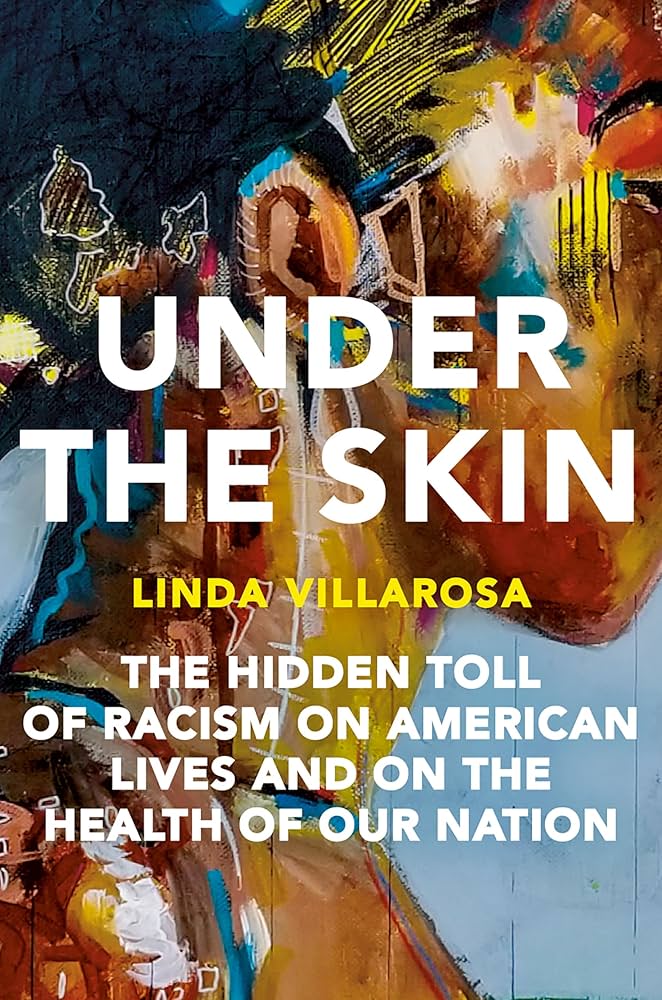
Under the Skin: The Hidden Toll of Racism on American Lives and on the Health of Our Nation by Linda Villarosa

Under the Skin: The Hidden Toll of Racism on American Lives and on the Health of Our Nation by Linda Villarosa

Under the Skin is the kind of book you dread to read, but once you start, you’re compelled to see it through — not because you like its contents, but because it would be immoral to look away. Indeed, it would be more than a little awkward to say that I liked the things I learned in Villarosa’s documentary of healthcare in America today. It is more accurate to say these were things I needed to know to in order to live in America today.

I read this for a book club at work; I work at a university so some of the messaging of Under The Skin felt like preaching to the choir, but it was, nonetheless, a lesson worth learning again. What lesson is that? Racism is not “over” and it hasn’t “ended” in any kind of definitive way. Anti-blackness especially is a legacy that remains and it’s tentacles are long and far reaching.

Indeed, its toll is not as hidden as it appears. Its toll is a scar and a fresh wound in living flesh.

This is a book worth reading at least once, and I would say, especially for women of color, for whom the tax of racism is higher, more exacting, even sometimes fatal.

A Woman of Pleasure: A Novel by Kiyoko Murata

A Woman of Pleasure: A Novel by Kiyoko Murata

 Woman of Pleasure is a slim novel whose size belies its powerful contents. For readers who enjoyed Memoirs of a Geisha, a novel by Arthur Golden (1997), Murata’s novel is the more historically accurate complement. Like Golden’s popular (but flawed and orientalist) work, this is a novel about Japanese geishas and their Floating World; however, unlike Golden, Murata draws on real events from Meiji-era Japan, weaving a story which is both fiction and history at their best. In Murata’s novel, geishas are not isolated from the rest of Japanese society, but integral to the larger whole.

The view of the floating world Murata offers us is raw and real, not romanticized; here we see women as they were, as actors with agency and power. We are given a glimpse into the real operations of a hanamachi and geisha houses of varying ranks and size, and the concerns of its most visible denizens. This is a powerful novel, one which removes geishas from the stereotypical niche they are often penned into, and places them in historical and economic context; Murata’s geishas are not dolls, but fleshy, flawed, and powerful individuals. This isn’t a romance, but an honest portrayal of what people do when they are denied their basic needs.

I am considering assigning A Woman of Pleasure in one of my history courses, as it emphasizes the change an individual and collective can invoke.

The Library Book, Non-Fiction by Susan Orlean

The Library Book by Susan Orlean

I read this for an Adult Book Club I’m part of at my local library. I wasn’t sure what to expect, but once I started reading, I was hooked.

The Library Book is about the Los Angeles Central Library, which I have walked past when I visited downtown LA last year, though it is not about that library, but the one which was very nearly destroyed by a fire on April 29th, 1986. Indeed, this is a book-lover’s dream book; it is about the history of the LA County Central library, the politics of the region and the immediate downtown area, the experiences of its staff, librarians, and patrons. Wrapped up into the book are issues that we face every day: sexism, homelessness, the politics of wealth and poverty.

Orleans opens with the arsonist and the investigation into the fire, which is fascinating in itself, but the book quickly branches out to discuss the rebuilding of the library, the meaning of the library to its patrons, staff, and to the community at large.

The history of the library is not the only appeal of the book. It is brilliantly written and deeply researched. Orlean writes with a keen sense of details, using them to bring what might seem to be a rather boring subject to life. Through her prose we can smell the charred incense of the library, feel the anguish of the staff, tense at the fury of the politics around the library’s governance.

The Dyatlov Pass Mystery: A Graphic History by Cédric Mayen

The Dyatlov Pass Mystery: A Graphic History by Cédric Mayen and illustrated by Jandro González

I don’t often read graphic histories, but I was intrigued by this one, not knowing much about the mystery of the Soviet team who were lost while passing through these mountains in the 1950s. On February 1st, 1959 a group of young Soviet students who were hiking through the mountains disappeared without a trace. It has never been fully understood or revealed what happened to them.

The graphic novel tracks along two timelines: the team as it traversed the snowy mountain trails and the investigation afterwards. In the former timeline, the reader is given a fictionalized glimpse into the relationships and conversations between the teammates, their hopes and dreams, and an understanding of who they were as individuals. The latter time line offers the reader an understanding of the politics surrounding the mystery and its investigation, an event potentially embarrassing to the then-regime.

It was an entertaining read, if thin on history.

The Last Colony: A Tale of Race, Exile, and Justice from Chagos to the Hague by Philippe Sands

The Last Colony: A Tale of Race, Exile, and Justice from Chagos to the Hague
by Philippe Sands

A brilliant legal historical monograph. I am tempted to use these in my classroom, except the course it would be relevant for is a lower division course and the depth and nuance of the book is too dense — and therefore unsuitable — for my typical first year cohort. Nonetheless, this is a book I would love to re-read and reconsider for a future course.

The core of this legal history focuses on Chagos, an island formerly French, then sold out from under its inhabitants to serve as a military outpost. These inhabitants, its natives, were forcibly removed and prevented from returning. Sands exposes the reader not only to the specific events of this case, but the larger political context around it: the slow and unwilling demise of European empires and their hold over their colonies, the heat of the Cold War, a long history of legal maneuvers played with cards held only by those with power.

Sands’ monograph is well written; its delivery is succinct, direct, and accessible, though I think it is better suited to an academically inclined reader than the general adult reader. It packs a punch in few pages; a fast-flowing torrent of information that propels and compels the reader to keep apace.