I was very excited to read The House of Doors, being Malaysian (though now living the diaspora). Tan did not disappoint in any way. I was profoundly moved; the setting of the novel, in high colonial era Penang, evoked a sense of lost history for me, being so far from Malaysia, and culturally divorced from all that home invokes, but I also suffered for the characters and felt the grief of their romantic losses.
This novel is a romantic anti-romance, the kind of romantic novel that mimics tragic, realistic romance in life, with all the attendant unhappy endings and disappoints, guilt and regret, nostalgia and memory that romance actually delivers.
There are two intertwined stories here, that of Lesley Hamlyn, a middle aged British woman living in Penang with her lawyer husband, and “Willie” Somerset Maugham, the novelist who comes to stay with them for a short holiday (which turns into a research and writing expedition). They are products of their British Colonial culture; this is the 1920s, the peak of British rule in Malaya, and they represent the elite class that enjoys all Asia has to offer.
Lesley and Willie form an unusual friendship, and in doing so, the stories of their respective romances is unveiled and threatens both of them and their place in society. Love brings both of them pain and escape; traps them and offers them a way out.
Tan tackles tough subjects: queerness, interracial romance, sexuality and sex, gendered expectations — all things the British were (are?) notorious for suppressing at home and abroad. Tan does this with great skill; the writing is gorgeous. A particular ocean scene utterly devastated me; I was as submerged as the characters in it.
This is a book I will need for my personal library.
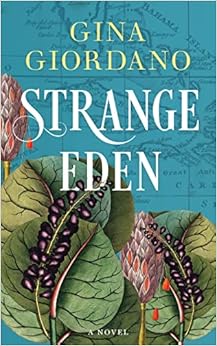
Strange Eden is a novel of many things. Foremost, it is a historical fiction set in the Bahamas in 1791, as the British Empire consolidates its colonies in the Caribbean and mourns the loss of its American ones. The story revolves around Eliza Sharpe née Hastings, a young English girl of the gentry class and her life as the bride of Lord Charles Sharpe, the scion of an old Colonial family and a Lieutenant Colonel in the British Army at Nassau. Their union is a relationship rife with hostility and repulsion; it is a core pillar of the novel, as is Eliza’s and Charles’ relationship with one of this old friends, Jean Charles de Longchamp.
Romance aside, the novel also possesses paranormal elements, political intrigue, and feminist assertions. Eliza is a young woman with many gifts, some which are less desirable in the highly hierarchical and patriarchal world of the Colonial 18th century: a fierce independence, a boldness of spirit and tongue, a sharp intelligence in matters spiritual and political, and an ability to see that which is beyond the visible. In her adventures on the island, Eliza encounters those who expand her view of the world and those who would seek to limit it. It is a diverse cast of characters: Lord Dunmore, the governor of the island, Charlotte and a host of aristocratic society women, Cleo, an enslaved obeah woman, pirates and smugglers, and a mysterious shadow man. Each one paints this Strange Eden in garish and sober colors. It is a paradoxical place for those who are free may also live in chains, though made of silk and gold, and only those who are enslaved know the notion of freedom is an illusion. The novel’s title is apt: what is a paradise for some is very often not a paradise for a great of many others.
This dissonance is what makes Strange Eden shine as a work of historical fiction. For this reader, the appeal of the novel is its attention to historical notions of gender, race, and class. Giordano includes a bibliography at the end, and it is clear that she has done a great deal of research. I hesitate to consider the novel appropriate for the classroom; it is not. The research is good, though not at a professional level. But it was not meant to be; Strange Eden is not a textbook. The historical research Giordano has done remains a positive attribute of the novel nonetheless.
Giordano highlights the expectations put upon women of Eliza’s aristocratic class, and the overarching misogyny women experienced in this era. This is a theme which threads throughout the novel. The expectations of white upperclass women are contrasted against those imposed on enslaved women, like her young maids, Celia and Lucy, and contrasted against the rights and privileges of powerful men like Charles, her husband, Jean de Longchamp, and Lord Dunmore.
Giordano also pays close attention to the slave trade in the Atlantic, racial hierarchies risen out of Europe’s Enlightenment, and the paternalistic racism of the so-called “Civilizing Mission” as it was inflicted on the indigenous and persons of color in the colonies. Britain’s slave trade was abolished in 1807 and the practice itself in 1833, several decades after the moment of the novel; the novel is bold in its recognition of the tension between abolitionists and slave-holders at this time.
Strange Eden delivers a powerful lesson about the gendered and racial notions of the British Colonial world.
The mode of its delivery unfolds at a languid pace. The novel’s prose is thick with description, rich like the molasses that were produced in the Caribbean islands the novel is set in. In some parts the prose, to stick with the analogy to molasses, is unrefined for this reader; on occasion its phrasing conveys cliché over clarity or is redundant, perhaps benefiting from further editing. These do not degrade the novel on the whole. Giordano delivers a cohesive narrative, tangible characters and dialogue, and — most importantly for this reader — weaves a textured fabric of the period. Readers will find the prose is performative of the heat, vibrancy, and slow pace of life inherent in the British colonies of the 18th century. The result is an immersive read.
Readers should also know Strange Eden is the first of a series. The novel ends on a cliffhanger, “to be continued“; however this should not dissuade readers for two reasons. First, the novel ends at 517 pages allowing one to meander through it at their leisure until the next in the series is available and second, the novel has the strength and narrative arc to stand alone without its sequel. The ending satisfies.
To purchase a copy of Strange Eden click here. At present, you can purchase it on Amazon for $19.99 (paperback) or $4.99 (Kindle ebook).
Translated by Pao-fang Hsu, Ian Maxwell, and Tung-jung Chen.
Puppet Flower: A Novel of 1867 Formosa by Yao-Chang Chen.
A historian’s historical novel! Puppet Flower is a narrative novel based on real events, a watershed moment in Taiwanese (Formosan) history when the United States and Western colonizing powers begin to encroach on Taiwan in earnest. The novel begins with an unfortunate event, wherein an American ship encounter one of Formosa’s indigenous tribes after surviving a storm at sea. The surviving crew — including a woman — are murdered by the Formosans, triggering a series of investigations and the arrival of more Western ships and military.
What makes Chen’s novel special in this genre of historical fiction is that Western perspectives are well-balanced with indigenous ones. It is rare to encounter fiction focused on Taiwan’s indigenous community, historical or otherwise; in highlighting their unique experience here Chen offers readers and the world at large a rare and unique literary opportunity. The result is a fantastic novel that — in my opinion — would do well in the classroom for a number of reasons aside from its historical focus:
The story arc is peppered with references and information about Formosan culture, providing a context for the historical events themselves. Unlike many historical novels, which rarely explain the cultural references they point to, Chen writes for the non-expert.
Puppet Flower offers multiple perspectives rather than focusing on a single protagonist. In this case, the novel allows us to see the event from an indigenous and Western point of view.
The prose is straightforward and not superciliously literary, making this an ideal undergraduate book; it does not require a great deal of knowledge about literary tropes, metaphors, and other devices typically used in novels. This is, truly, a history novel.
Overall, a novel of great historical value, not only in terms of its content, but in its production. This is decolonization at work, a piece of scholarship that highlights the indigenous perspective, a view of the imperial encounter from those who were colonized.



 Dr JoAnn LoSavio