Woman of Pleasure is a slim novel whose size belies its powerful contents. For readers who enjoyed Memoirs of a Geisha, a novel by Arthur Golden (1997), Murata’s novel is the more historically accurate complement. Like Golden’s popular (but flawed and orientalist) work, this is a novel about Japanese geishas and their Floating World; however, unlike Golden, Murata draws on real events from Meiji-era Japan, weaving a story which is both fiction and history at their best. In Murata’s novel, geishas are not isolated from the rest of Japanese society, but integral to the larger whole.
The view of the floating world Murata offers us is raw and real, not romanticized; here we see women as they were, as actors with agency and power. We are given a glimpse into the real operations of a hanamachi and geisha houses of varying ranks and size, and the concerns of its most visible denizens. This is a powerful novel, one which removes geishas from the stereotypical niche they are often penned into, and places them in historical and economic context; Murata’s geishas are not dolls, but fleshy, flawed, and powerful individuals. This isn’t a romance, but an honest portrayal of what people do when they are denied their basic needs.
I am considering assigning A Woman of Pleasure in one of my history courses, as it emphasizes the change an individual and collective can invoke.
The Nakano Thrift Shop: A Novel by Hiromi Kawakami
I saw this book at the library and the cover was so cute, I just couldn’t resist checking it out. I know, I know, I shouldn’t judge a book by its cover, but who doesn’t? Really? That said, the description also hooked me: I love thrift stores and I love Japanese fiction.
The Nakano Thrift Shop did not disappoint. The novel follows in that great Japanese literary tradition of deeply intimate writing. The story was simple, but poignant; it was recognizable and human in its simplicity, in its ordinariness. The events of the novel could have happened anywhere and to anyone, and that’s what makes it so relatable and so touching. Readers will find a part of themselves here in some way.
The novel revolves — unsurprisingly — around Nakano’s thrift store, a kind of junk store that sells amazing and banal things, and its employees. A young woman, a worker at the store, is the protagonist through whose eyes we view this small world. Her interactions with Nakano, a quiet young man who is her colleague, the shop owner’s sister, customers, and others within the orbit of the shop are the focus of the novel. This novel is about capturing a short moment in time, a time and world bracketed by the opening and closing of the store; it is a slice of their interconnected lives.
The events that take place are mundane: sales, returns, fixations on objects in the shop, the comings and goings of certain customers, falling in and out of love, the opening and closing of the store. Nothing “happens” but the slightest of events change the dynamics of the shop and its denizens, revealing a new perspective. The novel reveals how thin our veneers are, and how small actions can suddenly strip away our layers. The reader is treated to that peeling away, gets to witness characters in their most human and vulnerable form. That is the brilliance and appeal of this novel.
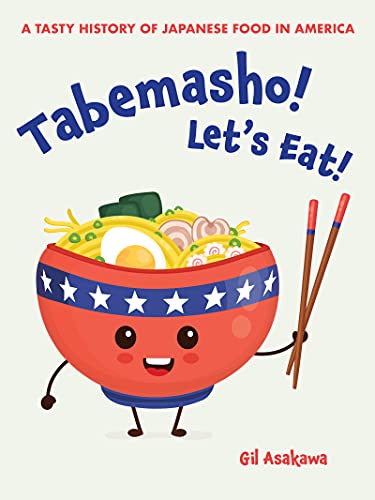
Tabemasho! Let’s Eat! A Tasty History of Japanese Food in America by Gil Asakawa
Tabemasho! Let’s Eat! reminds me of one of the very first times I went out to eat in America. I’d been in the country for a few days, maybe a week, and I was taken out to dinner at a local Chinese American restaurant. I was thrilled, having never had Chinese American food before. At the end of the meal my hosts asked me, “What kind of fortune cookies do y’all have over there?” I was stunned. “We don’t have them in Asia.” Then they were shocked, having always assumed that fortune cookies were authentic desserts from the exotic East. The culture shock on both sides of that encounter and the histories behind the assumptions made around food are what Asakawa’s Tabemasho! Let’s Eat! brings to the forefront.
Though there is a serious side to Asakawa’s Tabemasho! Let’s Eat!, the book is a fun, fun read. Asakawa’s prose is super-casczz, chummy, and hilarious. Reading him is like having a beer with a friend who’s found a great place to eat and can’t wait to take you there. Asakawa was quick at the elbow with a witty comment. He was there to give me the low-down tale behind a (his)story.
I appreciated was the book’s serious side too. I enjoyed how unafraid Asakawa was to speak his mind on the tougher topics of cultural appropriation and America’s racist history of Asian exclusion. Indeed, much of Asakawa’s point is that Japanese American cuisine and culture is borne out of that dark period.
The book is split into thematic chapters, each one taking on a different dish like Noodles or Bowls of Rice (don), or Sushi. Asakawa also devotes a chapter to Japanese American history and the ways in which transcultural cuisine develops through migration, separation, and racism. The sushi and noodle chapters are especially extensive, providing the reader with tips on where to go and what to expect, types of dishes, the differences between Japanese and American interpretations of various dishes, as well as histories of these dishes from both sides of the Pacific Ocean.
There are also chapters on lesser known delectables such as Japanese soft drinks. I was so happy to read about PocariSweat — one of my childhood favorites, sold in Southeast Asia by the case! — which is (I think), the inspiration for one of my favorite fizzy drinks, 100 Plus. I can’t describe how they taste; they’re a cross of salty and sweetness, their appeal much like chocolate-covered pretzels. I grew up in South Korea for a time as well; it was there I became familiar with Yakult, Calpico and the whole plethora of yogurt-based drinks that are so popular in East Asian culture. Reading these chapters was like sipping at a memory of my childhood.
The chapter on baked desserts and pastries made my mouth water. Stopping at a Chinese, Korean, or Japanese bakery is one my favorite weekend excursions. The soft, sweet, white bread that melts in your mouth is a paradise. The red bean pastes, creams, and the custards are unique interpretations of Chinese, French, and European treats.
Asakawa also provides the reader with an extensive (though non-academic) bibliography and reference list so the reader can let themselves wander further on this culinary path.



 Dr JoAnn LoSavio