
Puppet Flower: A Novel of 1867 Formosa by Yao-Chang Chen.

Translated by Pao-fang Hsu, Ian Maxwell, and Tung-jung Chen.

Puppet Flower: A Novel of 1867 Formosa by Yao-Chang Chen.

A historian’s historical novel! Puppet Flower is a narrative novel based on real events, a watershed moment in Taiwanese (Formosan) history when the United States and Western colonizing powers begin to encroach on Taiwan in earnest. The novel begins with an unfortunate event, wherein an American ship encounter one of Formosa’s indigenous tribes after surviving a storm at sea. The surviving crew — including a woman — are murdered by the Formosans, triggering a series of investigations and the arrival of more Western ships and military.

What makes Chen’s novel special in this genre of historical fiction is that Western perspectives are well-balanced with indigenous ones. It is rare to encounter fiction focused on Taiwan’s indigenous community, historical or otherwise; in highlighting their unique experience here Chen offers readers and the world at large a rare and unique literary opportunity. The result is a fantastic novel that — in my opinion — would do well in the classroom for a number of reasons aside from its historical focus:

  • The story arc is peppered with references and information about Formosan culture, providing a context for the historical events themselves. Unlike many historical novels, which rarely explain the cultural references they point to, Chen writes for the non-expert.
  • Puppet Flower offers multiple perspectives rather than focusing on a single protagonist. In this case, the novel allows us to see the event from an indigenous and Western point of view.
  • The prose is straightforward and not superciliously literary, making this an ideal undergraduate book; it does not require a great deal of knowledge about literary tropes, metaphors, and other devices typically used in novels. This is, truly, a history novel.

Overall, a novel of great historical value, not only in terms of its content, but in its production. This is decolonization at work, a piece of scholarship that highlights the indigenous perspective, a view of the imperial encounter from those who were colonized.
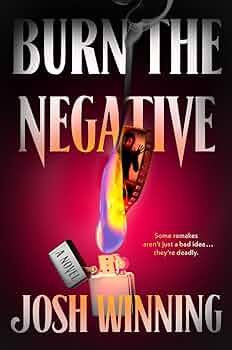
Burn The Negative: A Novel by Josh Winning

Burn The Negative: A Novel by Josh Winning

It’s such a cliché to say “I couldn’t put it down!” but with Burn The Negative it was so true! Thrillers set in contemporary digs are rarely my chosen genre, but every once in awhile a little thrill appeals to me and relieves me from the setting and character-driven interiority of historical or literary fiction. Burn The Negative had everything I wanted in a thriller: compelling characters with flawed, awful motives; a fast-paced plot that left me thinking “Oh no, what the WHAT?” as things go from horrendous to abysmal; mysterious hints that led me to announce “Aha!” far too early; and, the cherry on top: a twisted ending.

The novel opens with a fabulous line, immediately a portent of fuckery on a grand scale. A young women is headed somewhere she’d rather not be. It’s for work, but it isn’t really, and she’s having a bit of a nervous breakdown over it. The woman is the novel’s protagonist, Laura, who is a former child actor, now tasked with rehashing her Hollywood trauma as a journalist writing an article about the remake of the horror film that killed her career and ended her normal psychological development as a teenager. This is a novel that revolves around the drama of Hollywood on multiple levels, leaving the reader feeling very much like they are watching a Netflix Original horror film unfold in text.

As the remake of the film progresses, things go unbelievably wrong. But is this marketing? Is this the curse of the original horror film? Is it Laura herself? Both the remake and Laura’s memories of her Hollywood nightmare disintegrate into a surreal soup, leaving the reader wondering if there is something paranormal at foot or not.

The story alone is not the only draw of the novel. Winning’s prose is witty and the book includes fun elements — flashbacks, articles, ephemera, movie lore — which flesh out the story arc, provide context, and make the novel feel deliciously kitschy. This book is fun.

Fans of horror films, horror film lore, haunted media, and fast-paced mysteries can fully expect to enjoy Burn The Negative.

Welcome Me To The Kingdom: Stories by Mai Nardone

Welcome Me To The Kingdom: Stories by Mai Nardone

It is so rare to find novels and creative fiction that is not only set in Southeast Asia, but written by Southeast Asian authors (rare, not impossible!) that when I saw this coming out in 2023 I JUMPED on it! And I am so glad I did. This is a book that makes my heart sing!

Nardone’s Welcome Me to the Kingdom is a novel woven in stories, revolving around the lives of Thais who live in Thailand or beyond in the diaspora, transnational and transcultural Thais. This is a book about people, individuals as they navigate the multiethnic and multicultural world of Thailand, and what it means to be Thai for them. The characters, as diverse as they are in terms of ethnicity, class, and gender, are connected together in this novel; they and their lives serve as a microcosmic diorama of Thai realities where muslims of the south grapple with discrimination, poverty stricken girls from the village migrate to the city, mixed race Thai/White kids straddle two worlds and belong not quite fully into either one.

The stories span across several decades and generations, allowing the reader a view, not only into modern Thainess, but also how the concept has changed over time and the ways in which being Thai is differently defined for individuals of different religions, classes, genders, etc. Language is a significant element in these stories, not surprisingly since Thailand (like so many other parts of Southeast Asia) has and remains affected by colonialism and its invasive culture (though it was never politically colonized). Welcome Me to the Kingdom is about the rubbing together of cultures, the tension and chafing as multiple perspectives collide. This is a historical novel offering readers a textured, multi-faceted sense of contemporary Thailand, a place in which tradition and modernity coexist, sometimes contentiously, sometimes not.

My favorite characters were Nam and Lara, their story, interwoven with Pea’s and Rick’s, was my favorite, though I probably identified most with Ping. I think readers will find a little bit of themselves in these pages, whether they are Thai or not, as the emotion driving these stories is universal. Nardome’s stories are about desire, ambition, longing, and fear — that inevitable friction between parents and children, within families, the old(er) and new(er) attempting to find common ground.

For readers who enjoy anthropology, history, and postcolonial literature, Welcome Me to the Kingdom will be an especially enjoyable read.

How to Sell a Haunted House: A Novel by Grady Hendrix

How to Sell a Haunted House: A Novel by Grady Hendrix

Yes, Grady Hendrix’s books are kitschy. Yes, they are gimmicky. Yes, they are never what they seem — and isn’t that a great thing for a horror novel? Yes! This novel is nothing like what the title might seem. The horrors run far deeper than the house itself; like most of Hendrix’s horror stories, it is the past, relationships and families gone awfully awry that are the real terror.

The novel begins with a woman who dreads facing the task of cleaning up her childhood home with her estranged brother. The brother who is an utter assH*le. As they delve through their inheritance it becomes clear that there is an entity between them, something old and ancient, and malicious. This novel is not what it seems, but there really a haunted house in it!

What makes How to Sell a Haunted House so compelling though is not only the story arc, which is fairly straightforward, but the characters Hendrix creates. The characters are flawed in ways that are intimately familiar (everyone knows someone like the assH*le brother); I felt a real tension between wanting to slam the book shut on some of these people and desperately wanting to read on to find out if they got their comeuppance. That tension is Hendrix’s brilliance as an author; Hendrix creates people you love to hate or hate to hate… and who eventually, you hate to love. The heroes are villains in as much as they as are the neighbor next door, your sister in law, your mother, your teacher.

The novel is one of transformation; dare I say it? It is the story of an exorcism. But while there is a kind of fluff about the novel, it is also dark and its subject matter is deeply disturbing. This is the kind of horror that is so real, so plausible, that it seeps under your skin and make you wonder how things that can happen every day can morph into a tangible darkness. Readers, be prepared to feel creeped out, heartbroken, angry, and disgusted all at the same time.

How to Sell a Haunted House was Hendrix at their best (and I couldn’t imagine how they’d top My Best Friend’s Exorcism or The Southern Book Club’s Guide to Slaying Vampires (my two favorite Hendrix novels), but they did!)

The Last Heir to Blackwood Library: A Novel by Hester Fox

The Last Heir to Blackwood Library: A Novel by Hester Fox

If you enjoy books about books, especially of the quasi-historical/paranormal/mystery/romance variety, then The Last Heir to Blackwood Library will check all your boxes. The story revolves around Ivy Radcliffe, a young woman left devastated and alone by WWI in England. She finds herself leaving the loneliness of London for Blackwood Abbey in Yorkshire — and a seat among the gentry as Lady Hayworth.

Not only must she learn to navigate her inheritance, which includes the abbey and the eponymous library, but also her new servants, the village, neighbors, and…. herself. Ivy undergoes strange changes to herself that she cannot account for, though she is amply aware of them. The oddness and feeling of foreboding is amplified by the history of the abbey and the library.

The library becomes the focal point of all the madness and Ivy realizes she must make hard choices about what she wants from her new life and what part of herself she is willing to lose to obtain that.

The appeal of this novel is not only in the mystery of Ivy’s inheritance, built into the story arc, but Fox’s ability to inject a modern feminism into Ivy’s motivations and the old-fashioned world of the English gentry in the late Edwardian/Interwar period of the mid 1920s. The result, though somewhat anachronistic, is a very contemporary and appealing leading character and an inter-generational, inter-cultural kind of tension, the kind that pits traditionalism against modern sensibilities.

Old Babes in the Wood: Stories by Margaret Atwood

Old Babes in the Wood: Stories by Margaret Atwood

I’m not a huge fan of short story collections, especially those by a single author… but Margaret Atwood! It’s Margaret Atwood! So I was thrilled to read and review this.

As it turns out, Old Babes in the Wood includes a set of stories that unfolds like a novel told in segments. There are also some standalone stories in this collection, but several which incorporate the same characters and, combined, offer the read a novel-like narrative arc. This novel-in-stories revolves around a mature couple and their engagements with one another and others of their mature social circle. They are “empty nesters”, finding themselves now in a moment of their lives that is somewhat unfamiliar.

Other stories are also peppered with similarly mature life-stage themes and concerns. One of my favorites in this collection revolves around the hot topic of motherhood and mothering. As usual, Atwood delivers very creative approaches to each one, turning the perspective inside out, and presenting the reader with a novel experience.

That said, many tales here have been published in journals earlier, so readers should not expect a wholly new collection of stories. Their cohesiveness here, however, appears to mimic Atwood’s own life journey: these tales are concerned with change from one life-stage to another, mature themes and concerns (by which I do not mean X rated spice, but concerns of older adults). Atwood is, after all, an old babe in their own wood (no offense, Mx Atwood!) and like us all, navigating our own paths through life.

Mercy: A Novel by Kathleen Patrick

Mercy: A Novel by Kathleen Patrick

A profoundly moving novel, with a story so powerful as to cause me to pause every few pages to wipe away tears. Mercy packs an emotional punch along the lines of Tinker by Paul Harding or Annie Proulx’s Brokeback Mountain. This is an impressive debut novel, one well-worth the grief and tears it is sure to evoke.

The novel revolves around Sadie, a twelve-year old girl abandoned by her parents and her subsequent landing on her Uncle Charlie’s farm in South Dakota. Mercy is both what she finds and what she delivers to those in her life, whether they are deserving of forgiveness or not. This is literary fiction at its best: raw and rich characters; humanity at its flawed worst and inspiring best.

Patrick is an excellent writer; her prose is evocative and succinct, creating an affect that strikes the reader deep in the gut with very few words. In the space of 154 pages, Patrick immerses the reader in Sadie’s juvenile, but deeply adult and complicated world. The reader follows Sadie’s journey as she navigates the traumatic events of her abandonment, her memories of the past, her fears for her future. Patrick very successfully channels the emotions of a 12-year old, whilst balancing the very mature context of her circumstances; this is not a novel for a teenaged audience necessarily, its themes cross age-oriented literary boundaries.

The novel could use a professional editing, as there are some inaccuracies in turns of phrase; “Martha could have cared less” on page 23 for example. Indeed, it appears that Martha could not possibly have cared any less. [Some of the lack of professional editing may be due to the novel being independently published.] Still, despite the occasional typographic error, Mercy remains irresistible. I read it in an afternoon, I could not put it down.

I encountered this book via a Facebook Group, in which I serve as a reviewer for ARCs and independently published novels. I have previously read and reviewed another of Patrick’s books here, Anxiety in the Wilderness: Stories. If you are interested in Patrick’s work, please see her Amazon author page here. You may purchase Mercy there, currently priced at $9.99 for a paperback, $15.99 for a hardback, and $2.99 for the Kindle ebook format.

A Ricepaper Airplane: A Novel by Gary Pak

A Ricepaper Airplane: A Novel
by Gary Pak

Unlike my usual reviews, this is an older book, published in 1998. I found it on sale from the University of Hawai’i Press and since I enjoyed Pak’s other novel, Children of a Fireland by Gary Pak I had to read it. Like Pak’s other works, A Rice Paper Airplane is set in Hawai’i and revolves around one of its communities. In this case, the story centers of Koreans who migrated to the islands to seek better employment or escape from Japanese persecution during the period of the latter’s occupation of the former’s country.

The novel unfolds like origami, turning backwards and forward in time according to the scattered memories of an old man, Uncle, as he recounts his life for his nephew. Threaded through his memories are histories of Hawai’i and its many residents, Korean, Japanese, White, Indigenous. The novel also folds across geography, taking place in both Hawai’i and Korea. This is a novel about conflict, both cultural and political; desires, both of the individual kind and the ambitions of states; resistance and fighting spirit, in body and mind, through success and failure.

This is an emotional novel. Readers should expect to feel grief and sorrow. But also the hope and resilience of Korean migrants in cultures, circumstances, and places not of their own making and wholly according to history and fate.

For these reasons alone, this is a very worthwhile read. It is little known, but ought to rank with the best sellers of today in the vein of intergenerational, multi-generational historical fiction: Yaa Gyasi’s Homegoing for example.

But that is not the only reason to read A Ricepaper Airplane: Pak’s prose is also an appeal. The novel’s dialogue is written in Hawai’ian pidgin, a creole language that is unique to the islands, lending authentic voice and substance to the characters and the story itself. The exposition is unfussy, straightforward, yet also flowing. Pak leaves the reader with poetic silences that fill with organic emotion.

This is an incredible novel, one which deserves greater recognition.

This Other Eden: A Novel by Paul Harding

This Other Eden: A Novel by Paul Harding

Having read Tinkers, I began my reading of This Other Eden with high expectations and hopes. I wasn’t disappointed. On the surface it appears a pastoral novel. But this is false. To the reader the landscape is hidden — at first. Then as the novel unravels, it is clear there is a dark narrative thread running through the whole thing, a cohesion of some kind that is based on something less rosy than than a scenic, island reverie and altogether discomfiting: history, racism, resistance. This is a historical fiction, spanning the 18th through the 20th centuries, a significant time in the development of race and racism in America. Harding delivers this highly charged story carefully, in an ecological, atmospheric wrapper, one that makes the geography of the island on which the story takes place — its isolation, its raw, loam scent, its shaded trees — an important metaphorical actor. The island serves as a shroud and a setting for the demise of a way of life: a black way of life as it is subsumed by whiteness. Readers should expect to feel uncomfortable, perhaps a sense of claustrophobia from an inability to escape the island. This is to mimic the kind of slow isolation felt by its inhabitants.

This Other Eden is a novel about an island and its black inhabitants, the mainland and its white population, the slow — then rapid — shift of race and the infliction of racism on the former, the closing in on a way of life. The island is inhabited in 1792 by an interracial couple, not an uncommon pairing in this moment in time necessarily; Benjamin Honey and Patience, an Irish woman (the Irish having been ostracized as some Other race in the hierarchy of Western Europe). Their descendants occupy the island, but are increasingly subjected to America’s abhorrence and obsession with eradicating miscegenation. As the decades and centuries roll on, the islanders become targeted by eugenicists — much like the rest of the nation. So-called “good” intentions to bring progress and education to the island are misguided attempts, achieving none of their intended outcomes and instead excelling at cultural and racial erasure.

This Other Eden is told through the eyes of the islanders. Even while it addresses larger issues such as eugenics and racism, it is focused on the experiences of the islanders. It is a novel about people and the lives they must live, even while it is a commentary on America’s racist history.

Dear Chrysanthemums: A Novel in Stories by Fiona Sze-Lorrain

Dear Chrysanthemums: A Novel in Stories by Fiona Sze-Lorrain

A literary dream, that’s what this novel segmented into stories, felt like. Dear Chrysanthemums floats. There is something reminiscent in this novel of Cloud Atlas by David Mitchell or Virginia Woolf’s Orlando, a kind of immortal quality that flows one life into another, connects what appear to be disparate loci — combined with a historicity that reminds me of Jung Chang’s seminal, biographical, non fiction work, Wild Swans: Three Daughters of China about Chang’s mother and grandmother, women who lived and survived China’s imperial demise, revolution, Japanese occupation, and Communist Cultural Revolution.

The stories in this novel, seemingly unconnected at first, reveal an intimate connection in the end: the women who feature in them are ordinary women, servants, daughters, mothers. They are separated by time and space, but their desires and ambitions, fueled by the need to become individuals in their own right, fuse them together. There is tension between the women of each story, but there is also connection.

The novel crosses continents, spanning the globe from China to France, and across time. Each generation of woman encounters a different kind of struggle, but a struggle all the same, and the story of each them reveals a common desire to realize who they are and what they want from life and from the circumstances of their lives.

History plays a role here, shaping where the women begin and where they end, the trajectories of their journeys. Colonialism, conflict, and war shape their migrations, that is, their physical and metaphysical, subjective journeys towards themselves. The women in these stories are bound by history inasmuch as they are bound to each other and to their own individual desires.

For those who love historical fiction, literary layers to excavate, and strong and flawed female characters, this is the novel for you.