I love, love, love stories about ways we decolonize — and Ladies’ Tailor is absolutely a tale of life unravelling and rebuilding in the post-colonial, post-Partition Era. Set in India and Pakistan in the era after Partition (post 1947), the novel follows a cast of characters as they try to find a new place for themselves, heal from the violence of the migration and the ethnic hatred, and build a new purpose and identity. The story begins with one man as he navigates his migration into India as a refugee. He’s not a hero — or even a particularly nice man. He is an ordinary man with dreams and hopes to open a shop for women’s clothes for women.
As he begins to establish himself in India, the novel’s landscape begins to widen and the reader is introduced to the man’s circle of new acquaintances and business contacts — as well as the obstacles and hardships of navigating in a new environment.
A central focus of the novel are the inevitable ties between Pakistan and India, between Muslims, Hindus, and Sikhs, and how unbreakable and crucial those relationships were (and are!) to a successful post-Partition rebuilding. As a cultural and social historian, this thread of the novel was especially profound; the characters in Ladies’ Tailor are not only navigating new spaces, but also trying to rebuild old traditions, re-create parts of their lives and heritages they have lost. The novel focuses intently on those tensions, and the flexibility required of individuals to be successful. And of course, things never quite turn out the way things are planned.
The story is not the sole attraction: Hajeela delivers the story with well-crafted, economical prose. The characters are fleshy and tangible. Sometimes they seem like unpleasant people, sometimes they are oblique to the reader in their motives. Hajeela’s characters are real, and indeed, the story is based on true events and real individuals.
As far as its textual style, readers should know Ladies’ Tailor is not reflective, subjective literary fiction; it is not deeply emotional (it does not dwell on the horrors of the Partition, even while it acknowledges this wrenching event) or focused on internal strife and struggle, but the collective efforts of a community. It is written in a commercial style, what I might categorize as “summer reading” but in the vein of historical fiction. Its subject matter is sombre and serious, but its delivery lightens the load readers might expect to carry.
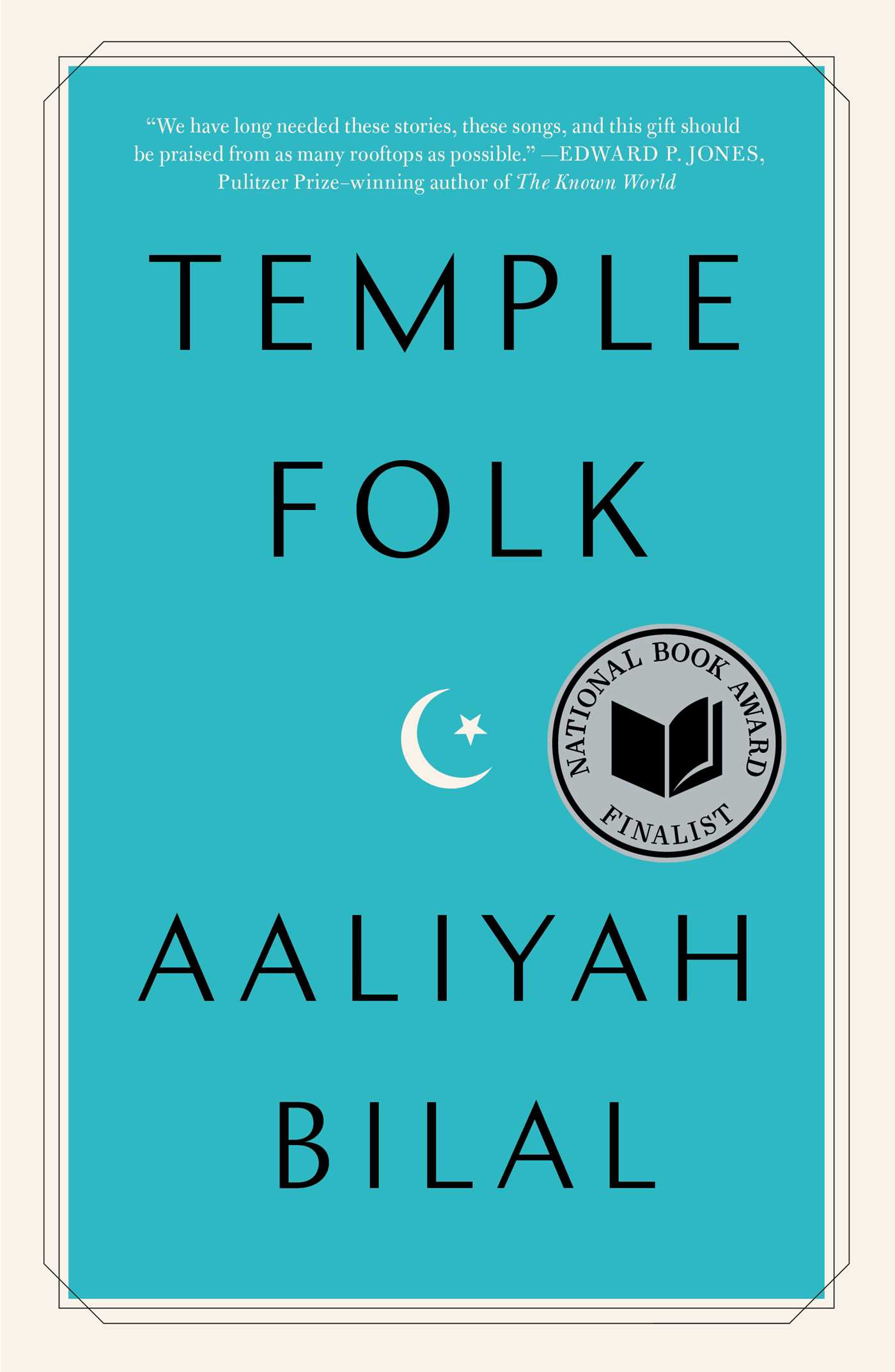
Marketing being often exaggerations, I rarely pay attention to the endorsement blurbs on covers; but, in this case, the quote is right and right on target. We — society as a whole, and especially readers of color — have long needed stories like these in Bilal’s collection, stories which reflect a way of thinking and life beyond the literal pale (read: whiteness) that has so long been taken as the norm in literature.
Literary canons still rarely feature writers and stories of diverse backgrounds, genders, and identities, and the term still conjures an Eurocentric image. Bilal’s collection is a balm, not a bandaid; a healing wound, not a scar; a mark of beauty, not a blemish. It highlights this paucity in modern literature and offers a concrete solution towards developing a greater oeuvre of our human experience.
The opening tale in Temple Folk orients the landscape of the collection as a whole: it centers on an interstate bus ride. The bus is filled with faithful black and white Muslim-American women, chartered to bring them from their small hometown, across a rural and white-dominated expanse, to Chicago where a Muslim conference will be held. This is a community unto itself, though it exists — consciously — as a part of white, Christianized America. Readers are given a privileged view into this world within a world.
The other tales highlight the daily, lived experiences of the citizens of the Nation of Islam. As a whole, these stories bring to the fore the intersection where NOI citizens, black denizens within their world, and the non-NOI, non-Muslim white world meet. Bilal presents the reader with scenarios where the whiteness of a child confronts the blackness of a woman, and what this might mean within the context of a religion that is often positioned adjacent and not central to the black/white politics of our era. Bilal pokes at the humor and seriousness of dating in the muslim world, knowing the gendered expectations of muslim women and men the reader is likely to filter her tales through. Bilal encourages a shift away from that pockmarked lens, offering a clearer view if the reader is willing to remove the glass from their eyes.
Indeed, most of my favorite stories were premised on a collision of modern, American ideas of empowerment and feminine identity, with Orientalist stereotypes of Islam and Muslims. But, the unique feature Bilal brings is a side-sweep which softens the collision and creates instead, a merger. Modern Muslim identity is not at odds with Islamic traditions and cultures (though it can be), nor do modern muslims (men, women, children, and all alike) need to make choices between their Blackness, modernity, and Islamic identities. In performing this clever maneuver, Bilal introduces the reader to a much more nuanced world of Black Islam, likely one that they have not seen before. Certainly, for this reader, this was the case.
This novel devastated me. And in the most profound and satisfying way. I could not put this book down; despite being a hefty read at 368 pages I devoured it in a weekend. This novel is a serious contender for my Book of The Year.
Razak’s Moth is set in Partition era India and Pakistan, the former mostly. Its events unfold in the year leading up to India’s independence in 1947 and the year directly after it, a violent and terrible time when Muslim Indians and Hindu Indians violated each other’s homes, families, bodies, and holy places of worship. Moth does not shy away from the terror or the brutality of this history; its story is premised on gendered violence, sexual violence, the kind wrought on women and girls before and since Partition.
This is not a novel for the faint of heart. Readers should prepare to feel chilled to their marrows at the cruelty Razak lays bare.
At the same time, Moth is an empowering read. This is a feminist novel. Not only is it told from the perspective of a young girl desperate to become a woman, Alma, it revolves around the actions of the women in her life and in her community. Alma comes from a high caste Brahmin family, a pair of progressive-minded parents who are highly-educated and who view their India as a place of ethnic, class, and caste equality. But Alma is a victim of her own immaturity and her Brahmin, Hindu grandmother’s ambitions and traditionalism. The history of India at this junction of conflict between colonial rule and independence, Hindu and Muslim segregation or peace, traditionalism or modernity plays out in Alma’s family’s words and deeds. The story opens and hinges upon Alma’s wedding to a Brahmin man, much older than herself.
Here is the first of the gendered debates the reader will encounter in this novel. Marriage, in its traditional and modern forms, the domains of power which men and women occupy — according to their familial rank, their class, their caste, they religion — is one of the fascinating, golden threads of this novel. Alma’s mother is unique in her historical time and place: She is a lecturer at a university, she works. Her marriage to Alma’s father is a foil to to the other marriages in the novel where wives are beaten, raped, abused in other myriad ways.
Moth is also compelling for its frank discussions of caste and class. Ethnicity, religion, race, nativism and xenophobia also serve as the fabric on which the patterns of its stories are told. While Moth is a historical fiction, these threads are visible in India today; this is not merely a fiction of the past, but also a commentary on Indian politics and society right now. Moth is truly an intersectional novel, one which weaves history into the present, one whose characters are shaped by their age, their experiences, religion, gender, ethnicity, and caste.
The characters are complex and developed. Even Razak’s villains are soft and vulnerable. In this novel no one is who they seem, even to themselves. The primary cast consists of Alma’s immediate and servile family: Her father whom we meet mostly as Bappu, simply, “father” and her Ma, named Tanisi; her sister, fondly nicknamed, Roop; her paternal grandmother, a matriarch in their home and her dead husband, the ghost of her Alma’s grandfather, a silent but present and poignant character in the events of the novel; their servants, Dilchain, a Hindu woman and Fatima Begum, a Muslim woman.
Religion and culture shape these characters, give them their reasons for compliance and rebellion, motivate them in their actions. Community expectations and subjective desires come into conflict within these characters, in some cases these poles are reconciled or exist in uneasy harmony. Razak places the reader in the midst of palpable, relatable characters who walk us through their lives as if we were there in the room with them. In Razak’s prose we can taste India, envision the hot sun and the colors of its markets and streets, feel the moisture of sweat and floral fragrance on our skin. Razak brings the reader so close to the characters we might detect their bodily scent or feel their eyes on our skin. In the characters’ actions and thoughts we, the readers, can recognize universal needs and motivations: teenage longing, maternal affection, filial piety, desire for belonging and approval — even while we are treated to a view into a world that is not our own, one that is past and gone, an India of long-ago and far-away.
That said, Moth is brilliant in its nuanced portrayal of India and Indian life and culture. It rejects the exoticism that so often plagues Indian literature, colonial and postcolonial alike. Instead its honest portrayal of Indian people and their experiences connect them to others; we may not know anything of the first hand experience of war, but through Moth we get a real feel for what that might look like, feel like, smell like. Razak’s India is a terrible, beautiful place. Its people are inhuman and yet, all the more human for their cruelty. In these pages the reader will encounter suffering, but, also inspiration. I was awed by the strength of the women and men in Moth. I felt hope, even while I cried as a witness to their pain. They were transformed by their experiences, in good and bad ways.
Moth highlights the catalytic effect of history in the most bitter-sweet way. This is a book you will regret and never regret reading.



 Dr JoAnn LoSavio