Almost Brown: A Mixed Race Memoir by Charlotte Gill

Almost Brown: A Mixed Race Memoir by Charlotte Gill

As a historian I deeply appreciate Gill’s memoir, and for multiple reasons. Gill’s childhood experiences and those of her parents, captured from her memories and filtered through an adult lens retrospectively, highlights mid-twentieth century tensions of empire and our global journey towards decolonization. Moreover, Gill does it with a sensitivity to the internal, subjective conflict “colonials” often face as they grapple with their identities. The frustration of Self that Gill reveals to the reader, through her parents and her own struggles, is not an artifact of the past, singular to the decades of peak decolonization in the mid-twentieth century; these are still liminal spaces individuals occupy and traverse today.

In that respect, Gill’s memoir not only captures a particular zeitgeist of the 1950s-1980s — decades which saw a mass migration of colonials across the world, decolonization and independence movements coming to fruition, and a general cultural revolution across the world in terms of race, racism, and anti-paternalism — it also makes the reader aware of the continuity of this historical spirit and its legacy as it is lived today.

The success of this memoir is in large part due to Gill’s self awareness and willingness to see her parents (and herself) for the people they are; Gill examines them with an academic eye, as historical subjects, but also as emotional, affective beings whose desires and needs are universal across time and cultures. The result is a very relatable, human memoir, one which draws the reader into the nucleus of Gill’s family as well as the age in which they lived.

Some of Almost Brown‘s success must also be attributed to the fanciful and (for their time) outrageous characters her parents are, for the daring ways they each challenged the norms of their age in terms of race/racism, gender, and transnationality. This is where Gill’s memoir appeals to more than the smallish subset of readers whose interest is in post-colonial subjectivities; for while the memoir hinges on post-coloniality as its primary locus, it is also about the oppressions we inflict upon each other, the intersectionality of our daily lives, and the myriad of ways in which power flows or not even within a family. Gill’s mixed-race family serves as the perfect case study in which brown people and white people — that is, race — can be upended by gendered expectations, or vice versa. Gill’s white mother was submerged under her brown husband, even while he was marginalized by a society that saw him as inferior by dint of his skin color. She, in turn, was snubbed by both her husband and society for daring to be that which society deemed heroic: an independent-minded mother.

In short, Almost Brown is a memoir well worth the reading.
Lay Them to Rest: On the Road with the Cold Case Investigators Who Identify the Nameless by Laurah Norton

Lay Them to Rest: On the Road with the Cold Case Investigators Who Identify the Nameless by Laurah Norton

I thoroughly enjoy my true crime reads, gruesome and terrifying as they are. I especially enjoy the intricacies of police work and investigation, probably that’s a side of the analysis that I can both relate to and have no idea about. I love learning about the ways in which investigations of this nature are conducted, the nuances of analysis and the low and high technology that comes into play.

Lay Them to Rest delivered… and yet, also didn’t quite hit the high notes for me.

The bad part first. I didn’t enjoy the degree of personal involvement and commentary Norton provided. While it is common for writers to relay their personal trajectories and use it to form the narrative arc of their non-fiction books, I found the way in which Norton did this to be distracting. The injection of her personal thoughts felt like intrusive minutiae. This is, of course, a subjective opinion; other readers may very much enjoy Norton’s personal journey. For this reader, not only did this detract from the primary story of the victims and their cold cases, but Norton’s self-deprecating approach undermined her credibility and authority, coming off as fumbling. I believe the intention was to code Norton’s “character” as endearing, but its delivery did not persuade me of this view of her.

But now, the good. Norton’s partnership with a biological anthropologist produced an academic perspective which I greatly appreciated. It is clear a great deal of research had been conducted, both by Norton and Amy Michael, as well as the many others Norton shadowed, interviewed, and worked with. The book provides a great deal of information, and Norton’s delivery of that — along with the abundant necessary context — was accomplished with both straightforward utility and finesse. Norton’s prose was smooth, its language accessible while still necessarily full of the argot of the subject matter. Norton distills an enormously complex subject into easily digestible and palatable parts.

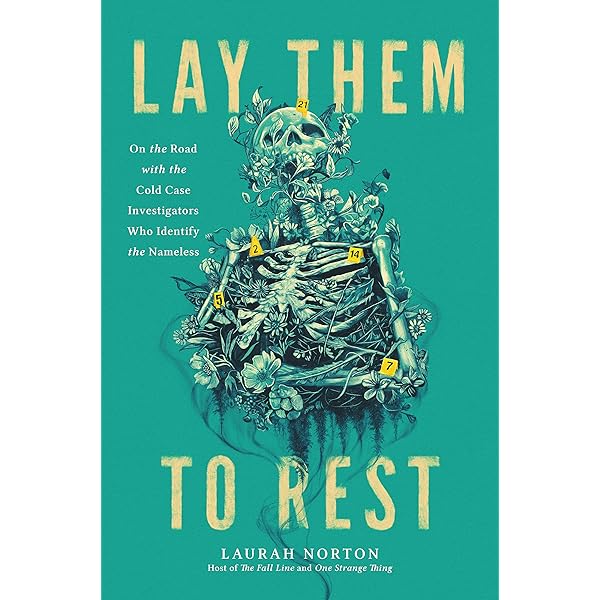
Lay Them to Rest is built through the cold cases of several victims, Jane Does, found dead and abandoned. Norton uses these cases to relay to the reader a nuanced view of the layered landscape of police work, forensic analysis, and dysfunctional systems of databases for DNA tracking used for investigating and solving crime. The focus here is not on the victims, or their families, or even on the police or investigators who strive to solve their crimes; Lay Them to Rest focuses on the structural elements of criminal investigation, the organizations and systems which organize and sift through the millions of bits of data and information that can be gathered about victims and the crimes against them. This angle into the world of criminal investigation was a novel one for me; most of the true crime I have read have not delved into this specific aspect of investigation. I found this perspective refreshing and intriguing.

Readers of true crime will find Lay Them to Rest a worthy addition to their libraries. Or, at the very least, well worth the time and effort of reading it.

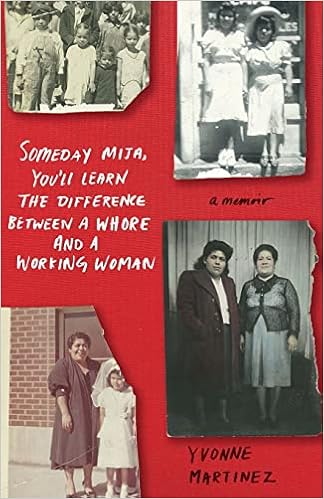
Someday Mija, You’ll Learn the Difference Between a Whore and a Working Woman: A Memoir by Yvonne Martinez

Someday Mija, You’ll Learn the Difference Between a Whore and a Working Woman: A Memoir
by Yvonne Martinez

This is an intensely powerful memoir; Martinez’s life is a scar tissue of intergenerational wounds. Someday Mija, You’ll Learn the Difference Between a Whore and a Working Woman is a serious treatment of what the traumas of racial violence, poverty, and sexual exploitation can do to a child and a family, and how Yvonne was able to weave these histories — her own, her mother’s, her grandmother’s, her family’s and her community’s — into a lifetime of “doing better.” This is not a memoir to be undertaken lightly.

Celebrate Hispanic Heritage, September 15th to October 15th — but also, whenever and always!

Someday Mija, You’ll Learn the Difference Between a Whore and a Working Woman is divided into two halves, the first reads like a novel and documents Martinez’s experiences as a child and growing up in a dysfunctional family. The second half addresses Yvonne’s life afterward, as an adult and specifically as an activist in the service of her community, as an organizer, and educator.

The two halves are intertwined: it is Martinez’s experiences growing up in an abusive and violent home that shapes her ability to understand the traumas that envelop her community. This shared experience is one not easily addressed by public health programs or the simple piling on of more and more education. Oppressive systems stemming from cultures steeped in patriarchy, sexual violence, and colonization cannot be wiped away, even replaced that easily. These cultures exist within even larger systems of oppression.

In Martinez’s case, however, these experiences also spurred them to take on systemic racism, sexism, violence, and poverty as institutions to be dismantled. This is a case of an individual working from within, for one’s own community (and for all communities). Change must be internal as well as external for it to sustain; Martinez’s life is proof of that.

A profound and consuming memoir that is in equal parts disturbing, sad, and inspiring.

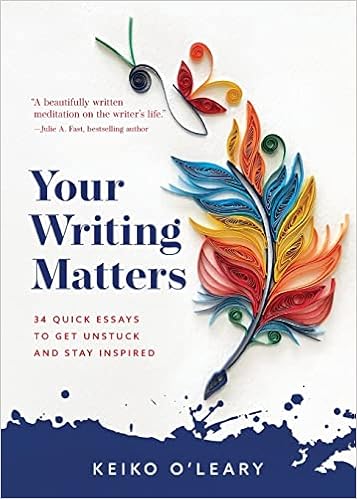
Your Writing Matters: 34 Quick Essays to Get Unstuck and Stay Inspired by Keiko O’Leary

Your Writing Matters: 34 Quick Essays to Get Unstuck and Stay Inspired
by Keiko O’Leary

I’m not one for “self-help” or instructional types of books, at least not in my pleasure reading. Sometimes I read non-fiction to learn new pedagogical strategies or theories, classroom psychology or activities, that sort of thing. But rarely do I read a book on how to write. I don’t generally need help writing (I mean, I’m here blogging for fun in my free time.) And my writing is decent. It’s not perfect, but it suffices. I know the more I do it, the better it gets — sometimes. Something I just don’t give a shhhuffft and will vomit-write.

But, back to Your Writing Matters.

O’Leary has some very solid advice here. The core message of this manual is to just write, all of it, until you’re done. So why read this? Because sometimes writers just need to hear it (or see it, in this case), to remember that they should keep writing. These are fantastic bite-sized pick-me-ups, short bursts of “hey, you can do it!” that a writer can inject into their day when they feel their productivity, their writing flagging.

Some of the essays include exercises for the reader to do while they are reading, while they are feeling self-conscious of their writing, when they are on the cusp of giving up. Other essays intend to remind the reader of their value as a writer, that their ideas — no matter how awfully expressed, no matter how chunkily written — are worthy artifacts to keep and to hone. A few intend to make light of the gravity of writing. They aim to make us smile, laugh even.

This is a book for a writer to keep at the ready, on the desk where the said task is done, next to the delete button to prevent the writer from second-guessing their work, next to the thesaurus.

I’m going to go now and write something.

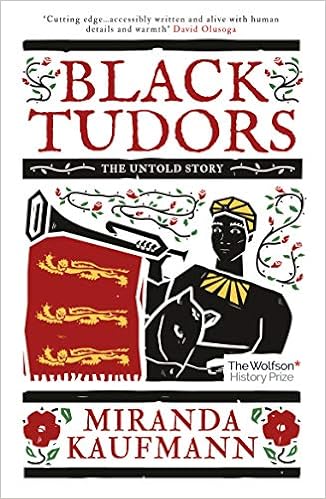
Black Tudors: The Untold Story by Miranda Kaufmann

Black Tudors: The Untold Story
by Miranda Kaufmann

This is the kind of history and historical writing that excites me! Kaufmann’s Black Tudors is a gem because of its topical focus, that is, centering black history, its accessible language, and smooth, flowing prose. I was very excited to read this book and it exceeded expectations!

Black Tudors is split into ten content chapters, bookended with an introduction and conclusion. Each chapter focuses on a specific individual, a black person who left a mark — sometimes a small one — in the historical record for us to find. These individuals were not lords or aristocrats (like Alessandro de Medici, Duke of Florence), but ordinary working folks who came to England through a number of avenues: trade, servitude, attached to diplomatic entourages, etc. While each chapter focuses largely on the individual who lends the chapter their name for its title, Kaufmann also includes evidence of other Black individuals from North and West Africa, the Southern Mediterranean, the Middle East. The result is a rich historical landscape of a hidden minority community and the cultural, social, and political context of their Tudor world.

The reader gets a textured, almost tactile experience of Tudor life, not from an aristocratic or royal perch, but from below. Kaufmann grants the reader entry into the working, merchant classes, into the world of the laborer, the Tudor servant class. This is a culture without a “middle class” in the way in which we understand the term, but there is a servant class, a working class, a peasant class, a mercantile class. Kaufmann gives us a view of these worlds from within and through the lens of foreigners, Africans, and Muslims.

Kaufmann adds to a growing number of histories which add color to the whiteness of European history. It joins the work of Marc Matera, Olivette Otele, and others which have and continue to excavate blackness in a traditionally white-centric history. That said, this is hard work; the act of research in these kinds of histories is difficult as so many layers need to be peeled off to discover hidden individuals in the historical record. I fully acknowledge Kaufmann’s effort and applaud their thorough research.

As an example of historical method and empiricism, Black Tudors shows the reader how to weave a history and a prosopography from very little archival material. This makes this book an excellent historiographical case study for an under– or graduate level seminar on historical methodology.

Victorian Murderesses by Debbie Blake

Victorian Murderesses by Debbie Blake

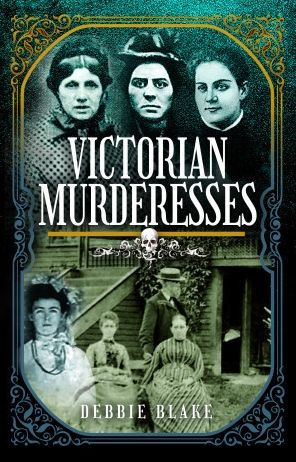
I am sucker for a good true crime non-fiction, any time — and Blake’s Victorian Murderesses absolutely satisfied my every expectation of the genre. It was gory and chilling, all the more so because of the historical grounding of each case covered here.

Each chapter — there are seven of them — examines a specific killer and the details of her crime(s). Four of them focus on British murderesses: Sarah Drake, Mary Ann Brogh, Kate Webster, and Mary Ann Cotton, while the remaining three cross the Atlantic to provide accounts of the disturbing murders perpetrated by Kate Bender, Lizzie Borden (of course), and Jane Toppan. I was grateful that Lizzie got only a chapter; the fame of her crime has sullied my interest in her case. I’ve simply read it too many times for it to invoke any novel shock, but I acknowledge that the Borden murders warrant a place in a book like this.

What makes Victorian Murderesses such a fantastic read is the way in which Blake colors in the context of these women’s lives; not only do we get a rare glimpse into their worlds, but the Victorian world as a whole, especially as it was for women of a certain working and middle class. The reader also gets to see how these women got away with their crimes for a significant part of their lives and how police operated to discover them. In some cases, like with Sarah Drake, I could not help but feel a bit sorry for the murderess as much as the victims; institutionalized sexism drove some of these women to extreme lengths — though I cannot say I condone their decisions to take innocent lives. In some cases, like Cotton’s and Webster’s I found myself wondering how it was possible for them to commit so many crimes without getting caught earlier! I wonder at how it was that Lizzie Borden became so famous when these other women committed so many more criminal acts.

Kate Bender and the Bender family were — for me — the most dastardly, the creepiest of the seven chapters. Their crimes were like those out of a grisly, B-rated horror where a family of four drives down a lonely farm road… and is never seen again… Brr. I feel shivers thinking of it now.

This was a fantastic true crime read, fun and gore all around, enough to keep you wanting more.