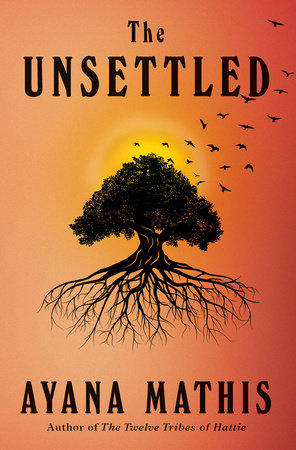
This novel gut-punched me in ways that only good novels can. I could feel tears sting along those nerves behind my eyes. Sometimes I felt my skin get sweat-clammy. The Unsettled unsettles, just like Mathis wants it to.
Right from the start, The Unsettled knocks you down and it doesn’t let up. Its breathless, relentless struggle, the way it forces the reader to keep grasping for relief mimics the feeling that its protagonists feel, trapped in a transient limbo of poverty and abuse and disappointment. This is a novel about what it is to be black and working class in urban America.
The novel revolves around a young boy and his mother, forced to live in temporary housing because of an abusive stepfather and husband, because of racist, classist inequities, because life has dealt them a harsh hand. The novel documents their life before and during their stay in this housing, the people they encounter there, at school, in their former and current neighborhoods. Interwoven between these grim chapters is the story of the mother’s past, her mother and a different world of an all-black enclave in the deep south. In this place too, there is the struggle for blackness to simply exist. The two stories are linked by several threads, the most salient of which is the structural oppression of blackness in America; both stories eventually merge into one, culminating in an explosive end.
Mathis writes with a machete, its edge as sharp as a scalpel. The prose in The Unsettled is blunt, straightforward, and will absolutely cut you down. But the pace of this beating does not exhaust; I was compelled to return to the book again and again until it was done with me (and not I done with it). Its characters were there with me, around me, so fleshy and tangible. I read mostly in bed, where I feel warm and safe, and there were more than a few times when I put down the book and nearly cried, wishing they did not have to live in such an unsafe, cold, grey place.
Heartland: A Memoir of Working Hard and Being Broke in the Richest Country on Earth by Sarah Smarsh
Heartland is a memoir at the intersection of Educated by Tara Westover and Nickel and Dimed by Barbara Ehrenreich. For readers who actively seek out trying on someone else’s shoes, Smarsh’s memoir will amply deliver.
Heartland explores the experiences of four generations of women and men in a working-class class family in rural Kansas, delving into their experiences of love, marriage, work, and education. The book is sectioned into thematic chapters, rather than being strictly chronological, covering her family’s peripatetic travels across the state for work, romance, love — and all too often, sanctuary and safety. Readers should know the book discusses abuse and neglect in a multitude of ways; violence is woven in the fabric of these women’s lives, both a symptom and cause of their poverty.
The book includes a massive cast of individuals from both sides of Smarsh’s family. [A family tree map would have been a helpful addition, but this is a minor detraction.] Through this account and interpretation of her family’s history, Smarsh makes an argument for greater attention to the social, cultural, and gendered reasons for poverty in America. She challenges the popular and misguided myth of meritocracy, especially highlighting the multiple ways spousal and domestic violence play an enormous role in this societal problem.
Smarsh’s delivery of this message lacks — thankfully — pedantism or blame, focusing instead on the interconnected web of cultural expectations and histories which have resulted in these outcomes. Her writing also is smooth, journalistic, and easily accessible; in fact, evoking an emotional response from this reader on more than one occasion.
Heartland is a fantastic non-fiction read on poverty, especially among the white working class, in middle America.
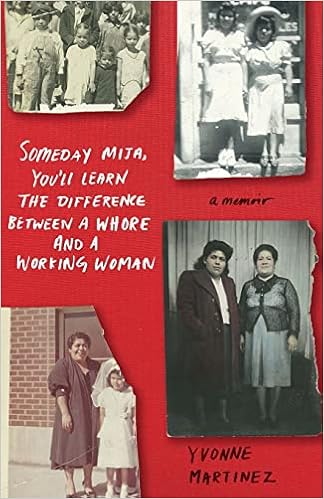
Someday Mija, You’ll Learn the Difference Between a Whore and a Working Woman: A Memoir by Yvonne Martinez
This is an intensely powerful memoir; Martinez’s life is a scar tissue of intergenerational wounds. Someday Mija, You’ll Learn the Difference Between a Whore and a Working Woman is a serious treatment of what the traumas of racial violence, poverty, and sexual exploitation can do to a child and a family, and how Yvonne was able to weave these histories — her own, her mother’s, her grandmother’s, her family’s and her community’s — into a lifetime of “doing better.” This is not a memoir to be undertaken lightly.
Celebrate Hispanic Heritage, September 15th to October 15th — but also, whenever and always!
Someday Mija, You’ll Learn the Difference Between a Whore and a Working Woman is divided into two halves, the first reads like a novel and documents Martinez’s experiences as a child and growing up in a dysfunctional family. The second half addresses Yvonne’s life afterward, as an adult and specifically as an activist in the service of her community, as an organizer, and educator.
The two halves are intertwined: it is Martinez’s experiences growing up in an abusive and violent home that shapes her ability to understand the traumas that envelop her community. This shared experience is one not easily addressed by public health programs or the simple piling on of more and more education. Oppressive systems stemming from cultures steeped in patriarchy, sexual violence, and colonization cannot be wiped away, even replaced that easily. These cultures exist within even larger systems of oppression.
In Martinez’s case, however, these experiences also spurred them to take on systemic racism, sexism, violence, and poverty as institutions to be dismantled. This is a case of an individual working from within, for one’s own community (and for all communities). Change must be internal as well as external for it to sustain; Martinez’s life is proof of that.
A profound and consuming memoir that is in equal parts disturbing, sad, and inspiring.
We Are Not Okay: Elegy for a Broken America, Memoir-in-essays by Christian Livermore
The title alone is enough to catch anyone’s attention. “We are not okay” are words that resonate across the world, with anyone who’s been alive for the past ten years — or the last three, for that matter. I’m not the first to tell you, Reader, that we are still struggling through a pandemic, an era of shrinking wages and increasing inflation, inadequate housing, dismal health care, sweltering/deluging/freezing climate change, and the list goes on and on and on… And has been accruing for… well, since human society began. And that’s part of Livermore’s point: We have not been okay for awhile and this is an intergenerational problem, an unescapable inheritance that will just keep paying it forward over and over — though, hopefully, with less interest for each successive cohort.
The teetering house on the stark cover of Livermore’s book is home for many of us. If I had a house, it might have been my own. This is We Are Not Okay‘s appeal: it is a book that sends a familiar vibration in all of us (except the wealthy 5%), “us” meaning the lower, working, striving-to-be-middle-class end gamers. I think Livermore (and I) are accurate in our assumption that there are more of us in this category, more of “us” than we want to admit to. It’s taken me decades to shrug off my mother’s middle class aspirations and acknowledge that we’ve balanced on that razor edge for generations, a paycheck, a job, a single recession, a whiff of luck and one good friend away from being not okay.
Here is where Livermore shows their metal: it’s not where we are now, but where we’ve come from that marks us. Poverty is that malingering virus that begets a comorbidity of chronic dysfunctions so banal as to be classified as “life” or “age.” (Health is one of the key points Livermore brings up, health and unhealth those of the lower and lower-working classes just assume to be a part of living.)
I am writing this on my Mac Air, which I bought new (with a justified educator discount) and I have a great job — and like Livermore, I have a degree that I thought made me… well, to be frank, classy. Now, in some ways — and Livermore doesn’t raise this point much — my degree has elevated my status. I can command a kind of respect in some circles, not so much in others. (My brother asked me in my last year of graduate school, “What’re you going to do with that degree? You must really like school, you keep going back.” What he didn’t say was, “For the love of biscuits, WHY?” I replied, “Yeah, I’m not going to make much money, but it’s important to me.” And it is. It really is. But, I digress.)
Livermore’s point is: Poverty is not a number, it is not something you can grow out of or improve, except in that small incremental way, like a credit score — but not really within one’s lifetime, but through generations. Three points up in one generation. Twelve points down the next. Because someone lost a job, had a mental breakdown, fell into alcoholism… Three points up in a month. Twelve points down in this lifetime. Because I paid off my car. Poverty is not something Livermore, I, or anyone can erase with a piece of paper that confers on the bearer the title “Doctor” — and a student loan. But we can learn the appropriate disguises, find the a mask that hides our origins enough. I can pump up my credit score enough to get that car loan, I can.
This is a form of code switching.
But here is where Livermore and I part ways a little. Code switching for me and for many other Americans is embedded in a racial history. Livermore is white, their experiences are also white. This is not to say Livermore is raceless; no one is without race. But there were elements of Livermore’s story I couldn’t fully reconcile. It is here that Livermore schools me (though it’s a lesson I’ve learnt before, it is one worth repeating): White code switching is class-passing. Race and class are inextricably intertwined, it’s true. Racial code switching for whites pulls from the intangible domain of “class.”
Class is a tricky category, meaning so many things, some tangible like income and the size and type of your house, others intangible like the way you hold your fork. I see it in my students (of all colors and races and ethnicities) who don’t ask for help in class or anywhere because they’re used to not getting any, used to being beaten down, used to being denied. Class is about getting access to things and services and attention. Whiteness is about the same, but not all whites have class. And the way in which Livermore presents that is brilliant.
Livermore’s prose is authentic, the highest praise I can imagine for a memoir. It is brutal in parts and funny and sad and emotional. It is detached in other parts. It is cold and harsh. It performs the emotions and conflicts Livermore is bringing to the forefront. This swiveling, this code switching is a key characteristic of poor people. It is self hate, it is selfishness as self care. It is as convoluted as humanity because poverty is a wholly human construction built on the development of hierarchical society, that is: civilization.
Livermore’s We Are Not Okay follows in the vein of Tara Westover’s Educated: A Memoir in that it explores the embodied cultural legacies of poverty. However, Livermore’s book differs from Westover’s in that it is more relatable. First, Westover’s book is grounded in a specific religious community, society, and history. Livermore’s background is more ordinary and bland, therein, more relatable. Livermore might be anyone’s neighbor, anyone’s school mate, anyone’s professor. I wonder now how much or how little do I know about my colleagues, my former professors. Do I see their whiteness and assume a privilege that isn’t really there? Livermore’s We Are Not Okay is one to linger with any reader. I will think of it when the Fall semester begins again, as I look into my sea of students, throw back summer stories with my faculty peers. Second, and perhaps more poignantly, Livermore’s We Are Not Okay does not come to a natural closure as Educated: A Memoir does. I will not spoil the ending; you’ll have to read it. Let’s just say Livermore’s memoir is… realistic. It is not that Westover’s is not, but if you’ve read Educated: A Memoir it does come to an organic closure. Livermore leaves us in that teetering house, pondering our own fate… This is part of the lingering of this book, a sensation that makes this worth reading.
Livermore delivers. This is a book that will stick with you. It may even dig into your bones where poverty may have been leaching away at your marrow for longer than you know.




 Dr JoAnn LoSavio