
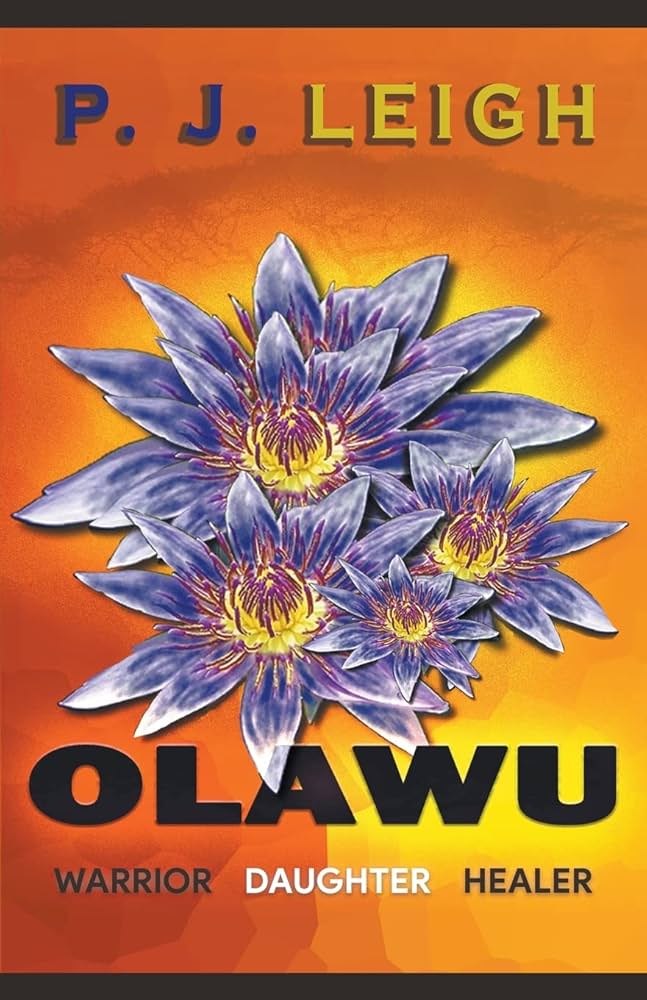
Olawu appealed to my longing for a postcolonial canon. It delivered — and then some. The novel is reminiscent of the work by Yaa Gyasi, Chinua Achebe, and Ngũgĩ wa Thiong’o; the language and the prose — sparse but evocative — is striking, the characters live and breathe, the story is inspiring. A whopping ⭐️⭐️⭐️⭐️⭐️ for this young adult historical romance/fiction.
This novel disrupts modern colonial culture (in which we all live) on multiple levels:
- As an independently published novel by an author of color, Olawu is a challenge to the institution of traditional publishing and gatekeeping that that system engenders.
- As a novel set in a pre-colonial East African world, Olawu highlights the existence of East Africa, its diverse peoples, kingdoms, and communities as independent from European history. We do not need to mark African time according to European histories and events.
- The eponymous protagonist is a strong woman and the novel draws attention to the role of women in pre-colonial East African society. In doing so, Olawu challenges euro-centric notions of gender, especially those imposed on women and womanhood.
- The incorporation of Xhosa, KiSwahili, and Zulu words, phrases, and culture into the text is an act of postcolonial defiance. Given the Colonial weaponization of language, this act of text is a rejection of the primacy of English.
The novel is an East African bildungsroman, it follows its eponymous protagonist, Olawu as she comes of age, becomes a young woman, and finds her place in the world as an adult. It unfolds in what might be seen as three parts. The first focuses on her childhood and ambitions — and how the community into which she is born and raised deems her inferior on the basis of her gender. The second exposes Olawu and the reader to other possibilities, how women might be valued and how womanhood might be performed elsewhere. This is also the part of the novel where she struggles to understand herself, her desires, and the inevitable tension between conformity and personal fulfillment, especially when the latter flies in the face of cultural norms. The last part is when Olawu decides who she will be and how she negotiates with that tension to achieve her objectives. Romance (not sex) is woven into this story about a young woman shaping herself and the world around her, serving as the scales which Olawu must balance and ultimately tip one way or another.
A number of themes thread through the novel from start to end: Olawu’s ambitions, the institutions and individuals who stand in her way, and her resilience and resistance against them. A major contributor to Olawu’s success in finding herself and her place in the world is her family, both biological and found. The proverb, “Umntu ngumtu ngabantu” (A person is a person because of other people) is an important element of the novel; Olawu does not accomplish what she does on her own, but through the kindness, love, and sacrifice of others.
Olawu‘s success as a novel is also due to Leigh’s incisive and evocative prose, and well-crafted characters. Leigh’s prose reminds me of Things Fall Apart; the writing is succinct and sharp, absent of flowery and unnecessary description. Leigh focuses on the characters, letting the reader organically create an image. The characters are distinctive and recognizable; their flaws — even Olawu’s — mirror our own, making the reader sympathize with all of them, even when they are at odds with one another.
The result is a highly character-driven, powerful coming of age story.
Leigh’s depth of research must also be commended. While the novel does not draw from specific East African pre-colonial history, it is evident Leigh has researched the region’s precolonial political systems, structures, and gender history. I especially appreciated the inclusion of glossary terms and pronunciations at the beginning of the book.
This is a fantastic read for all young people, but especially young women of color who need to see themselves represented decolonizing/post colonial literature like this.
I encountered Olawu through a Facebook group I’m in, where I serve as a reviewer of (mostly) independently published books. Organized by the admins of this group, the review event takes place bimonthly, and involves reviewers submitting a short biography to the organizer. Authors who are looking for reviews of their work reply to the organizer, selecting the reviewer of their choice. Reviewers then select which authors and books they’d agree to review based on the descriptions of the books.
If you would like to read Olawu yourself, you can find it here on Amazon. It is 318 pages and the paperback is currently priced at $14.99 and the Kindle ebook at $8.99.
 Dr JoAnn LoSavio