The Master: A Novel by Patrick Rambaud

Translated by Nicole and David Ball

The Master: A Novel
by Patrick Rambaud

The Master is a stark novel, the kind that is absent of luxurious words and descriptions, but whose minimal lines imply a lush intellectual interior may lie beyond the text, if the reader is willing to linger on the line just a little longer than necessary.

The protagonist is Zhuang Zhou (also known as Zhaungzi), an actual historical figure, a Chinese philosopher who lived circa 369 BCE to 286 BCE and contributed greatly to the philosophy of Taoism. He is the eponymous master of this novel. It begins with his childhood and recounts the fictionalized events of his life, with especial attention to Zhaung’s moments of philosophical enlightenment. Zhuang is propelled, by his choice or by the whims of others, from one kingdom to another, finding his life and livelihood tied to the court, a recipient of a benefice from the king. In some periods of his life he welcomes this privileged position, living the abstracted life of the mind. At other times he rejects this and delves into more material pursuits. His experiences lead him to write the piece of scholarship he is known for, The Zhuangzi.

The novel reads like an ancient epic moving swiftly from one event to another. It does allow the reader some interiority into Zhuang’s mind, but only his, and only insofar as it pertains to his judgements on morality and ethical behavior. This is not a personal account of the interiority of his life in an emotional sense; the reader should not expect entree into Zhuang’s feelings, so much as his intellectual musings on morality and correct ways ruler should govern. (Indeed, the reader may get the impression Zhuang was a less than stellar parent and romantic lover.) Rambaud delivers the character with a kind of detachment, as if merely filtering a series of observations for the benefit of the reader and for the reader to analyze and judge Zhuang for themselves.

The purpose of the novel seems to be less focused on the man than his scholarship. I have the distinct impression I am meant to walk away with a fuller view of what the sage intended for us to understand about Taoism. But I admit, I was less impressed with Zhuang’s heavy handed pedagogy and deliberate elusiveness, and so the lesson missed me.

As a result, this reader notices a pedantic aspect to the book, which while it performs the conventions of Chinese philosophical writing authentic to its setting and protagonist, may read as supercilious to the modern reader. But then again, the philosophy of ethics is about passing judgement and imposing moral watermarks on society, so… I am left wondering if a book on a topic like this can ever be written without an element of condescension baked into it. If so, Rambaud is excused from any accusation of arrogance; indeed, Rambaud’s role in this novel is exemplary otherwise.

Rambaud’s portrayal of Zhuang follows an expected patriarchal narrative that is likely accurate; we are not given any historical evidence that the real Zhuang was a feminist, after all. To portray him as such would have been inauthentic (if satisfying as a disruption, a revolution). We can understand Rambaud’s role here as a messenger. His prose is beautiful in its sparseness; with few words an image of Zhuang — not his physical being but his essence — is apparent to the reader, as are his friends who accompany him, betray him, befriend him on the journey of his life. Rambaud delivers the tensions of the social landscape of ancient China well, without romanticizing or Orientalizing the place or people. It is a harsh world: peasants live and die at the whims of their lords, people live and die at the whims of nature via its tantrums in the form of floods or droughts. Rambaud transports the reader to this moment and place well.

Overall, The Master is an enjoyable read, one that informs and does what historical fiction ought to do: transport the reader across time.

The Wintering Place by Kevin McCarthy

The Wintering Place by Kevin McCarthy

Five words or phrases to describe McCarthy’s The Wintering Place: Raw, Disturbing, Visceral, Emotionally Invasive, Riveting. This is a novel for fans of Donald Ray Pollock and Cormac McCarthy, readers who enjoy (perhaps with grimacing faces) the feel of dirt under the character’s nails, an odor of decaying blood lingering and fetid, the kind of novel that settles a deep chill in your bones and in your soul. The Wintering Place is a novel about resilience and survival and the cost of that survival on the human soul.

The novel is set in the 1840s on the American plains, in the rural hills and the long stretches of lonely woods. It revolves around two brothers, Irish immigrants, who have fought and lived according to a primal form of justice. They are army deserters, fugitives in more ways than one. Blood and death are on their hands, rightly or wrongly. A woman, the bride of one of the brothers, accompanies them — and together they are a kind of family, dependent on each other for their survival and security. There is a bond of love between, the kind that is weathered by the harshness of life, silent, sullen, and not always kind. The woman is like the brothers: alone in the world, a survivor of a place and time that beats women out of their dignity, power, and softness.

The three of them seek a wintering place. A place to hole up for the dark season. They need only to survive the weather — that is, until they encounter animals of their own kind who threaten them. Humanity is the evil that lurks in the shadows of the forest. The snow, wolves, and frost kill too, but humans pose the most danger.

The three of them encounter ruffians like themselves, Native Americans, officers of the law, traders and merchants who hold the power of life or death over all who dare to traverse the plains in winter. Everyone is seeking a safe wintering place in some way or another.

My description sounds stark, but McCarthy’s prose and the way he unpicks the fabric of the story and lets it unravel into its bare parts, is captivating. I read this novel compulsively, wanting always to know what happens next. Do they survive another day? Will one of them perish in the effort?

The characters were fleshy, real, and irresistible; the stink of their unwashed bodies and the smell of blood permeated the safety of my apartment as I read this book. It was as if I could sense them in the room with me. McCarthy uses an epistolary delivery, bringing the characters into dialogue with the reader directly; it is almost like having a conversation with them.

At the end of the novel, this reader even felt a little lost — as if there was a little death in the finishing of this book.

I must add one more word to the description: Haunting.

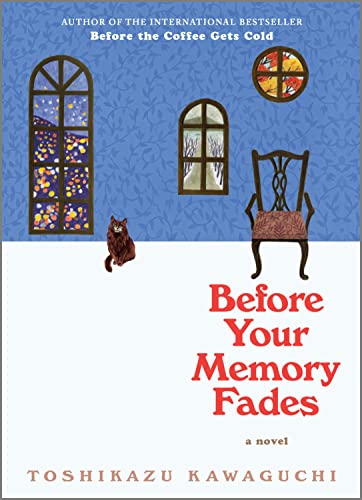
Before Your Memory Fades: A Novel by Toshikazu Kawaguchi

Before the Coffee Gets Cold #3

Before Your Memory Fades: A Novel
by Toshikazu Kawaguchi

Before Your Memory Fades is the third installment of the Before The Coffee Gets Cold series. It picks up directly where the second novel, Tales From The Café leaves off. I thoroughly enjoyed the first novel and loved how the second one tied up loose ends; this third novel follows with the same pace, cadence, and story. For those who love the way the past and present and future intertwines and the mythology of the series, Before Your Memory Fades will feel like a warm welcome in an old and familiar place (the Cafe Funiculi Funicula, of course!)

For me, personally, Before Your Memory Fades made less of an impression on me than I expected. I think I had tired of the story; indeed, there was nothing necessarily new in this novel that the previous two had not delivered. The emotional payoff for me was spent, but this does not lessen the potential payoff of the novel for a fan of the series: There is a ghost, albeit a new one, in The Seat in the café and there are new eager patrons who come to use the time traveling device to correct some wrong they have committed in the past or have yet to commit in the future. Then there is the same terrible lesson they learn: that love and obligation are on the same sides of the coin and that they cannot change the events fated to them, but the knowledge they learn in the past or future can change their hearts and souls in their present.

We are reintroduced to familiar, new, and newish characters, Nagare and Kei’s now teenaged daughter, Miki, and a new employee, Reiji, who works at another café in the “family”, Café Donna Donna, which also has its own time-bending seat, its own ghost, and its own crew of café regulars, Nanako and Dr Saki Muraoka, There are familiar characters: Nagare and Kazu. There is also Kazu’s daughter, Sachi, who is the newest Tokita woman to wield the power of the coffee and time travel. There are new patrons who arrive at the Café Donna Donna to rewrite their pasts: a daughter who seeks out her parents and a way to manifest her vengeance, a comedic celebrity who needs to tell his wife something important, and others.

All in all, Before Your Memory Fades delivers on its promise. It is a fantastic addition to the existing two novels. It continues the tradition of the Café Funiculi Funicula, giving the reader more of what they fell in love with in the first novel.

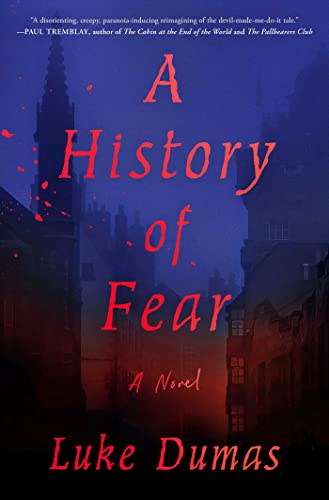
A History of Fear: A Novel by Luke Dumas

A History of Fear: A Novel
by Luke Dumas

By page three, I was hooked. The ending comes to a perfect, organic conclusion — but I readily admit that if Dumas writes a sequel, I’m all in.

A History of Fear unfolds like Stoker’s Dracula, adopting an epistolary approach, delivering the story via journal entries, letters, official reports from doctors, prison officials, and newspaper articles. The novel dives deep into the most disturbing parts of human psychosis reminiscent of Dostoevsky’s Crime and Punishment. It delivers gothic horror too, in the manner of Shelley’s Frankenstein. In the end, the reader can’t be entirely sure of who is the monster, if demons are real, if evil is more human than we comfortable with. A History of Fear is a horror fan’s feast: gore and psychological terror stride side-by-side, the paranormal and the divine and the mundane intertwine to create a world the reader is never entirely sure is real. Illusion may very well be reality… or worse.

But the story is not fantasy; there is a real history embedded in this novel — and a commentary on a history of monstrous bodies, sexuality, religion, and intergenerational trauma. There is a reality underlying the one Dumas weaves for us. This is what makes the novel so appealing; there is a real horror here, one that we can recognize. This history is one that might be so common as to be truly terrifying because it might actually exist within ourselves. Or someone we know.

A History of Fear follows the main character’s slow descent into madness — or his ascent into clarity, depending on your interpretation. There is a true mystery here and this drives the story forward. The reader needs to discover what the main character also seeks: some sense of closure and parental acceptance. The main character is driven by a need to know themselves and their past. This is a genealogy of a family and the homophobic culture of the West. Dumas focuses on the psychological damage inflicted on those who deviated from the dominant norm and those who dared to question their place in it. The novel travels between the past and the present, each part of the jigsaw puzzle adds to the image of the whole of time, allowing the reader to witness the unraveling of the man’s mind and the suffering caused by intergenerational trauma.

The novel opens with the main character’s eventual, inevitable fate; this is the mystery. We know what happens to him. The mystery is why and how. The horror is the long arm of intergenerational trauma.

A wonderful book to have read in October, the Halloween month, but really, a fantastic gothic horror for any time of the year.

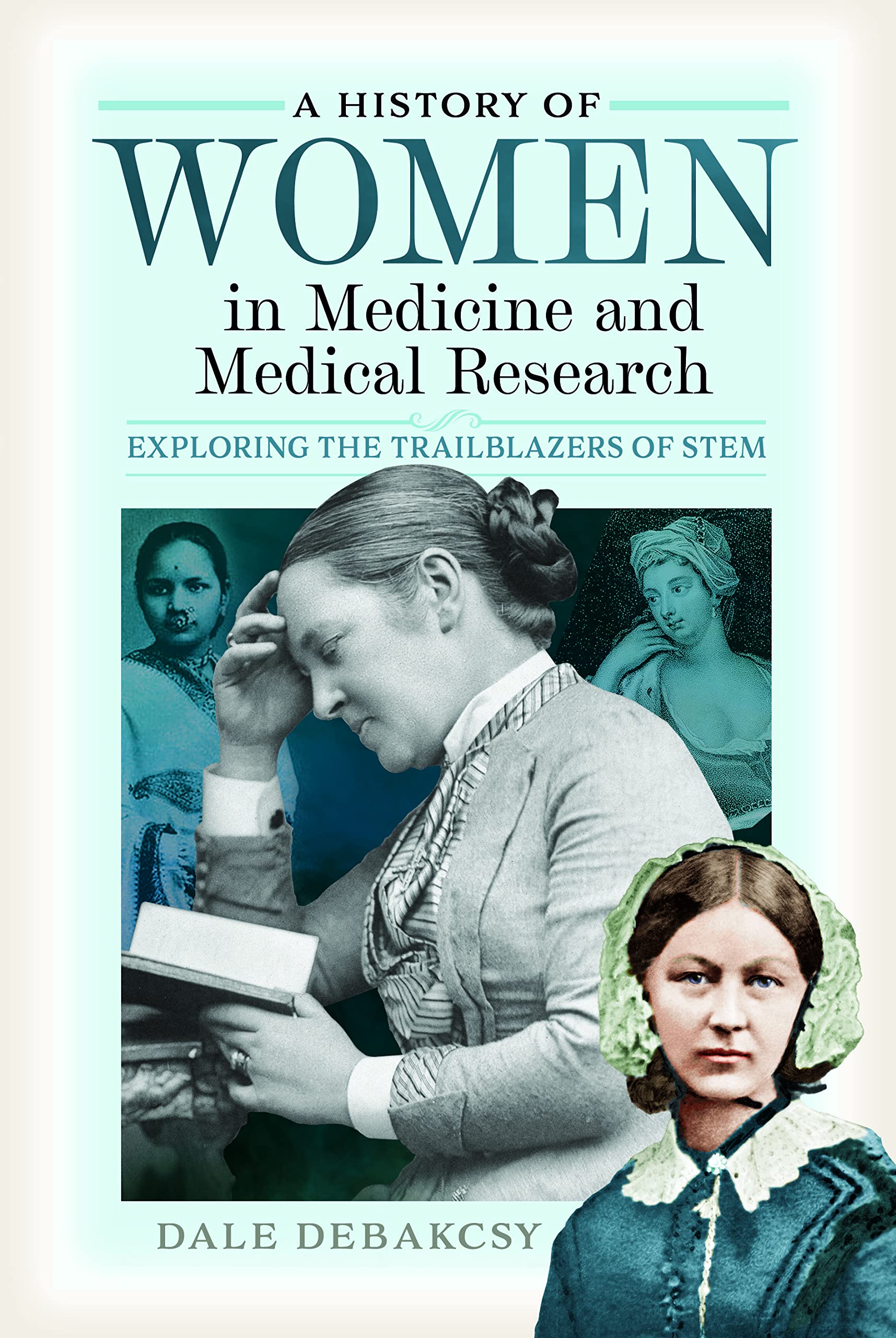
A History of Women in Medicine and Medical Research: Exploring the Trailblazers of Stem by Dale Debakcsy

A History of Women in Medicine and Medical Research: Exploring the Trailblazers of Stem
by Dale Debakcsy

I loved reading this ARC (Advanced Reader’s Copy) so much I pre-ordered it! Eye-opening, superbly written, and well-researched. I cannot think of higher praise for a non-peer-reviewed non-fiction written for a general audience. I can’t wait for my copy to arrive so I can re-read it!

A History of Women in Medicine and Medical Research: Exploring the Trailblazers of Stem is broken down into several chapters, each one focusing on a specific woman, her personal background or life story, and her professional career in the sciences. The book progresses chronologically from the 16th century up to the near present, ending in the 1970s.

Each chapter ends with a section devoted to further reading and sources. While the book lacks citations and formal references, these inclusions are especially valuable. This kind of historiography is difficult to discover without a significant investment of time and effort making Debakcsy’s book all the more useful and appealing. I do not mind admitting this is a key reason why I have chosen to purchase my own copy.

These are not long or exhaustive studies of each individual; these historiographical sections allow the reader to explore further. That said, the brevity of each chapter is not a detraction. These are easily digestible chapters, perfect for classroom use or as readings for an undergraduate course. The chapters capture all they need to, leaving the reader satisfied but curious for more.

The women themselves are fascinating subjects, not only for their contributions to STEM, but also for their perseverance and resilience in the face of class, gender, and racial prejudices. Many of the women derive from the upper classes, but a significant number of them are working- or middle-class. Some were immigrants or enslaved (or lived just outside that category). Many had to break with their families to pursue their dreams. In many cases these women knew or knew of one another, interacted closely or within similar professional circles. A cohort of pioneering women in these fields is visible in the 19th century, particularly in the fields of medicine.

While the majority of women examined and brought to light in DeBakcsy’s book are white, European or American, there are also significant chapters focusing on women of color in the Western world. These are mostly (but not exclusively) black women who broke academic and professional ceilings.

This is a fantastic book for the classroom and any library (academic and home, alike). I cannot wait for my copy to arrive!

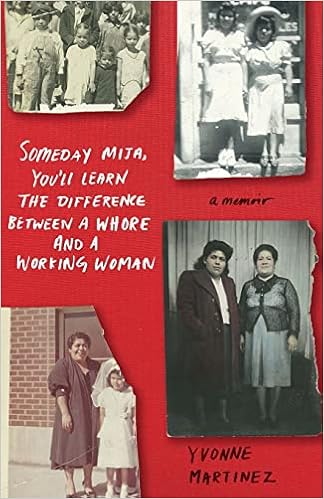
Someday Mija, You’ll Learn the Difference Between a Whore and a Working Woman: A Memoir by Yvonne Martinez

Someday Mija, You’ll Learn the Difference Between a Whore and a Working Woman: A Memoir
by Yvonne Martinez

This is an intensely powerful memoir; Martinez’s life is a scar tissue of intergenerational wounds. Someday Mija, You’ll Learn the Difference Between a Whore and a Working Woman is a serious treatment of what the traumas of racial violence, poverty, and sexual exploitation can do to a child and a family, and how Yvonne was able to weave these histories — her own, her mother’s, her grandmother’s, her family’s and her community’s — into a lifetime of “doing better.” This is not a memoir to be undertaken lightly.

Celebrate Hispanic Heritage, September 15th to October 15th — but also, whenever and always!

Someday Mija, You’ll Learn the Difference Between a Whore and a Working Woman is divided into two halves, the first reads like a novel and documents Martinez’s experiences as a child and growing up in a dysfunctional family. The second half addresses Yvonne’s life afterward, as an adult and specifically as an activist in the service of her community, as an organizer, and educator.

The two halves are intertwined: it is Martinez’s experiences growing up in an abusive and violent home that shapes her ability to understand the traumas that envelop her community. This shared experience is one not easily addressed by public health programs or the simple piling on of more and more education. Oppressive systems stemming from cultures steeped in patriarchy, sexual violence, and colonization cannot be wiped away, even replaced that easily. These cultures exist within even larger systems of oppression.

In Martinez’s case, however, these experiences also spurred them to take on systemic racism, sexism, violence, and poverty as institutions to be dismantled. This is a case of an individual working from within, for one’s own community (and for all communities). Change must be internal as well as external for it to sustain; Martinez’s life is proof of that.

A profound and consuming memoir that is in equal parts disturbing, sad, and inspiring.